
Introduction
Highway engineers design roads that allow vehicles to travel safely, comfortably, and efficiently at different speeds. Curved sections of a highway present a unique challenge because moving vehicles experience centrifugal force that pushes them outward. If engineers ignore this force, vehicles may skid, overturn, or lose control, especially at higher speeds or during wet weather.
This is where superelevation plays a vital role. By raising the outer edge of the pavement above the inner edge on horizontal curves, engineers create a slope that helps counteract centrifugal force and improves vehicle stability. Properly designed superelevation increases safety, enhances driving comfort, reduces pavement wear, and extends the service life of the roadway.
Understanding What is Super-Elevation? is essential for civil engineers, transportation professionals, contractors, and engineering students. It forms one of the fundamental concepts of highway geometric design and directly influences road safety and traffic performance.
This guide explains the concept of superelevation, its engineering principles, design considerations, influencing factors, practical applications, and industry best practices in a clear and practical manner.
What is Super-Elevation?
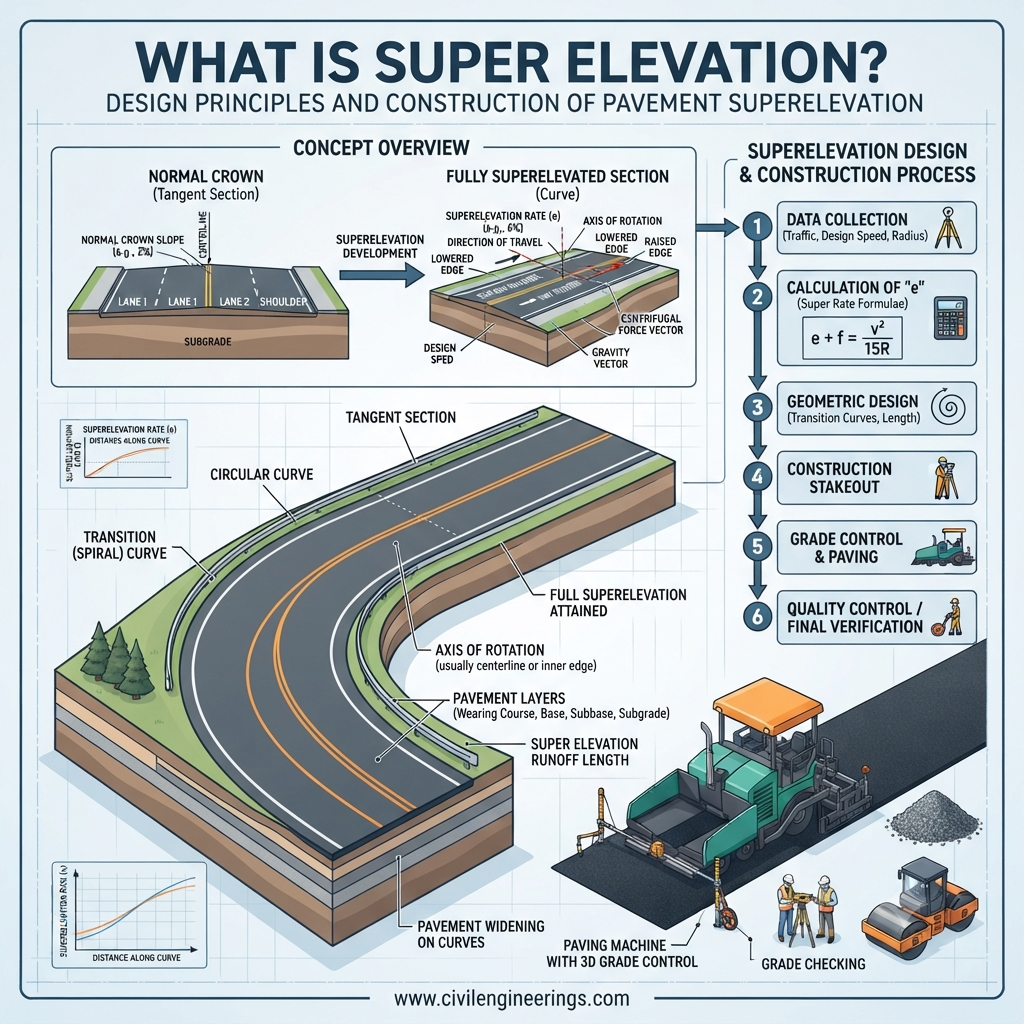
Super elevation is the transverse slope provided on a horizontal road curve by raising the outer edge of the pavement above the inner edge. This roadway inclination helps balance the outward centrifugal force acting on moving vehicles while they negotiate a curve.
Instead of relying only on tire friction to keep a vehicle on its path, super elevation allows a portion of the centrifugal force to be resisted by gravity. As a result, vehicles can travel around curves more safely and comfortably.
In simple words, superelevation tilts the road toward the center of the curve, allowing vehicles to follow the curved path with greater stability.
Definition
Super elevation is the difference in elevation between the outer and inner edges of a pavement on a horizontal curve, expressed as a slope or percentage.
Typical Super-Elevation Values
The exact value depends on design speed, curve radius, terrain, and applicable standards. Highway agencies establish maximum permissible values to ensure both safety and driving comfort.
Why Super Elevation is Important
Without proper superelevation, drivers depend almost entirely on tire-road friction to resist centrifugal force. This increases the likelihood of skidding, particularly on wet or icy pavements.
A correctly designed superelevation offers several important benefits.
Improves Road Safety
The inclined pavement reduces the outward force acting on vehicles, helping them maintain stability throughout the curve.
Reduces Skidding
Superelevation decreases dependence on friction, lowering the risk of vehicles sliding outward.
Increases Driving Comfort
Passengers experience smoother and more comfortable movement because vehicles negotiate curves with less lateral force.
Reduces Tire Wear
Proper load distribution minimizes uneven tire wear and improves vehicle performance.
Extends Pavement Life
Balanced wheel loads reduce pavement distress, including rutting and edge failures.
Supports Higher Design Speeds
Engineers can safely accommodate higher operating speeds when curves incorporate appropriate super elevation.
Engineering Principle Behind Super-Elevation
When a vehicle travels along a straight road, its weight acts vertically downward, and the pavement provides an equal upward reaction.
On a curved road, the vehicle also experiences centrifugal force directed outward from the center of the curve.
Without superelevation, friction alone resists this outward force.
With superelevation, gravity contributes to balancing centrifugal force, reducing the demand on pavement friction.
Forces Acting on a Vehicle
- Vehicle weight (W)
- Centrifugal force (Fc)
- Normal reaction (N)
- Frictional resistance (F)
The combination of pavement slope and friction keeps the vehicle moving safely along the desired path.
Engineering Diagram: Vehicle on a Horizontal Curve
                Vehicle
                  🚗
                 /|
                / |
_______________/  |________________ Outer Edge
              /   |
             /θ   |
____________/_____|_______________ Inner Edge

      ← Centrifugal Force

      Gravity ↓
The raised outer edge creates a transverse slope that helps counteract the outward centrifugal force.
Components of Super Elevation
Several engineering parameters influence the design of superelevation.
Design Speed
Higher vehicle speeds generate greater centrifugal force. Engineers generally require larger superelevation values for higher design speeds.
Radius of Curve
Sharp curves require greater superelevation because centrifugal force increases as the curve radius decreases.
Side Friction
Pavement friction supplements super elevation by resisting lateral movement. Engineers limit the design reliance on friction to maintain safety under varying weather conditions.
Pavement Width
Road width influences the vertical difference between the inner and outer pavement edges during construction.
Traffic Characteristics
Heavy vehicles, mixed traffic, and expected operating speeds all influence super elevation design.
Super-Elevation Formula and Design Concepts
Engineers commonly relate design speed, curve radius, friction, and pavement slope through established highway engineering equations.
A simplified expression is:
e + f = V² / (127R)
Where:
- e = Super elevation rate
- f = Side friction factor
- V = Design speed (km/h)
- R = Radius of horizontal curve (m)
Interpretation
As vehicle speed increases, the required superelevation generally increases.
As the curve radius becomes larger, the required superelevation generally decreases.
Engineers always check that the calculated value remains within the maximum limits specified by the applicable highway design standards.
Super Elevation Design Flow
Design Speed
      │
      ▼
Curve Radius
      │
      ▼
Traffic Analysis
      │
      ▼
Calculate Super Elevation
      │
      ▼
Check Maximum Permissible Value
      │
      ▼
Prepare Road Design
This sequence ensures that the selected superelevation satisfies both safety and design requirements.
Factors Affecting Super Elevation
Several engineering and environmental factors influence the final superelevation value.
1. Design Speed
Higher speeds increase centrifugal force and require greater pavement inclination.
2. Radius of Horizontal Curve
Smaller radii produce sharper curves, demanding higher superelevation rates.
3. Climate
Regions with frequent rainfall, snow, or ice require careful consideration because pavement friction decreases under wet conditions.
4. Traffic Volume
Roads carrying heavy traffic or large numbers of trucks require stable geometric design to maintain safe vehicle operation.
5. Terrain
Mountainous highways often include tighter curves than highways in flat terrain, influencing super elevation requirements.
6. Pavement Surface Condition
Surface texture, skid resistance, and maintenance condition affect the available friction between tires and pavement.
7. Road Classification
Expressways, national highways, rural highways, and urban roads may follow different design criteria depending on their function and operating speed.
Types of Road Curves Where Super Elevation Is Used
Super elevation is mainly provided on horizontal curves because vehicles experience lateral acceleration while changing direction.
Simple Circular Curves
The most common application where the pavement gradually transitions into the required slope.
Compound Curves
Engineers adjust super elevation carefully when two different curve radii connect.
Reverse Curves
Special transition arrangements ensure a smooth change from one direction of super elevation to the opposite direction.
Spiral Transition Curves
Modern highway design frequently introduces super elevation gradually along spiral curves to improve vehicle comfort and reduce sudden lateral acceleration.
Practical Example
Consider a four-lane highway designed for high-speed traffic. The alignment includes a sharp horizontal curve near a hillside. Instead of keeping the pavement level, engineers raise the outer edge according to the calculated super elevation rate. This adjustment allows vehicles to negotiate the curve safely, reduces reliance on tire friction, improves passenger comfort, and lowers the risk of skidding during rainy conditions.
Key Takeaways
Understanding What is Super Elevation? forms the foundation of safe highway geometric design. Super elevation counteracts centrifugal force by raising the outer edge of the pavement, improving vehicle stability, reducing skidding, enhancing passenger comfort, and extending pavement life. Engineers determine the appropriate super elevation by considering design speed, curve radius, traffic characteristics, terrain, climate, and pavement conditions while following recognized highway engineering standards. Proper design and implementation create safer, more durable, and more efficient roadways for all users.
Methods of Providing Super Elevation
Engineers introduce super elevation gradually instead of creating an abrupt change in pavement slope. A gradual transition improves vehicle stability and provides a comfortable driving experience.
Several methods are commonly used depending on road classification, terrain, and design standards.
1. Rotation About the Center Line
In this method, engineers rotate the pavement around the road center line.
Advantages
- Maintains a balanced road profile.
- Produces uniform pavement edges.
- Suits divided highways and rural roads.
Applications
- National highways
- Expressways
- High-speed roadways
2. Rotation About the Inner Edge
The inner edge remains fixed while the outer edge rises gradually until it reaches the required superelevation.
Advantages
- Simple construction procedure.
- Convenient where drainage restrictions exist.
- Suitable for embankment sections.
3. Rotation About the Outer Edge
The outer edge remains at its original elevation while engineers lower the inner edge.
Although this method is less common, it becomes useful where existing structures or utility lines restrict vertical adjustments.
Super-Elevation Transition
A sudden change in pavement slope creates discomfort and increases accident risk. Engineers therefore provide a transition length that allows vehicles to adjust smoothly while entering and leaving a horizontal curve.
Transition Objectives
- Improve riding comfort.
- Reduce lateral acceleration.
- Minimize steering corrections.
- Prevent sudden load transfer.
- Enhance vehicle stability.
Engineering Diagram: Super Elevation Transition
Normal Road            Transition            Full Super Elevation

─────────────       ╱────────────        ╱────────────
─────────────     ╱────────────        ╱────────────
─────────────   ╱────────────        ╱────────────
The pavement gradually changes from a normal cross slope to the full superelevation rate, ensuring a smooth and safe transition.
Step-by-Step Construction Procedure
Proper construction ensures that the designed super-elevation performs effectively throughout the pavement’s service life.
Step 1: Survey and Setting Out
Surveyors establish:
- Center line
- Curve limits
- Transition points
- Design elevations
Accurate surveying prevents alignment errors during construction.
Step 2: Earthwork Preparation
Construction crews prepare the embankment or cutting according to approved design levels.
Proper compaction creates a stable foundation for pavement layers.
Step 3: Formation of Pavement Layers
Workers construct:
- Subgrade
- Sub-base
- Base course
Each layer follows the required cross slope before placing the surface course.
Step 4: Adjustment of Cross Slope
Engineers gradually raise the outer pavement edge according to the approved drawings.
Motor graders and paving machines help achieve uniform slopes.
Step 5: Pavement Construction
Contractors place asphalt or concrete while maintaining the specified superelevation throughout the curve.
Step 6: Quality Control
Quality engineers verify:
- Cross slope
- Pavement thickness
- Surface evenness
- Compaction
- Elevation differences
- Drainage performance
Only after meeting project specifications should the roadway proceed to the next construction stage.
Practical Applications of Super Elevation
Superelevation plays a vital role in many transportation facilities.
Highways
High-speed highways rely on superelevation to maintain vehicle stability around horizontal curves.
Mountain Roads
Mountain highways often contain sharp bends where super elevation significantly improves safety.
Expressways
Controlled-access expressways use carefully designed superelevation to support high operating speeds.
Railway Curves
Railway engineers also apply the principle by raising the outer rail on curved tracks to improve train stability.
Airport Taxiways
Taxiways with curves use similar geometric design principles to support safe aircraft movement.
Advantages of Super-Elevation
A properly designed super elevation provides numerous engineering benefits.
- Improves vehicle stability.
- Reduces skidding.
- Enhances passenger comfort.
- Allows safer travel at design speeds.
- Reduces pavement edge stresses.
- Minimizes uneven tire wear.
- Extends pavement service life.
- Improves traffic flow.
- Reduces accident risk on curves.
- Supports efficient geometric design.
Limitations of Super Elevation
Despite its benefits, engineers must consider several practical limitations.
- Construction costs increase slightly.
- Very low-speed traffic may experience discomfort.
- Urban intersections often restrict its use.
- Poor drainage design can create water accumulation.
- Snow and ice require careful maintenance.
- Incorrect construction may increase accident risks.
Proper design and construction minimize these limitations.
Common Mistakes to Avoid
Many pavement failures and safety issues arise from poor implementation rather than poor design.
Avoid these common mistakes:
- Providing insufficient transition length.
- Ignoring drainage requirements.
- Using inaccurate survey data.
- Constructing incorrect pavement slopes.
- Neglecting field quality control.
- Failing to maintain pavement cross slopes.
- Allowing surface irregularities.
- Overlooking design speed during calculations.
Best Practices
Experienced highway engineers follow several proven practices.
- Conduct detailed topographic surveys.
- Verify curve geometry before design.
- Use accurate traffic forecasts.
- Maintain proper drainage.
- Follow approved construction tolerances.
- Check elevations regularly during paving.
- Perform continuous quality assurance.
- Inspect completed curves before opening to traffic.
- Schedule routine maintenance to preserve pavement geometry.
Practical Recommendations
Civil Engineers
- Verify design calculations independently.
- Coordinate roadway geometry with drainage design.
- Monitor construction using precise surveying equipment.
- Review pavement cross slopes after every construction stage.
Contractors
- Train equipment operators on pavement slope requirements.
- Use calibrated instruments for level control.
- Protect finished pavement from premature traffic.
- Perform quality checks throughout construction.
Engineering Students
- Understand the relationship between centrifugal force and super elevation.
- Practice solving design problems using standard highway equations.
- Study horizontal alignment together with transition curves.
- Observe super elevation during site visits to understand field implementation.
General Discussion of IRC, AASHTO, and ICE Practices
International highway design organizations emphasize safe geometric design through scientifically established engineering principles.
General guidance commonly includes:
- Select super elevation based on design speed and curve radius.
- Limit maximum super elevation according to regional climatic and operational conditions.
- Provide adequate transition lengths between normal cross slope and full super elevation.
- Consider side friction factors to maintain vehicle stability.
- Ensure effective drainage to prevent water accumulation on curved pavements.
- Maintain strict construction quality control to achieve the designed cross slope.
- Incorporate safety features such as pavement markings, warning signs, and guardrails on curved sections.
These principles, widely reflected in IRC, AASHTO, and ICE guidance, help engineers deliver safer and more durable highways.
Frequently Asked Questions (FAQs)
1. What is super elevation in highway engineering?
Super elevation is the transverse slope created by raising the outer edge of a road on horizontal curves to counteract centrifugal force and improve vehicle stability.
2. Why is super elevation necessary?
It reduces skidding, enhances safety, improves passenger comfort, and allows vehicles to negotiate curves more efficiently.
3. Where is superelevation provided?
Engineers mainly provide super elevation on horizontal curves of highways, expressways, mountain roads, ramps, and similar facilities.
4. Which factors influence superelevation design?
Design speed, curve radius, traffic volume, climate, pavement condition, road classification, and terrain all influence the required super elevation.
5. What happens if superelevation is too low?
Vehicles rely heavily on tire friction, increasing the risk of skidding and reducing safety, especially during wet weather.
6. Can excessive superelevation create problems?
Yes. Excessive super elevation may reduce driver comfort, complicate drainage, and affect slow-moving vehicles.
7. How does super-elevation improve pavement performance?
Balanced wheel loads reduce pavement distress, edge failures, rutting, and uneven wear, extending the pavement’s service life.
8. Is super-elevation used in railway engineering?
Yes. Railway engineers raise the outer rail on curves to improve train stability using the same fundamental principle.
9. What role does transition length play?
Transition length allows the pavement slope to change gradually, ensuring smooth steering, improved comfort, and safer vehicle movement.
10. How do engineers verify superelevation during construction?
They use surveying instruments, cross-slope measurements, elevation checks, compaction records, and final quality inspections to confirm compliance with design specifications.
Conclusion
Understanding What is Super-Elevation? is fundamental for anyone involved in highway engineering, road design, or transportation infrastructure. Superelevation helps vehicles negotiate horizontal curves safely by balancing centrifugal force with the pavement’s transverse slope. A well-designed and accurately constructed super-elevation reduces skidding, enhances passenger comfort, improves pavement durability, and supports efficient traffic movement. Engineers determine the appropriate super-elevation by considering design speed, curve radius, traffic characteristics, terrain, and environmental conditions while following recognized highway engineering standards. Successful implementation also depends on proper transition design, effective drainage, accurate surveying, and rigorous quality control during construction. Whether you are a civil engineer, contractor, or engineering student, mastering What is Super Elevation? strengthens your understanding of highway geometric design and contributes to the development of safer, more reliable, and longer-lasting road infrastructure.

Kamran Malik is a passionate civil engineering writer and researcher who specializes in construction, transportation, structural engineering, and infrastructure topics. Through his articles on CivilEngineerings.com, he simplifies complex engineering concepts and shares practical insights, industry trends, and educational resources for students, professionals, and engineering enthusiasts.