
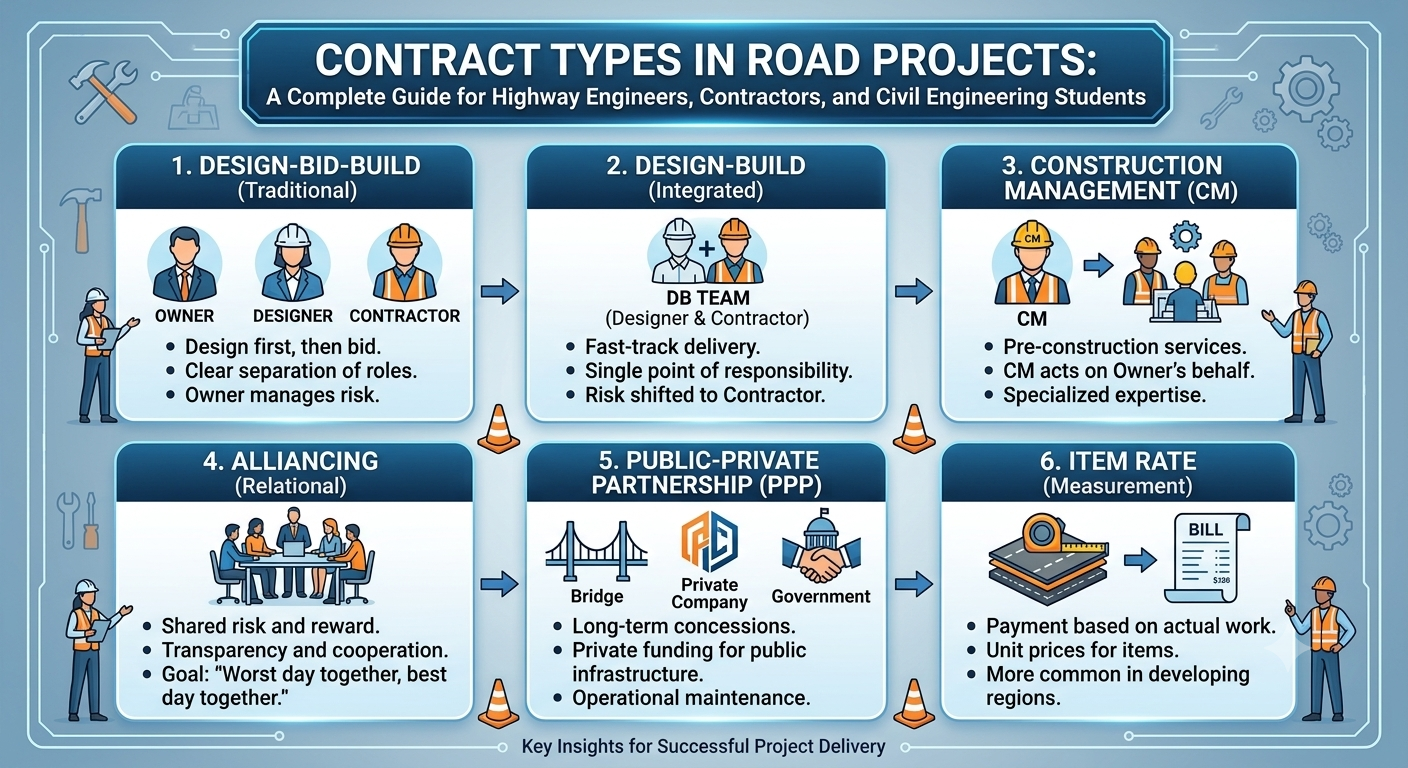
Road construction projects vary widely in size, complexity, funding, and risk. A village access road may require a simple agreement between a contractor and the project owner, while a multi-billion-dollar expressway demands sophisticated contractual arrangements involving designers, contractors, consultants, financiers, and government agencies. Selecting the appropriate contract type is one of the most important decisions made before construction begins because it directly influences project cost, quality, schedule, risk allocation, and dispute resolution.
Understanding Contract Types in Road Projects helps engineers, contractors, project managers, and students make informed decisions during project planning and execution. Every contract defines the responsibilities of each party, establishes payment methods, allocates project risks, and outlines procedures for handling changes or unforeseen conditions. Choosing the wrong contract can lead to delays, cost overruns, contractual disputes, and compromised construction quality.
This comprehensive guide explains the most common contract types used in highway and road construction, their advantages, disadvantages, practical applications, and the engineering principles behind their selection.
What Are Contract Types in Road Projects?
A road construction contract is a legally binding agreement that defines how a highway or road project will be executed. It specifies the scope of work, payment terms, project duration, quality standards, responsibilities of the parties involved, and procedures for handling variations or disputes.
The contract acts as the foundation of the entire construction process by establishing clear expectations before work begins.
In road engineering, contracts are designed to:
- Define project responsibilities.
- Allocate financial and technical risks.
- Establish payment mechanisms.
- Maintain construction quality.
- Ensure timely project completion.
- Protect the interests of both the owner and the contractor.
The choice of contract depends on the project’s complexity, design maturity, funding method, and level of uncertainty.
Why Contract Selection Is Critical
Selecting the appropriate contract type affects almost every aspect of a road project. An unsuitable contract can increase costs, create scheduling conflicts, or lead to disagreements between stakeholders.
A well-structured agreement offers several benefits:
- Better financial control
- Clear allocation of responsibilities
- Improved quality assurance
- Reduced project risks
- Faster dispute resolution
- Greater accountability
- More predictable project outcomes
For example, a road project with a fully completed design may benefit from a Lump Sum Contract, while a project with uncertain quantities often performs better under a Unit Price Contract.
Factors Affecting Contract Selection
Before selecting a contract, project owners and engineers evaluate several technical and commercial factors.
1. Project Size
Large expressways, tunnels, and bridge projects typically require more sophisticated contractual arrangements than short rural roads.
2. Design Completion
If the design is complete and quantities are well defined, fixed-price contracts become more suitable. In contrast, projects with evolving designs may require flexible payment methods.
3. Risk Allocation
Every project contains risks such as:
- Material price fluctuations
- Unforeseen ground conditions
- Weather delays
- Utility conflicts
- Design changes
The contract determines which party is responsible for managing these risks.
4. Funding Source
Projects financed by governments, international agencies, or private investors often have different procurement requirements and contractual frameworks.
5. Construction Duration
Long-term infrastructure projects require contracts that accommodate inflation, material cost changes, and potential design modifications.
6. Technical Complexity
Projects involving major interchanges, flyovers, or difficult terrain usually require contract structures that allow flexibility while maintaining quality and cost control.
Types of Contracts in Road Projects
1. Lump Sum Contract
A Lump Sum Contract, also known as a Fixed-Price Contract, is one of the most common contract types used in road construction when the project scope and design are clearly defined.
Under this arrangement, the contractor agrees to complete the entire project for a fixed amount regardless of the actual quantities used, provided that the scope of work does not change.
How It Works
The client prepares detailed drawings, specifications, and Bills of Quantities before inviting bids. Contractors estimate the total project cost and submit a single price for completing all work.
If awarded the contract, the contractor assumes responsibility for completing the project within the agreed price.
Suitable Applications
- Residential roads
- Urban streets
- Parking facilities
- Small highway improvements
- Projects with complete designs
Advantages
- Easy budget planning
- Simple payment administration
- Clear project cost from the beginning
- Strong incentive for efficient construction
- Reduced administrative effort
Disadvantages
- Limited flexibility
- Contractors may include higher risk allowances
- Design changes can become expensive
- Variation orders may delay the project
Practical Example
A municipality plans to construct a 5-kilometer urban road with completed engineering drawings and accurately estimated quantities. Since the scope is unlikely to change, a Lump Sum Contract offers predictable costs and simplified contract administration.
2. Item Rate (Unit Price) Contract
The Item Rate Contract, also called the Unit Price Contract, is widely used for road and highway projects where exact work quantities cannot be determined before construction.
Instead of quoting one overall price, contractors provide unit rates for individual work items such as excavation, embankment construction, asphalt paving, concrete works, drainage installation, and road marking.
Payments are based on the actual quantities measured after completion.
How It Works
The project owner prepares a Bill of Quantities (BOQ) listing estimated work items. Contractors submit unit rates for each item, and payment is calculated by multiplying the measured quantity by the agreed unit rate.
Suitable Applications
- National highways
- Rural road programs
- Mountain roads
- Road widening projects
- Rehabilitation works
Advantages
- Greater flexibility
- Accurate payment for completed work
- Suitable for uncertain site conditions
- Easier incorporation of design changes
- Fair compensation for actual quantities
Disadvantages
- Final project cost is uncertain
- Requires continuous measurement
- More administrative effort
- Quantity overruns can increase costs
Practical Example
A highway passes through hilly terrain where rock excavation quantities cannot be accurately predicted before construction. Using an Item Rate Contract allows payment based on the actual volume excavated rather than estimated quantities.
3. Percentage Rate Contract
A Percentage Rate Contract is commonly used by government agencies for maintenance works and smaller infrastructure projects.
In this system, the owner prepares a schedule of standard rates for each work item. Contractors bid by offering a percentage above, below, or equal to these published rates.
How It Works
For example:
- Government schedule rate = $100 per cubic meter
- Contractor bids 5% below schedule
- Payment rate becomes $95 per cubic meter
Similarly, a contractor may quote:
- 3% above schedule
- 10% below schedule
- At par (no percentage adjustment)
The awarded contractor receives payment according to the agreed percentage adjustment applied to the standard rates.
Suitable Applications
- Road maintenance
- Periodic resurfacing
- Drainage repairs
- Shoulder improvements
- Municipal road works
Advantages
- Faster tender evaluation
- Standardized pricing
- Transparent procurement
- Simplified bidding process
- Reduced pricing disputes
Disadvantages
- Depends on accurate government schedule rates
- Less flexibility for unique projects
- Not ideal for highly specialized highway works
Practical Example
A local authority plans annual maintenance for several district roads. Instead of preparing separate rates for every project, contractors bid using a percentage above or below the published schedule of rates, making procurement quicker and more consistent.
Practical Comparison of Common Contract Types
| Feature | Lump Sum Contract | Item Rate Contract | Percentage Rate Contract |
|---|---|---|---|
| Payment Basis | Fixed total price | Actual measured quantities | Percentage adjustment to schedule rates |
| Cost Certainty | High | Moderate | Moderate |
| Quantity Flexibility | Low | High | Moderate |
| Suitable for Design Changes | Limited | Excellent | Moderate |
| Administrative Effort | Low | High | Medium |
| Best Used For | Fully designed projects | Projects with uncertain quantities | Government maintenance works |
Engineering Considerations When Choosing a Contract
Before selecting a contract type, engineers should evaluate:
- Accuracy of design documents.
- Reliability of quantity estimates.
- Project complexity.
- Geological uncertainty.
- Risk-sharing requirements.
- Funding arrangements.
- Construction schedule.
- Long-term maintenance objectives.
Selecting the most appropriate contract structure improves cost control, reduces disputes, and supports successful project delivery.
4. Cost Plus Contract
A Cost Plus Contract is used when the scope of work cannot be accurately defined before construction begins. Instead of agreeing on a fixed project price, the client reimburses the contractor for the actual construction costs and pays an additional fee as profit.
This contract provides flexibility for projects where design details are still evolving or where unexpected site conditions are likely.
How It Works
The contractor maintains detailed records of all project expenses, including:
- Labor costs
- Construction materials
- Equipment usage
- Site overheads
- Subcontractor payments
The client then reimburses these costs and pays an agreed fee, which may be:
- A fixed amount
- A percentage of the total cost
- An incentive-based fee linked to project performance
Suitable Applications
- Emergency road repairs
- Disaster recovery projects
- Complex bridge approaches
- Projects with uncertain site conditions
Advantages
- Flexible for changing project requirements.
- Construction can begin before the final design is complete.
- Higher collaboration between the owner and contractor.
- Reduced risk of contractor claims caused by unforeseen conditions.
Disadvantages
- Final project cost is uncertain.
- Requires strict financial monitoring.
- Less incentive for contractors to minimize costs unless incentive clauses are included.
Practical Example
Following severe flooding, a highway embankment requires immediate reconstruction. Because the full extent of damage is unknown, a Cost Plus Contract enables work to begin quickly while reimbursing actual construction expenses.
5. EPC (Engineering, Procurement, and Construction) Contract
An Engineering, Procurement, and Construction (EPC) contract places responsibility for designing, procuring materials, and constructing the project under a single contractor.
This approach is widely used for large infrastructure developments because it simplifies project management for the owner.
Responsibilities of the EPC Contractor
- Engineering design
- Material procurement
- Equipment sourcing
- Construction management
- Testing and commissioning
- Project handover
Suitable Applications
- Expressways
- National highways
- Major interchanges
- Toll road developments
- Infrastructure funded by international agencies
Advantages
- Single point of responsibility.
- Better coordination between design and construction.
- Faster project delivery.
- Improved cost control.
- Reduced disputes between designers and contractors.
Disadvantages
- Limited owner involvement during design.
- Higher initial contract value.
- Careful contractor selection is essential.
Practical Example
A government plans a six-lane expressway with a strict completion deadline. Using an EPC contract allows one organization to manage design, procurement, and construction, improving coordination and reducing delays.
6. Design-Build Contract
A Design-Build Contract combines engineering design and construction services into one agreement. Unlike traditional procurement, where design and construction are handled separately, both activities proceed under a single contract.
Key Features
- Integrated project delivery
- Early contractor involvement
- Faster decision-making
- Improved communication
- Reduced project duration
Suitable Applications
- Urban bypasses
- Highway widening
- Airport access roads
- Fast-track infrastructure projects
Advantages
- Shorter project schedules.
- Reduced design conflicts.
- Better innovation.
- Improved collaboration.
- Simplified contract administration.
Disadvantages
- Owners have less direct control over design.
- Design modifications after construction begins can be costly.
- Requires clearly defined performance requirements.
Practical Example
A rapidly growing city requires a new bypass road before an international event. A Design-Build contract accelerates project delivery by allowing design and construction activities to overlap.
7. BOT (Build-Operate-Transfer) Contract
A Build-Operate-Transfer (BOT) contract is commonly used for major highway infrastructure financed by private investors.
Under this model, a private company finances, designs, constructs, operates, and maintains the highway for a specified concession period. At the end of the agreed term, ownership is transferred to the government.
BOT Project Stages
- Project financing
- Detailed design
- Construction
- Operation and maintenance
- Revenue collection (often through tolls)
- Transfer to the public authority
Suitable Applications
- Toll motorways
- Expressways
- Bridges
- Tunnels
Advantages
- Reduces government funding requirements.
- Encourages private investment.
- Promotes long-term maintenance.
- Transfers many project risks to the private sector.
Disadvantages
- Complex legal and financial arrangements.
- Revenue depends on traffic demand.
- Longer procurement process.
- Requires strong regulatory oversight.
8. Public-Private Partnership (PPP) Contract
A Public-Private Partnership (PPP) is a collaborative arrangement in which public agencies and private companies share the responsibilities, risks, financing, and rewards associated with infrastructure development.
PPP models can take several forms, including BOT, BOOT (Build-Own-Operate-Transfer), DBFO (Design-Build-Finance-Operate), and concession agreements.
Suitable Applications
- National highway networks
- Ring roads
- Urban expressways
- Large transportation corridors
Advantages
- Access to private financing.
- Improved innovation.
- Enhanced operational efficiency.
- Better lifecycle asset management.
- Reduced financial burden on governments.
Disadvantages
- Complex contract management.
- Extensive negotiations.
- Long approval timelines.
- Revenue uncertainty for private investors.
Practical Example
A metropolitan authority partners with a private consortium to finance and operate a new ring road. The government oversees regulatory compliance while the private partner manages construction and maintenance under a long-term concession.
Simple Contract Selection Diagram
Project Requirements
         │
         ▼
Is the Design Complete?
         │
 ┌───────┴────────┐
 │                │
Yes              No
 │                │
 ▼                ▼
Lump Sum     Item Rate / Cost Plus
 │                │
 ▼                ▼
Large Integrated Project?
         │
 ┌───────┴────────┐
 │                │
Yes              No
 │                │
 ▼                ▼
EPC / Design-Build
         │
         ▼
Private Financing Needed?
         │
 ┌───────┴────────┐
 │                │
Yes              No
 │
 ▼
BOT / PPP
Best Practices for Selecting
Choosing the right contract is as important as selecting appropriate construction materials or pavement design. The following practices improve project success:
- Match the contract type to project complexity and design maturity.
- Clearly define the scope of work before tendering.
- Allocate risks to the party best able to manage them.
- Include transparent procedures for handling variations and claims.
- Establish measurable quality and performance requirements.
- Maintain detailed documentation throughout the project lifecycle.
- Encourage open communication among owners, consultants, and contractors.
- Review lessons learned from previous road projects before selecting a procurement strategy.
Practical Recommendations
Civil Engineers
- Evaluate design completeness before recommending a contract model.
- Understand how each contract allocates technical and financial risks.
- Monitor contract compliance through regular inspections and documentation.
- Coordinate with legal and procurement teams during tender preparation.
Contractors
- Carefully review contract conditions before submitting bids.
- Develop realistic cost estimates and construction schedules.
- Maintain accurate records of labor, equipment, and material usage.
- Proactively manage risks to reduce delays and disputes.
Civil Engineering Students
- Study the advantages and limitations of different procurement methods.
- Learn how Bills of Quantities (BOQs) are prepared and used.
- Understand the relationship between contract type and project risk.
- Explore real-world case studies of highway projects using different contract models.
General Discussion of IRC, AASHTO, and ICE Practices
Leading highway organizations emphasize that contract selection should support efficient project delivery while promoting safety, quality, and accountability.
In general, accepted engineering practices include:
- Preparing complete design documentation before tendering whenever practical.
- Conducting detailed site investigations to reduce uncertainty.
- Allocating project risks fairly between contracting parties.
- Encouraging transparent procurement procedures.
- Implementing robust quality assurance and quality control systems.
- Considering whole-life costs rather than focusing solely on the lowest initial bid.
- Prioritizing road user safety throughout design, construction, and maintenance.
These principles are widely reflected in the guidance published by organizations such as IRC, AASHTO, and ICE, although specific procedures vary by jurisdiction.
Frequently Asked Questions (FAQs)
1. Which contract type is most commonly used in road projects?
Item Rate (Unit Price) Contracts are widely used for highway construction because they accommodate variations in work quantities and site conditions.
2. What is the main difference between a Lump Sum Contract and an Item Rate Contract?
A Lump Sum Contract pays a fixed total price for the completed project, whereas an Item Rate Contract compensates the contractor based on the actual measured quantities of work.
3. When should an EPC Contract be selected?
An EPC Contract is suitable for large infrastructure projects requiring a single organization to manage design, procurement, and construction.
4. Why are Cost Plus Contracts used?
They are appropriate when project scope or site conditions are uncertain, allowing work to begin before all design details are finalized.
5. What are the benefits of a Design-Build Contract?
Design-Build Contracts shorten project duration, improve coordination, encourage innovation, and reduce conflicts between designers and contractors.
6. How does a BOT Contract work?
A private company finances, constructs, operates, and maintains the highway for a concession period before transferring ownership to the government.
7. What is a Public-Private Partnership (PPP)?
A PPP is a long-term collaboration where public and private sectors share responsibilities, risks, financing, and operational duties for infrastructure projects.
8. How does contract selection affect project risk?
Different contracts distribute financial, technical, and construction risks differently. Selecting the appropriate model helps manage uncertainty and improve project outcomes.
9. Which contract is best for projects with uncertain quantities?
An Item Rate Contract is generally preferred because payment is based on actual measured work rather than fixed estimates.
10. Why is understanding contract types important for civil engineers?
Knowledge of contract types enables engineers to recommend suitable procurement methods, manage risks effectively, and contribute to successful project delivery.
Conclusion
Selecting the appropriate contract in road project is a strategic decision that influences every stage of highway development, from planning and procurement to construction and maintenance. Each contract model offers distinct advantages depending on project size, design maturity, funding arrangements, and risk profile. Lump Sum Contracts provide cost certainty for well-defined projects, while Item Rate and Cost Plus Contracts offer flexibility when quantities or site conditions are uncertain. EPC, Design-Build, BOT, and PPP models are particularly valuable for large and complex infrastructure projects where integrated delivery or private investment is required.

Kamran Malik is a passionate civil engineering writer and researcher who specializes in construction, transportation, structural engineering, and infrastructure topics. Through his articles on CivilEngineerings.com, he simplifies complex engineering concepts and shares practical insights, industry trends, and educational resources for students, professionals, and engineering enthusiasts.