
Introduction
The success of any highway project depends not only on sound engineering and quality construction but also on a transparent and well-structured procurement system. Before excavation begins or construction equipment reaches the site, the project owner must select a capable contractor through a formal tendering procedure. This systematic approach ensures fair competition, efficient use of public funds, and the successful delivery of transportation infrastructure.
The Highway Tender Process is a structured sequence of activities that includes project planning, preparation of tender documents, contractor prequalification, bid invitation, evaluation, contract award, and project execution. Every stage is designed to promote transparency, accountability, and technical excellence while reducing financial and contractual risks.
Whether the project involves a national highway, expressway, bridge, bypass, or urban roadway, understanding the tender process is essential for civil engineers, transportation professionals, contractors, and engineering students. This guide explains the first stages of the highway tender process, highlights industry best practices, and demonstrates how effective procurement contributes to successful highway development.
What Is the Highway Tender Process?
The Highway Tender Process is the official procurement procedure used by government agencies, highway authorities, and private organizations to select the most suitable contractor for a highway construction project.
Rather than awarding projects directly, clients invite qualified contractors to submit competitive bids based on predefined technical specifications and contractual requirements. The submitted proposals are then evaluated using objective criteria such as technical capability, financial strength, previous experience, equipment availability, project methodology, and bid price.
The primary objectives of highway tendering include:
- Ensuring fair and open competition.
- Achieving value for money.
- Selecting technically competent contractors.
- Maintaining transparency and accountability.
- Minimizing project risks.
- Encouraging quality construction.
A properly managed tender process helps deliver highway projects on time, within budget, and according to engineering standards.
Why the Highway Tender Process Is Important
Tendering is more than an administrative requirement—it is a critical project management tool that influences the quality, cost, and success of highway construction.
An organized procurement process enables project owners to compare multiple contractors objectively while reducing the likelihood of disputes, delays, and budget overruns.
Key Benefits
- Promotes transparent procurement.
- Encourages healthy market competition.
- Improves project quality.
- Reduces corruption and favoritism.
- Ensures efficient use of public funds.
- Selects experienced and financially capable contractors.
- Supports long-term infrastructure sustainability.
Practical Example
Suppose a highway authority plans to construct a 60-kilometer dual carriageway. Instead of assigning the work directly, it issues a public tender inviting qualified contractors to submit bids. Each proposal is reviewed against technical specifications, project methodology, construction schedule, equipment resources, financial capability, and price. The contract is then awarded to the bidder offering the best overall value rather than simply the lowest cost.
Types of Highway Tenders
Highway projects use different tendering methods depending on project complexity, urgency, procurement policies, and funding requirements.
Open Tender
An open tender allows any eligible contractor to participate.
This method provides maximum competition and transparency because all qualified firms can submit bids.
Advantages
- Wide contractor participation.
- Competitive pricing.
- Transparent procurement.
- Equal opportunities for bidders.
Limitations
- Large number of bids.
- Longer evaluation period.
- Increased administrative workload.
Limited Tender
A limited tender invites only a selected group of qualified contractors.
It is commonly used for specialized projects or when project timelines are short.
Advantages
- Faster procurement.
- Easier bid evaluation.
- Better control over contractor quality.
Limitations
- Reduced competition.
- Fewer pricing options.
Selective Tender
Under selective tendering, contractors first undergo a qualification process before receiving tender documents.
Selection criteria may include:
- Previous highway experience.
- Financial capacity.
- Technical staff.
- Construction equipment.
- Quality management systems.
This approach helps ensure that only competent organizations compete for complex infrastructure projects.
Negotiated Tender
In certain situations, the client negotiates directly with one contractor instead of inviting competitive bids.
Negotiated tendering is generally reserved for:
- Emergency works.
- Specialized engineering projects.
- Continuation of existing contracts.
- Urgent infrastructure restoration.
Because competition is limited, this method requires careful justification and strong oversight.
EPC and Design-Build Tender
Many modern highway authorities adopt Engineering, Procurement, and Construction (EPC) or Design-Build procurement models.
Under these arrangements, one contractor is responsible for:
- Detailed design.
- Procurement of materials.
- Construction.
- Testing.
- Project completion.
This integrated approach can shorten project schedules, improve coordination, and simplify contract administration.
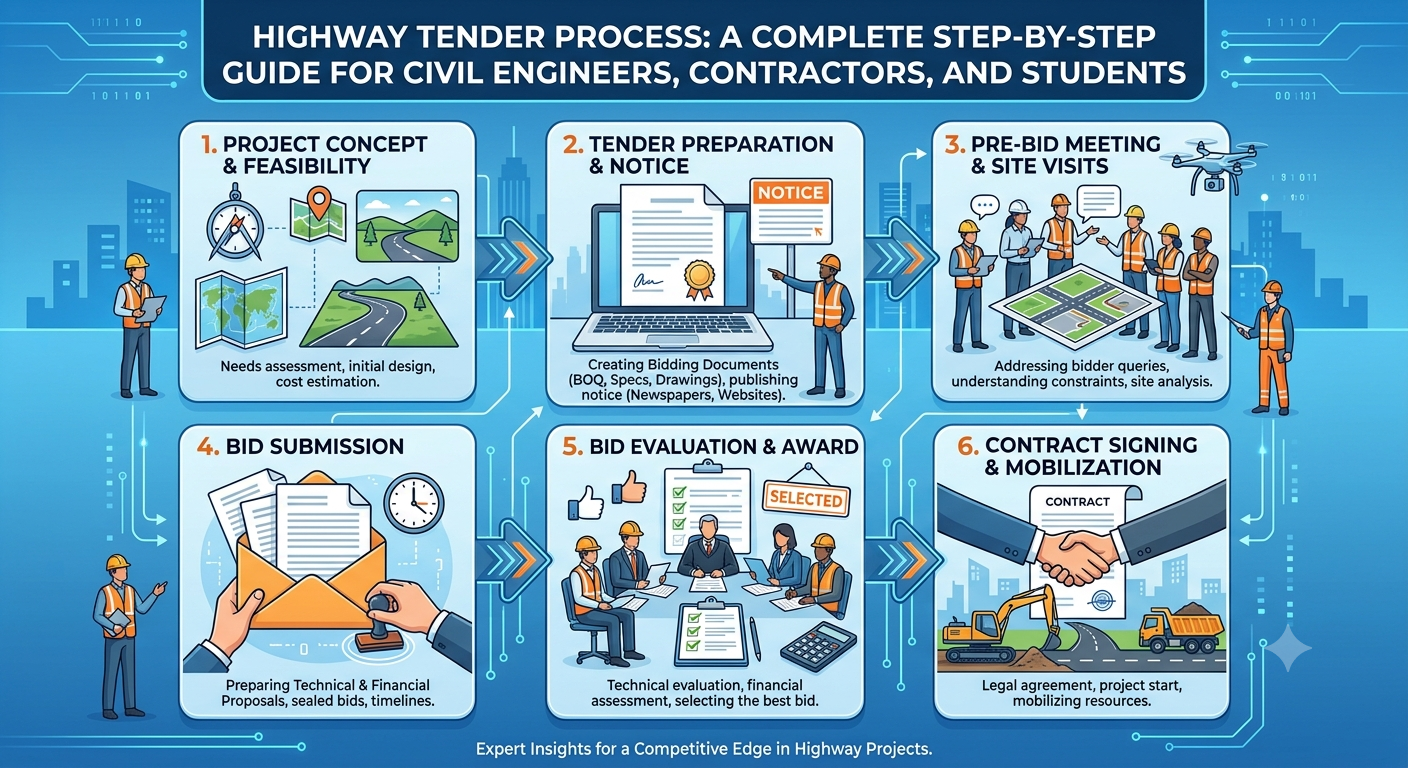
Highway Tender Process Step by Step
Although procurement procedures vary between organizations, the overall highway tender process follows a logical sequence of planning, documentation, contractor selection, and contract award.
Step 1: Project Planning
Every successful tender begins with detailed project planning.
Before inviting bids, the project owner must define the project’s objectives, scope, budget, and technical requirements.
Planning Activities
- Defining project scope.
- Confirming project funding.
- Reviewing feasibility studies.
- Preparing preliminary designs.
- Identifying project risks.
- Developing procurement strategies.
- Establishing project schedules.
Engineering Considerations
During planning, engineers evaluate:
- Traffic forecasts.
- Highway alignment.
- Pavement design requirements.
- Bridge and drainage structures.
- Utility relocations.
- Environmental constraints.
- Safety requirements.
Clear project planning reduces uncertainty and minimizes contractual disputes during construction.
Step 2: Preparation of Tender Documents
Tender documents provide contractors with all the information needed to prepare accurate and competitive bids.
Well-prepared documentation ensures that all bidders price the same scope of work, making comparisons fair and objective.
Typical Contents
- Invitation to Tender (ITT)
- Instructions to Bidders
- General Conditions of Contract
- Special Conditions of Contract
- Technical Specifications
- Construction Drawings
- Material Specifications
- Project Schedule
- Quality Requirements
- Safety Requirements
- Environmental Requirements
- Bill of Quantities (BOQ)
- Bid Forms
Why Tender Documents Matter
Comprehensive documentation helps:
- Eliminate ambiguity.
- Reduce claims.
- Improve pricing accuracy.
- Standardize bid preparation.
- Facilitate objective evaluation.
Step 3: Cost Estimation and Bill of Quantities (BOQ)
Accurate cost estimation forms the financial foundation of every highway tender.
Project owners prepare an engineer’s estimate, while contractors use the BOQ to calculate their own bid prices.
Components of a BOQ
Typical highway items include:
- Site clearance.
- Earthworks.
- Subgrade preparation.
- Granular sub-base.
- Base course.
- Asphalt or concrete pavement.
- Drainage works.
- Culverts.
- Bridges.
- Road furniture.
- Traffic signs and markings.
- Environmental protection measures.
Purpose of Cost Estimation
Cost estimates help:
- Establish project budgets.
- Compare contractor bids.
- Evaluate financial feasibility.
- Monitor project costs.
- Control expenditures during construction.
Accurate quantities also reduce disputes arising from measurement errors.
Step 4: Prequalification of Contractors
Many highway agencies require contractors to complete a prequalification process before bidding.
Prequalification ensures that only organizations with sufficient technical and financial capability participate in the tender.
Evaluation Criteria
Contractors are assessed based on:
- Highway construction experience.
- Financial stability.
- Available equipment.
- Skilled personnel.
- Quality management systems.
- Safety performance.
- Previous project completion records.
- Litigation history.
- Technical expertise.
Benefits of Prequalification
- Reduces project risks.
- Improves construction quality.
- Simplifies bid evaluation.
- Prevents inexperienced firms from undertaking complex projects.
Step 5: Invitation to Bid
After completing the planning and documentation stages, the client formally invites contractors to submit proposals.
The invitation contains important project information and bidding instructions.
Information Typically Included
- Project title.
- Project location.
- Scope of work.
- Eligibility criteria.
- Bid submission deadline.
- Tender fee (if applicable).
- Bid security requirements.
- Pre-bid meeting schedule.
- Contact information.
Pre-Bid Meeting
Many highway projects include a pre-bid conference where contractors can:
- Clarify technical requirements.
- Ask contractual questions.
- Review project specifications.
- Visit the construction site.
- Understand bidding procedures.
Providing equal access to information helps maintain fairness and transparency throughout the procurement process.
Highway Tender Process Flow Diagram
Project Planning
        │
        ▼
Tender Documents
        │
        ▼
Cost Estimation & BOQ
        │
        ▼
Prequalification
        │
        ▼
Invitation to Bid
        │
        ▼
Bid Submission
        │
        ▼
Evaluation
        │
        ▼
Contract Award
Step 6: Bid Submission
Once the tender documents have been issued and contractors have completed their technical and financial preparations, the next stage is bid submission. This phase is critical because every proposal must comply with the instructions provided in the tender documents.
Most highway authorities now use electronic procurement (e-procurement) systems, although some organizations still accept sealed physical bids.
Documents Commonly Submitted
A complete bid package generally includes:
- Technical proposal
- Financial proposal
- Completed Bill of Quantities (BOQ)
- Bid security or bid bond
- Company registration documents
- Tax compliance certificates
- Financial statements
- Equipment list
- Key personnel details
- Construction methodology
- Project work schedule
- Health, Safety, and Environment (HSE) plan
- Quality Assurance/Quality Control (QA/QC) plan
Best Practices for Contractors
To improve the chances of success, contractors should:
- Review every tender requirement carefully.
- Ensure all forms are completed accurately.
- Verify BOQ calculations before submission.
- Submit bids before the deadline.
- Double-check supporting documents for completeness.
Incomplete or late submissions are often rejected without further evaluation.
Step 7: Bid Opening
After the submission deadline, the project owner officially opens the received bids.
This process is conducted according to established procurement procedures to ensure transparency and fairness.
Bid Opening Activities
During the opening session, officials generally record:
- Contractor’s name
- Bid submission status
- Bid security details
- Quoted bid price
- Number of submitted documents
For public projects, representatives of participating contractors are often invited to witness the opening process.
Why Transparency Matters
A transparent bid opening process:
- Builds confidence among bidders.
- Reduces procurement disputes.
- Prevents unauthorized changes.
- Demonstrates fairness and accountability.
Step 8: Technical and Financial Evaluation
Bid evaluation is one of the most important stages in the Highway Tender Process because it determines which contractor offers the best overall value for the project.
Evaluation usually occurs in two phases.
Technical Evaluation
The technical proposal is reviewed first to determine whether the contractor meets all project requirements.
Typical evaluation criteria include:
- Previous highway construction experience
- Financial capability
- Technical staff qualifications
- Construction equipment availability
- Project methodology
- Work program and schedule
- Safety management system
- Quality management procedures
- Environmental management approach
Contractors that fail to satisfy mandatory technical requirements are usually excluded before financial bids are considered.
Financial Evaluation
Only technically qualified bidders proceed to financial evaluation.
The evaluation committee compares:
- Total bid price
- Unit rates
- Arithmetic accuracy
- Price reasonableness
- Commercial compliance
- Life-cycle cost considerations (where applicable)
The contract is generally awarded to the bidder providing the most advantageous combination of technical competence and financial value rather than simply the lowest price.
Practical Example
Suppose two contractors submit bids for a highway project:
- Contractor A offers the lowest price but lacks sufficient equipment and experienced personnel.
- Contractor B submits a slightly higher bid while demonstrating strong technical expertise, modern machinery, and an excellent project delivery record.
In many procurement systems, Contractor B may be selected because the proposal presents lower execution risks and greater long-term value.
Step 9: Contract Award
After completing the evaluation process, the project owner identifies the successful bidder and issues a formal notification of award.
Before awarding the contract, additional verification may include:
- Reference checks
- Financial verification
- Equipment inspection
- Personnel confirmation
- Clarification meetings
Contract Award Documents
The successful contractor generally receives:
- Letter of Acceptance (LOA)
- Notice of Award
- Contract Agreement
- Performance Security requirements
- Mobilization instructions
Unsuccessful bidders are normally informed according to applicable procurement procedures.
Importance of Proper Contract Award
A structured award process:
- Protects the interests of both parties.
- Reduces legal disputes.
- Ensures contractual clarity.
- Facilitates smooth project commencement.
Step 10: Contract Signing and Notice to Proceed
Once contractual conditions have been satisfied, both parties formally sign the agreement.
The client then issues the Notice to Proceed (NTP), authorizing the contractor to begin project activities.
Activities Before Construction Begins
Before mobilization, contractors typically:
- Submit performance guarantees.
- Arrange project insurance.
- Mobilize equipment.
- Recruit project staff.
- Establish site offices.
- Prepare construction schedules.
- Develop traffic management plans.
- Conduct safety inductions.
Only after these preparations are complete does physical construction begin.
Engineering Principles Behind a Successful Highway Tender Process
A successful procurement system follows fundamental engineering and project management principles that promote quality and efficiency.
Transparency
Every qualified contractor should receive equal access to project information and evaluation criteria.
Fair Competition
Competitive bidding encourages innovation, improves quality, and often results in better value for public investment.
Technical Competence
Selection should prioritize contractors with proven engineering capability and relevant project experience.
Risk Management
Potential technical, financial, contractual, and environmental risks should be identified and allocated appropriately before construction begins.
Quality Assurance
Tender documents should clearly define quality standards, testing procedures, and inspection requirements to ensure compliance throughout the project.
Practical Recommendations
Civil Engineers
- Prepare clear and comprehensive tender documents.
- Review BOQs carefully to minimize quantity errors.
- Coordinate with design, geotechnical, and environmental teams before tender issuance.
- Maintain complete documentation throughout the procurement process.
Contractors
- Study tender specifications thoroughly before pricing.
- Visit the project site whenever permitted.
- Build realistic construction schedules.
- Avoid underpricing that may affect project quality.
- Ensure all legal and financial documents remain up to date.
Engineering Students
- Learn how BOQs are prepared and measured.
- Understand the difference between technical and financial evaluations.
- Study standard forms of construction contracts.
- Familiarize yourself with procurement ethics and professional responsibilities.
Best Practices for Highway Tendering
- Prepare accurate and detailed engineering designs before inviting bids.
- Use standardized tender documents to improve consistency.
- Conduct pre-bid meetings to clarify technical issues.
- Apply objective evaluation criteria for all bidders.
- Maintain confidentiality throughout the evaluation process.
- Encourage digital procurement systems for greater efficiency.
- Allocate project risks fairly between client and contractor.
- Monitor contract performance from project commencement to completion.
- Keep transparent procurement records for future audits.
- Continuously improve procurement procedures based on lessons learned.
General Discussion of IRC, AASHTO, and ICE Practices
Although procurement regulations differ between countries, recognized engineering organizations such as the Indian Roads Congress (IRC), the American Association of State Highway and Transportation Officials (AASHTO), and the Institution of Civil Engineers (ICE) promote several common principles for infrastructure procurement.
These generally include:
- Preparing complete engineering designs before tendering.
- Developing accurate cost estimates and Bills of Quantities.
- Selecting contractors through transparent and competitive procedures.
- Evaluating bids using both technical and financial criteria.
- Clearly defining quality standards and testing requirements.
- Allocating contractual responsibilities appropriately.
- Promoting ethical procurement and professional accountability.
- Supporting effective project management throughout construction.
Adopting these principles contributes to safer, higher-quality, and more sustainable highway infrastructure.
Frequently Asked Questions (FAQs)
1. What is the Highway Tender Process?
The Highway Tender Process is the formal procurement procedure used to select a qualified contractor for highway construction through competitive bidding.
2. Why is tendering important in highway projects?
Tendering promotes transparency, encourages fair competition, controls project costs, and helps select contractors with the technical capability to deliver quality infrastructure.
3. What documents are included in highway tender documents?
Typical documents include the Invitation to Tender, Instructions to Bidders, technical specifications, construction drawings, BOQ, contract conditions, project schedule, and bid forms.
4. What is a Bill of Quantities (BOQ)?
A BOQ is a detailed list of construction activities, materials, quantities, and measurement units used for pricing and evaluating contractor bids.
5. What is contractor prequalification?
Prequalification is the process of assessing contractors’ technical experience, financial strength, equipment, personnel, and past performance before allowing them to submit bids.
6. What is the difference between technical and financial evaluation?
Technical evaluation assesses a contractor’s capability and compliance with project requirements, while financial evaluation compares bid prices and commercial proposals among technically qualified bidders.
7. Why are pre-bid meetings conducted?
Pre-bid meetings allow contractors to clarify project requirements, understand site conditions, and ask questions before preparing their bids.
8. What happens after the contract is awarded?
The successful contractor signs the contract, submits required securities and insurance documents, mobilizes resources, and receives the Notice to Proceed before construction begins.
9. Can the lowest bidder always win a highway contract?
Not necessarily. Many highway authorities award contracts to the bidder offering the best overall value, considering both technical competence and financial competitiveness.
10. How does digital tendering improve procurement?
Electronic tendering enhances transparency, reduces paperwork, speeds up bid processing, improves record management, and minimizes opportunities for administrative errors.
Conclusion
The Highway Tender Process is a vital component of successful highway project delivery because it establishes a transparent and systematic framework for selecting competent contractors. Beginning with careful project planning and detailed tender documentation, the process continues through bid submission, technical and financial evaluation, contract award, and formal project commencement. Each stage contributes to reducing risks, controlling costs, maintaining quality, and ensuring accountability. For engineers, understanding procurement procedures helps improve project planning and contract administration, while contractors benefit from preparing competitive and compliant bids. Engineering students also gain valuable insight into how infrastructure projects move from design to execution. By following recognized procurement principles and adopting best practices inspired by organizations such as IRC, AASHTO, and ICE, stakeholders can deliver safer, more durable, and economically efficient highways. Mastering the Highway Tender Process ultimately supports the development of reliable transportation networks that serve communities and economies for decades.

Kamran Malik is a passionate civil engineering writer and researcher who specializes in construction, transportation, structural engineering, and infrastructure topics. Through his articles on CivilEngineerings.com, he simplifies complex engineering concepts and shares practical insights, industry trends, and educational resources for students, professionals, and engineering enthusiasts.