
Introduction
In every successful infrastructure project, technical expertise alone is not enough to achieve the desired outcome. Whether constructing a highway, bridge, airport, railway, or commercial building, the interests and expectations of numerous individuals and organizations must be carefully managed throughout the project lifecycle. This is where Stakeholder Management becomes a critical component of effective project management.
Construction projects often involve government authorities, consultants, contractors, local communities, utility companies, environmental agencies, investors, and end users. Each stakeholder has unique objectives, varying levels of influence, and different concerns regarding cost, quality, environmental impacts, timelines, and safety. Failing to engage these groups appropriately can result in delays, disputes, budget overruns, legal challenges, or even project cancellation.
From over 15 years of experience in civil and transportation engineering, one lesson remains consistent: projects that prioritize communication and stakeholder engagement are more likely to finish on schedule, stay within budget, and gain long-term public acceptance.
This guide explains Stakeholder Management from an engineering perspective, covering identification, analysis, mapping, and practical applications while following internationally recognized project management principles.
What Is Stakeholder Management?
Stakeholder Management is the systematic process of identifying, analyzing, engaging, communicating with, and monitoring individuals or organizations that can influence or be affected by a project.
In civil engineering, stakeholders extend far beyond the project owner. They include everyone whose decisions, resources, or interests have the potential to affect project success.
The objective is not simply to keep stakeholders informed but to build trust, manage expectations, resolve concerns proactively, and encourage collaboration throughout every phase of the project.
Effective stakeholder management begins during project planning and continues through design, procurement, construction, commissioning, and maintenance.
Why Stakeholder Management Is Important in Civil Engineering
Infrastructure projects operate in complex environments where technical decisions often have social, economic, environmental, and political implications.
A technically sound design may still fail if stakeholders are not properly engaged.
For example, a highway alignment that minimizes construction costs may encounter strong opposition from nearby communities if it affects residential areas or agricultural land. Similarly, inadequate coordination with utility providers can delay construction despite excellent engineering planning.
Proper stakeholder management helps engineers:
- Improve project transparency
- Reduce disputes and claims
- Build public confidence
- Enhance decision-making
- Support regulatory approvals
- Reduce construction delays
- Improve project quality
- Strengthen long-term project sustainability
Successful projects recognize that engineering excellence and stakeholder satisfaction must work together.
Types of Project Stakeholders
Understanding the different categories of stakeholders enables project teams to develop suitable engagement strategies.
Internal Stakeholders
Internal stakeholders are directly involved in planning, designing, financing, or executing the project.
Examples include:
- Project owners
- Government agencies
- Design consultants
- Civil engineers
- Contractors
- Project managers
- Construction supervisors
- Financial institutions
- Procurement teams
These groups generally have a high level of influence over project decisions.
External Stakeholders
External stakeholders may not participate directly in construction but are often affected by project activities.
Examples include:
- Local communities
- Residents
- Businesses
- Utility companies
- Environmental organizations
- Emergency services
- Educational institutions
- Media organizations
- Future road users
Ignoring external stakeholders often increases project risks.
Primary Stakeholders
Primary stakeholders experience direct impacts from project outcomes.
Examples:
- Highway users
- Nearby residents
- Landowners
- Contractors
- Investors
Secondary Stakeholders
Secondary stakeholders influence project performance indirectly.
Examples:
- Academic institutions
- Industry associations
- Professional engineering organizations
- Environmental advocacy groups
- Insurance providers
Stakeholder Identification Process
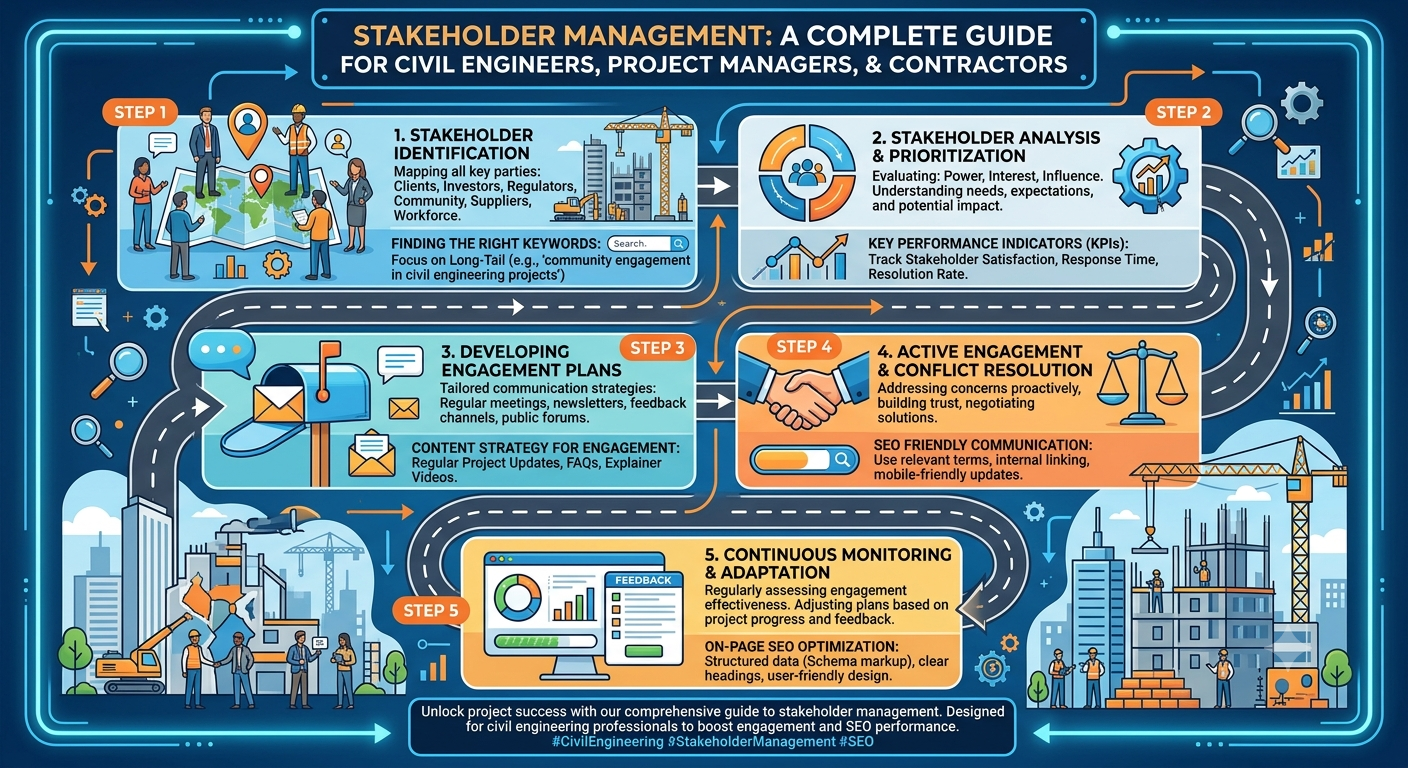
The first practical step in stakeholder management is identifying every individual or organization connected to the project.
Identification should begin during project initiation and continue whenever project conditions change.
Common Identification Methods
Project Documentation Review
Engineers review:
- Project charters
- Design reports
- Environmental studies
- Contract documents
- Utility records
Brainstorming Sessions
Project teams discuss potential stakeholders based on previous project experience.
Expert Consultation
Senior engineers and subject specialists often identify overlooked stakeholders based on their practical knowledge.
Site Investigations
Field visits frequently reveal local businesses, communities, and infrastructure owners who may be affected.
Questions to Ask During Identification
Project teams should consider:
- Who funds the project?
- Who approves the project?
- Who benefits from the project?
- Who may oppose the project?
- Who supplies critical resources?
- Who regulates project activities?
- Who may experience environmental or social impacts?
Answering these questions creates a comprehensive stakeholder register.
Stakeholder Analysis
After identifying stakeholders, engineers analyze their interests, expectations, influence, and potential impact on project success.
Stakeholder analysis enables project managers to prioritize communication efforts and allocate resources effectively.
Key Evaluation Criteria
Level of Influence
Can the stakeholder affect project decisions?
Level of Interest
How closely does the stakeholder follow project progress?
Decision-Making Authority
Does the stakeholder approve permits, budgets, or technical changes?
Potential Risks
Could disagreements create delays, legal issues, or financial losses?
Communication Needs
How often should updates be provided?
Benefits of Stakeholder Analysis
A structured analysis helps engineers:
- Allocate communication resources efficiently.
- Identify potential project risks.
- Prevent misunderstandings.
- Improve collaboration.
- Support faster decision-making.
- Reduce resistance to change.
Stakeholder Mapping Using the Power–Interest Matrix
One of the most widely used stakeholder management tools is the Power–Interest Matrix.
It categorizes stakeholders according to their level of influence and degree of interest in the project.
Four Main Categories
High Power – High Interest
These stakeholders require continuous engagement.
Examples:
- Project owner
- Government authority
- Major contractor
Management approach:
- Manage closely.
- Hold regular meetings.
- Involve in major decisions.
High Power – Low Interest
These stakeholders possess significant authority but require less frequent involvement.
Examples:
- Funding agencies
- Senior executives
Management approach:
- Keep satisfied.
- Provide strategic updates.
Low Power – High Interest
These stakeholders are interested in project outcomes but have limited influence.
Examples:
- Local communities
- Nearby businesses
- Road users
Management approach:
- Keep informed.
- Encourage feedback.
- Address concerns promptly.
Low Power – Low Interest
These stakeholders require periodic communication.
Examples:
- General public
- Educational organizations
Management approach:
- Monitor periodically.
- Share major project milestones.
Simple Power–Interest Matrix
                    High Interest
                         ▲
                         │
 Manage Closely      │   Keep Informed
 (High Power)        │   (Low Power)
─────────────────────┼──────────────────► Power
 Keep Satisfied      │   Monitor
 (High Power)        │   (Low Power)
                         │
                    Low Interest
This matrix assists project teams in prioritizing communication efforts while ensuring that influential stakeholders receive appropriate attention.
Practical Example in Highway Construction
Consider a project involving the construction of a new four-lane highway bypass around a growing city.
The project team identifies several stakeholder groups:
| Stakeholder | Interest | Influence | Engagement Strategy |
|---|---|---|---|
| Highway Authority | High | High | Weekly coordination meetings |
| Design Consultant | High | High | Technical design reviews |
| Contractor | High | High | Daily progress monitoring |
| Local Residents | High | Medium | Community consultation sessions |
| Utility Companies | Medium | High | Utility relocation planning |
| Environmental Agency | High | High | Environmental compliance reviews |
| Local Businesses | Medium | Medium | Access management discussions |
By engaging these stakeholders early, the project team can address concerns about traffic diversions, land acquisition, utility relocation, and environmental protection before construction begins.
Engineering Principles Behind Effective Stakeholder Management
Successful stakeholder management is guided by several fundamental engineering principles:
- Identify stakeholders as early as possible.
- Base decisions on accurate technical information.
- Communicate openly and consistently.
- Document commitments and agreements.
- Integrate stakeholder feedback into project planning where feasible.
- Resolve conflicts before they escalate.
- Balance technical, environmental, economic, and social considerations.
- Monitor stakeholder expectations throughout the project lifecycle.
These principles help create stronger relationships, reduce project uncertainty, and improve the likelihood of delivering infrastructure that meets both engineering standards and public expectations.
Stakeholder Engagement Strategies
Identifying stakeholders is only the beginning. The true value of Stakeholder Management lies in building productive relationships throughout the project lifecycle. Effective engagement encourages collaboration, minimizes resistance, and helps maintain trust even when unexpected challenges arise.
Engagement should be continuous rather than limited to the project’s initial stages. As projects evolve, stakeholder expectations, priorities, and concerns often change, making regular interaction essential.
Develop a Stakeholder Engagement Plan
A stakeholder engagement plan outlines:
- Stakeholder roles and responsibilities
- Communication objectives
- Preferred communication methods
- Meeting schedules
- Reporting frequency
- Feedback mechanisms
- Escalation procedures
A structured plan ensures that every stakeholder receives relevant information at the appropriate time.
Encourage Early Participation
Involving stakeholders during planning and design enables project teams to identify concerns before construction begins.
Examples include:
- Public consultation meetings
- Technical workshops
- Community awareness programs
- Design review sessions
- Environmental consultation forums
Early engagement often reduces objections during later project phases.
Maintain Transparent Communication
Transparency strengthens confidence between project teams and stakeholders.
Good communication should be:
- Accurate
- Timely
- Consistent
- Honest
- Easy to understand
- Well documented
Technical information should be explained in language appropriate for the intended audience, particularly when communicating with local communities.
Communication Planning
Communication is one of the most powerful tools in stakeholder management. Even technically successful projects can encounter difficulties if information is poorly communicated.
A communication plan defines how project information will be shared, who will receive it, and how frequently updates will be provided.
Communication Methods
Different stakeholders require different communication approaches.
Formal Communication
Examples include:
- Progress reports
- Contract meetings
- Technical presentations
- Official correspondence
- Regulatory submissions
Informal Communication
Examples include:
- Site discussions
- Telephone calls
- Video conferences
- Team briefings
- Community meetings
Digital Communication
Modern construction projects increasingly use:
- Project management software
- Building Information Modeling (BIM)
- Cloud document sharing
- Email updates
- Mobile reporting applications
- GIS-based project dashboards
Selecting the right communication method improves efficiency and reduces misunderstandings.
Conflict Resolution in Construction Projects
Construction projects frequently involve competing interests. Landowners may seek higher compensation, contractors may request additional time, while regulatory agencies may require design modifications.
Managing these conflicts professionally is a key responsibility of project managers and engineers.
Common Sources of Conflict
- Land acquisition issues
- Budget constraints
- Design changes
- Utility relocation
- Environmental concerns
- Construction delays
- Contract disputes
- Resource shortages
Effective Conflict Resolution Techniques
Active Listening
Understanding stakeholder concerns before responding often prevents unnecessary disagreements.
Collaborative Problem Solving
Project teams should work together to identify solutions that satisfy both technical requirements and stakeholder expectations.
Negotiation
Negotiation helps balance project objectives with stakeholder interests.
Documentation
Keeping accurate records of meetings, agreements, and design decisions reduces future disputes.
Independent Mediation
For complex disagreements, neutral third-party mediators may assist in reaching acceptable solutions.
Resolving issues early is generally more cost-effective than addressing disputes during construction.
Risk Management Through Stakeholder Engagement
Many construction risks originate from inadequate stakeholder communication rather than technical failures.
Examples include:
- Community protests
- Regulatory delays
- Permit rejections
- Legal claims
- Utility conflicts
- Environmental objections
Effective stakeholder engagement reduces these risks by identifying concerns before they escalate.
Risk Mitigation Measures
- Conduct regular stakeholder reviews.
- Monitor changing stakeholder expectations.
- Update communication plans as projects progress.
- Document all commitments.
- Respond promptly to complaints.
- Maintain transparency throughout decision-making.
Proactive engagement often saves considerable time and cost during project execution.
Best Practices for Effective Stakeholder Management
Successful infrastructure projects consistently follow several proven practices.
- Identify stakeholders at the earliest project stage.
- Keep the stakeholder register updated throughout the project.
- Classify stakeholders according to influence and interest.
- Develop a formal communication strategy.
- Encourage meaningful public participation.
- Respond to stakeholder concerns promptly.
- Maintain complete documentation of decisions and commitments.
- Monitor stakeholder satisfaction regularly.
- Promote collaboration between technical and non-technical teams.
- Review stakeholder engagement strategies periodically.
These practices strengthen relationships while supporting successful project delivery.
Practical Recommendations
Civil Engineers
- Integrate stakeholder analysis into project planning.
- Explain technical decisions using clear and accessible language.
- Coordinate closely with environmental, structural, and utility specialists.
- Record all stakeholder meetings and agreed actions.
Contractors
- Communicate construction schedules in advance.
- Minimize disruptions to nearby communities whenever possible.
- Address complaints professionally and without unnecessary delay.
- Ensure site staff understand stakeholder communication protocols.
Engineering Students
- Learn stakeholder management alongside technical engineering subjects.
- Participate in project simulations involving multiple stakeholders.
- Develop presentation and communication skills.
- Understand how engineering decisions influence society and the environment.
Technical knowledge alone is rarely sufficient for managing large infrastructure projects. Strong communication and leadership skills are equally valuable.
General Discussion of IRC, AASHTO, and ICE Perspectives
Professional engineering organizations consistently recognize the importance of stakeholder engagement in infrastructure development.
Although their publications focus on different regional practices, several common principles are emphasized:
- Begin stakeholder engagement during project planning rather than after design completion.
- Base engineering decisions on reliable technical investigations and objective data.
- Consider safety, sustainability, environmental protection, and public interest throughout project development.
- Coordinate effectively with government authorities, utility providers, and regulatory agencies.
- Document project decisions and maintain transparency during implementation.
- Incorporate risk management into project planning and stakeholder communication.
- Promote continuous quality improvement through collaboration among all project participants.
Applying these widely accepted principles contributes to safer, more sustainable, and socially responsible infrastructure projects.
Frequently Asked Questions (FAQs)
1. What is stakeholder management in civil engineering?
Stakeholder management is the process of identifying, analyzing, communicating with, and engaging individuals or organizations that can influence or are affected by a construction project.
2. Why is stakeholder management important for infrastructure projects?
It helps reduce project delays, improves communication, minimizes conflicts, supports regulatory approvals, and increases the likelihood of successful project completion.
3. Who are the primary stakeholders in a highway construction project?
Primary stakeholders typically include project owners, government agencies, contractors, consultants, local communities, utility providers, investors, and road users.
4. What is a stakeholder register?
A stakeholder register is a document containing information about identified stakeholders, including their roles, influence, interests, communication requirements, and engagement strategies.
5. What is the Power–Interest Matrix?
The Power–Interest Matrix is a stakeholder mapping tool used to classify stakeholders according to their level of influence and interest, helping project teams prioritize communication and engagement efforts.
6. How does stakeholder management reduce project risks?
Early communication identifies concerns before they develop into disputes, legal issues, regulatory delays, or construction interruptions.
7. What communication methods are commonly used in construction projects?
Common methods include meetings, technical reports, presentations, emails, digital project management platforms, public consultations, and site briefings.
8. How often should stakeholders be engaged?
Engagement frequency depends on each stakeholder’s influence, interest, and project role. High-priority stakeholders generally require regular communication throughout the project lifecycle.
9. What skills are essential for effective stakeholder management?
Successful stakeholder management requires communication, negotiation, leadership, problem-solving, conflict resolution, technical knowledge, and active listening.
10. Can poor stakeholder management lead to project failure?
Yes. Inadequate stakeholder engagement can result in construction delays, community opposition, legal disputes, budget overruns, environmental challenges, and loss of public trust.
Conclusion
Effective Stakeholder Management is one of the most important factors influencing the success of civil engineering and transportation projects. While technical excellence remains essential, infrastructure projects also depend on strong relationships with government agencies, contractors, consultants, utility providers, local communities, environmental organizations, and end users. Identifying stakeholders early, understanding their expectations, maintaining transparent communication, and resolving conflicts promptly create a collaborative environment that supports informed decision-making and minimizes project risks. By integrating stakeholder engagement into every phase of project planning, design, construction, and operation, engineers can improve project quality, control costs, reduce delays, and build lasting public confidence. Following recognized engineering practices and maintaining a structured approach to Stakeholder Management enables infrastructure professionals to deliver projects that are not only technically sound but also socially responsible, environmentally sustainable, and widely accepted by the communities they serve.

Kamran Malik is a passionate civil engineering writer and researcher who specializes in construction, transportation, structural engineering, and infrastructure topics. Through his articles on CivilEngineerings.com, he simplifies complex engineering concepts and shares practical insights, industry trends, and educational resources for students, professionals, and engineering enthusiasts.