
Introduction
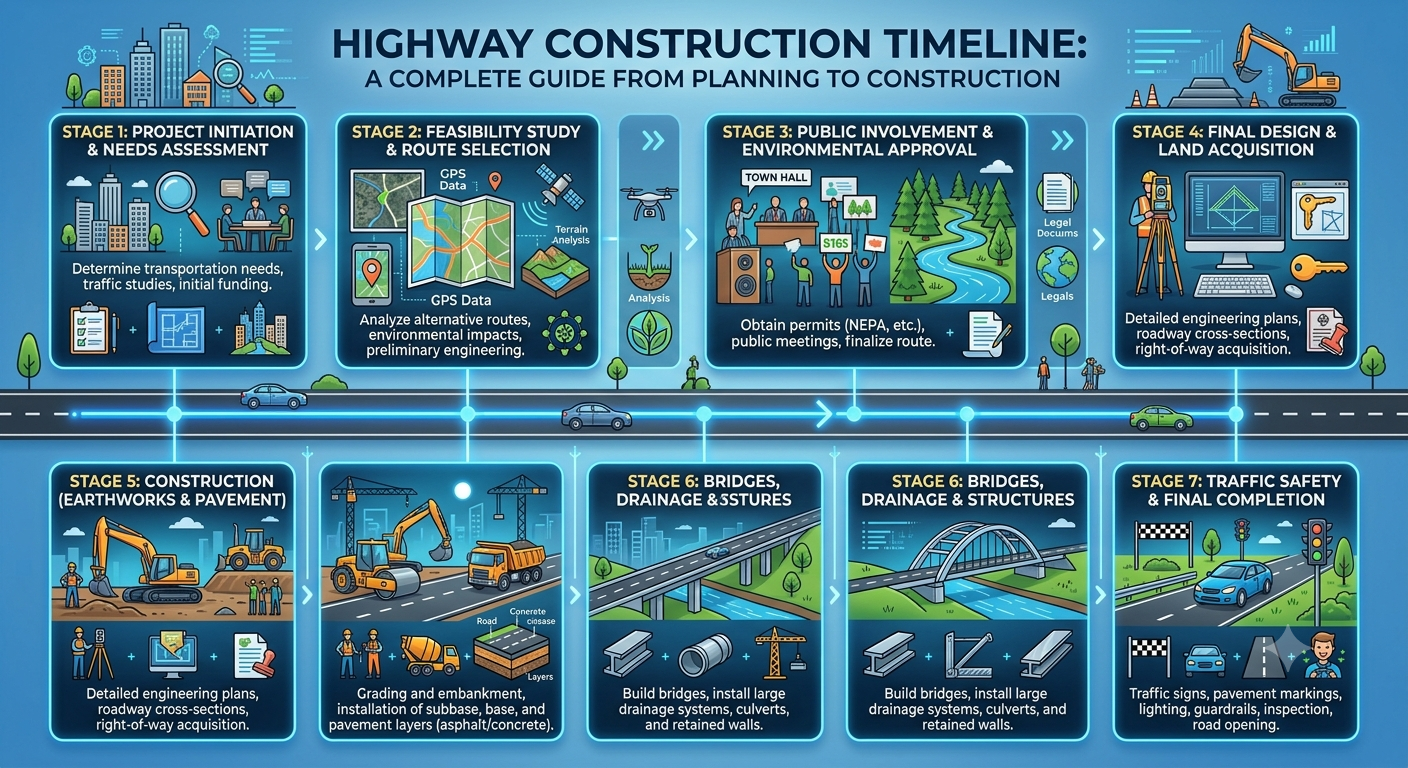
Highway construction is a complex engineering process that requires careful planning, technical expertise, regulatory approvals, and efficient project management. From the initial concept to the final pavement layer, every stage follows a structured schedule known as the Highway Construction Timeline. This timeline helps engineers, contractors, government agencies, and project managers coordinate activities, allocate resources, control costs, and complete projects safely and efficiently.
A highway project may take anywhere from one year to more than ten years depending on its size, location, environmental conditions, funding availability, and engineering challenges. Large expressways and national highways often require extensive investigations, detailed designs, land acquisition, utility relocation, and environmental approvals before construction can even begin.
Whether you are a civil engineering student, highway engineer, contractor, or infrastructure enthusiast, understanding the Highway Construction Timeline provides valuable insight into how major transportation projects are planned and executed. This guide explains each phase of the timeline using practical engineering principles, real-world examples, and industry best practices.
What Is a Highway Construction Timeline?
A Highway Construction Timeline is a structured schedule that outlines every major activity required to plan, design, construct, and deliver a highway project. Rather than focusing only on construction work, the timeline begins with identifying the transportation need and continues through planning, approvals, construction, quality control, and final project handover.
Each phase depends on the successful completion of the previous one. For example, engineers cannot finalize pavement design until geotechnical investigations are complete, and contractors cannot mobilize equipment until land acquisition and approvals have been secured.
Typical Duration of a Highway Project
Although every project differs, a general timeline may look like this:
| Project Phase | Approximate Duration |
|---|---|
| Planning and Feasibility | 6–18 months |
| Surveys and Design | 6–12 months |
| Environmental Approvals | 6–24 months |
| Land Acquisition | 6–36 months |
| Tendering and Procurement | 3–6 months |
| Construction | 12–60 months |
| Final Inspection and Handover | 1–3 months |
Large expressways, mountain highways, and urban bypasses may require significantly longer durations because of technical and regulatory challenges.
Why Is a Highway Construction Timeline Important?
A well-developed construction timeline provides a clear roadmap for everyone involved in the project. It defines when each task should begin, how long it should take, and which activities depend on others.
Key Benefits
- Improves project coordination.
- Supports accurate budgeting.
- Minimizes construction delays.
- Enhances resource management.
- Reduces contractual disputes.
- Improves construction quality.
- Facilitates regulatory compliance.
- Helps monitor project progress.
Without an organized timeline, projects often experience cost overruns, scheduling conflicts, and inefficient resource utilization.
Factors That Affect Highway Construction Duration
Several technical, environmental, financial, and administrative factors influence how long a highway project takes to complete.
1. Project Size
A two-lane rural highway typically requires less time than a six-lane expressway with multiple bridges and interchanges.
2. Terrain Conditions
Mountainous regions involve rock excavation, tunnels, retaining walls, and slope stabilization, all of which increase construction time.
3. Soil Conditions
Weak soils require stabilization, ground improvement, or replacement before construction can proceed.
4. Weather Conditions
Heavy rainfall, flooding, snow, or extreme temperatures may delay earthwork, paving, and concrete placement.
5. Environmental Regulations
Projects located near forests, wetlands, rivers, or protected areas often require additional studies and permits.
6. Land Acquisition
Acquiring land from multiple property owners can become one of the longest phases of a highway project.
7. Funding Availability
Construction schedules depend on timely financing. Budget constraints may slow project progress or require phased implementation.
8. Utility Relocation
Moving power lines, water mains, gas pipelines, and communication cables often takes considerable time and coordination.
Highway Construction Timeline Explained
Phase 1: Project Identification
Every highway project begins by identifying a transportation problem or future infrastructure need. Transportation authorities analyze population growth, traffic congestion, freight demand, and regional development plans to determine whether a new highway or roadway improvement is necessary.
Major Activities
- Traffic demand forecasting
- Population studies
- Economic analysis
- Preliminary route evaluation
- Infrastructure planning
Engineering Objective
The primary goal is to determine whether constructing a new highway is the most effective solution compared to widening or upgrading existing roads.
Practical Example
A rapidly growing industrial zone generates increasing freight traffic, causing severe congestion on local roads. Traffic studies indicate that a new bypass highway would significantly reduce travel time and improve safety.
Phase 2: Feasibility Study
Once the need has been established, engineers conduct a comprehensive feasibility study to determine whether the project is technically, economically, financially, and socially viable.
Components of a Feasibility Study
Technical Analysis
Engineers assess:
- Terrain characteristics
- Existing road network
- Geological conditions
- River crossings
- Utility conflicts
Economic Evaluation
The analysis estimates:
- Construction costs
- Maintenance costs
- Vehicle operating cost savings
- Travel time savings
- Economic benefits
Financial Assessment
Project planners evaluate:
- Government funding
- Public-private partnerships
- Investment requirements
- Long-term financial sustainability
Social Considerations
The study also examines:
- Community impacts
- Property acquisition
- Employment opportunities
- Public accessibility
A detailed feasibility study reduces uncertainty and supports informed decision-making before substantial investments are made.
Phase 3: Traffic Surveys and Site Investigations
Reliable field data is essential for designing a highway that can safely accommodate current and future traffic volumes.
Transportation engineers perform several surveys to collect the information required for planning and design.
Traffic Surveys
- Traffic volume counts
- Classified vehicle counts
- Origin–destination surveys
- Speed studies
- Axle load surveys
Site Investigations
Field investigations include:
- Topographic surveys
- Geotechnical investigations
- Hydrological studies
- Utility mapping
- Environmental baseline surveys
Why These Investigations Matter
Accurate field data enables engineers to:
- Determine pavement thickness.
- Design safe intersections.
- Estimate future traffic demand.
- Select appropriate drainage systems.
- Improve construction planning.
Phase 4: Environmental Impact Assessment (EIA)
Environmental protection has become an essential component of highway development. Before construction begins, many projects require an Environmental Impact Assessment to evaluate potential environmental effects.
Environmental Studies Include
- Air quality analysis
- Noise assessment
- Water resource evaluation
- Wildlife habitat studies
- Vegetation surveys
- Wetland assessments
- Cultural heritage investigations
Common Mitigation Measures
- Wildlife crossings
- Noise barriers
- Erosion control systems
- Stormwater management
- Tree plantation programs
- Dust suppression during construction
Early environmental planning reduces project risks while supporting sustainable infrastructure development.
Phase 5: Detailed Engineering Design
Once investigations are complete, engineers prepare detailed design documents that will guide construction.
Design Components
Highway Geometry
- Horizontal alignment
- Vertical alignment
- Curves
- Gradients
- Cross sections
Pavement Design
- Flexible pavement
- Rigid pavement
- Layer thickness
- Material specifications
Drainage Design
- Side drains
- Culverts
- Cross drainage structures
- Stormwater channels
Structural Design
- Bridges
- Flyovers
- Underpasses
- Retaining walls
Detailed engineering drawings also include technical specifications, construction quantities, and cost estimates.
Phase 6: Land Acquisition
Before construction equipment can enter the site, the required land must be legally acquired.
Land acquisition often becomes one of the most time-consuming phases because it involves legal documentation, property valuation, negotiations, and utility relocation.
Major Activities
- Property surveys
- Ownership verification
- Compensation assessments
- Legal documentation
- Utility relocation
- Resettlement planning where required
Challenges
- Legal disputes
- Compensation negotiations
- Utility conflicts
- Community concerns
- Environmental restrictions
Proper stakeholder engagement and transparent compensation processes help reduce delays and build public trust.
Highway Construction Timeline Flow Diagram
Transportation Need
        │
        ▼
Project Identification
        │
        ▼
Feasibility Study
        │
        ▼
Traffic & Site Surveys
        │
        ▼
Environmental Assessment
        │
        ▼
Engineering Design
        │
        ▼
Land Acquisition
        │
        ▼
Construction Phase (Part 2)
Phase 7: Tendering and Contractor Selection
After completing the planning and design stages, the project enters the procurement phase. During this stage, the project owner invites qualified contractors to submit bids for constructing the highway.
Selecting the right contractor is a critical decision because construction quality, project duration, safety, and cost control depend heavily on the contractor’s expertise and resources.
Tendering Process
The tendering process typically includes:
- Preparation of tender documents
- Advertisement and invitation to bid
- Pre-bid meetings
- Submission of contractor proposals
- Technical and financial evaluation
- Contract award
- Contract signing
Evaluation Criteria
Project owners usually assess contractors based on:
- Previous highway construction experience
- Technical capability
- Financial stability
- Availability of equipment
- Qualified engineering staff
- Safety performance
- Quality management systems
Engineering Importance
A transparent procurement process minimizes disputes, promotes fair competition, and increases the likelihood of successful project delivery.
Phase 8: Site Preparation
Before major construction begins, the project site must be prepared for safe and efficient operations.
This phase creates suitable working conditions while ensuring that construction activities can proceed without unnecessary interruptions.
Site Preparation Activities
- Land clearing
- Removal of vegetation
- Demolition of unwanted structures
- Topsoil stripping
- Utility relocation
- Temporary access road construction
- Construction camp setup
- Site fencing and security
Engineering Considerations
Proper site preparation:
- Improves construction efficiency
- Reduces equipment downtime
- Prevents environmental damage
- Enhances worker safety
- Facilitates material transportation
Phase 9: Earthwork and Embankment Construction
Earthwork forms the foundation of every highway. During this phase, engineers reshape the natural ground to achieve the required road profile.
The objective is to create a stable formation capable of supporting pavement layers throughout the highway’s design life.
Major Earthwork Operations
Excavation
High ground is removed to achieve the planned roadway level.
Embankment Construction
Fill material is placed in low-lying areas to raise the road formation.
Layer-by-Layer Compaction
Each soil layer is compacted to achieve the specified density before the next layer is placed.
Equipment Commonly Used
- Excavators
- Bulldozers
- Motor graders
- Dump trucks
- Water tankers
- Vibratory rollers
- Compactors
Quality Control During Earthwork
Engineers monitor:
- Moisture content
- Layer thickness
- Compaction density
- Formation level
- Soil suitability
Proper compaction significantly improves pavement performance and reduces long-term settlement.
Phase 10: Pavement Construction
Once the embankment and subgrade meet engineering requirements, pavement construction begins.
The pavement structure distributes traffic loads safely to the underlying layers while providing a durable and comfortable riding surface.
Typical Pavement Layers
- Compacted Subgrade
- Granular Sub-base
- Base Course
- Binder Course
- Wearing Course
Flexible Pavement Construction
For asphalt highways, the process generally includes:
- Prime coat application
- Tack coat application
- Asphalt mixing
- Asphalt paving
- Roller compaction
- Surface finishing
Rigid Pavement Construction
For concrete highways, construction involves:
- Formwork installation
- Reinforcement placement (if required)
- Concrete pouring
- Mechanical vibration
- Surface finishing
- Joint cutting
- Concrete curing
Engineering Principle
Each pavement layer must satisfy the specified density, thickness, and material quality before the next layer is placed.
Phase 11: Drainage and Highway Structures
Water is one of the most damaging elements affecting highway performance. Effective drainage systems protect pavement layers and reduce maintenance requirements.
At the same time, highway structures ensure uninterrupted transportation across rivers, valleys, and existing infrastructure.
Drainage Components
- Side drains
- Cross drains
- Culverts
- Median drains
- Stormwater channels
- Catch basins
Highway Structures
- Bridges
- Flyovers
- Underpasses
- Retaining walls
- Box culverts
Engineering Benefits
Well-designed drainage systems:
- Prevent pavement weakening
- Reduce erosion
- Improve traffic safety
- Extend pavement life
- Protect surrounding land
Phase 12: Road Furniture and Finishing Works
After structural work is complete, the project enters the finishing stage.
These installations improve safety, guide drivers, and prepare the highway for public use.
Road Furniture Includes
- Traffic signs
- Pavement markings
- Guardrails
- Crash barriers
- Delineators
- Reflective road studs
- Median barriers
- Street lighting
- Kilometer stones
Landscaping
Many highway projects also include:
- Tree plantation
- Grassing of embankment slopes
- Erosion control measures
- Beautification works
These improvements enhance environmental sustainability while protecting roadside areas from erosion.
Phase 13: Quality Control, Testing, and Project Handover
Quality assurance continues throughout the construction process and reaches its final stage before the highway is opened to traffic.
Each completed component undergoes inspection to verify compliance with approved specifications.
Common Field Tests
Soil Testing
- Field Density Test
- Moisture Content Test
- California Bearing Ratio (CBR)
Aggregate Testing
- Los Angeles Abrasion Test
- Aggregate Impact Value
- Water Absorption Test
Asphalt Testing
- Marshall Stability Test
- Bitumen Content Test
- Core Density Test
- Surface Smoothness Test
Concrete Testing
- Slump Test
- Compressive Strength Test
- Flexural Strength Test
Final Inspection Checklist
Engineers verify:
- Pavement thickness
- Surface evenness
- Drainage performance
- Road geometry
- Road signs and markings
- Bridge completion
- Safety installations
- Quality documentation
Once all requirements are satisfied, the highway is officially handed over for public use.
Practical Recommendations
Highway Engineers
- Review site investigation data thoroughly before construction.
- Monitor project milestones using scheduling software.
- Conduct regular quality audits.
- Maintain detailed project records.
- Prioritize drainage throughout construction.
Contractors
- Mobilize equipment according to the approved schedule.
- Train operators in modern construction techniques.
- Follow approved material specifications.
- Perform routine equipment maintenance.
- Implement strict workplace safety measures.
Civil Engineering Students
- Understand the relationship between planning and construction.
- Learn common field tests used during highway projects.
- Study pavement layer functions.
- Visit construction sites to observe real-world practices.
- Develop proficiency in project scheduling and quality management.
Best Practices for Managing a Highway Construction Timeline
A successful highway project depends on more than technical design. Effective management of time, resources, and communication is equally important.
Key best practices include:
- Develop a realistic project schedule with achievable milestones.
- Perform comprehensive geotechnical and traffic investigations.
- Coordinate utility relocation before construction begins.
- Monitor progress through regular site meetings and reporting.
- Maintain continuous quality assurance throughout every phase.
- Integrate environmental protection measures into daily operations.
- Prepare contingency plans for weather delays and unforeseen conditions.
- Encourage collaboration among designers, contractors, consultants, and project owners.
- Review project risks periodically and update mitigation strategies.
- Use modern project management tools to track costs and timelines.
General Discussion of IRC, AASHTO, and ICE Practices
Leading highway engineering organizations such as the Indian Roads Congress (IRC), the American Association of State Highway and Transportation Officials (AASHTO), and the Institution of Civil Engineers (ICE) promote a systematic approach to highway development.
Although their detailed standards vary by region, they commonly emphasize:
- Comprehensive planning before construction.
- Reliable traffic forecasting.
- Detailed geotechnical investigations.
- Proper pavement and drainage design.
- High-quality construction materials.
- Continuous inspection and quality control.
- Strong focus on road safety.
- Sustainable and environmentally responsible engineering practices.
- Lifecycle cost considerations.
- Regular maintenance planning after project completion.
These principles contribute to durable, safe, and cost-effective highway infrastructure.
Frequently Asked Questions (FAQs)
1. What is a highway construction timeline?
A highway construction timeline is a structured schedule that outlines every phase of a highway project, from planning and design to construction, testing, and project handover.
2. How long does a typical highway project take?
The duration varies depending on project size and complexity. Small highway improvements may take one to two years, while large expressways can require five to ten years or more.
3. Which phase usually takes the longest?
Land acquisition and environmental approvals often consume the most time because they involve legal procedures, stakeholder coordination, and regulatory compliance.
4. Why are traffic surveys important before construction?
Traffic surveys provide the data needed to determine lane requirements, pavement thickness, intersection design, and future traffic capacity.
5. How does weather affect highway construction?
Heavy rainfall, flooding, snow, and extreme temperatures can delay earthwork, paving, concrete placement, and material transportation.
6. What is the purpose of quality control during construction?
Quality control ensures that materials, workmanship, and completed structures meet design specifications, resulting in a safe and durable highway.
7. Why is drainage included in the construction timeline?
Drainage protects pavement layers from water damage, reduces erosion, and significantly extends the service life of the highway.
8. What role do engineers play throughout the project?
Engineers oversee planning, design, investigations, quality control, construction supervision, safety compliance, and final inspections to ensure project success.
9. How can project delays be minimized?
Delays can be reduced through accurate planning, timely approvals, effective communication, proper resource management, proactive risk assessment, and continuous monitoring.
10. Why is project handover important?
The handover process confirms that the completed highway complies with technical specifications, safety requirements, and contractual obligations before it is opened to traffic.
Conclusion
A well-planned Highway Construction Timeline is the backbone of every successful highway project. It connects planning, engineering design, procurement, construction, quality assurance, and project delivery into a coordinated sequence of activities. Each phase, from contractor selection and earthwork to pavement construction, drainage installation, finishing works, and final inspections, plays a vital role in ensuring the highway performs safely and efficiently throughout its design life. Careful scheduling, thorough investigations, effective communication, and strict quality control help minimize delays, optimize resources, and reduce overall project costs. By following proven engineering practices and the general principles promoted by organizations such as IRC, AASHTO, and ICE, engineers and contractors can deliver durable, sustainable, and high-performing transportation infrastructure. Whether you are a student learning the fundamentals or a professional managing large-scale projects, understanding the Highway Construction Timeline provides the knowledge needed to plan, execute, and maintain modern highways with confidence.

Kamran Malik is a passionate civil engineering writer and researcher who specializes in construction, transportation, structural engineering, and infrastructure topics. Through his articles on CivilEngineerings.com, he simplifies complex engineering concepts and shares practical insights, industry trends, and educational resources for students, professionals, and engineering enthusiasts.