
Introduction
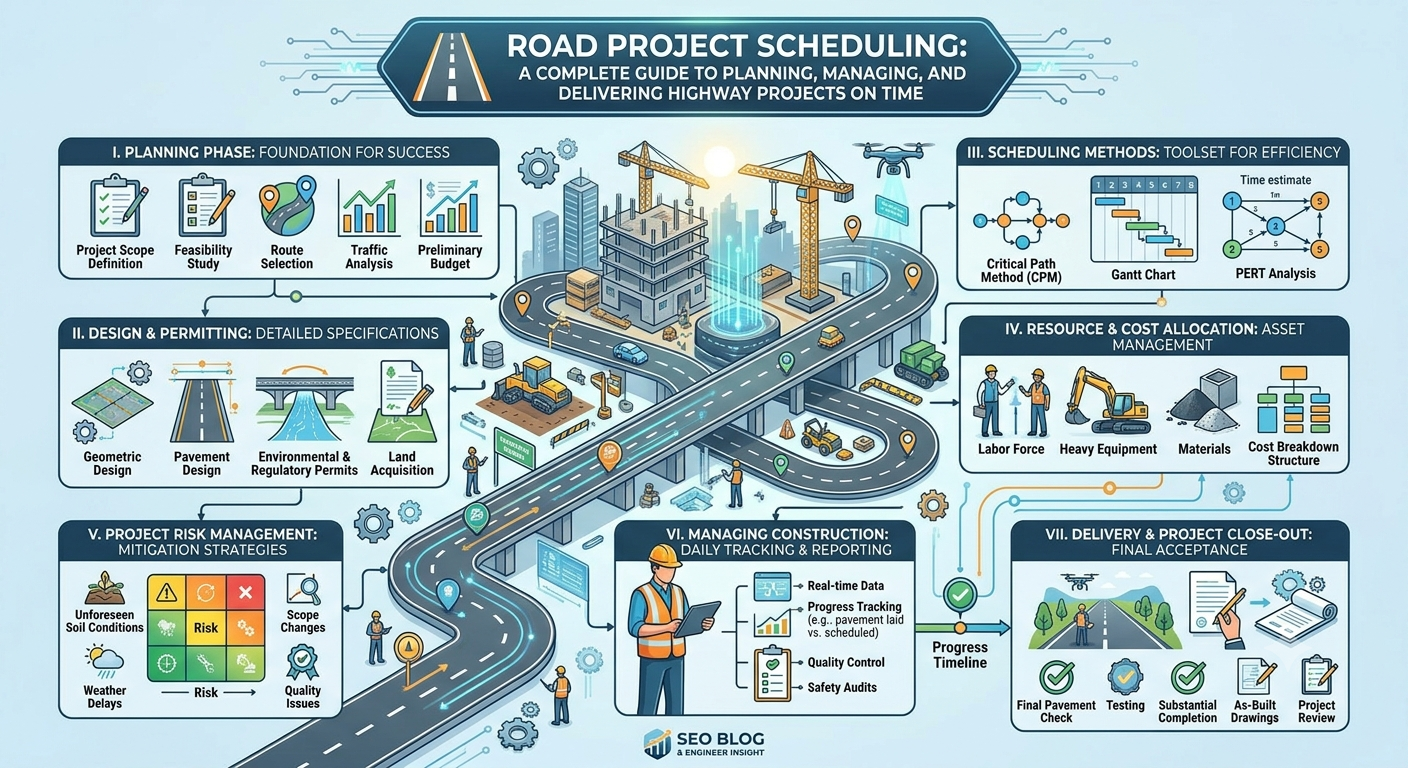
Road infrastructure projects involve numerous activities, multiple stakeholders, specialized equipment, and strict quality standards. Without a structured schedule, even a well-designed project can experience delays, budget overruns, resource shortages, and contractual disputes. Effective Road Project Scheduling provides the roadmap that keeps construction activities organized from project initiation to final completion.
Whether constructing a rural access road, an urban street, or a multi-lane highway, project scheduling enables engineers and contractors to coordinate labor, equipment, materials, and finances while maintaining safety and quality standards. A realistic schedule also helps identify critical activities, monitor progress, and respond quickly to unexpected challenges such as adverse weather, material shortages, or design changes.
This guide explains the fundamentals of Road Project Scheduling, its engineering principles, practical applications, scheduling methods, and industry best practices for successful highway construction projects.
What is Road Project Scheduling?
Road Project Scheduling is the systematic process of planning, organizing, sequencing, and monitoring all construction activities required to complete a road project within the approved time frame and budget. It establishes when each task should begin, how long it should take, and how it relates to other activities.
Unlike a simple calendar, a project schedule integrates engineering tasks, procurement, labor availability, equipment utilization, weather considerations, and contractual milestones into a coordinated execution plan.
A well-prepared schedule serves as a communication tool for project owners, consultants, contractors, suppliers, and site engineers. It also forms the basis for tracking progress and evaluating project performance throughout the construction lifecycle.
Why Road Project Scheduling is Important
Road construction projects often involve hundreds of interconnected activities. Delays in one operation can affect several subsequent tasks, leading to increased costs and missed deadlines.
Effective scheduling helps project teams:
- Complete projects on time.
- Improve coordination among stakeholders.
- Optimize labor and equipment utilization.
- Minimize idle time.
- Control construction costs.
- Identify critical activities.
- Improve productivity.
- Reduce contractual disputes.
- Enhance decision-making.
- Maintain consistent workflow.
For example, pavement construction cannot begin until earthworks, drainage installation, and base preparation have been completed. Proper scheduling ensures these activities occur in the correct sequence without unnecessary delays.
Objectives of Road Project Scheduling
The primary objective of scheduling is to create a realistic and achievable construction timeline while balancing available resources, project constraints, and contractual requirements.
Key Objectives
Deliver the Project Within the Contract Duration
A detailed schedule helps contractors meet contractual milestones and avoid penalties associated with delayed completion.
Optimize Resource Utilization
Scheduling ensures labor, machinery, and construction materials are available when required, reducing idle equipment and workforce downtime.
Improve Project Coordination
Project managers can synchronize activities across multiple teams, subcontractors, and suppliers.
Monitor Project Progress
Actual progress can be compared against the baseline schedule to identify delays and implement corrective actions.
Support Cost Control
Efficient scheduling minimizes waste, reduces equipment standby costs, and improves financial planning.
Enhance Construction Safety
Well-organized work sequences reduce congestion on-site and improve overall safety management.
Major Components of a Road Project Schedule
Every successful road project schedule contains several essential components.
1. Scope Definition
The project scope defines exactly what work will be completed.
Typical scope items include:
- Earthworks
- Drainage structures
- Pavement construction
- Bridges
- Culverts
- Traffic signs
- Road markings
- Landscaping
Clearly defining the scope prevents misunderstandings and uncontrolled project expansion.
2. Work Breakdown Structure (WBS)
A Work Breakdown Structure divides the entire project into smaller, manageable work packages.
Example:
Road Project
│
├── Surveying
├── Earthworks
├── Drainage
├── Subgrade
├── Sub-base
├── Base Course
├── Asphalt Works
├── Road Furniture
└── Final Inspection
Breaking the project into smaller activities makes scheduling, budgeting, and progress monitoring much easier.
3. Activity Sequencing
Construction activities must follow a logical order.
For example:
- Site clearing
- Earthworks
- Drainage installation
- Subgrade preparation
- Sub-base construction
- Base course
- Asphalt paving
- Road markings
- Final inspection
Incorrect sequencing often leads to rework, equipment conflicts, and unnecessary delays.
4. Resource Planning
Each scheduled activity requires appropriate resources.
These include:
- Skilled labor
- Construction equipment
- Building materials
- Survey teams
- Quality control personnel
- Fuel and utilities
Resource planning ensures that construction proceeds smoothly without interruptions.
5. Time Estimation
Engineers estimate the duration of each activity using:
- Historical project data
- Productivity rates
- Equipment capacity
- Crew size
- Weather conditions
- Site accessibility
Accurate time estimation is essential for creating realistic project schedules.
Road Project Scheduling Process
The scheduling process transforms engineering plans into an organized timeline for execution.
Step 1: Define Project Scope
The first step is identifying all project deliverables.
Engineers review:
- Construction drawings
- Technical specifications
- Contract documents
- Site conditions
- Client requirements
A clearly defined scope establishes the foundation for the entire schedule.
Step 2: Develop the Work Breakdown Structure
The project is divided into manageable activities.
Rather than scheduling “Build Highway,” engineers schedule individual operations such as:
- Clearing
- Excavation
- Embankment
- Drainage
- Aggregate placement
- Asphalt paving
- Line marking
This improves planning accuracy and simplifies progress tracking.
Step 3: Identify Construction Activities
Every activity necessary to complete the project must be listed.
Typical road construction activities include:
- Mobilization
- Surveying
- Utility relocation
- Earthworks
- Compaction
- Culvert installation
- Base preparation
- Asphalt paving
- Traffic signage
- Testing
- Demobilization
Missing activities often cause schedule revisions and unexpected delays.
Step 4: Estimate Activity Durations
Each activity receives an estimated duration based on available data.
For example:
| Activity | Estimated Duration |
|---|---|
| Site Clearing | 5 Days |
| Earthworks | 20 Days |
| Drainage Installation | 12 Days |
| Subgrade Preparation | 10 Days |
| Asphalt Paving | 15 Days |
Engineers continuously review these estimates as the project progresses.
Step 5: Sequence Activities
After estimating durations, activities are arranged according to their dependencies.
Example:
Surveying
      │
      ▼
Site Clearing
      │
      ▼
Earthworks
      │
      ▼
Drainage
      │
      ▼
Subgrade
      │
      ▼
Sub-base
      │
      ▼
Base Course
      │
      ▼
Asphalt Paving
      │
      ▼
Road Marking
      │
      ▼
Project Completion
This sequence minimizes conflicts and ensures that prerequisite activities are completed before dependent tasks begin.
Common Road Project Scheduling Techniques
Project managers use different scheduling methods depending on project complexity.
Gantt Chart
A Gantt Chart presents project activities on a timeline using horizontal bars. It is one of the most widely used scheduling tools because it is easy to understand and provides a visual overview of project progress.
Best suited for:
- Small to medium-sized road projects
- Progress reporting
- Client presentations
Critical Path Method (CPM)
The Critical Path Method identifies the sequence of activities that directly determines the project’s completion date. Any delay in these critical activities will delay the entire project unless corrective action is taken.
Advantages:
- Identifies critical tasks
- Helps prioritize resources
- Supports delay analysis
- Improves decision-making
Program Evaluation and Review Technique (PERT)
PERT is commonly used when activity durations are uncertain. Instead of using a single duration estimate, it considers optimistic, most likely, and pessimistic time estimates.
This technique is particularly useful during the planning stage of complex highway projects where uncertainties exist.
Practical Example
Consider a project to construct a 12-kilometer two-lane highway. The contractor prepares a detailed schedule that begins with site surveying and clearing, followed by earthworks, drainage installation, subgrade preparation, pavement layers, and finishing works.
By applying the Critical Path Method, the project team identifies earthworks, drainage, and asphalt paving as critical activities. Additional equipment and labor are assigned to these tasks to reduce the risk of delays. Weekly progress meetings compare actual performance with the baseline schedule, allowing managers to address issues before they affect the overall completion date.
Resource Planning and Allocation
A project schedule is only effective when the necessary resources are available at the right time and in the right quantity. Resource planning ensures that labor, equipment, materials, and finances are allocated efficiently throughout the project lifecycle.
Poor resource allocation can result in idle machinery, workforce shortages, material delays, and increased project costs. Proper planning, on the other hand, maximizes productivity while minimizing waste.
Key Resources in Road Construction
Human Resources
A typical road project requires a multidisciplinary team, including:
- Project managers
- Resident engineers
- Site engineers
- Surveyors
- Quality control engineers
- Safety officers
- Skilled machine operators
- Construction laborers
Assigning personnel according to their expertise improves work quality and reduces operational risks.
Equipment Resources
Road construction relies heavily on specialized machinery such as:
- Excavators
- Bulldozers
- Motor graders
- Asphalt pavers
- Concrete pavers
- Vibratory rollers
- Water tankers
- Dump trucks
- Loaders
Scheduling equipment efficiently prevents unnecessary idle time and minimizes operating costs.
Material Resources
Materials should arrive according to the construction schedule rather than being delivered too early or too late.
Typical construction materials include:
- Granular aggregates
- Bitumen
- Cement
- Reinforcement steel
- Geotextiles
- Drainage pipes
- Concrete
A well-planned procurement schedule helps avoid work stoppages caused by material shortages.
Risk Management in Road Project Scheduling
Every road construction project faces uncertainties that can affect the project timeline. Risk management identifies these uncertainties and develops strategies to reduce their impact.
Common Scheduling Risks
Adverse Weather
Heavy rainfall, flooding, or extreme temperatures can interrupt earthworks, paving operations, and concrete placement.
Material Supply Delays
Unexpected shortages or transportation disruptions may delay construction activities.
Equipment Breakdowns
Mechanical failures can halt critical operations if backup equipment is unavailable.
Design Changes
Modifications during construction often require schedule revisions and additional resources.
Land Acquisition Delays
Legal disputes or compensation issues may postpone site access.
Utility Relocation
Relocating water pipelines, electrical lines, and communication cables can affect the construction sequence.
Risk Mitigation Strategies
Experienced project managers reduce scheduling risks by:
- Preparing contingency plans.
- Including time buffers for critical activities.
- Monitoring weather forecasts.
- Maintaining backup equipment.
- Diversifying material suppliers.
- Conducting regular schedule reviews.
- Holding coordination meetings with stakeholders.
Proactive risk management improves schedule reliability and reduces the likelihood of costly delays.
Monitoring and Schedule Control
Developing a schedule is only the beginning. Continuous monitoring ensures that construction activities remain aligned with the planned timeline.
Project managers compare actual progress against the baseline schedule to identify deviations and implement corrective measures.
Performance Indicators
Common indicators include:
- Percentage of work completed
- Planned versus actual progress
- Schedule variance
- Productivity rates
- Equipment utilization
- Labor efficiency
Schedule Updating
Schedules should be updated regularly to reflect:
- Completed activities
- Delayed tasks
- Revised completion dates
- Approved design changes
- Weather-related interruptions
Regular updates allow project teams to respond quickly to changing site conditions.
Corrective Actions
When delays occur, project managers may:
- Increase labor resources.
- Add construction shifts.
- Deploy additional equipment.
- Modify work sequences.
- Reschedule non-critical activities.
- Accelerate critical path activities where practical.
Effective schedule control helps maintain project momentum while minimizing disruption.
Software Used for Road Project Scheduling
Modern scheduling software enables engineers to plan, monitor, and manage complex highway projects more efficiently than manual methods.
Primavera P6
Primavera P6 is widely used for large infrastructure projects due to its advanced scheduling and resource management capabilities.
Key Features
- Critical Path Method (CPM) analysis
- Resource allocation
- Cost control
- Progress tracking
- Baseline comparison
- Delay analysis
Microsoft Project
Microsoft Project is commonly used for small to medium-sized construction projects.
It offers:
- Gantt charts
- Task dependencies
- Resource planning
- Progress reporting
- Budget monitoring
BIM Integration
Building Information Modeling (BIM) integrates scheduling with three-dimensional digital models, enabling engineers to visualize construction sequences before work begins.
Benefits include:
- Improved coordination
- Clash detection
- Enhanced communication
- Better planning accuracy
- Reduced construction conflicts
Engineering Principles Behind Effective Scheduling
A successful road project schedule is built on sound engineering principles rather than assumptions.
Logical Construction Sequence
Activities should follow the natural order of construction to avoid rework and inefficiencies.
Resource Optimization
Labor, equipment, and materials should be allocated to maximize productivity without causing congestion or delays.
Time–Cost Balance
Accelerating construction often increases costs, while excessive delays may result in contractual penalties. Engineers must balance these competing factors.
Quality Integration
Quality control activities, inspections, and testing should be incorporated into the schedule rather than treated as separate tasks.
Safety Considerations
Construction schedules should allow sufficient time for implementing safety measures, conducting inspections, and maintaining safe working conditions.
Practical Applications of Road Project Scheduling
Road project scheduling is applied across a wide range of infrastructure projects, including:
- National highways
- Urban expressways
- Rural roads
- Airport access roads
- Industrial roads
- Bridge approaches
- Bypass roads
- Ring roads
For example, when constructing a four-lane divided highway, the schedule coordinates activities such as earthworks, drainage installation, bridge construction, utility relocation, pavement works, and traffic management to ensure efficient project execution.
Best Practices for Successful Road Project Scheduling
Following proven scheduling practices significantly improves project outcomes.
- Define project objectives clearly before preparing the schedule.
- Develop a detailed Work Breakdown Structure (WBS).
- Use realistic productivity rates when estimating activity durations.
- Include weather allowances for climate-sensitive operations.
- Coordinate procurement with construction activities.
- Update schedules regularly using actual site data.
- Monitor critical path activities closely.
- Maintain clear communication among project stakeholders.
- Document schedule changes and approved revisions.
- Conduct regular progress review meetings.
Practical Recommendations
Civil Engineers
- Prepare realistic schedules based on field conditions rather than optimistic assumptions.
- Review productivity data from previous projects to improve time estimates.
- Coordinate scheduling with design, procurement, and quality control teams.
- Monitor critical activities frequently and address delays promptly.
Contractors
- Mobilize resources according to the approved schedule.
- Maintain standby equipment for critical operations.
- Communicate scheduling issues early to project stakeholders.
- Record daily progress accurately to support schedule updates.
Engineering Students
- Learn the fundamentals of CPM, PERT, and Gantt charts.
- Practice preparing simple construction schedules using project management software.
- Understand how scheduling influences project cost, quality, and safety.
- Study completed highway projects to analyze actual scheduling challenges and solutions.
General Discussion of IRC, AASHTO, and ICE Practices
Leading highway engineering organizations recognize project scheduling as a fundamental component of successful infrastructure delivery.
General guidance commonly emphasizes:
- Preparing comprehensive project schedules before construction begins.
- Coordinating scheduling with traffic forecasts, design requirements, and resource availability.
- Updating schedules throughout the construction process based on actual progress.
- Incorporating quality assurance, safety inspections, and environmental protection into project timelines.
- Managing risks proactively through contingency planning and regular performance reviews.
- Maintaining clear documentation and communication among all project participants.
Although individual project requirements vary, these principles promote efficient project management and contribute to timely, high-quality road construction.
Frequently Asked Questions (FAQs)
1. What is road project scheduling?
Road project scheduling is the process of planning, organizing, sequencing, and monitoring construction activities to ensure a road project is completed within the planned time and budget.
2. Why is scheduling important in road construction?
Scheduling improves coordination, optimizes resource utilization, reduces delays, controls costs, and helps project teams meet contractual deadlines.
3. What is a Work Breakdown Structure (WBS)?
A Work Breakdown Structure divides a project into smaller, manageable tasks, making planning, scheduling, budgeting, and progress monitoring more effective.
4. What is the Critical Path Method (CPM)?
CPM identifies the sequence of activities that directly determines the project’s completion date. Delays in critical path activities typically delay the entire project.
5. How does risk management improve project scheduling?
Risk management identifies potential disruptions, such as weather or equipment failures, and develops mitigation strategies to minimize schedule impacts.
6. Which software is commonly used for road project scheduling?
Primavera P6 and Microsoft Project are widely used for planning, scheduling, resource management, and progress monitoring. BIM platforms are increasingly integrated with scheduling to improve project visualization and coordination.
7. How often should a construction schedule be updated?
Project schedules should be reviewed and updated regularly—typically weekly or monthly, depending on project complexity—to reflect actual progress and address any delays.
8. What is the difference between a Gantt Chart and CPM?
A Gantt Chart provides a visual timeline of project activities, while CPM focuses on identifying critical activities and calculating the minimum project duration.
9. What are the most common causes of schedule delays in road projects?
Frequent causes include adverse weather, material shortages, equipment breakdowns, design revisions, land acquisition issues, utility relocation delays, and insufficient resource planning.
10. How can engineers improve scheduling accuracy?
Engineers can improve accuracy by using reliable historical data, conducting thorough site investigations, estimating realistic activity durations, involving experienced project teams, and continuously monitoring project performance.
Conclusion
Effective Road Project Scheduling is the backbone of successful highway and road construction projects. It transforms complex engineering activities into a structured and manageable sequence, allowing project teams to coordinate labor, equipment, materials, and finances with confidence. A well-developed schedule not only helps achieve contractual deadlines but also improves productivity, enhances safety, supports quality assurance, and reduces unnecessary costs. By integrating proven scheduling techniques such as Gantt Charts, Critical Path Method (CPM), and PERT with modern project management software, engineers can respond proactively to changing site conditions and project risks. Adhering to recognized engineering principles and the general guidance of organizations such as IRC, AASHTO, and ICE further strengthens project planning and execution. Whether you are a civil engineer, contractor, project manager, or engineering student, mastering Road Project Scheduling is essential for delivering durable, efficient, and economically successful transportation infrastructure that meets both present and future demands.

Kamran Malik is a passionate civil engineering writer and researcher who specializes in construction, transportation, structural engineering, and infrastructure topics. Through his articles on CivilEngineerings.com, he simplifies complex engineering concepts and shares practical insights, industry trends, and educational resources for students, professionals, and engineering enthusiasts.