
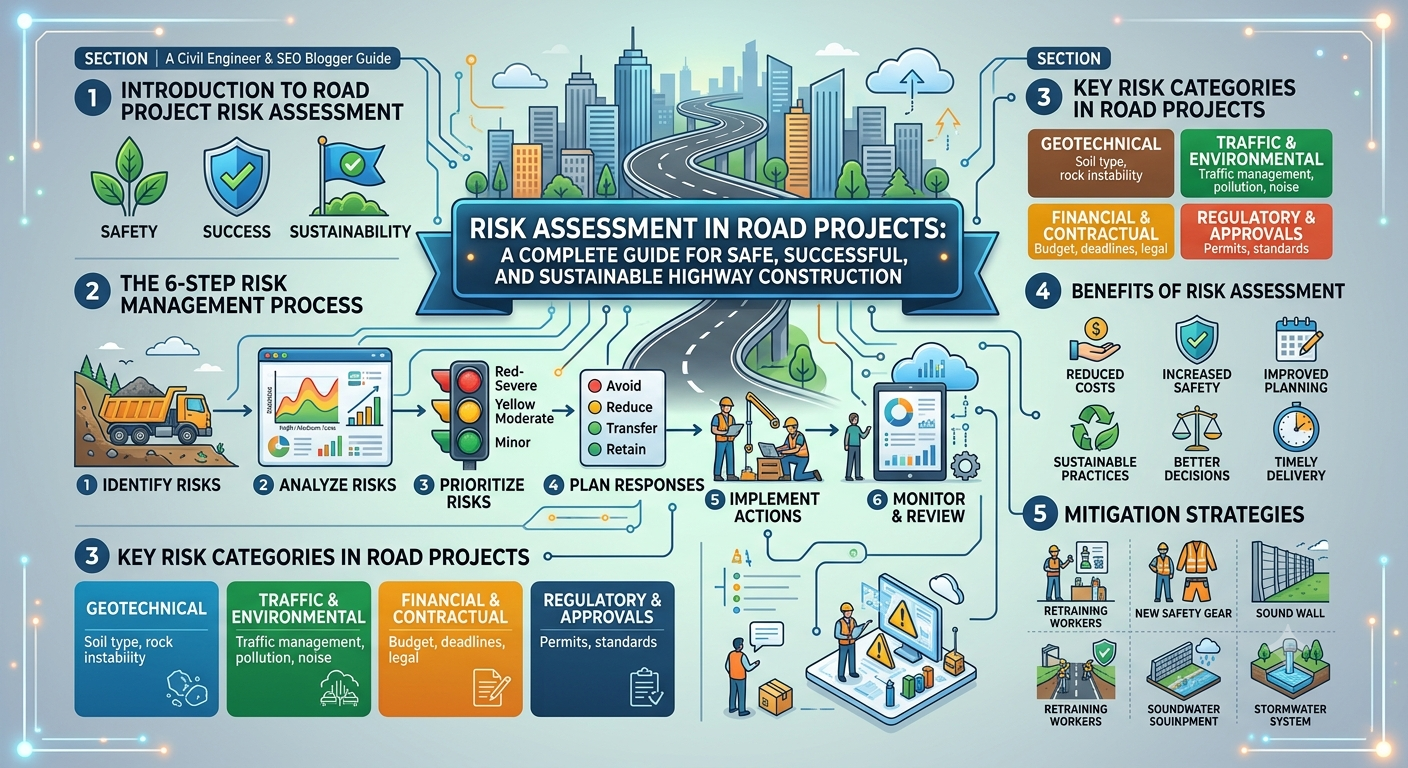
Risk Assessment in Road Projects
Road construction projects involve significant investments, complex engineering activities, multiple stakeholders, and challenging site conditions. Every stage—from planning and design to construction and maintenance—contains uncertainties that can affect project cost, schedule, quality, safety, and environmental performance. Without a structured approach to identifying and managing these uncertainties, even a well-designed road project can experience delays, cost overruns, contractual disputes, or structural failures.
Risk Assessment in Road Projects is a systematic engineering process used to identify potential hazards, evaluate their likelihood and consequences, and implement appropriate control measures before they become serious problems. Rather than reacting to issues after they occur, engineers use risk assessment to make informed decisions that improve project performance and protect both people and infrastructure.
Whether the project involves a rural access road, an urban arterial, an expressway, or a national highway, effective risk assessment helps project teams reduce uncertainty, improve safety, optimize resources, and increase the likelihood of successful project delivery.
This guide explains the principles, methods, and practical applications of Risk Assessment in Road Projects, making it a valuable resource for civil engineers, transportation professionals, contractors, project managers, and engineering students.
What Is Risk Assessment in Road Projects?
Risk Assessment in Road Projects is the structured process of identifying, analyzing, and evaluating potential events that could negatively influence the successful completion of a road or highway project.
A risk is any uncertain event that may affect one or more project objectives, including:
- Construction cost
- Project schedule
- Structural quality
- Worker safety
- Environmental compliance
- Operational performance
Unlike routine project planning, risk assessment focuses on uncertainties and prepares project teams to manage them before they escalate into major issues.
For example, discovering weak soil conditions during construction can lead to expensive redesigns and delays. However, identifying this possibility during the planning stage allows engineers to conduct detailed geotechnical investigations and develop suitable foundation solutions in advance.
Why Risk Assessment Is Important
Road infrastructure projects are exposed to numerous uncertainties because they involve changing weather conditions, variable ground conditions, evolving regulations, material price fluctuations, and coordination among many stakeholders.
A structured risk assessment provides several important benefits.
Improves Decision-Making
Project managers can compare alternatives based on potential risks instead of relying solely on cost or schedule.
Enhances Safety
Identifying construction hazards early reduces accidents involving workers, equipment, and road users.
Controls Project Costs
Preventing problems is generally less expensive than correcting them during construction.
Minimizes Delays
Early planning allows contingency measures to be implemented before risks disrupt project progress.
Improves Project Quality
Effective risk management reduces defects caused by poor workmanship, unsuitable materials, or inadequate planning.
Supports Regulatory Compliance
Environmental and safety risks can be addressed before construction begins, reducing the likelihood of legal issues.
Objectives of Risk Assessment
The primary goal of risk assessment is not to eliminate every risk, as that is rarely possible. Instead, it aims to reduce uncertainty to an acceptable level while maintaining project objectives.
Key objectives include:
- Identifying potential project threats
- Evaluating the likelihood of risk occurrence
- Measuring potential consequences
- Prioritizing critical risks
- Developing effective mitigation strategies
- Supporting informed engineering decisions
- Protecting project resources
- Improving overall project performance
A well-executed risk assessment also promotes better communication among project owners, consultants, contractors, and regulatory agencies.
Risk Management Process Overview
Risk assessment forms part of the broader risk management framework commonly applied in civil engineering projects.
The typical process includes:
- Risk Identification
- Risk Analysis
- Risk Evaluation
- Risk Mitigation
- Risk Monitoring and Review
Each stage builds on the previous one, creating a continuous cycle that extends throughout the project lifecycle.
Simplified Risk Management Flow
Project Planning
       │
       ▼
Risk Identification
       │
       ▼
Risk Analysis
       │
       ▼
Risk Evaluation
       │
       ▼
Risk Mitigation
       │
       ▼
Monitoring & Review
This systematic approach enables project teams to respond proactively rather than reactively.
Types of Risks in Road Projects
Every road project faces a unique combination of risks. Understanding these categories helps engineers develop targeted management strategies.
Technical Risks
Technical risks arise from engineering uncertainties or design-related issues.
Examples include:
- Inadequate pavement design
- Incorrect traffic forecasts
- Weak subgrade conditions
- Survey inaccuracies
- Design errors
- Utility conflicts
Proper investigations and independent design reviews help reduce technical risks.
Financial Risks
Financial risks affect project budgets and investment returns.
Common examples include:
- Material price increases
- Fuel cost fluctuations
- Inflation
- Currency exchange variations
- Funding shortages
- Contractor insolvency
Regular cost reviews and contingency budgets improve financial resilience.
Environmental Risks
Environmental factors can significantly influence project execution and long-term sustainability.
Examples include:
- Flooding
- Landslides
- Soil erosion
- Dust pollution
- Water contamination
- Wildlife impacts
Environmental management plans and effective drainage systems help minimize these risks.
Construction Risks
Construction activities introduce numerous operational uncertainties.
Typical construction risks include:
- Equipment breakdown
- Material shortages
- Labor shortages
- Poor workmanship
- Delayed deliveries
- Unexpected ground conditions
Strong site supervision and detailed construction planning reduce operational disruptions.
Safety Risks
Worker safety remains one of the highest priorities in road construction.
Common safety hazards include:
- Heavy equipment accidents
- Excavation collapses
- Traffic-related incidents
- Working near utilities
- Falls from structures
- Electrical hazards
Comprehensive safety training and site-specific safety plans significantly reduce accident rates.
Legal and Contractual Risks
Road projects involve multiple contracts, approvals, and regulatory requirements.
Potential legal risks include:
- Land acquisition disputes
- Contract interpretation issues
- Permit delays
- Environmental violations
- Claims and litigation
Clear contract documentation and proactive stakeholder engagement help manage these challenges.
Step 1: Risk Identification
Risk identification is the foundation of the entire assessment process. If significant risks are overlooked at this stage, later analysis and mitigation efforts may be ineffective.
The objective is to identify every reasonably foreseeable event that could affect project objectives.
Methods for Identifying Risks
Experienced project teams use several techniques, including:
- Brainstorming workshops
- Expert interviews
- Site inspections
- Historical project reviews
- Design reviews
- Geotechnical investigations
- Environmental studies
- Lessons learned from previous projects
Combining multiple methods improves the completeness and reliability of the risk register.
Practical Example
During preliminary site investigations for a highway project, engineers discover evidence of seasonal flooding in low-lying sections of the proposed alignment.
Instead of waiting for flooding to occur during construction, the project team identifies this as a high-priority risk and recommends:
- Raising the embankment level
- Increasing culvert capacity
- Improving drainage design
- Scheduling earthworks outside the rainy season
This proactive approach reduces construction delays and long-term maintenance issues.
Step 2: Risk Analysis
Once risks have been identified, engineers analyze them to understand their probability of occurrence and the severity of their potential impacts.
Risk analysis helps determine which risks require immediate attention and which can be monitored.
Qualitative Risk Analysis
Qualitative analysis ranks risks using descriptive categories such as:
- Very Low
- Low
- Moderate
- High
- Very High
This approach is relatively simple and suitable during the early planning stages.
Quantitative Risk Analysis
Quantitative analysis uses numerical methods to estimate the financial or schedule impacts of risks.
Common techniques include:
- Expected Monetary Value (EMV)
- Sensitivity Analysis
- Monte Carlo Simulation
- Decision Tree Analysis
Large highway and expressway projects often employ quantitative methods because of their higher complexity and financial exposure.
Risk Assessment Matrix
A risk matrix is one of the most widely used tools for prioritizing project risks.
                    CONSEQUENCE
             Low   Medium   High
Likelihood
High         Medium  High   Extreme
Medium       Low     Medium High
Low          Low     Low    Medium
Risks located in the Extreme category receive the highest priority for mitigation, while Low risks may simply be monitored throughout the project.
Using a standardized risk matrix enables project teams to allocate resources effectively and focus on the most significant threats.
Step 3: Risk Evaluation
After analyzing identified risks, the next stage is risk evaluation. This process determines whether each risk is acceptable or whether additional measures are required to reduce its impact.
Risk evaluation helps project managers prioritize resources by focusing on the risks that pose the greatest threat to project objectives.
Instead of treating every risk equally, engineers compare each identified risk against predefined acceptance criteria, project objectives, legal requirements, and organizational policies.
Risk Prioritization
Risks are generally classified into three categories:
High-Priority Risks
These risks require immediate mitigation because they can significantly affect project safety, cost, schedule, or quality.
Examples include:
- Major landslides
- Flood-prone construction zones
- Bridge foundation instability
- Contractor financial failure
- Critical design errors
Medium-Priority Risks
These risks should be monitored closely and controlled through preventive measures.
Examples include:
- Temporary material shortages
- Moderate weather delays
- Utility relocation issues
- Equipment maintenance problems
Low-Priority Risks
These risks have limited consequences and are typically monitored without extensive intervention.
Examples include:
- Minor delivery delays
- Small design revisions
- Temporary labor shortages
Proper prioritization ensures that project teams invest time and resources where they will have the greatest impact.
Step 4: Risk Mitigation Strategies
Risk mitigation involves developing practical actions to reduce either the likelihood of a risk occurring or the severity of its consequences.
Successful mitigation begins during project planning and continues throughout construction.
Common Risk Response Strategies
Risk Avoidance
Avoidance eliminates the source of risk by changing project plans.
Example:
A proposed highway alignment passes through unstable mountainous terrain. Engineers select an alternative alignment with more stable geological conditions to eliminate the landslide risk.
Risk Reduction
Reduction minimizes the probability or consequences of a risk.
Examples include:
- Improving drainage systems
- Stabilizing weak soils
- Increasing pavement thickness
- Installing retaining walls
- Enhancing quality control inspections
Risk Transfer
Some risks are transferred to another party through contractual arrangements or insurance.
Examples include:
- Construction insurance
- Professional indemnity insurance
- Performance bonds
- Equipment insurance
Risk Acceptance
Certain low-impact risks may be accepted because mitigation costs exceed potential losses.
However, accepted risks should still be documented and monitored throughout the project.
Practical Example
Consider a highway embankment being constructed during the rainy season.
Potential risks include:
- Soil erosion
- Slope instability
- Construction delays
- Reduced compaction quality
Mitigation measures may include:
- Temporary drainage channels
- Geotextile erosion protection
- Scheduling earthworks during dry weather
- Continuous moisture monitoring
- Additional compaction testing
These preventive actions reduce both construction risks and long-term maintenance costs.
Step 5: Risk Monitoring and Control
Risk management does not end after mitigation plans are prepared.
Construction conditions change continuously, requiring engineers to review existing risks and identify new ones throughout the project lifecycle.
Risk monitoring ensures that mitigation measures remain effective.
Monitoring Activities
Project teams should regularly:
- Update the risk register.
- Review construction progress.
- Conduct site inspections.
- Monitor weather forecasts.
- Evaluate contractor performance.
- Verify compliance with safety procedures.
- Review quality control results.
- Assess financial performance.
Regular monitoring allows corrective actions to be implemented before minor issues develop into major project problems.
Practical Applications of Risk Assessment in Road Projects
Risk assessment supports better decision-making during every project phase.
Highway Planning
Engineers evaluate multiple route alternatives to minimize environmental impacts and construction costs.
Bridge Construction
Detailed geotechnical investigations reduce foundation risks before structural work begins.
Pavement Design
Traffic forecasting and subgrade investigations help determine appropriate pavement thickness.
Construction Management
Risk assessments identify hazards associated with excavation, heavy equipment operation, traffic diversions, and temporary works.
Maintenance Planning
Periodic inspections identify pavement deterioration before expensive rehabilitation becomes necessary.
Real-World Engineering Example
Imagine a contractor constructing a four-lane divided highway across a floodplain.
Initial investigations identify several potential risks:
- Seasonal flooding
- Soft clay deposits
- Utility conflicts
- Heavy rainfall
- Material transportation delays
The project team develops a comprehensive mitigation plan that includes:
- Raising embankment elevations
- Installing additional culverts
- Improving temporary drainage
- Stabilizing weak soils with lime treatment
- Scheduling earthworks during the dry season
- Establishing backup aggregate suppliers
As a result, construction progresses with fewer delays, reduced maintenance costs, and improved safety performance.
This example demonstrates how early risk assessment contributes to successful project delivery.
Best Practices for Risk Assessment in Road Projects
The following best practices improve the effectiveness of risk management throughout a project’s lifecycle:
- Begin risk assessment during the planning stage.
- Conduct detailed topographic and geotechnical investigations.
- Develop and maintain a comprehensive risk register.
- Involve multidisciplinary engineering teams in risk reviews.
- Update risk assessments regularly as project conditions change.
- Perform independent design reviews for major infrastructure projects.
- Implement robust quality assurance and quality control procedures.
- Prioritize worker health and safety throughout construction.
- Maintain effective communication among all stakeholders.
- Document lessons learned for future projects.
Practical Recommendations
For Civil Engineers
- Integrate risk assessment into every design decision.
- Review site investigation reports carefully before finalizing designs.
- Prioritize constructability alongside technical performance.
- Monitor critical project risks throughout construction.
Contractors
- Prepare detailed project-specific risk management plans.
- Conduct daily safety briefings.
- Inspect equipment before operation.
- Maintain emergency response procedures.
- Encourage workers to report hazards immediately.
Project Managers
- Update the risk register frequently.
- Allocate contingency budgets for high-priority risks.
- Monitor contractor performance continuously.
- Encourage collaboration among designers, consultants, and construction teams.
Engineering Students
- Study real highway projects to understand practical risk management.
- Learn common geotechnical and construction testing methods.
- Develop knowledge of construction safety principles.
- Understand how engineering decisions influence project risk.
General Discussion of IRC, AASHTO, and ICE Guidance
Leading engineering organizations emphasize the importance of systematic risk management throughout the lifecycle of road infrastructure projects.
Although their detailed procedures vary, IRC, AASHTO, and ICE generally encourage engineers to:
- Carry out comprehensive feasibility studies before design.
- Perform detailed geotechnical, hydrological, and traffic investigations.
- Identify project risks during planning rather than after construction begins.
- Apply appropriate quality assurance and quality control measures.
- Incorporate road safety principles into design and construction.
- Maintain effective drainage systems to protect pavement performance.
- Monitor project risks continuously and revise mitigation plans as conditions change.
- Promote sustainable construction practices and environmental protection.
Following these broadly accepted engineering principles improves project reliability, enhances public safety, and supports long-term infrastructure performance.
Frequently Asked Questions (FAQs)
1. What is risk assessment in road projects?
Risk assessment is the systematic process of identifying, analyzing, evaluating, and managing uncertainties that may affect the cost, schedule, safety, quality, or performance of a road construction project.
2. Why is risk assessment important before road construction begins?
Early risk assessment helps engineers identify potential problems before they occur, allowing preventive measures to reduce delays, improve safety, and control project costs.
3. What are the most common risks in highway construction?
Common risks include unstable soil conditions, extreme weather, material shortages, design errors, equipment failures, safety hazards, environmental impacts, and contractual disputes.
4. What is a risk register?
A risk register is a document that records identified risks, their likelihood, potential impacts, responsible personnel, mitigation measures, and monitoring status throughout the project.
5. How does geotechnical investigation reduce project risks?
Geotechnical investigations identify soil and rock conditions before construction begins, enabling engineers to design stable foundations, embankments, and pavement structures.
6. What is the difference between qualitative and quantitative risk analysis?
Qualitative analysis ranks risks using descriptive categories such as low or high, while quantitative analysis estimates numerical impacts on project cost, schedule, or performance.
7. Who is responsible for managing risks in a road project?
Risk management is a shared responsibility involving project owners, consultants, design engineers, contractors, construction managers, safety officers, and regulatory authorities.
8. How often should project risks be reviewed?
Project risks should be reviewed regularly throughout planning, design, construction, and maintenance, especially after significant project changes or unexpected events.
9. Can all risks be eliminated?
No. It is generally impossible to eliminate every risk. The objective is to reduce risks to acceptable levels through effective planning, engineering controls, and continuous monitoring.
10. Which tools are commonly used for risk assessment?
Engineers commonly use risk matrices, risk registers, brainstorming sessions, expert judgment, failure mode analysis, sensitivity analysis, Monte Carlo simulations, and project review meetings.
Conclusion
Effective Risk Assessment in Road Projects is essential for delivering safe, durable, and cost-efficient transportation infrastructure. Every road project faces uncertainties related to engineering design, ground conditions, weather, environmental compliance, construction activities, finances, and stakeholder coordination. By systematically identifying risks, analyzing their likelihood and impact, evaluating priorities, implementing practical mitigation measures, and continuously monitoring project conditions, engineers can significantly reduce the probability of costly failures and unexpected delays. Risk assessment is not a one-time exercise but an ongoing process that supports informed decision-making throughout the project lifecycle. Adopting internationally recognized engineering principles, maintaining strong communication among stakeholders, and promoting a proactive safety culture further enhance project success. Whether you are a civil engineer, transportation planner, contractor, project manager, or engineering student, understanding Risk Assessment in Road Projects will help you improve project performance, protect valuable resources, and contribute to the successful development of reliable and sustainable road infrastructure.

Kamran Malik is a passionate civil engineering writer and researcher who specializes in construction, transportation, structural engineering, and infrastructure topics. Through his articles on CivilEngineerings.com, he simplifies complex engineering concepts and shares practical insights, industry trends, and educational resources for students, professionals, and engineering enthusiasts.