
Highway infrastructure plays a vital role in economic development, regional connectivity, and sustainable transportation. However, before construction equipment reaches the project site, every highway project must pass through a structured approval system involving technical evaluations, environmental assessments, financial reviews, and regulatory clearances. This systematic approach ensures that the proposed highway is technically feasible, economically viable, environmentally responsible, and socially beneficial.
Understanding the Highway Project Approval Process is essential for civil engineers, transportation planners, contractors, engineering students, and government agencies. Each approval stage influences project cost, construction schedule, legal compliance, and long-term performance. A well-managed approval process reduces project risks, minimizes delays, and helps deliver safe and durable transportation infrastructure.
This comprehensive guide explains how highway projects move from an initial concept to an approved development plan. It covers the engineering principles, practical applications, documentation requirements, and decision-making processes commonly followed by transportation authorities worldwide.
What Is the Highway Project Approval Process?
The Highway Project Approval Process is a structured sequence of technical, administrative, financial, legal, and environmental evaluations conducted before a highway construction project receives permission to proceed.
Rather than approving construction immediately, transportation authorities examine multiple aspects of the proposed project to ensure it meets engineering standards, public needs, safety requirements, and regulatory obligations.
The approval process typically involves collaboration among:
- Highway authorities
- Civil engineers
- Transportation planners
- Environmental specialists
- Surveyors
- Financial analysts
- Government agencies
- Legal experts
- Local communities
The complexity of the approval process depends on the size and significance of the project. A rural bypass may require fewer approvals than a national expressway crossing multiple jurisdictions.
Why the Highway Project Approval Process Is Important
Highway construction represents a major public investment. Without a structured approval framework, projects may face cost overruns, environmental damage, technical deficiencies, or legal disputes.
A comprehensive approval process helps ensure that the proposed highway:
- Meets transportation needs.
- Complies with engineering standards.
- Protects environmental resources.
- Uses public funds efficiently.
- Improves public safety.
- Supports long-term regional development.
- Minimizes construction risks.
Careful planning and review at the approval stage often save significant time and money during construction and maintenance.
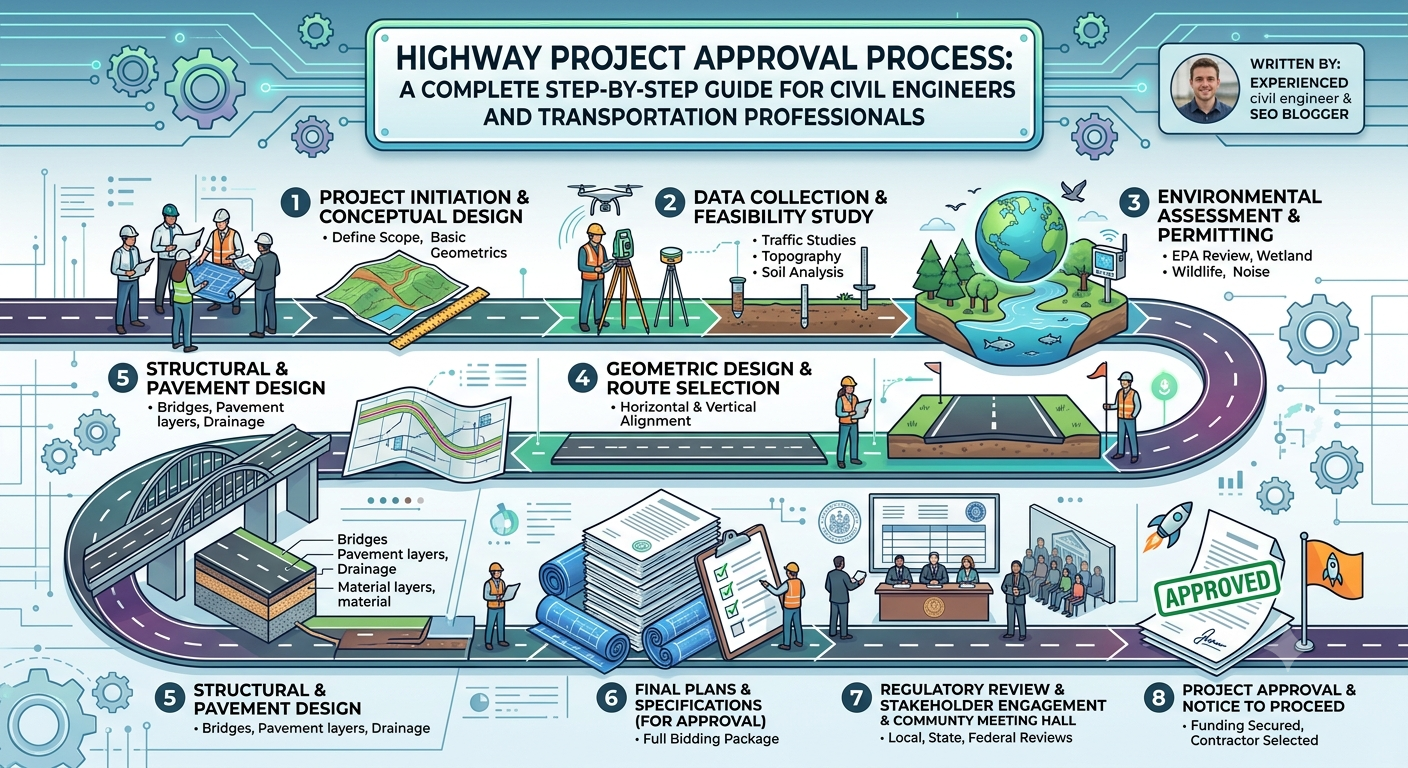
Highway Project Approval Workflow
The approval process follows a logical sequence in which each stage builds upon the findings of the previous one.
Simplified Approval Flow Diagram
Transportation Need
        │
        ▼
Project Identification
        │
        ▼
Preliminary Feasibility Study
        │
        ▼
Traffic & Engineering Investigations
        │
        ▼
Environmental Assessment
        │
        ▼
Detailed Project Report (DPR)
        │
        ▼
Technical & Financial Approval
        │
        ▼
Land Acquisition
        │
        ▼
Tendering
        │
        ▼
Construction Approval
Each stage provides essential information that supports informed decision-making before construction begins.
Step 1: Project Identification
Every highway project begins with identifying a transportation problem or development need. This stage determines whether a new highway, road widening, bypass, or interchange is necessary.
Transportation agencies collect data from existing road networks, traffic conditions, and regional development plans to justify the project.
Common Reasons for Highway Projects
- Rapid urban expansion
- Population growth
- Traffic congestion
- Increased freight movement
- Poor road safety records
- Industrial development
- Tourism growth
- Strategic regional connectivity
Engineering Considerations
During project identification, engineers evaluate:
- Existing road capacity
- Accident history
- Future traffic demand
- Alternative transportation options
- Economic development plans
- Public transportation availability
Practical Example
Suppose a two-lane highway connecting two industrial cities experiences heavy truck traffic and frequent congestion. Traffic forecasts indicate a significant increase in freight movement over the next two decades. Engineers may recommend constructing a four-lane divided highway to improve safety, reduce travel time, and support economic growth.
Project identification ensures that infrastructure investments address genuine transportation needs rather than temporary issues.
Step 2: Preliminary Feasibility Study
After identifying the transportation need, engineers conduct a preliminary feasibility study to determine whether the proposed project is practical and beneficial.
The feasibility study provides decision-makers with the information required to decide whether the project should advance to the next stage.
Main Objectives
- Assess technical viability.
- Estimate preliminary costs.
- Evaluate economic benefits.
- Identify environmental constraints.
- Review potential risks.
- Compare alternative solutions.
Components of the Feasibility Study
Technical Feasibility
Engineers examine:
- Terrain conditions
- Existing infrastructure
- Geological characteristics
- Drainage requirements
- Construction challenges
Economic Feasibility
The analysis considers:
- Construction costs
- Maintenance costs
- Vehicle operating cost savings
- Travel time reductions
- Economic development potential
Financial Feasibility
Project planners review:
- Funding sources
- Government budgets
- Public-private partnership opportunities
- Loan availability
- Investment priorities
Social Feasibility
The study evaluates:
- Community impacts
- Employment opportunities
- Land acquisition requirements
- Public acceptance
- Accessibility improvements
Benefits
A comprehensive feasibility study reduces uncertainty and helps decision-makers prioritize projects that deliver the greatest long-term value.
Step 3: Traffic and Engineering Investigations
Reliable engineering data is essential before approving any highway project. Engineers perform detailed traffic surveys and site investigations to understand existing conditions and forecast future requirements.
Traffic Surveys
Common traffic investigations include:
- Traffic volume counts
- Vehicle classification surveys
- Origin-destination studies
- Speed surveys
- Axle load surveys
- Turning movement counts
These studies help determine:
- Required number of lanes
- Design speed
- Intersection layouts
- Pavement thickness
- Future capacity requirements
Engineering Surveys
In addition to traffic studies, engineers perform:
Topographic Survey
Provides information on:
- Ground elevations
- Terrain features
- Rivers
- Existing structures
- Utility locations
Geotechnical Investigation
Engineers collect soil samples to determine:
- Bearing capacity
- Soil classification
- Moisture content
- Compaction characteristics
- California Bearing Ratio (CBR)
Hydrological Investigation
Hydrologists assess:
- Rainfall patterns
- Flood-prone areas
- Watersheds
- Drainage channels
- Culvert requirements
Practical Application
If investigations reveal weak subgrade soils or flood-prone terrain, engineers may revise the alignment, strengthen pavement design, or incorporate additional drainage structures before seeking approval.
Step 4: Environmental and Social Impact Assessment
Modern highway development must consider environmental sustainability and community well-being. An Environmental and Social Impact Assessment (ESIA) evaluates how the proposed project may affect natural ecosystems and local populations.
Environmental Factors
Typical assessments include:
- Air quality
- Noise levels
- Water resources
- Wildlife habitats
- Forests and vegetation
- Wetlands
- Soil erosion
- Climate resilience
Social Considerations
The assessment also examines:
- Land acquisition impacts
- Community displacement
- Cultural heritage sites
- Public health
- Local employment opportunities
- Access to schools and hospitals
Mitigation Measures
Where impacts are identified, engineers recommend measures such as:
- Wildlife crossings
- Noise barriers
- Stormwater management systems
- Tree plantation programs
- Sediment control
- Community consultation plans
Importance
A well-prepared environmental and social assessment promotes sustainable infrastructure development while improving public confidence in the project.
Step 5: Preparation of the Detailed Project Report (DPR)
Once the preliminary studies are complete, engineers prepare the Detailed Project Report (DPR). This document forms the technical foundation for obtaining official approvals and securing project funding.
The DPR compiles all engineering, environmental, financial, and construction information into a single comprehensive report.
Contents of a DPR
A typical Detailed Project Report includes:
- Project objectives
- Alignment plans
- Survey data
- Geotechnical findings
- Pavement design
- Structural design
- Drainage design
- Traffic analysis
- Environmental recommendations
- Cost estimates
- Construction schedule
- Risk assessment
- Bill of Quantities (BOQ)
Engineering Importance
The DPR serves as the primary reference document during:
- Technical reviews
- Financial evaluations
- Government approvals
- Tender preparation
- Construction planning
A clear, accurate, and well-documented DPR significantly increases the likelihood of timely project approval while reducing future design revisions and contractual disputes.
Step 6: Technical Review and Government Approval
After the Detailed Project Report (DPR) is completed, it undergoes a comprehensive technical review by the relevant highway authority or government department. The purpose of this review is to verify that the proposed project complies with engineering standards, safety regulations, environmental requirements, and national infrastructure policies.
Depending on the project’s size and strategic importance, several government agencies may participate in the review process.
Major Review Activities
- Verification of engineering drawings
- Evaluation of traffic forecasts
- Review of pavement and structural designs
- Assessment of drainage systems
- Examination of environmental recommendations
- Compliance with applicable regulations
- Review of project costs and timelines
Technical Evaluation Criteria
Review committees generally assess whether the project:
- Meets transportation objectives
- Provides adequate road safety
- Uses appropriate engineering methods
- Follows approved design standards
- Is technically feasible
- Can be constructed efficiently
- Offers long-term value for public investment
Practical Example
Suppose a proposed highway passes through a flood-prone area. During the technical review, engineers may recommend increasing embankment height, enlarging culverts, or redesigning drainage structures before granting approval.
This review process helps identify design deficiencies before construction begins, reducing future modifications and project delays.
Step 7: Financial Approval and Budget Allocation
A technically sound project cannot proceed without financial approval. Once the engineering review is complete, financial authorities evaluate the project’s funding requirements and economic justification.
This stage ensures that sufficient financial resources are available throughout the project lifecycle.
Budget Components
Typical highway project budgets include:
- Site preparation
- Earthworks
- Pavement construction
- Bridges and culverts
- Drainage systems
- Utility relocation
- Traffic safety installations
- Environmental mitigation
- Construction supervision
- Land acquisition
- Contingency funds
Funding Sources
Highway projects may be financed through:
- Government development budgets
- Infrastructure development programs
- Public-Private Partnerships (PPP)
- International development agencies
- Infrastructure bonds
- Development loans
Why Financial Approval Matters
Proper budgeting:
- Prevents funding shortages.
- Reduces construction interruptions.
- Improves cost control.
- Supports transparent public spending.
- Ensures timely project delivery.
Step 8: Land Acquisition and Statutory Clearances
Before construction activities begin, the required land must be legally acquired, and statutory approvals must be obtained.
Land acquisition often represents one of the most challenging phases of the Highway Project Approval Process because it involves legal procedures, stakeholder consultations, and property compensation.
Land Acquisition Activities
- Property identification
- Boundary surveys
- Ownership verification
- Property valuation
- Compensation payments
- Relocation planning
- Utility shifting
Statutory Clearances
Depending on the project location, authorities may require approvals related to:
- Environmental protection
- Forest land use
- Wildlife conservation
- Water resource management
- Utility relocation
- Cultural and heritage preservation
- Local government permissions
Common Challenges
- Ownership disputes
- Delayed compensation
- Utility conflicts
- Community objections
- Regulatory approvals
- Legal proceedings
Best Practice
Maintaining transparent communication with affected communities and ensuring fair compensation can significantly reduce delays and build public trust.
Step 9: Tendering and Contractor Selection
Once approvals and funding are secured, the project enters the procurement phase. Qualified contractors are invited to submit bids through a structured tendering process.
Selecting an experienced contractor is critical because construction quality depends heavily on technical expertise, available resources, and project management capabilities.
Tendering Process
The procurement process generally includes:
- Preparation of tender documents.
- Advertisement of the project.
- Contractor prequalification.
- Submission of bids.
- Technical evaluation.
- Financial evaluation.
- Contract award.
Contractor Evaluation Criteria
Authorities commonly assess:
- Technical capability
- Financial stability
- Previous highway experience
- Construction equipment
- Skilled workforce
- Quality management systems
- Safety performance
- Project completion history
Practical Application
A contractor with proven experience in constructing high-speed expressways is often preferred over one with limited highway experience, even if the initial bid is slightly higher. Quality and reliability frequently provide better long-term value.
Step 10: Notice to Proceed and Construction Mobilization
After the contract is signed, the project owner issues a Notice to Proceed (NTP). This document formally authorizes the contractor to begin construction activities.
Mobilization involves preparing all necessary resources before major construction starts.
Mobilization Activities
- Establishing the site office
- Setting up construction camps
- Mobilizing equipment
- Recruiting project personnel
- Procuring construction materials
- Installing temporary utilities
- Preparing traffic management plans
- Implementing safety procedures
Equipment Commonly Mobilized
- Excavators
- Bulldozers
- Motor graders
- Rollers
- Asphalt pavers
- Concrete batching plants
- Dump trucks
- Cranes
- Survey equipment
Importance of Mobilization
Proper mobilization:
- Reduces startup delays.
- Improves productivity.
- Enhances worker safety.
- Ensures efficient resource utilization.
- Supports smooth project execution.
General Discussion of IRC, AASHTO, and ICE Practices
Leading highway organizations such as the Indian Roads Congress (IRC), the American Association of State Highway and Transportation Officials (AASHTO), and the Institution of Civil Engineers (ICE) promote engineering principles that contribute to safe, durable, and sustainable highway projects.
Although their standards vary according to regional requirements, they generally emphasize:
- Comprehensive traffic forecasting.
- Detailed geotechnical and topographic investigations.
- Proper geometric design.
- Durable pavement design based on expected traffic loading.
- Effective drainage systems.
- Environmental sustainability.
- Road safety integration.
- Rigorous quality assurance and quality control.
- Lifecycle cost analysis.
- Continuous maintenance planning.
Following these recognized engineering principles helps improve project reliability and long-term infrastructure performance.
Best Practices for Highway Project Approval
- Begin planning with reliable traffic and socioeconomic data.
- Complete detailed site investigations before design.
- Engage stakeholders during the planning stage.
- Prepare comprehensive and accurate DPR documentation.
- Perform independent technical reviews.
- Allocate realistic project budgets.
- Obtain statutory approvals early.
- Use transparent procurement procedures.
- Select contractors based on competence, not solely on the lowest bid.
- Maintain detailed project documentation throughout the approval process.
Practical Recommendations
Civil Engineers
- Verify all survey and geotechnical data before preparing designs.
- Coordinate closely with environmental, structural, and transportation specialists.
- Document engineering decisions clearly.
- Anticipate future traffic growth in project planning.
Contractors
- Review contract documents thoroughly before bidding.
- Develop realistic construction schedules.
- Ensure quality assurance systems are in place.
- Maintain effective communication with project stakeholders.
Engineering Students
- Study the complete highway project lifecycle, not only construction methods.
- Understand the importance of environmental and social assessments.
- Learn how feasibility studies influence engineering decisions.
- Familiarize yourself with project documentation and approval procedures.
Common Challenges in the Highway Project Approval Process
Despite careful planning, highway projects may encounter several approval-related challenges, including:
- Incomplete feasibility studies.
- Delays in environmental clearances.
- Land acquisition disputes.
- Budget constraints.
- Utility relocation issues.
- Changes in project scope.
- Public opposition.
- Regulatory compliance delays.
Early risk identification and proactive planning can significantly improve project outcomes.
Frequently Asked Questions (FAQs)
1. What is the Highway Project Approval Process?
It is the structured procedure through which a proposed highway project undergoes technical, environmental, financial, and administrative reviews before construction is authorized.
2. Why is a Detailed Project Report (DPR) important?
The DPR provides comprehensive engineering, financial, environmental, and construction information required for project evaluation, approval, and funding.
3. Who approves highway projects?
Depending on the project’s scope, approvals may involve transportation authorities, government departments, environmental agencies, financial institutions, and regulatory bodies.
4. Why are environmental assessments required?
Environmental assessments help identify potential impacts on ecosystems, water resources, wildlife, and communities while recommending mitigation measures.
5. What happens after financial approval?
Following financial approval, land acquisition, statutory clearances, tendering, contractor selection, and project mobilization are completed before construction begins.
6. Why is contractor selection so important?
Experienced contractors improve construction quality, reduce project risks, enhance safety, and increase the likelihood of completing projects on schedule.
7. How long does the Highway Project Approval Process usually take?
The duration varies depending on project complexity, regulatory requirements, environmental approvals, and land acquisition. Large highway projects may require several months to multiple years before construction begins.
8. What role do traffic studies play in project approval?
Traffic studies estimate current and future traffic demand, helping engineers determine road capacity, pavement design, intersection layouts, and overall project feasibility.
9. How do international engineering practices improve highway approvals?
Guidance from organizations such as IRC, AASHTO, and ICE promotes consistent engineering practices, quality assurance, road safety, and sustainable infrastructure development.
10. Can a highway project proceed without all required approvals?
No. Beginning construction without the necessary technical, environmental, financial, and statutory approvals can result in legal issues, project suspension, financial losses, and safety concerns.
Conclusion
The Highway Project Approval Process is a critical foundation for delivering safe, efficient, and sustainable transportation infrastructure. Every stage—from project identification and feasibility studies to technical reviews, financial approvals, land acquisition, and contractor selection—plays an essential role in determining a project’s success. Thorough engineering investigations, transparent decision-making, and compliance with regulatory requirements reduce risks while improving cost control and construction quality. Adopting internationally recognized engineering principles and maintaining strong collaboration among planners, engineers, contractors, and government agencies helps ensure that highway projects meet both current transportation needs and future growth demands. For civil engineers, transportation professionals, contractors, and students, understanding the Highway Project Approval Process provides valuable insight into how successful highway developments progress from concept to construction. A well-managed approval process not only accelerates project delivery but also creates durable, safe, and economically beneficial road networks that support communities and national development for decades.

Kamran Malik is a passionate civil engineering writer and researcher who specializes in construction, transportation, structural engineering, and infrastructure topics. Through his articles on CivilEngineerings.com, he simplifies complex engineering concepts and shares practical insights, industry trends, and educational resources for students, professionals, and engineering enthusiasts.