
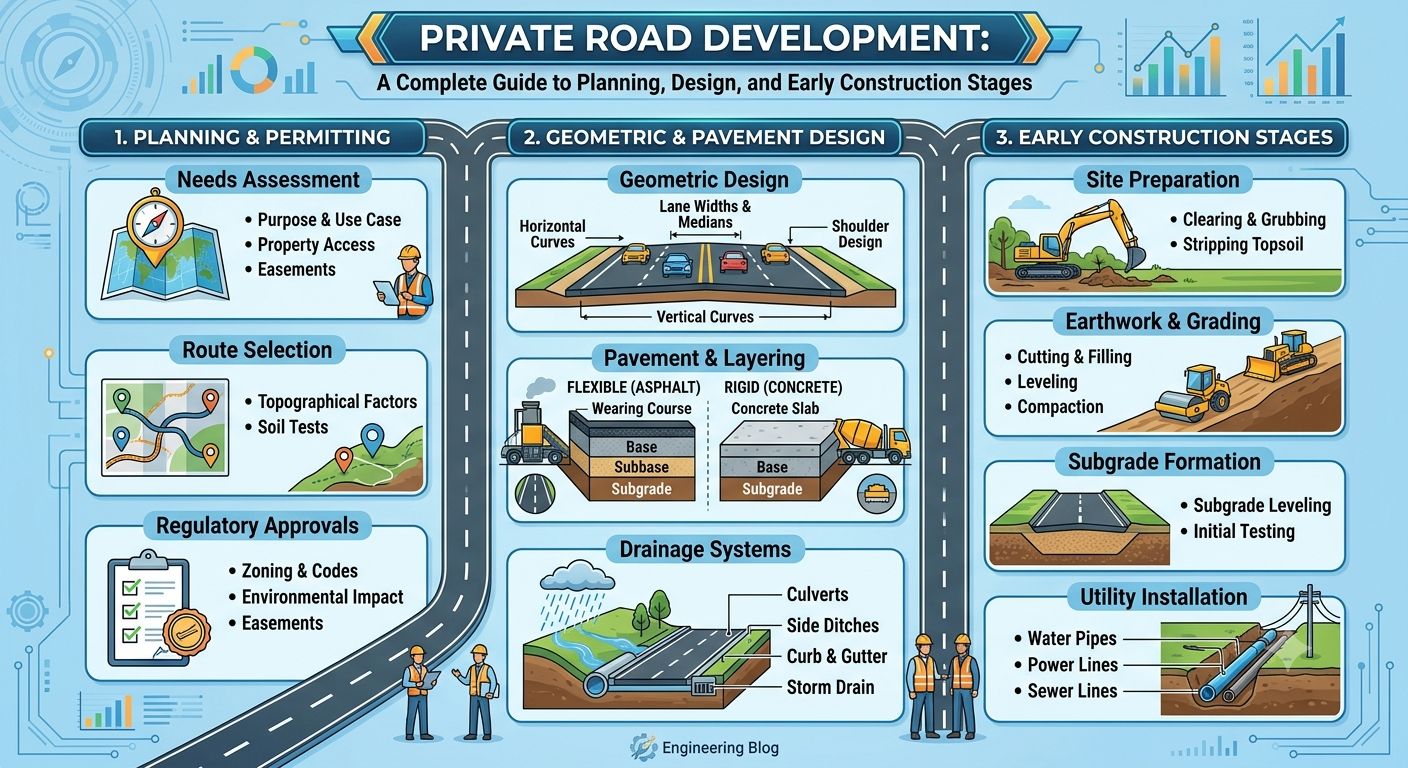
Introduction
Private roads play a vital role in connecting residential communities, industrial facilities, commercial developments, farms, resorts, and institutional campuses to the public road network. Unlike public highways, private roads are typically financed, constructed, and maintained by private individuals, developers, companies, or homeowner associations. Although ownership differs, the engineering principles used to develop a durable, safe, and cost-effective private road remain largely the same.
Successful Private Road Development requires careful planning, detailed site investigations, sound engineering design, and strict quality control throughout the project lifecycle. A poorly planned road can lead to drainage problems, pavement failures, excessive maintenance costs, and safety hazards. On the other hand, a well-designed private road provides reliable access, increases property value, and minimizes long-term maintenance expenses.
This guide explains the complete process of Private Road Development, focusing on engineering practices, practical applications, and industry recommendations that benefit engineers, contractors, developers, and civil engineering students.
What Is Private Road Development?
Private Road Development is the process of planning, designing, constructing, and maintaining roads that are privately owned rather than managed by a government authority. These roads provide access to privately owned land, buildings, or facilities while ensuring safe and efficient movement of people, vehicles, and goods.
Although private roads may not always be open to the general public, they must still be designed to accommodate expected traffic loads, local environmental conditions, and future maintenance requirements.
Depending on the project, a private road may be constructed using asphalt, concrete, gravel, or stabilized aggregate materials. The choice depends on traffic volume, soil conditions, climate, budget, and intended use.
Common Applications of Private Roads
Private roads are commonly developed for:
- Residential housing societies
- Gated communities
- Industrial estates
- Warehouses and logistics centers
- Shopping complexes
- Hotels and resorts
- Educational institutions
- Hospitals
- Farms and agricultural properties
- Mining and energy projects
Each application requires a different design approach based on anticipated traffic patterns and operational requirements.
Why Private Road Development Is Important
Private roads are more than simple access routes. They support economic activity, improve accessibility, and enhance the functionality of private developments.
A properly engineered private road offers several long-term benefits:
- Safe and reliable transportation
- Improved property value
- Reduced maintenance costs
- Better stormwater management
- Increased operational efficiency
- Enhanced emergency vehicle access
- Greater user comfort
Poorly designed roads often experience settlement, potholes, drainage failures, and premature pavement deterioration. Investing in proper engineering during the planning stage significantly reduces these risks.
Types of Private Roads
Private roads vary depending on their intended purpose and expected traffic volume.
Residential Private Roads
Residential private roads serve housing developments, apartment complexes, and gated communities. These roads generally experience moderate traffic consisting of passenger vehicles, service trucks, and emergency vehicles.
Typical design considerations include:
- Low design speeds
- Pedestrian safety
- Street lighting
- Parking access
- Stormwater drainage
- Landscaping integration
Commercial and Industrial Access Roads
Industrial roads accommodate heavier traffic, including delivery trucks, forklifts, and heavy commercial vehicles.
Important design considerations include:
- Higher pavement strength
- Wider turning radii
- Larger pavement thickness
- Heavy axle load capacity
- Efficient drainage systems
- Durable pavement materials
Agricultural and Rural Roads
Agricultural roads connect farms, storage facilities, and rural communities.
These roads often experience seasonal traffic variations and may remain unpaved depending on operational requirements.
Engineers prioritize:
- Cost-effective construction
- Adequate drainage
- Soil stabilization
- Ease of maintenance
- All-weather accessibility
Institutional and Campus Roads
Universities, hospitals, business parks, and industrial campuses often require internal private road networks.
Their design emphasizes:
- Pedestrian movement
- Bicycle facilities
- Emergency access
- Traffic calming
- Accessibility for persons with disabilities
Private Road Development Process
Every successful private road project follows a structured engineering process. The first five stages establish the technical foundation for durable pavement construction.
Step 1: Project Planning and Feasibility Study
Every private road project begins with careful planning.
The objective is to determine whether the proposed road is technically feasible, economically viable, and capable of meeting current and future transportation needs.
Activities Performed
- Identifying project objectives
- Estimating expected traffic volume
- Reviewing available budgets
- Assessing environmental constraints
- Evaluating site accessibility
- Identifying utility conflicts
- Establishing project timelines
Engineering Considerations
Engineers assess:
- Topography
- Existing road connections
- Land ownership
- Flood risks
- Soil conditions
- Future expansion potential
Practical Example
A developer planning a gated residential community may estimate that the road will serve approximately 300 homes. Traffic forecasts help determine the required pavement width, parking layout, and intersection design before construction begins.
Step 2: Site Survey and Investigation
Accurate site data forms the basis of sound engineering design.
Surveyors and engineers collect information about the site’s physical characteristics before preparing construction drawings.
Types of Surveys
Topographic Survey
Provides information about:
- Ground elevations
- Natural drainage
- Existing structures
- Trees
- Utility lines
- Property boundaries
Utility Survey
Locates underground infrastructure such as:
- Water pipelines
- Gas lines
- Electrical cables
- Communication ducts
Hydrological Survey
Evaluates:
- Surface runoff
- Flood-prone areas
- Existing drainage paths
- Watercourses
Benefits
Detailed surveys reduce design errors and minimize costly modifications during construction.
Step 3: Route Selection and Road Alignment
Selecting the best road alignment is one of the most important engineering decisions in private road development.
A carefully chosen alignment minimizes construction costs while improving safety and operational efficiency.
Factors Affecting Alignment
- Terrain
- Existing buildings
- Environmental features
- Property boundaries
- Utility corridors
- Future development plans
Alignment Objectives
A good alignment should:
- Minimize earthwork
- Reduce sharp curves
- Provide adequate sight distance
- Ensure efficient drainage
- Allow future expansion where possible
Engineering Principle
Straight alignments are generally preferred for visibility and construction simplicity. However, moderate curves may be introduced to avoid obstacles, reduce environmental impacts, or improve aesthetics.
Step 4: Geotechnical Investigation
The strength of the underlying soil directly affects pavement performance.
Geotechnical investigations help engineers determine whether the existing ground can safely support the proposed roadway.
Field Investigations
- Boreholes
- Trial pits
- Soil sampling
- Groundwater observations
Laboratory Tests
Common laboratory tests include:
- Grain size analysis
- Atterberg limits
- California Bearing Ratio (CBR)
- Standard Proctor Test
- Moisture content determination
Why It Matters
Weak or expansive soils can lead to:
- Pavement cracking
- Settlement
- Rutting
- Drainage problems
If poor soil conditions are identified, engineers may recommend soil stabilization, replacement, or geosynthetic reinforcement to improve performance.
Step 5: Road Design and Engineering
Once sufficient site data has been collected, engineers prepare the detailed road design.
This stage transforms survey results into construction drawings and technical specifications.
Design Components
Geometric Design
Includes:
- Road width
- Horizontal curves
- Vertical alignment
- Cross slopes
- Sight distances
Pavement Design
Engineers determine:
- Pavement type
- Layer thickness
- Material selection
- Design traffic
- Service life
Drainage Design
Effective drainage systems include:
- Side drains
- Culverts
- Cross-drainage structures
- Surface runoff channels
Typical Private Road Cross Section
        Shoulder      Carriageway       Shoulder
-------------------------------------------------------
 Asphalt/Concrete Surface Course
-------------------------------------------------------
 Base Course
-------------------------------------------------------
 Granular Sub-base
-------------------------------------------------------
 Compacted Subgrade
-------------------------------------------------------
 Natural Ground
Each pavement layer performs a specific structural function, distributing wheel loads while protecting the underlying soil from excessive stress and moisture.
Engineering Best Practice
The road design should consider not only current traffic demands but also future expansion, maintenance accessibility, and climate conditions to maximize service life and reduce lifecycle costs.
Step 6: Earthwork and Drainage Construction
After the road design is finalized and approved, construction begins with earthwork operations. This phase prepares the site by shaping the terrain to match the design levels while creating a stable foundation for the pavement.
Earthwork is one of the most important activities in Private Road Development because the long-term performance of the pavement depends on the quality of the underlying soil structure.
Earthwork Activities
The main operations include:
- Site clearing and grubbing
- Removing vegetation and organic soil
- Excavation in high areas
- Filling low-lying sections
- Embankment construction
- Layer-by-layer compaction
- Final grading
Each fill layer is compacted to the specified density before placing the next layer. Proper compaction minimizes settlement and improves load-bearing capacity.
Importance of Drainage
Water is one of the leading causes of pavement deterioration. An effective drainage system prevents water from weakening the pavement layers and the subgrade.
A typical private road drainage system includes:
- Side drains
- Longitudinal drains
- Cross drains
- Culverts
- Catch basins
- Surface channels
Practical Example
Consider a private industrial estate built on gently sloping land. Without proper side drains and culverts, rainwater may accumulate on the pavement, causing erosion and reducing the road’s service life. Incorporating drainage structures during construction helps avoid these issues and lowers future maintenance costs.
Step 7: Pavement Construction
After completing earthworks and drainage, the pavement structure is constructed. The pavement must be capable of supporting expected traffic loads while resisting environmental effects.
The choice of pavement depends on traffic volume, budget, maintenance strategy, and soil conditions.
Flexible Pavement
Flexible pavements are commonly used for residential developments, commercial complexes, and industrial facilities.
Typical pavement layers include:
- Surface course
- Binder course (if required)
- Base course
- Granular sub-base
- Compacted subgrade
Advantages
- Lower initial cost
- Faster construction
- Easier maintenance
- Smooth riding quality
Rigid Pavement
Concrete pavements are selected where heavy traffic, frequent truck movements, or long service life is required.
Typical applications include:
- Factory yards
- Container terminals
- Logistics centers
- Heavy industrial roads
Advantages
- High structural strength
- Longer service life
- Lower maintenance frequency
- Better resistance to fuel and oil spills
Engineering Principle
The pavement structure distributes vehicle loads through successive layers. The upper layers resist direct traffic loading, while lower layers transfer stresses safely to the natural ground.
Step 8: Quality Control and Inspection
Quality control is a continuous process rather than a single inspection at the end of construction. Every stage should be checked to ensure compliance with design specifications.
Common Field Tests
Soil Testing
- Field Density Test
- Moisture Content Test
- California Bearing Ratio (CBR)
Aggregate Testing
- Gradation Analysis
- Los Angeles Abrasion Test
- Water Absorption Test
Asphalt Testing
- Marshall Stability Test
- Bitumen Content Test
- Core Density Test
Concrete Testing
- Slump Test
- Compressive Strength Test
- Flexural Strength Test
Final Inspection Checklist
Before opening the road for use, engineers inspect:
- Pavement thickness
- Surface smoothness
- Cross slope
- Drainage performance
- Road width
- Alignment
- Compaction records
- Material quality
- Safety installations
Regular inspections during construction reduce the likelihood of expensive repairs after completion.
Step 9: Road Safety Features
A private road should be designed with the same commitment to safety as a public roadway. Even roads with low traffic volumes require appropriate safety measures to protect users.
Common Safety Features
- Road signs
- Pavement markings
- Speed humps where necessary
- Reflective road studs
- Guardrails on steep embankments
- Street lighting
- Pedestrian crossings
- Directional signs
- Convex mirrors at blind corners
Engineering Considerations
Safety features should be selected based on:
- Traffic speed
- Road geometry
- User type
- Visibility
- Nighttime operation
- Emergency vehicle access
Well-planned safety measures reduce accidents and improve user confidence.
Practical Applications of Private Road Development
Private roads are developed in a wide variety of projects. Each application has unique engineering requirements.
Residential Communities
Roads should provide comfortable driving conditions, efficient drainage, and safe pedestrian movement while complementing the overall landscape.
Industrial Developments
Roads must withstand repeated heavy axle loads from trucks, forklifts, and delivery vehicles. Strong pavement structures and durable materials are essential.
Commercial Properties
Shopping centers and business parks require road networks that efficiently manage vehicle circulation, parking access, and service deliveries.
Agricultural Projects
Farm roads should provide reliable access throughout the year while minimizing construction and maintenance costs.
Tourism and Resort Developments
Roads serving resorts should combine functionality with visual appeal. Designers often integrate landscaping, traffic calming measures, and environmentally sensitive construction practices.
Engineering Principles Behind Successful Private Roads
Several engineering principles guide the development of high-quality private roads.
Load Distribution
Pavement layers spread vehicle loads over a wider area, reducing stress on the natural ground.
Compaction
Proper compaction increases density, improves stability, and minimizes future settlement.
Drainage
Efficient drainage prevents water infiltration, protects pavement layers, and extends service life.
Material Selection
Selecting suitable aggregates, asphalt, concrete, and stabilized soils improves structural performance and durability.
Lifecycle Cost Analysis
A slightly higher initial investment in quality materials and construction often results in significantly lower maintenance costs over the road’s lifespan.
Best Practices for Private Road Development
Following proven engineering practices improves construction quality and long-term performance.
- Conduct comprehensive site investigations before design.
- Use laboratory-tested construction materials.
- Compact each layer to the specified density.
- Install effective drainage systems before paving.
- Follow approved construction drawings and specifications.
- Perform quality control tests throughout construction.
- Protect completed pavement from premature traffic loading.
- Develop a preventive maintenance schedule after construction.
- Plan for future utility installations to avoid unnecessary pavement cutting.
- Consider sustainability by using recycled materials where appropriate.
Practical Recommendations
Civil Engineers
- Verify survey and geotechnical data before preparing final designs.
- Monitor compaction and drainage construction closely.
- Maintain accurate project documentation.
- Coordinate with architects, utility providers, and environmental specialists.
Contractors
- Use calibrated construction equipment.
- Ensure experienced operators handle paving and compaction.
- Store construction materials properly to maintain quality.
- Address drainage issues immediately during construction.
Engineering Students
- Study pavement layer functions in detail.
- Learn common laboratory and field testing procedures.
- Visit construction sites to observe road-building techniques.
- Understand how poor drainage affects pavement performance.
General Discussion of IRC, AASHTO, and ICE Practices
Although specific requirements differ between countries and projects, recognized engineering organizations such as IRC, AASHTO, and ICE promote several common principles for road development:
- Base road designs on expected traffic loading and site conditions.
- Carry out detailed geotechnical and topographic investigations before construction.
- Design effective drainage systems to protect pavement layers.
- Use approved materials that meet established quality standards.
- Perform continuous quality assurance and field testing.
- Incorporate appropriate road safety features during the design stage.
- Consider long-term maintenance and lifecycle costs when selecting pavement types.
Following these widely accepted engineering principles contributes to safer, more durable, and sustainable private roads.
Frequently Asked Questions (FAQs)
1. What is private road development?
Private road development is the planning, design, construction, and maintenance of roads owned by private individuals, organizations, or developers rather than public authorities.
2. Who is responsible for maintaining a private road?
Maintenance is generally the responsibility of the property owner, developer, homeowner association, or organization that owns the road.
3. Which pavement type is better for private roads?
Flexible asphalt pavements are suitable for most residential and commercial developments, while rigid concrete pavements are preferred for heavy industrial traffic and long service life.
4. Why is drainage important in private road construction?
Drainage prevents water from weakening pavement layers and the subgrade, reducing the risk of potholes, erosion, and premature pavement failure.
5. What factors influence pavement thickness?
Pavement thickness depends on expected traffic loads, soil strength, climate, drainage conditions, and the desired design life.
6. Are geotechnical investigations necessary for small private roads?
Yes. Even small projects benefit from understanding soil conditions, helping engineers select suitable pavement designs and avoid costly failures.
7. How can developers reduce long-term maintenance costs?
Using quality materials, ensuring proper compaction, installing efficient drainage systems, and following preventive maintenance practices significantly reduce lifecycle costs.
8. What quality tests are commonly performed during private road construction?
Common tests include Field Density Tests, California Bearing Ratio (CBR), Proctor Compaction Tests, Aggregate Gradation Tests, Marshall Stability Tests, and Concrete Strength Tests.
9. Can recycled materials be used in private road development?
Yes. Recycled aggregates and reclaimed asphalt pavement (RAP) can be used where appropriate, provided they meet engineering and quality requirements.
10. Why should future expansion be considered during road design?
Planning for future traffic growth, utility installations, and property development reduces reconstruction costs and extends the usefulness of the road.
Conclusion
Private Road Development is far more than constructing a paved access route—it is a systematic engineering process that combines planning, site investigation, design, earthworks, drainage, pavement construction, and quality assurance to deliver a safe and durable transportation facility. Every decision made during the early planning and construction stages influences the road’s long-term performance, maintenance requirements, and lifecycle cost. By applying sound engineering principles, selecting suitable materials, ensuring proper drainage, and maintaining strict quality control, developers can build private roads that provide reliable service for decades. Whether the project involves a residential community, industrial complex, commercial property, or agricultural facility, investing in professional planning and construction practices results in safer travel, improved accessibility, and greater asset value. Understanding the complete process of Private Road Development enables engineers, contractors, students, and developers to make informed decisions and deliver infrastructure that meets current needs while remaining adaptable to future growth.

Kamran Malik is a passionate civil engineering writer and researcher who specializes in construction, transportation, structural engineering, and infrastructure topics. Through his articles on CivilEngineerings.com, he simplifies complex engineering concepts and shares practical insights, industry trends, and educational resources for students, professionals, and engineering enthusiasts.