
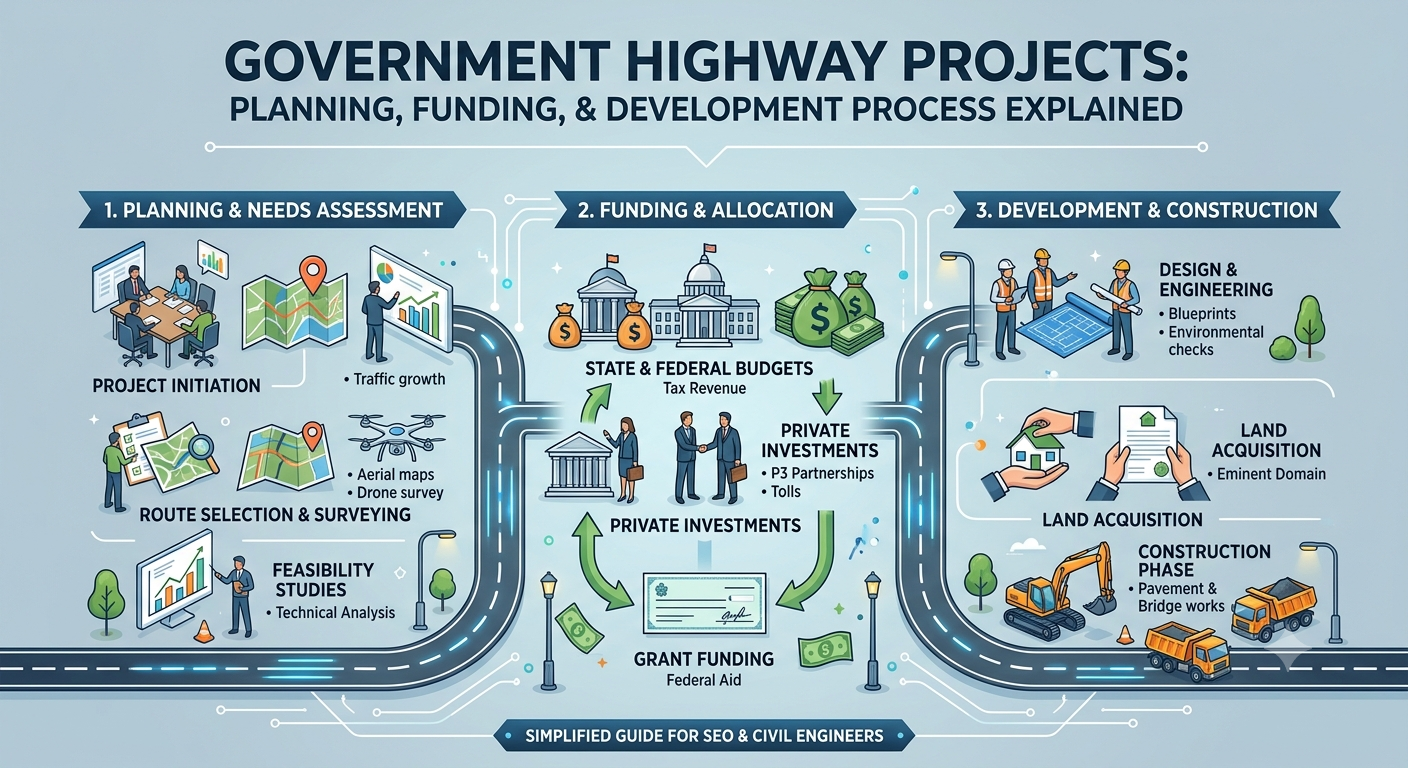
Highways are the backbone of a nation’s transportation network, connecting cities, industries, ports, airports, and rural communities. Most major highways are developed through government highway projects, which involve careful planning, engineering design, environmental assessment, funding approval, and coordinated execution. These projects not only improve mobility but also stimulate economic growth, create employment opportunities, and enhance regional development.
Unlike private infrastructure developments, government highway projects follow strict engineering standards, procurement procedures, and regulatory frameworks. Multiple stakeholders—including transportation departments, planning authorities, environmental agencies, consultants, contractors, and local communities—work together to ensure that each project delivers long-term value while maintaining safety and sustainability.
Whether it is constructing a new expressway, widening an existing highway, replacing aging bridges, or rehabilitating deteriorated pavements, every government-funded project follows a structured lifecycle. Understanding this process is valuable for civil engineers, transportation professionals, contractors, engineering students, and anyone interested in infrastructure development.
In this guide, you’ll learn how government highway projects are initiated, funded, planned, and prepared before construction begins, along with the engineering principles and best practices that contribute to successful project delivery.
What Are Government Highway Projects?
Government highway projects are publicly funded infrastructure initiatives undertaken by national, provincial, state, or local authorities to develop, improve, or maintain highway networks. These projects are designed to meet transportation demands, improve public safety, reduce travel time, and support economic development.
A government highway project may involve:
- Constructing new highways or expressways
- Widening existing roads
- Rehabilitating deteriorated pavements
- Building bypasses around urban areas
- Constructing bridges, tunnels, and flyovers
- Improving intersections and interchanges
- Upgrading drainage and road safety features
These projects typically follow established engineering standards and procurement procedures to ensure transparency, quality, and efficient use of public funds.
Why Government Highway Projects Are Important
Transportation infrastructure is one of the strongest drivers of economic and social progress. Government investment in highways creates long-term benefits that extend well beyond improved road connectivity.
Economic Growth
Efficient highways reduce transportation costs, improve supply chain performance, and encourage industrial development by connecting production centers with markets.
Improved Mobility
New highways decrease travel time, reduce traffic congestion, and provide safer routes for both passenger and freight transportation.
Regional Development
Road infrastructure opens access to remote areas, encouraging tourism, agriculture, education, healthcare, and business investment.
Public Safety
Modern highway designs include wider lanes, better sight distances, median barriers, improved signage, and controlled access, significantly reducing accident risks.
Employment Opportunities
Government highway projects generate thousands of jobs during planning, design, construction, supervision, and maintenance stages while supporting industries that supply construction materials and equipment.
Types of Government Highway Projects
Government agencies undertake different categories of highway projects depending on transportation needs and available funding.
New Highway Construction
New routes are developed where existing transportation facilities cannot accommodate current or future traffic demands.
Example Applications
- National expressways
- Economic corridors
- Ring roads
- Rural connectivity programs
Highway Widening Projects
As traffic volumes increase, authorities often expand two-lane roads into four-lane or six-lane highways to improve capacity and safety.
Typical widening activities include:
- Additional traffic lanes
- Median construction
- Shoulder improvements
- Drainage upgrades
Highway Rehabilitation
Older pavements gradually deteriorate due to traffic loading and environmental conditions.
Rehabilitation projects may include:
- Overlay construction
- Pavement strengthening
- Surface recycling
- Structural repairs
Bridge and Flyover Projects
Bridges eliminate river crossings, while flyovers separate conflicting traffic movements at busy intersections.
Benefits include:
- Reduced congestion
- Improved traffic flow
- Enhanced safety
- Lower travel times
Road Safety Improvement Projects
Many government initiatives focus specifically on improving highway safety rather than constructing entirely new roads.
Common improvements include:
- Guardrails
- Road markings
- Reflective signage
- Crash barriers
- Pedestrian crossings
- Intelligent traffic management systems
Government Highway Project Lifecycle
Although project requirements vary by country and project size, most government highway developments follow a structured sequence of planning and engineering activities.
The early stages determine whether the project is technically feasible, financially viable, environmentally responsible, and socially beneficial.
Phase 1: Transportation Need Assessment
Every successful highway project begins with identifying a transportation problem or opportunity.
Transportation planners evaluate existing road networks to determine where improvements are required.
Common Reasons for Government Highway Projects
- Population growth
- Rapid urbanization
- Industrial expansion
- Traffic congestion
- Freight transportation demand
- High accident rates
- Regional connectivity needs
Engineering Activities
During this phase, engineers collect baseline information, including:
- Traffic volume
- Vehicle classifications
- Travel times
- Accident records
- Population forecasts
- Economic growth projections
This information helps authorities prioritize projects based on public demand and expected long-term benefits.
Phase 2: Planning and Feasibility Studies
After identifying the transportation need, engineers and planners perform a comprehensive feasibility study.
The purpose of this study is to determine whether the proposed highway project can be implemented successfully from technical, financial, environmental, and social perspectives.
Technical Feasibility
Engineers evaluate:
- Terrain characteristics
- Existing infrastructure
- Geological conditions
- Drainage patterns
- Utility conflicts
- Construction challenges
Economic Feasibility
Analysts compare anticipated project costs with long-term benefits, including:
- Reduced vehicle operating costs
- Travel time savings
- Economic productivity
- Accident cost reductions
- Regional development opportunities
Financial Feasibility
Funding options are assessed based on:
- Government budgets
- Infrastructure development programs
- Public-private partnerships (PPP)
- Development bank financing
- Long-term investment plans
Social Feasibility
Planners examine:
- Community impacts
- Property acquisition requirements
- Public opinion
- Employment generation
- Accessibility improvements
A well-prepared feasibility study provides decision-makers with reliable information before significant investments are made.
Phase 3: Funding and Budget Approval
Unlike privately financed developments, government highway projects require formal budget approval before design and construction can proceed.
Funding decisions are typically based on project priorities, economic returns, and available public resources.
Common Funding Sources
- National government budgets
- Provincial or state allocations
- Municipal infrastructure funds
- International development agencies
- Infrastructure bonds
- Public-private partnership investments
Budget Components
A comprehensive highway budget generally includes:
- Land acquisition
- Surveying and investigations
- Engineering design
- Construction costs
- Utility relocation
- Environmental mitigation
- Project supervision
- Contingency allowances
- Future maintenance planning
Proper budgeting helps minimize financial risks and ensures that sufficient resources remain available throughout the project lifecycle.
Phase 4: Route Selection and Preliminary Design
Selecting the most suitable highway alignment is one of the most important engineering decisions in any government highway project.
Engineers compare multiple alternatives before recommending the preferred corridor.
Factors Affecting Route Selection
Topography
Gentle terrain generally reduces earthwork, construction costs, and maintenance requirements.
Geological Conditions
Routes should avoid unstable slopes, weak soils, landslide-prone areas, and excessive rock excavation whenever practical.
Environmental Constraints
Sensitive ecosystems, wetlands, forests, and protected areas are considered during route evaluation to minimize environmental impacts.
Existing Infrastructure
The proposed alignment should integrate effectively with:
- Existing highways
- Railways
- Airports
- Utility corridors
- Urban developments
Economic Considerations
Alternative routes are evaluated based on:
- Construction cost
- Land acquisition cost
- Maintenance expenses
- Long-term operational efficiency
Preliminary Highway Design
Once a preferred corridor is selected, engineers prepare preliminary design layouts showing:
- Highway alignment
- Typical cross-sections
- Major bridges
- Interchanges
- Drainage concepts
- Preliminary pavement structure
These conceptual designs provide the foundation for detailed engineering work in the next project phase.
Highway Planning Flow Diagram
Transportation Need
        │
        ▼
Traffic Studies
        │
        ▼
Feasibility Study
        │
        ▼
Funding Approval
        │
        ▼
Alternative Route Analysis
        │
        ▼
Preliminary Highway Design
        │
        ▼
Detailed Engineering Design
Phase 5: Environmental and Social Impact Assessment
After the preliminary alignment is selected, the project enters one of its most important planning stages—the Environmental and Social Impact Assessment (ESIA). Modern highway projects are expected to balance transportation development with environmental protection and community welfare.
The assessment identifies how the proposed highway may affect ecosystems, water resources, nearby settlements, cultural heritage sites, and local economies. It also recommends measures to reduce or eliminate negative impacts before construction begins.
Major Environmental Factors
Engineers and environmental specialists evaluate:
- Air quality
- Noise and vibration
- Surface water and groundwater
- Forests and vegetation
- Wildlife habitats
- Wetlands
- Agricultural land
- Climate resilience
Social Considerations
A highway project can influence thousands of people living near the proposed corridor. Therefore, planners assess:
- Land ownership
- Population displacement
- Access to schools and hospitals
- Local businesses
- Public transportation routes
- Community safety
Mitigation Measures
Common mitigation strategies include:
- Wildlife crossings
- Noise barriers
- Tree plantation programs
- Sediment and erosion control
- Stormwater management systems
- Dust suppression during construction
- Community consultation programs
Proper environmental planning improves project sustainability and helps obtain regulatory approvals more efficiently.
Phase 6: Detailed Engineering Design
Once planning approvals are secured, engineers prepare the detailed engineering design that contractors will use during construction.
Every drawing, calculation, and specification must meet safety, durability, and performance requirements.
Major Design Components
Geometric Design
This includes:
- Horizontal alignment
- Vertical profile
- Lane width
- Shoulders
- Medians
- Sight distance
- Curves and gradients
Pavement Design
Transportation engineers determine:
- Pavement type
- Layer thickness
- Material selection
- Design traffic
- Design life
- Drainage requirements
Structural Design
Structures commonly included are:
- Bridges
- Culverts
- Retaining walls
- Flyovers
- Underpasses
- Pedestrian bridges
Drainage Design
An effective drainage system protects pavement layers from moisture damage.
Typical components include:
- Side drains
- Cross drains
- Culverts
- Median drains
- Stormwater channels
Road Safety Design
Safety features incorporated into the design include:
- Guardrails
- Traffic signs
- Pavement markings
- Crash barriers
- Road lighting
- Delineators
- Emergency lay-bys
Detailed engineering drawings minimize construction errors and ensure that all project stakeholders work from the same technical information.
Phase 7: Land Acquisition and Utility Relocation
Government highway projects frequently require additional land for roadways, bridges, drainage systems, service roads, and future expansion.
Land acquisition is often one of the longest phases because it involves legal procedures, negotiations, and compensation.
Major Activities
- Boundary surveys
- Property ownership verification
- Land valuation
- Compensation payments
- Legal documentation
- Utility identification
- Utility relocation planning
Utilities that may require relocation include:
- Water pipelines
- Sewer networks
- Electrical transmission lines
- Gas pipelines
- Fiber optic cables
- Telecommunication infrastructure
Proper coordination prevents costly construction delays and service interruptions.
Phase 8: Tendering and Contractor Selection
After the design and budget are finalized, government agencies invite qualified contractors to bid for the project.
Transparent procurement ensures fair competition while delivering value for public funds.
Typical Tendering Process
- Preparation of tender documents
- Public advertisement
- Contractor prequalification
- Submission of bids
- Technical evaluation
- Financial evaluation
- Contract award
- Project mobilization
Contractor Evaluation Criteria
Authorities typically assess:
- Technical capability
- Financial stability
- Relevant project experience
- Quality management systems
- Construction equipment
- Safety performance
- Skilled workforce
Selecting an experienced contractor significantly improves project quality and reduces construction risks.
Phase 9: Construction and Quality Control
Construction transforms engineering plans into a functioning highway through a sequence of carefully managed operations.
Each activity is monitored to ensure compliance with project specifications.
Typical Construction Activities
- Site clearing
- Earthworks
- Embankment construction
- Subgrade preparation
- Sub-base placement
- Base course construction
- Pavement laying
- Bridge construction
- Drainage installation
- Road furniture installation
Quality Control During Construction
Quality assurance begins on the first day of construction and continues until project completion.
Common field and laboratory tests include:
Soil Tests
- Field Density Test
- Proctor Compaction Test
- California Bearing Ratio (CBR)
Aggregate Tests
- Los Angeles Abrasion Test
- Aggregate Impact Value
- Flakiness Index
Asphalt Tests
- Marshall Stability Test
- Bitumen Content Test
- Density Test
Concrete Tests
- Slump Test
- Cube Compression Test
- Flexural Strength Test
Regular inspections help identify defects early, reducing costly repairs and ensuring compliance with design specifications.
Phase 10: Project Completion and Maintenance
Construction does not mark the end of a government highway project. Before opening the highway to traffic, engineers perform final inspections and verify that every component meets the required standards.
Final Inspection Checklist
- Pavement smoothness
- Layer thickness
- Road geometry
- Drainage performance
- Bridge inspections
- Safety barriers
- Traffic signs
- Pavement markings
- Lighting systems
After project completion, the highway enters its operational phase.
Routine maintenance activities include:
- Crack sealing
- Pothole repairs
- Drain cleaning
- Pavement resurfacing
- Shoulder maintenance
- Vegetation control
- Bridge inspections
- Sign replacement
Preventive maintenance extends pavement life, improves safety, and reduces lifecycle costs.
Engineering Best Practices
Successful government highway projects typically follow these best practices:
- Perform comprehensive traffic forecasting before design.
- Complete detailed geotechnical investigations.
- Prioritize effective drainage systems.
- Select durable, specification-compliant construction materials.
- Implement strict quality assurance and quality control procedures.
- Use modern surveying technologies such as GPS, drones, and GIS where appropriate.
- Coordinate closely with environmental authorities and utility agencies.
- Maintain accurate project documentation throughout every phase.
- Plan for future traffic growth instead of only current demand.
- Incorporate sustainable construction practices wherever feasible.
Practical Recommendations
Civil Engineers
- Review investigation reports thoroughly before preparing designs.
- Verify field conditions regularly during construction.
- Maintain clear communication with consultants and contractors.
- Keep detailed inspection and testing records.
Contractors
- Mobilize experienced technical staff.
- Calibrate testing equipment before use.
- Follow approved construction methodologies.
- Never compromise quality for speed.
Engineering Students
- Learn the complete project lifecycle, not only construction methods.
- Study pavement design and transportation planning.
- Visit highway construction sites to observe field practices.
- Develop knowledge of surveying, materials testing, and project management.
General Discussion of IRC, AASHTO, and ICE Practices
Leading highway engineering organizations such as IRC (Indian Roads Congress), AASHTO (American Association of State Highway and Transportation Officials), and ICE (Institution of Civil Engineers) emphasize several common principles for successful highway development.
These generally include:
- Designing highways using reliable traffic projections.
- Conducting detailed geotechnical and topographic investigations.
- Providing adequate pavement drainage.
- Following standardized material specifications.
- Performing continuous quality control throughout construction.
- Prioritizing road safety during planning and design.
- Considering long-term maintenance requirements.
- Promoting sustainable and resilient infrastructure practices.
Although design standards vary by country, these engineering principles remain widely recognized across the transportation industry.
Frequently Asked Questions (FAQs)
1. What are government highway projects?
Government highway projects are publicly funded infrastructure programs that involve constructing, expanding, upgrading, or maintaining highways to improve transportation, safety, and economic development.
2. Who is responsible for planning government highway projects?
Transportation departments, highway authorities, consulting engineers, environmental agencies, financial institutions, and government planners typically collaborate throughout the planning process.
3. Why are feasibility studies important before highway construction?
Feasibility studies evaluate technical, financial, environmental, and social factors to determine whether a project is practical and economically justified.
4. How are government highway projects funded?
Funding may come from national or state budgets, municipal allocations, infrastructure development programs, international financing institutions, infrastructure bonds, or public-private partnerships.
5. Why is land acquisition often time-consuming?
Legal procedures, property valuation, ownership verification, compensation negotiations, and utility relocation can significantly extend project timelines.
6. What quality tests are commonly performed during highway construction?
Common tests include the California Bearing Ratio (CBR), Field Density Test, Proctor Compaction Test, Los Angeles Abrasion Test, Marshall Stability Test, Slump Test, and Concrete Compression Test.
7. Why is drainage critical in highway engineering?
Proper drainage prevents water infiltration into pavement layers, reduces erosion, protects the subgrade, and significantly increases pavement service life.
8. What is the purpose of road safety features?
Road signs, guardrails, pavement markings, lighting, and crash barriers improve driver awareness, reduce accident severity, and enhance overall highway safety.
9. How long do government highway projects usually take?
Project duration depends on size, complexity, environmental approvals, funding, and land acquisition. Small projects may take one to two years, while major expressways can require five years or more.
10. How can engineering students prepare for careers in highway engineering?
Students should build strong foundations in transportation engineering, surveying, pavement materials, geotechnical engineering, project management, and field quality control while gaining practical exposure through internships and site visits.
Conclusion
Government Highway Projects are far more than construction activities; they are strategic investments that shape a country’s economic growth, mobility, and long-term infrastructure resilience. From identifying transportation needs and conducting feasibility studies to environmental assessments, engineering design, land acquisition, contractor selection, construction, and ongoing maintenance, every phase requires careful planning and technical expertise. Successful projects depend on collaboration among government agencies, engineers, consultants, contractors, and local communities while adhering to recognized engineering standards and quality assurance practices. By applying sound engineering principles, adopting sustainable construction methods, and prioritizing safety throughout the project lifecycle, governments can deliver highways that serve future generations efficiently and reliably. Whether you are a civil engineer, contractor, student, or infrastructure enthusiast, understanding Government Highway Projects provides valuable insight into how modern transportation networks are planned, financed, built, and maintained to support national development and improve the quality of life.

Kamran Malik is a passionate civil engineering writer and researcher who specializes in construction, transportation, structural engineering, and infrastructure topics. Through his articles on CivilEngineerings.com, he simplifies complex engineering concepts and shares practical insights, industry trends, and educational resources for students, professionals, and engineering enthusiasts.