PPP Road Projects
Building modern highways requires significant financial investment, advanced engineering expertise, and long-term maintenance planning. As governments face increasing budget constraints and growing transportation demands, many countries have adopted PPP Road Projects as an effective solution for developing high-quality road infrastructure.
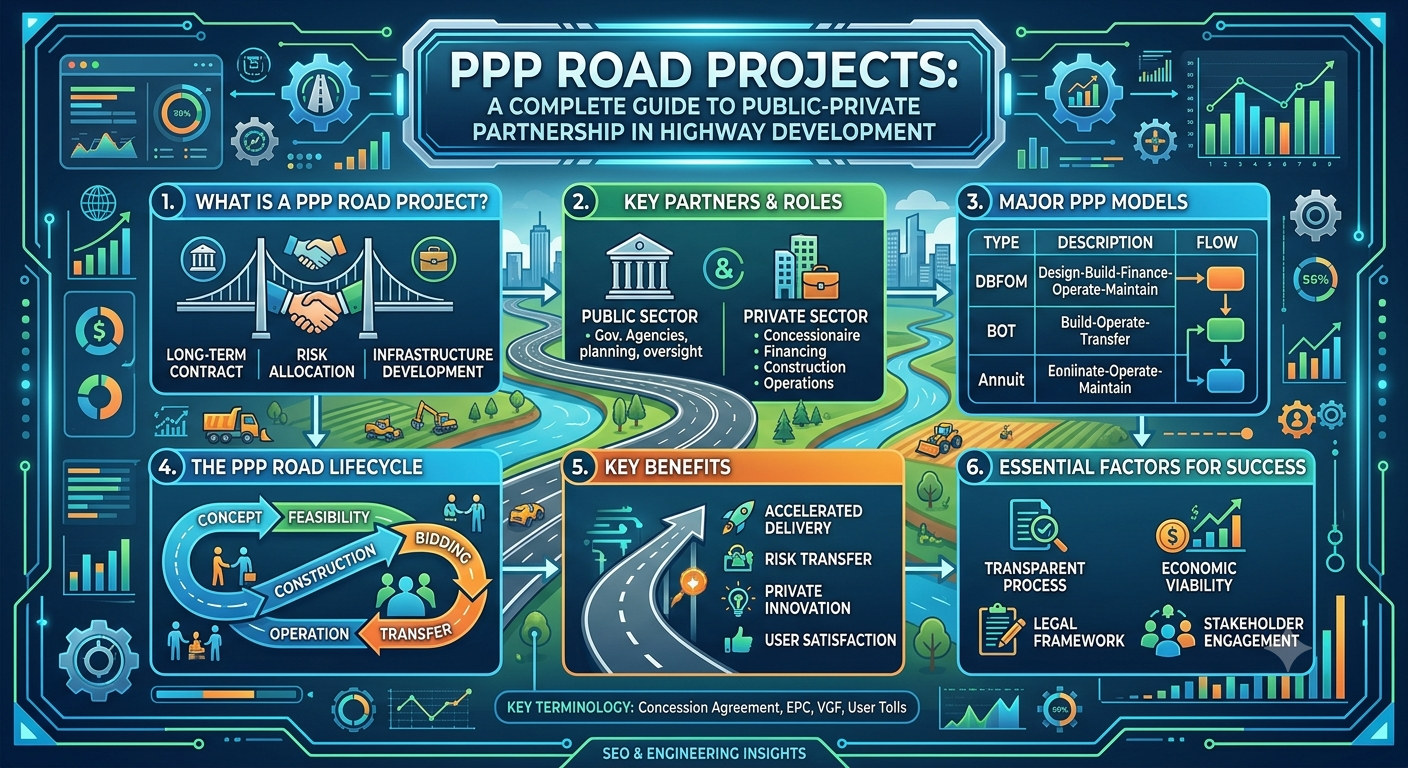
Public-Private Partnership (PPP) combines the strengths of the public and private sectors to finance, design, construct, operate, and maintain road projects. Instead of relying entirely on government funding, PPP models encourage private investment while ensuring that roads are built and managed according to agreed performance standards.
Today, PPP Road Projects are widely used for expressways, national highways, bypasses, bridges, tunnels, and urban road networks. When structured properly, these partnerships improve construction efficiency, reduce project delays, and deliver better value throughout the infrastructure’s life cycle.
This comprehensive guide explains the fundamentals of PPP Road Projects, their development process, common contract models, engineering considerations, and practical applications. Whether you are a civil engineer, transportation professional, contractor, or engineering student, understanding PPP frameworks is essential for working on large-scale highway infrastructure.
What Are PPP Road Projects?
PPP Road Projects are infrastructure developments in which a government agency and one or more private companies collaborate to deliver road or highway projects. The partnership typically extends beyond construction and may include financing, operation, maintenance, and eventual transfer of the asset back to the public authority.
Unlike conventional government-funded projects, PPP arrangements distribute responsibilities and risks between the public and private sectors. Each party contributes its expertise, resources, and capabilities to achieve a common objective: delivering safe, durable, and cost-effective transportation infrastructure.
A typical PPP road project may involve:
- Highway planning
- Detailed engineering design
- Land development coordination
- Financing and investment
- Construction
- Traffic management
- Routine maintenance
- Periodic rehabilitation
- Toll collection (where applicable)
- Asset transfer at the end of the concession period
Practical Example
Imagine a government plans to construct a 250-kilometer expressway but lacks sufficient public funds. Instead of postponing the project, it enters into a PPP agreement with a private consortium. The consortium finances and builds the highway, operates it for a specified concession period, recovers its investment through toll revenue or government payments, and eventually transfers the highway back to the public authority in good operating condition.
Why PPP Road Projects Matter
Transportation infrastructure is essential for economic growth, regional development, and public mobility. However, highway construction requires enormous capital investment, skilled project management, and continuous maintenance.
PPP Road Projects help address these challenges by combining public oversight with private-sector efficiency.
Key Benefits
- Accelerated infrastructure development
- Access to private financing
- Improved project management
- Faster construction schedules
- Higher construction quality
- Better lifecycle maintenance
- Enhanced innovation
- Reduced burden on public budgets
Rather than focusing only on the initial construction cost, PPP contracts encourage long-term performance because private partners remain responsible for maintaining the asset over many years.
Objectives of PPP Road Projects
The primary goal of PPP Road Projects is to deliver sustainable transportation infrastructure while maximizing value for public investment.
Specific objectives include:
- Improving highway connectivity
- Reducing traffic congestion
- Enhancing road safety
- Supporting economic development
- Encouraging private investment
- Promoting innovation in construction techniques
- Improving maintenance standards
- Reducing lifecycle costs
- Increasing project delivery efficiency
A successful PPP project balances engineering quality, financial sustainability, environmental responsibility, and user satisfaction.
Common PPP Models
Different projects require different partnership structures. The selected PPP model depends on project complexity, financing arrangements, government policies, and risk allocation.
Build-Operate-Transfer (BOT)
The BOT model is one of the most widely used PPP structures for highway development.
Under this arrangement, the private partner:
- Designs the project
- Finances construction
- Builds the highway
- Operates and maintains it for a fixed concession period
- Transfers ownership to the government after the concession expires
Revenue is often generated through toll collection or agreed government payments.
Best suited for:
- Toll roads
- Expressways
- Major bridges
- Urban bypasses
Build-Own-Operate-Transfer (BOOT)
The BOOT model is similar to BOT but allows the private partner to own the asset during the concession period.
Ownership is transferred to the government once contractual obligations have been fulfilled.
Advantages
- Greater investment security
- Long-term operational planning
- Strong incentive for quality construction
- Efficient asset management
Design-Build-Finance-Operate (DBFO)
Under the DBFO model, a private consortium is responsible for:
- Designing
- Financing
- Constructing
- Operating
- Maintaining
The government usually retains ownership of the asset while compensating the private partner through availability payments or performance-based contracts.
This model emphasizes lifecycle performance rather than toll revenue.
Hybrid Annuity Model (HAM)
The Hybrid Annuity Model combines public funding with private investment.
Typically:
- The government contributes a significant portion of the construction cost during implementation.
- The private developer finances the remaining share.
- Payments are made periodically based on project milestones and operational performance.
HAM reduces financial risks for private investors while ensuring project continuity.
Benefits
- Lower financing burden
- Reduced traffic revenue risk
- Improved project bankability
- Faster implementation
EPC vs PPP: Understanding the Difference
Although EPC (Engineering, Procurement, and Construction) and PPP are both common delivery methods, they differ significantly in terms of financing, risk, and long-term responsibilities.
| Feature | EPC | PPP |
|---|---|---|
| Financing | Government-funded | Public and private investment |
| Construction | Contractor builds | Private partner often finances and builds |
| Operation | Government responsibility | Private partner may operate the asset |
| Maintenance | Government manages | Often included in the concession |
| Revenue Risk | Government | Shared or private depending on contract |
| Contract Duration | Short-term | Long-term (15–30 years or more) |
Public private partnership emphasizes lifecycle asset management, while EPC focuses primarily on project delivery.
PPP Road Project Development Process
PPP Road Projects follow a structured development process to ensure technical, financial, and legal feasibility before construction begins.
Step 1: Project Identification
The process starts by identifying transportation needs through:
- Traffic demand analysis
- Economic development studies
- Regional planning
- Population growth forecasts
- Existing road network assessments
The objective is to determine whether a PPP approach provides better value than traditional procurement.
Step 2: Feasibility Study
A detailed feasibility study evaluates the project’s viability from multiple perspectives.
Technical Assessment
Engineers analyze:
- Highway alignment
- Terrain conditions
- Geotechnical characteristics
- Drainage requirements
- Utility conflicts
Financial Assessment
Financial experts estimate:
- Capital costs
- Operating expenses
- Revenue potential
- Investment returns
- Funding requirements
Environmental Assessment
Specialists evaluate:
- Ecological impacts
- Air quality
- Noise
- Water resources
- Community concerns
Only projects demonstrating strong technical and economic feasibility proceed to the next stage.
Step 3: Financial and Risk Assessment
One of the defining features of PPP Road Projects is effective risk allocation.
At this stage, project teams identify and assign major risks to the party best equipped to manage them.
Typical risks include:
- Construction delays
- Cost overruns
- Inflation
- Traffic demand uncertainty
- Environmental compliance
- Land acquisition delays
- Force majeure events
- Operational performance
Proper risk allocation improves investor confidence and enhances project success.
Step 4: Procurement and Bid Preparation
Once feasibility studies and financial assessments are complete, the government prepares procurement documents and invites qualified private companies to participate.
Typical procurement activities include:
- Preparing concession agreements
- Developing technical specifications
- Issuing Requests for Qualification (RFQ)
- Issuing Requests for Proposal (RFP)
- Bid evaluation
- Contractor selection
- Contract negotiation
Transparent procurement encourages fair competition and helps secure experienced private partners.
PPP Process Flow Diagram
Transportation Need
        │
        ▼
Project Identification
        │
        ▼
Feasibility Study
        │
        ▼
Financial & Risk Assessment
        │
        ▼
Procurement & Bidding
        │
        ▼
PPP Agreement
        │
        ▼
Design & Construction
        │
        ▼
Operation & Maintenance
        │
        ▼
Asset Transfer (if applicable)
This structured framework ensures that engineering, financial, legal, and operational aspects are addressed before large-scale investments are made.
Risk Allocation in PPP Road Projects
Risk allocation is one of the defining characteristics of PPP Road Projects. Unlike traditional government-funded projects, risks are shared between the public authority and the private partner based on which party is best equipped to manage them.
A balanced allocation of risks reduces disputes, attracts investors, and improves project performance throughout the concession period.
Common Types of Risks
Construction Risk
Construction risks include:
- Delays due to unforeseen conditions
- Material price fluctuations
- Design errors
- Equipment breakdowns
- Labor shortages
- Poor workmanship
The private partner typically assumes these risks because it controls project execution.
Financial Risk
Financial risks involve:
- Interest rate changes
- Inflation
- Exchange rate fluctuations
- Funding availability
- Cost overruns
Effective financial planning and diversified funding sources help minimize these uncertainties.
Traffic Demand Risk
For toll-based projects, actual traffic volumes may differ from forecasts. Lower-than-expected traffic can reduce revenue and affect financial viability.
Governments sometimes mitigate this risk through minimum revenue guarantees or availability payment mechanisms.
Environmental Risk
Environmental risks include:
- Flooding
- Landslides
- Environmental permit delays
- Protected habitats
- Extreme weather events
Comprehensive environmental studies during the planning stage reduce these risks.
Political and Regulatory Risk
Changes in government policies, taxation, or regulations can influence project performance. Well-drafted concession agreements help provide contractual stability for investors.
Financing Structure of PPP Road Projects
Financing is one of the main reasons governments choose PPP models. Instead of relying entirely on public budgets, funding is obtained from a combination of public and private sources.
Typical Funding Sources
- Private equity
- Commercial bank loans
- Infrastructure investment funds
- Government grants
- Development finance institutions
- Infrastructure bonds
- Multilateral development banks
Typical Financial Structure
A PPP project generally includes:
- Equity contributed by project sponsors
- Long-term debt from financial institutions
- Government support where applicable
- Revenue generated through tolls or availability payments
The financing structure is carefully designed to ensure that the project remains economically sustainable throughout its operational life.
Roles and Responsibilities in PPP Road Projects
Successful PPP Road Projects require close collaboration among multiple stakeholders.
Government Authority
The public authority is responsible for:
- Identifying project needs
- Preparing feasibility studies
- Acquiring land
- Obtaining statutory approvals
- Monitoring contract compliance
- Protecting public interests
Private Partner
The private concessionaire generally undertakes:
- Detailed design
- Financing
- Construction
- Operation
- Maintenance
- Asset management
- Performance reporting
Engineering Consultants
Engineering consultants provide:
- Detailed surveys
- Geotechnical investigations
- Highway design
- Construction supervision
- Quality assurance
- Independent engineering reviews
Financial Institutions
Banks and infrastructure lenders evaluate:
- Financial feasibility
- Creditworthiness
- Risk allocation
- Debt servicing capacity
- Long-term project sustainability
Engineering Principles Behind PPP Road Projects
Although PPP focuses on financing and project delivery, sound engineering principles remain the foundation of every successful highway.
Key engineering considerations include:
Lifecycle Design
Engineers design highways for long-term performance rather than minimizing initial construction costs alone. Durable materials and optimized pavement structures reduce maintenance expenses over the concession period.
Quality Assurance
Comprehensive quality control is essential during:
- Earthworks
- Pavement construction
- Bridge construction
- Drainage installation
- Traffic safety works
Continuous testing helps ensure compliance with project specifications.
Sustainable Construction
Modern PPP projects increasingly adopt sustainable engineering practices such as:
- Recycling pavement materials
- Energy-efficient lighting
- Low-carbon construction methods
- Rainwater management
- Erosion control
- Green landscaping
Asset Management
Routine inspections, preventive maintenance, and pavement condition monitoring extend service life and reduce long-term rehabilitation costs.
Advantages of PPP Road Projects
PPP Road Projects provide numerous benefits for governments, investors, and road users.
Major Advantages
- Faster project delivery
- Access to private investment
- Improved construction efficiency
- Better lifecycle maintenance
- Enhanced innovation
- Reduced pressure on public finances
- Performance-based contracts
- Higher service quality
- Efficient risk sharing
- Long-term asset management
By integrating construction and maintenance responsibilities, PPP projects encourage the use of durable materials and high-quality engineering solutions.
Challenges of PPP Road Projects
Despite their advantages, PPP projects also present several challenges that require careful management.
Common Challenges
- Complex contractual arrangements
- Lengthy procurement processes
- Land acquisition delays
- Financing difficulties
- Revenue uncertainty
- Political interference
- Public opposition to tolling
- Inflation and material price escalation
- Regulatory changes
- Dispute resolution
Early planning, transparent communication, and effective contract administration help overcome these challenges.
Best Practices for Successful PPP Road Projects
Successful highway partnerships share several important characteristics.
- Conduct detailed traffic demand forecasting.
- Complete comprehensive geotechnical and environmental investigations.
- Allocate risks fairly between stakeholders.
- Prepare realistic financial models.
- Use transparent procurement procedures.
- Implement independent quality assurance systems.
- Monitor performance continuously throughout the concession period.
- Maintain open communication among all project participants.
- Apply modern digital technologies for project monitoring.
- Plan maintenance from the design stage rather than after construction.
Practical Recommendations
Civil Engineers
- Design pavement structures with lifecycle costs in mind.
- Review geotechnical data thoroughly before finalizing designs.
- Prioritize constructability and maintainability.
- Monitor construction quality at every stage.
- Coordinate closely with financial and legal teams during project planning.
Contractors
- Develop realistic construction schedules.
- Maintain high safety standards.
- Invest in skilled personnel and modern equipment.
- Document quality control activities comprehensively.
- Establish proactive maintenance strategies after project completion.
Engineering Students
- Understand the differences between PPP and traditional procurement.
- Study concession agreements and contract structures.
- Learn the basics of infrastructure finance.
- Strengthen knowledge of pavement engineering and project management.
- Visit operational PPP highway projects to observe maintenance and asset management practices.
General Discussion of IRC, AASHTO, and ICE Practices
Recognized highway organizations such as IRC, AASHTO, and ICE promote engineering principles that support the successful implementation of PPP Road Projects.
These principles generally include:
- Conducting reliable traffic forecasting before project approval.
- Performing comprehensive geotechnical and environmental investigations.
- Designing pavements for anticipated traffic loading and service life.
- Providing efficient drainage systems to protect pavement performance.
- Applying rigorous quality assurance during construction.
- Incorporating road safety features throughout the project lifecycle.
- Considering long-term maintenance and lifecycle costs during project planning.
- Encouraging sustainable construction practices and resilient infrastructure design.
Although project requirements differ between countries, these principles provide a strong engineering foundation for delivering durable, safe, and efficient highway infrastructure.
Frequently Asked Questions (FAQs)
1. What are PPP Road Projects?
PPP Road Projects are transportation infrastructure developments where public authorities collaborate with private companies to finance, design, construct, operate, and maintain highways under long-term agreements.
2. Why are PPP Road Projects becoming more popular?
They help governments accelerate infrastructure development by attracting private investment, improving project efficiency, and reducing pressure on public budgets.
3. What is the difference between PPP and EPC contracts?
PPP contracts usually include financing, operation, and maintenance responsibilities, while EPC contracts focus primarily on engineering, procurement, and construction.
4. Who owns a PPP road?
Ownership depends on the contract model. In many cases, the government retains ownership while the private partner operates and maintains the asset during the concession period. In other models, ownership transfers to the government at the end of the concession.
5. How are PPP Road Projects financed?
Funding may come from private equity, commercial loans, government support, infrastructure funds, development banks, and revenue generated through tolls or availability payments.
6. What risks do private partners typically assume?
Private partners generally manage construction, financing, operational, maintenance, and performance risks, while governments often retain regulatory and land acquisition responsibilities.
7. Are PPP Road Projects suitable for all highways?
Not necessarily. They are most effective for projects with strong traffic demand, reliable revenue potential, and long-term operational requirements.
8. What role do engineers play in PPP Road Projects?
Engineers are responsible for planning, investigations, design, quality assurance, construction supervision, asset management, and ensuring compliance with technical standards throughout the project lifecycle.
9. How do PPP Road Projects benefit road users?
They often deliver improved road quality, better maintenance, enhanced safety, shorter travel times, and more reliable transportation services.
10. Why is lifecycle maintenance important in PPP contracts?
Because the private partner remains responsible for maintaining the infrastructure over many years, there is a strong incentive to use durable materials, apply quality construction practices, and minimize long-term maintenance costs.
Conclusion
PPP Road Projects have transformed the way modern highways are planned, financed, constructed, and maintained. By combining public oversight with private-sector investment, innovation, and technical expertise, these partnerships enable governments to deliver critical transportation infrastructure more efficiently while optimizing lifecycle performance. Successful PPP initiatives depend on comprehensive feasibility studies, balanced risk allocation, transparent procurement, sound engineering design, and continuous asset management. They also require strong collaboration among government agencies, concessionaires, consultants, contractors, financial institutions, and local communities. When supported by robust contract management and high engineering standards, PPP Road Projects can reduce project delays, improve maintenance quality, encourage sustainable construction practices, and provide long-term economic benefits. For civil engineers, transportation professionals, contractors, and engineering students, understanding PPP Road Projects is increasingly important as public-private partnerships continue to shape the future of highway infrastructure around the world.

Kamran Malik is a passionate civil engineering writer and researcher who specializes in construction, transportation, structural engineering, and infrastructure topics. Through his articles on CivilEngineerings.com, he simplifies complex engineering concepts and shares practical insights, industry trends, and educational resources for students, professionals, and engineering enthusiasts.