
Introduction
Highway infrastructure is a cornerstone of economic growth, regional development, and national connectivity. Every new expressway, motorway, bypass, or interstate highway requires significant financial investment before construction even begins. While engineering design and construction often receive the most attention, securing adequate funding is equally critical to a project’s success. Without a sustainable financing strategy, even technically sound highway projects may face delays, cost overruns, or cancellation.
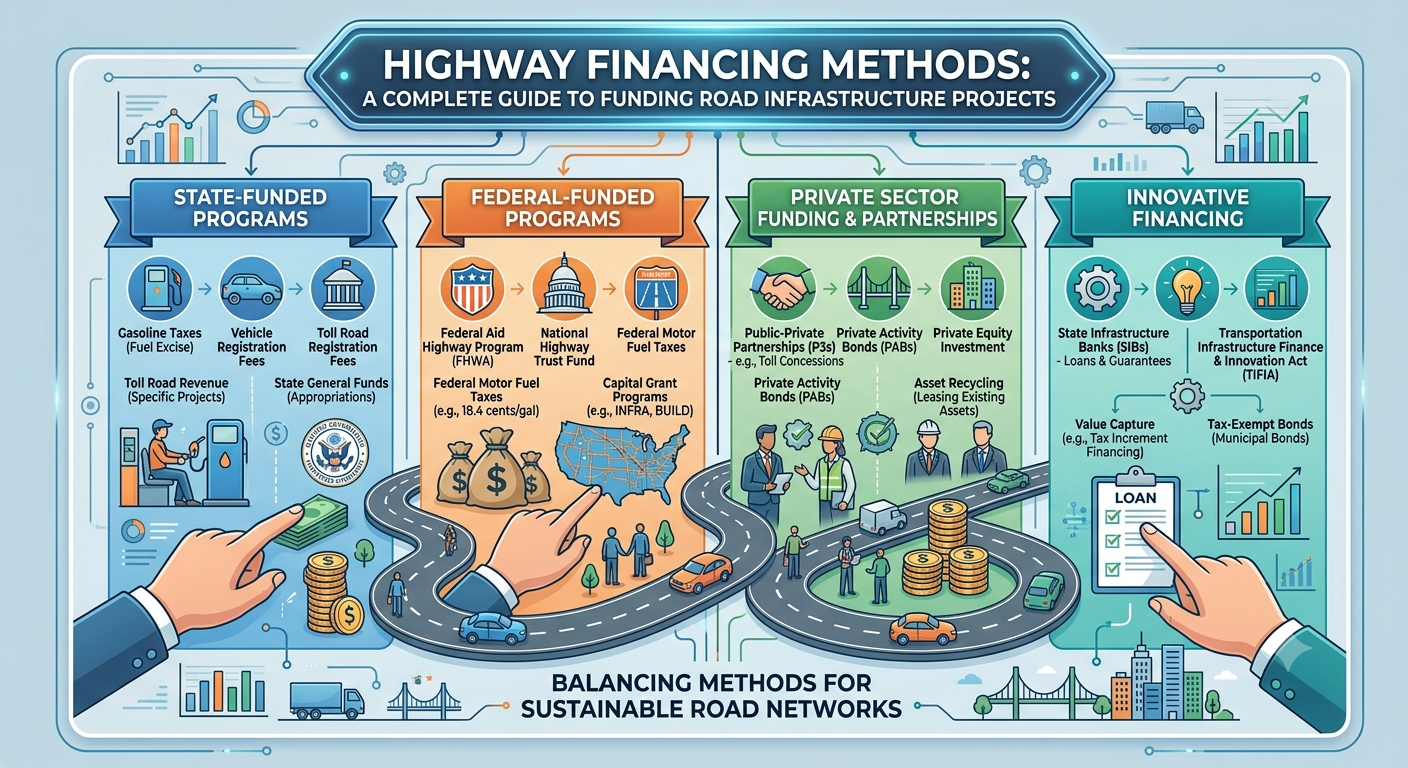
Understanding Highway Financing Methods is essential for civil engineers, transportation planners, contractors, policymakers, and engineering students. Different financing models determine how highways are planned, constructed, operated, and maintained throughout their service life. Governments around the world increasingly rely on a combination of public funding, private investment, toll revenues, and innovative financial instruments to meet growing transportation demands.
This guide explores the most widely used highway financing methods, explains their advantages and limitations, and highlights practical applications that support long-term infrastructure development.
What Are Highway Financing Methods?
Highway Financing Methods refer to the various approaches governments and private organizations use to generate funds for planning, designing, constructing, operating, rehabilitating, and maintaining highway infrastructure.
Unlike ordinary construction projects, highways require substantial capital investment because they involve land acquisition, earthworks, bridges, drainage systems, pavements, traffic management facilities, environmental mitigation, and long-term maintenance.
Financing methods determine:
- How project funds are raised.
- Who bears the financial risk.
- How construction costs are recovered.
- Who owns and operates the highway.
- How maintenance expenses are financed throughout the asset’s life.
Modern highway projects often combine multiple financing sources to reduce financial risks and improve project sustainability.
Why Highway Financing Is Important
Developing transportation infrastructure requires long-term financial planning. A well-designed financing strategy ensures that highway projects can be completed without unnecessary delays while maintaining construction quality and public safety.
Effective financing contributes to:
- Faster project delivery.
- Improved transportation networks.
- Sustainable maintenance funding.
- Better investment planning.
- Reduced economic losses caused by congestion.
- Enhanced regional development.
- Increased investor confidence.
Poor financial planning, on the other hand, can lead to incomplete projects, budget overruns, reduced construction quality, and higher lifecycle costs.
Fundamental Principles of Highway Financing
Before selecting a financing model, transportation agencies typically evaluate several engineering and economic principles.
Financial Sustainability
A financing system should generate sufficient revenue to support construction, operation, maintenance, and future rehabilitation without creating excessive financial burdens.
Equity
Costs should be distributed fairly among taxpayers, road users, businesses, and private investors based on the benefits they receive.
Economic Efficiency
Funds should be allocated to projects that provide the greatest long-term economic and social benefits, including reduced travel times, lower vehicle operating costs, and improved freight movement.
Risk Allocation
Financial, operational, and construction risks should be assigned to the parties best equipped to manage them.
Transparency
Clear financial reporting, competitive procurement, and public accountability help build trust and encourage efficient use of resources.
Types of Highway Financing Methods
1. Government Budget Financing
Government budget financing is the oldest and most widely used method for funding highway projects.
Under this approach, national, state, or local governments allocate funds from annual budgets to finance transportation infrastructure.
These funds generally originate from:
- General taxation
- Income tax
- Sales tax
- Corporate tax
- Property tax
- Government revenues
How It Works
The government approves transportation budgets through legislative processes. Highway agencies then allocate these funds to planning, design, construction, rehabilitation, and maintenance activities.
Advantages
- No direct charges for road users.
- Suitable for public-interest projects.
- Strong government control over infrastructure.
- Supports rural and low-traffic roads.
Limitations
- Budget constraints may delay projects.
- Political priorities can influence funding.
- Limited flexibility during economic downturns.
Practical Example
A government may finance a national highway connecting remote regions where traffic volumes are too low to support toll collection but where improved accessibility promotes economic development and social inclusion.
2. Fuel Taxes and Road User Charges
Fuel taxes remain one of the most reliable sources of transportation funding in many countries.
Every purchase of gasoline or diesel contributes a small amount toward highway development and maintenance.
This approach follows the user-pay principle, where individuals who use road infrastructure contribute to its upkeep.
Revenue Sources
- Petrol taxes
- Diesel taxes
- Vehicle registration fees
- Heavy vehicle charges
- Road usage fees
Benefits
- Stable revenue stream.
- Simple collection process.
- Encourages efficient fuel consumption.
- Links road usage with funding.
Challenges
- Increasing adoption of electric vehicles may reduce fuel tax revenues.
- Revenue may fluctuate with fuel consumption.
- Tax increases may face public resistance.
Engineering Perspective
Transportation planners often use projected traffic growth and fuel consumption trends to estimate long-term funding availability for highway improvement programs.
3. Toll Road Financing
Toll financing is one of the most recognizable Highway Financing Methods. Drivers pay a fee to use specific roads, bridges, tunnels, or expressways, and the collected revenue is used to recover construction costs, repay debt, fund operations, and finance maintenance.
Types of Toll Collection
- Manual toll booths
- Electronic toll collection (ETC)
- Open-road tolling
- Distance-based tolling
Advantages
- Reduces dependence on government budgets.
- Generates dedicated revenue.
- Supports long-term maintenance.
- Encourages efficient use of infrastructure.
Limitations
- High initial investment in tolling systems.
- Public acceptance may vary.
- Traffic may divert to alternative routes.
Practical Example
A newly constructed expressway connecting two major cities can recover part of its construction cost through electronic toll collection while providing faster travel times and reduced congestion.
4. Public-Private Partnerships (PPPs)
Public-Private Partnerships (PPPs) have become increasingly popular for delivering large transportation projects.
Under a PPP arrangement, a government collaborates with a private company to finance, design, construct, operate, and sometimes maintain highway infrastructure under a long-term contractual agreement.
Common PPP Models
- Build-Operate-Transfer (BOT)
- Design-Build-Finance-Operate (DBFO)
- Build-Own-Operate (BOO)
- Design-Build-Finance-Maintain (DBFM)
Benefits
- Access to private investment.
- Faster project delivery.
- Improved innovation.
- Better lifecycle cost management.
- Transfer of selected project risks.
Potential Challenges
- Complex contractual arrangements.
- Long negotiation periods.
- Revenue uncertainty.
- Need for strong government oversight.
Engineering Application
Large expressways, ring roads, urban bypasses, and international highway corridors frequently use PPP models where long-term operational performance is incorporated into the contract.
5. Municipal and Infrastructure Bonds
Municipal and infrastructure bonds allow governments or public agencies to borrow funds from investors for transportation projects.
Investors purchase bonds and receive regular interest payments until the principal amount is repaid at maturity.
How Bond Financing Works
- Government identifies a highway project.
- Bonds are issued to investors.
- Capital is raised for construction.
- Highway is constructed.
- Bondholders receive scheduled repayments.
Advantages
- Provides significant upfront capital.
- Enables large projects to begin immediately.
- Distributes repayment over many years.
- Supports long-term infrastructure planning.
Limitations
- Creates future debt obligations.
- Interest costs increase total project expenditure.
- Requires strong financial management.
Practical Application
Many metropolitan regions use municipal bonds to finance urban highways, bridge replacements, and major interchange improvements without waiting for sufficient annual budget allocations.
Simplified Highway Financing Flow Diagram
Transportation Need
          │
          ▼
Project Planning
          │
          ▼
Funding Strategy Selection
          │
          ├──────────────┐
          │              │
Government Funding   Private Investment
          │              │
          └──────┬───────┘
                 ▼
        Highway Construction
                 ▼
   Operation & Maintenance
The diagram illustrates how different funding sources converge to support the delivery and long-term management of highway infrastructure.
4.6 Infrastructure Banks
Infrastructure banks are specialized financial institutions that provide long-term funding for large public infrastructure projects, including highways, bridges, tunnels, and transit systems. Rather than financing projects directly through annual government budgets, these institutions offer loans, credit assistance, and financial guarantees to transportation agencies.
Infrastructure banks encourage investment in projects that generate long-term economic benefits while reducing immediate pressure on public finances.
Key Features
- Long-term, low-interest financing
- Support for major transportation projects
- Flexible repayment schedules
- Funding for nationally significant infrastructure
Advantages
- Accelerates project delivery.
- Attracts private investment.
- Reduces reliance on annual government budgets.
- Supports sustainable infrastructure development.
Limitations
- Strict eligibility requirements.
- Detailed financial evaluation.
- Long approval procedures.
Practical Example
A regional highway authority may obtain financing from an infrastructure bank to construct a new expressway while repaying the loan gradually through future government revenues or toll collections.
4.7 International Development Loans
Many developing countries finance highway projects with assistance from international financial institutions. These organizations provide long-term loans for transportation projects that improve economic growth, regional integration, and public mobility.
Such financing is commonly used for:
- National highways
- Rural road improvement programs
- International transport corridors
- Bridge construction
- Expressway development
Benefits
- Lower borrowing costs.
- Long repayment periods.
- Technical advisory support.
- Improved project management practices.
Challenges
- Detailed environmental assessments.
- Procurement requirements.
- Compliance with lender guidelines.
- Currency exchange risks.
These loans often combine financial assistance with technical expertise, helping governments implement complex transportation projects more effectively.
4.8 Value Capture Financing
Highway projects often increase nearby land values by improving accessibility and reducing travel times. Value Capture Financing allows governments to recover a portion of this increase in land value and reinvest it in transportation infrastructure.
Instead of relying entirely on taxes or borrowing, this method links infrastructure investment with the economic benefits created by the project.
Common Value Capture Tools
- Betterment levies
- Tax increment financing
- Development charges
- Special assessment districts
- Joint development agreements
Advantages
- Generates additional revenue.
- Encourages planned urban growth.
- Reduces dependence on public budgets.
- Shares costs with beneficiaries.
Limitations
- Complex property valuation.
- Legal and administrative challenges.
- Revenue depends on land market performance.
Practical Application
A new ring road around a rapidly growing city may increase commercial land values. Local authorities can collect development charges from benefiting properties to help finance the project.
4.9 Shadow Tolls
Shadow tolls are an alternative financing mechanism in which road users do not pay tolls directly. Instead, the government compensates the private operator based on the number and type of vehicles using the highway.
This model combines private sector participation with free access for motorists.
How It Works
- Private company finances and builds the highway.
- Motorists use the road without paying tolls.
- Traffic volumes are monitored.
- Government pays the operator according to agreed performance and traffic levels.
Advantages
- No direct toll collection from drivers.
- Encourages efficient highway maintenance.
- Improves service quality through performance-based contracts.
Limitations
- Long-term financial obligations for governments.
- Accurate traffic monitoring is essential.
- Payment commitments must be carefully managed.
4.10 Availability Payment Model
Availability payments are commonly used when governments wish to attract private investment without relying on toll revenues.
Under this approach, the private partner receives regular payments if the highway meets predefined performance standards related to safety, availability, and maintenance.
Payments are linked to service quality rather than traffic volume.
Performance Indicators
- Pavement condition
- Lane availability
- Drainage performance
- Road safety
- Maintenance response time
- Asset condition
Advantages
- Predictable revenue for investors.
- High maintenance standards.
- Reduced traffic revenue risk.
- Better lifecycle asset management.
Limitations
- Long-term government funding commitments.
- Detailed performance monitoring.
- Complex contractual arrangements.
Comparison of Highway Financing Methods
| Financing Method | Primary Funding Source | Suitable Projects | Major Advantage | Main Challenge |
|---|---|---|---|---|
| Government Budget | Public revenue | National and rural highways | Public ownership | Limited budgets |
| Fuel Taxes | Road users | Highway maintenance | Stable revenue | Declining fuel consumption |
| Toll Roads | Toll-paying motorists | High-traffic expressways | Dedicated funding | Public acceptance |
| PPPs | Public and private investment | Large infrastructure | Risk sharing | Complex contracts |
| Municipal Bonds | Investors | Urban highway projects | Immediate capital | Debt repayment |
| Infrastructure Banks | Financial institutions | Major transportation projects | Long-term financing | Approval requirements |
| International Loans | Development institutions | National highway networks | Low-interest funding | Compliance obligations |
| Value Capture | Land value growth | Urban corridors | Additional revenue | Property valuation |
| Shadow Tolls | Government payments | PPP highways | Free road access | Long-term fiscal commitments |
| Availability Payments | Government budget | Performance-based PPPs | High maintenance quality | Ongoing payments |
Practical Applications of Highway Financing Methods
Selecting an appropriate financing strategy depends on project characteristics, traffic demand, economic conditions, and government policy.
Urban Expressways
High-traffic urban expressways often combine toll revenues with public-private partnerships to recover construction costs while maintaining service quality.
Rural Highway Development
Projects serving low-density populations are typically funded through government budgets because toll revenues may not be sufficient to cover costs.
National Economic Corridors
Large strategic corridors frequently use a combination of government funding, international development loans, and private investment to distribute financial risks and accelerate project completion.
Bridge and Tunnel Projects
High-cost structures often rely on toll financing or long-term concession agreements because they require significant upfront investment.
General Discussion of IRC, AASHTO, and ICE Practices
Although financing policies differ among countries, recognized engineering organizations such as IRC, AASHTO, and ICE emphasize several common principles for sustainable highway investment.
These generally include:
- Selecting financing methods based on long-term economic benefits rather than short-term affordability.
- Integrating lifecycle maintenance costs into financial planning.
- Ensuring transparency in procurement and contract management.
- Performing comprehensive traffic and economic analyses before investment decisions.
- Allocating project risks to the parties best able to manage them.
- Maintaining strong quality assurance throughout planning, design, construction, and operation.
- Supporting sustainable funding for maintenance to preserve infrastructure performance.
These principles encourage efficient use of public resources while promoting safe and durable transportation networks.
Best Practices for Highway Financing
- Conduct comprehensive financial feasibility studies before selecting a financing model.
- Combine multiple funding sources where appropriate to diversify financial risk.
- Estimate lifecycle costs instead of focusing only on construction expenses.
- Maintain transparent procurement and contract management procedures.
- Incorporate realistic traffic forecasts into revenue projections.
- Establish dedicated maintenance funding to protect long-term asset performance.
- Monitor project costs continuously throughout construction.
- Engage stakeholders early to improve public acceptance of financing decisions.
- Periodically review financing strategies to adapt to changing economic conditions.
Practical Recommendations
Civil Engineers
- Understand the relationship between engineering design and project financing.
- Consider lifecycle costs during pavement and structural design.
- Coordinate closely with financial planners and project managers.
- Incorporate value engineering to improve cost efficiency.
Contractors
- Prepare accurate cost estimates during bidding.
- Monitor project cash flow throughout construction.
- Follow contract requirements carefully to avoid payment disputes.
- Focus on quality to reduce future maintenance liabilities.
Engineering Students
- Study both engineering and infrastructure economics.
- Learn the fundamentals of public-private partnerships.
- Understand how financing influences project delivery.
- Develop knowledge of project management and cost estimation techniques.
Frequently Asked Questions (FAQs)
1. What are highway financing methods?
Highway financing methods are the various approaches used to raise funds for planning, constructing, operating, and maintaining highway infrastructure.
2. Which financing method is most commonly used?
Government budget financing remains the most widely used approach, although many large projects now combine public funding with private investment.
3. What is a Public-Private Partnership (PPP)?
A PPP is a long-term agreement in which the public and private sectors share responsibilities for financing, designing, constructing, operating, or maintaining highway projects.
4. Why are toll roads important?
Toll roads generate dedicated revenue that helps recover construction costs and finance long-term maintenance without relying entirely on government budgets.
5. How do fuel taxes support highway development?
Fuel taxes apply the user-pay principle by collecting revenue from motorists based on fuel consumption, which helps fund transportation infrastructure.
6. What is value capture financing?
Value capture financing recovers part of the increase in nearby land values created by transportation improvements and uses those funds to support infrastructure projects.
7. When are international development loans used?
They are commonly used for large transportation projects in developing countries that require substantial long-term investment and technical support.
8. What are availability payments?
Availability payments are government payments made to private operators when highways meet agreed performance standards, regardless of traffic volume.
9. Which financing method is best for rural highways?
Government budget financing is generally the most suitable option because rural roads often generate insufficient traffic to support toll-based funding.
10. Why is lifecycle cost analysis important in highway financing?
Considering lifecycle costs ensures that financing plans account for construction, operation, maintenance, rehabilitation, and future upgrades, resulting in more sustainable infrastructure investment.
Conclusion
Selecting the right Highway Financing Methods is fundamental to the successful delivery of transportation infrastructure. While engineering excellence determines the physical quality of a highway, an effective financing strategy ensures that projects can be planned, constructed, operated, and maintained without unnecessary financial constraints. Government funding, fuel taxes, toll roads, municipal bonds, public-private partnerships, infrastructure banks, international loans, and innovative approaches such as value capture and availability payments each offer unique advantages depending on project size, traffic demand, and economic conditions.
In practice, many successful highway projects combine several financing models to balance risks, improve funding stability, and support long-term maintenance. Engineers, contractors, policymakers, and students should understand not only the technical aspects of highway construction but also the financial mechanisms that make these projects possible. By adopting transparent, sustainable, and well-planned Highway Financing Methods, transportation agencies can deliver safer, more durable, and economically beneficial highway networks that continue serving communities for generations.

Kamran Malik is a passionate civil engineering writer and researcher who specializes in construction, transportation, structural engineering, and infrastructure topics. Through his articles on CivilEngineerings.com, he simplifies complex engineering concepts and shares practical insights, industry trends, and educational resources for students, professionals, and engineering enthusiasts.