
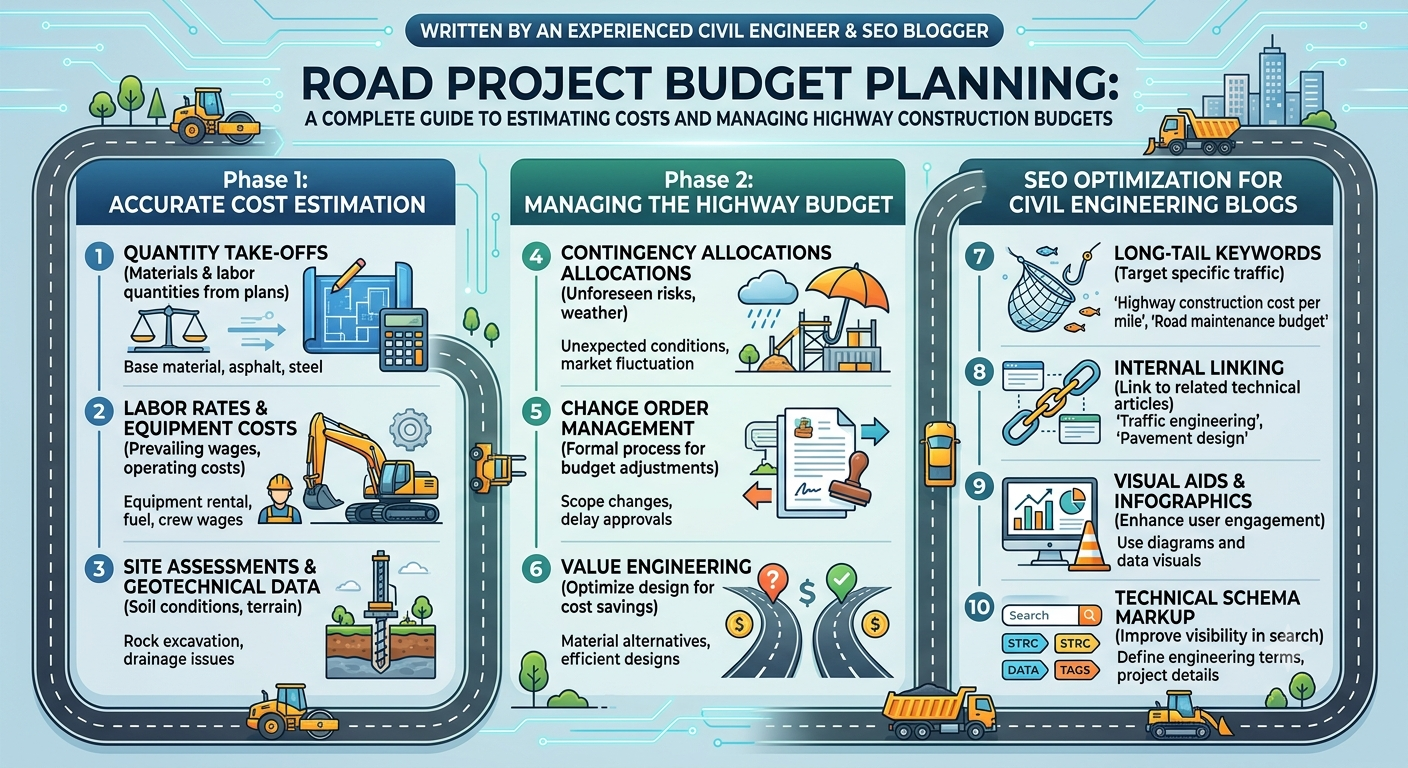
Introduction
Every successful road project begins with more than sound engineering—it starts with a realistic and well-structured budget. Whether constructing a rural access road, a city street, or a multi-lane highway, careful financial planning determines whether the project will be completed on time, within budget, and to the required quality standards.
Road Project Budget Planning is the process of estimating, allocating, monitoring, and controlling the financial resources required throughout a road project’s lifecycle. It covers everything from preliminary surveys and land acquisition to construction, quality control, and maintenance planning. An accurate budget helps project owners avoid unexpected expenses, minimize financial risks, and make informed decisions during every stage of development.
For civil engineers, transportation planners, contractors, and engineering students, understanding budget planning is as important as understanding pavement design or construction methods. A technically sound project can still fail if financial planning is inaccurate or poorly managed.
This comprehensive guide explains the fundamentals of road project budget planning, the major cost components, practical estimation techniques, and engineering best practices used in modern highway projects.
What Is Road Project Budget Planning?
Road Project Budget Planning is the systematic process of calculating the expected cost of designing, constructing, supervising, and maintaining a road project. It combines engineering estimates with financial management to ensure that sufficient funds are available for every activity throughout the project.
Rather than focusing only on construction costs, budget planning includes all project-related expenses, such as:
- Preliminary surveys
- Engineering design
- Land acquisition
- Utility relocation
- Earthworks
- Pavement construction
- Drainage systems
- Bridges and culverts
- Traffic safety installations
- Environmental protection measures
- Quality testing
- Project management
- Contingency allowances
A comprehensive budget acts as a financial roadmap, enabling stakeholders to allocate resources efficiently and monitor expenditures from project initiation to completion.
Why Road Project Budget Planning Is Important
Poor budgeting can result in cost overruns, construction delays, contractual disputes, and compromised quality. By contrast, a well-prepared budget improves decision-making and enhances project success.
Benefits of Effective Budget Planning
- Controls project expenditure
- Supports informed investment decisions
- Reduces financial uncertainty
- Improves resource allocation
- Helps secure project funding
- Minimizes delays caused by budget shortages
- Facilitates cost monitoring during construction
- Enhances transparency and accountability
For government-funded infrastructure projects, accurate budgeting is particularly important because public resources must be managed responsibly.
Major Components of a Road Project Budget
A road construction budget consists of both direct and indirect costs. Understanding these categories helps engineers prepare accurate estimates and avoid overlooking critical expenses.
Direct Costs
Direct costs are directly associated with physical construction activities.
Examples include:
- Earthwork and excavation
- Embankment construction
- Granular sub-base
- Base course
- Asphalt or concrete pavement
- Drainage structures
- Bridges and culverts
- Road signs and markings
- Traffic barriers
- Street lighting
Indirect Costs
Indirect costs support project execution but are not tied to a specific construction activity.
Examples include:
- Project management
- Site offices
- Equipment mobilization
- Temporary utilities
- Insurance
- Permits and approvals
- Quality assurance
- Safety management
- Administrative expenses
Contingency Costs
A contingency allowance is included to cover unforeseen events such as:
- Unexpected ground conditions
- Material price fluctuations
- Design revisions
- Weather-related delays
- Utility conflicts
Including a contingency reserve helps reduce financial risks during project execution.
Road Project Budget Planning Process
Step 1: Define the Project Scope
Every accurate budget begins with a clearly defined project scope. Without understanding exactly what is to be constructed, reliable cost estimation is impossible.
The project scope outlines:
- Project objectives
- Road classification
- Alignment length
- Number of lanes
- Pavement type
- Design standards
- Required structures
- Safety features
- Environmental mitigation measures
Example
A two-lane rural highway and a six-lane urban expressway may have similar lengths, but their budgets differ significantly due to variations in pavement thickness, drainage systems, traffic control devices, bridges, and utility relocation.
Clearly defining the scope prevents cost underestimation and scope creep during construction.
Step 2: Site Investigation and Data Collection
Reliable cost estimates depend on accurate field information. Before preparing the budget, engineers collect technical data through surveys and site investigations.
Typical Site Investigations
Topographic Survey
Provides information about:
- Existing ground levels
- Natural drainage
- Rivers
- Hills
- Existing infrastructure
Geotechnical Investigation
Determines:
- Soil classification
- Bearing capacity
- Groundwater conditions
- California Bearing Ratio (CBR)
- Soil stabilization requirements
Traffic Survey
Collects data on:
- Current traffic volume
- Heavy vehicle percentage
- Future traffic projections
- Design traffic loading
Utility Investigation
Identifies existing:
- Water pipelines
- Electrical lines
- Communication cables
- Gas pipelines
- Sewer systems
Why It Matters
If site investigations reveal weak soil conditions or buried utilities, the budget can be adjusted early to account for stabilization work or utility relocation, avoiding costly surprises during construction.
Step 3: Estimate Material Costs
Material costs typically represent the largest portion of a road construction budget. Engineers prepare detailed quantity estimates based on project drawings, specifications, and material rates.
Common Construction Materials
- Soil fill
- Crushed aggregates
- Granular sub-base
- Wet Mix Macadam (WMM)
- Bitumen
- Asphalt mix
- Cement
- Reinforcement steel
- Concrete
- Geotextiles
- Drainage pipes
- Kerbstones
Factors Affecting Material Costs
- Material availability
- Transportation distance
- Market demand
- Fuel prices
- Supplier competition
- Seasonal price variations
Quantity Take-Off (QTO)
Engineers prepare a Quantity Take-Off (QTO) by calculating the exact quantities required for each work item.
For example:
- Cubic meters of excavation
- Tonnes of asphalt
- Cubic meters of concrete
- Kilometers of drainage pipes
- Square meters of pavement markings
Accurate quantity estimation minimizes waste and improves budget reliability.
Step 4: Estimate Labor and Equipment Costs
In addition to materials, labor and construction equipment account for a significant share of project costs.
Labor Cost Estimation
Labor estimates depend on:
- Project duration
- Workforce size
- Skill level
- Local wage rates
- Productivity
- Working hours
Typical personnel include:
- Site engineers
- Surveyors
- Equipment operators
- Skilled laborers
- General laborers
- Safety officers
- Quality inspectors
Equipment Cost Estimation
Road construction relies on heavy machinery, including:
- Excavators
- Bulldozers
- Motor graders
- Asphalt pavers
- Concrete pavers
- Vibratory rollers
- Dump trucks
- Water tankers
- Cranes
Equipment costs include:
- Rental or ownership
- Fuel consumption
- Operator wages
- Maintenance
- Repairs
- Depreciation
Engineering Principle
Equipment selection should maximize productivity while minimizing idle time. Matching equipment capacity to project requirements helps control costs and improve construction efficiency.
Budget Planning Flow Diagram
Project Scope
      │
      ▼
Site Investigation
      │
      ▼
Quantity Take-Off (QTO)
      │
      ▼
Material Cost Estimation
      │
      ▼
Labor & Equipment Cost Estimation
      │
      ▼
Preliminary Project Budget
This sequence provides a logical framework for developing an accurate and realistic road project budget before construction begins.
Step 5: Estimate Indirect Costs and Contingencies
After calculating direct construction costs, engineers must account for indirect expenses that support project execution. Although these costs do not directly contribute to physical construction, they are essential for delivering the project successfully.
Common Indirect Costs
Project Administration
Administrative expenses typically include:
- Project management staff
- Office facilities
- Documentation
- Communication systems
- Information technology support
Site Establishment
Before construction begins, contractors incur costs for:
- Site offices
- Storage yards
- Temporary fencing
- Worker accommodation
- Temporary utilities
- Security arrangements
Quality Assurance and Safety
Road projects require continuous monitoring to ensure compliance with specifications and safety regulations.
Typical expenses include:
- Material testing
- Laboratory services
- Inspection teams
- Safety equipment
- Training programs
- Environmental monitoring
Contingency Planning
No construction project is free from uncertainty. A contingency allowance is therefore included to manage unforeseen events without disrupting the overall budget.
Typical contingency risks include:
- Unexpected rock excavation
- Weak soil conditions
- Flooding
- Material price increases
- Design modifications
- Delays caused by extreme weather
- Utility relocation issues
Most infrastructure projects include a contingency reserve based on project complexity and risk level. The exact percentage varies according to the owner’s policies and project conditions.
Step 6: Risk Assessment and Cost Control
Effective Road Project Budget Planning is not limited to estimating costs. Continuous risk assessment and cost control are equally important throughout the project lifecycle.
Common Budget Risks
- Inflation
- Fuel price fluctuations
- Labor shortages
- Equipment breakdowns
- Delayed material deliveries
- Design changes
- Contractor performance issues
- Environmental restrictions
Cost Control Strategies
Experienced project managers apply several techniques to maintain financial control.
Regular Cost Monitoring
Compare planned expenditures with actual costs throughout construction.
Progress Reporting
Prepare weekly and monthly financial reports to identify cost trends early.
Value Engineering
Evaluate alternative construction methods and materials that provide equal performance at a lower overall cost without compromising quality.
Change Order Management
Every design modification should be carefully reviewed, approved, and documented before implementation to prevent uncontrolled cost increases.
Engineering Principle
Early identification of financial risks is significantly less expensive than correcting major cost overruns after construction has progressed.
Step 7: Budget Monitoring During Construction
Preparing a budget is only the beginning. Successful projects require continuous monitoring to ensure expenditures remain within approved limits.
Budget monitoring involves comparing actual project costs with the planned budget while tracking work progress.
Key Performance Indicators (KPIs)
Project managers often monitor:
- Planned Value (PV)
- Actual Cost (AC)
- Earned Value (EV)
- Cost Variance (CV)
- Schedule Variance (SV)
- Cost Performance Index (CPI)
These indicators help identify deviations early and support informed decision-making.
Digital Budget Management
Modern road projects frequently use project management software to:
- Track expenditures in real time
- Generate financial reports
- Monitor procurement
- Manage contractor payments
- Forecast remaining project costs
Digital tools improve transparency and reduce manual errors.
Practical Example of Road Project Budget Planning
Consider a proposed 10-kilometer two-lane rural highway.
The engineering team prepares a preliminary budget covering the following work items:
| Budget Component | Example Cost Category |
|---|---|
| Preliminary surveys | Topographic and traffic surveys |
| Engineering design | Geometric design and pavement design |
| Land acquisition | Property purchase and compensation |
| Earthworks | Excavation and embankment construction |
| Pavement works | Sub-base, base, and asphalt layers |
| Drainage | Culverts and side drains |
| Road furniture | Signs, guardrails, and markings |
| Quality control | Material testing and inspections |
| Site administration | Project management and supervision |
| Contingency | Allowance for unforeseen conditions |
Instead of focusing solely on construction costs, the budget considers the complete project lifecycle, providing a more realistic estimate for funding and execution.
Best Practices for Road Project Budget Planning
Successful infrastructure projects consistently follow proven budgeting practices.
- Clearly define the project scope before estimating costs.
- Conduct detailed site investigations and surveys.
- Prepare accurate quantity take-offs (QTO).
- Use current market rates for labor, materials, and equipment.
- Include realistic indirect costs and contingency allowances.
- Review estimates with experienced engineers.
- Update the budget periodically as project conditions change.
- Apply value engineering where appropriate.
- Maintain complete financial documentation.
- Monitor costs continuously during construction.
These practices reduce uncertainty and improve financial performance.
Practical Recommendations
Civil Engineers
- Base cost estimates on verified engineering drawings and site data.
- Coordinate closely with surveyors, geotechnical engineers, and quantity surveyors.
- Review market prices regularly before preparing estimates.
- Consider lifecycle costs rather than only initial construction expenses.
Contractors
- Develop detailed work schedules before preparing financial plans.
- Track equipment utilization to reduce idle time.
- Maintain proper procurement records.
- Monitor labor productivity daily.
- Report cost deviations promptly to project managers.
Engineering Students
- Learn the principles of quantity estimation and BOQ preparation.
- Study cost estimation software used in highway projects.
- Understand how technical decisions influence project budgets.
- Gain practical exposure through internships and site visits.
General Discussion of IRC, AASHTO, and ICE Practices
Internationally recognized engineering organizations promote structured approaches to budgeting and project management.
In general, IRC emphasizes accurate project planning, realistic quantity estimation, quality construction practices, and proper lifecycle maintenance for road infrastructure.
AASHTO encourages agencies to evaluate pavement alternatives, traffic loading, material performance, and long-term asset management when preparing transportation budgets.
ICE promotes effective project management, risk allocation, sustainable infrastructure development, and transparent financial planning throughout the project lifecycle.
Although procedures vary by country and project type, these organizations share common principles:
- Base budgets on reliable engineering data.
- Integrate risk management into financial planning.
- Maintain quality throughout construction.
- Consider long-term maintenance costs.
- Promote efficient use of public resources.
Frequently Asked Questions (FAQs)
1. What is Road Project Budget Planning?
Road Project Budget Planning is the process of estimating, allocating, monitoring, and controlling the financial resources required to complete a road construction project successfully.
2. Why is accurate budgeting important in road construction?
Accurate budgeting helps prevent cost overruns, construction delays, funding shortages, and disputes while improving project planning and financial management.
3. What are the major components of a road project budget?
The primary components include direct construction costs, indirect costs, administrative expenses, quality control, contingency allowances, and project management costs.
4. What is a Quantity Take-Off (QTO)?
A Quantity Take-Off is the process of calculating the quantities of materials, labor, and work items required for construction based on engineering drawings and specifications.
5. Why should contingency costs be included?
Contingency funds provide financial protection against unforeseen events such as price inflation, adverse weather, design changes, or unexpected ground conditions.
6. How can engineers control project costs during construction?
Cost control involves regular financial monitoring, progress reporting, value engineering, efficient procurement, and timely management of change orders.
7. Which professionals contribute to road budget preparation?
Civil engineers, transportation engineers, quantity surveyors, cost estimators, project managers, geotechnical engineers, and contractors all play important roles.
8. What software is commonly used for construction budgeting?
Many organizations use tools such as Microsoft Excel, Primavera P6, Microsoft Project, BIM-based estimating software, and specialized cost estimation applications.
9. How often should a project budget be reviewed?
Budgets should be reviewed regularly throughout the project, especially after major milestones, approved design changes, or significant market price fluctuations.
10. What is the difference between direct and indirect costs?
Direct costs relate to physical construction activities such as earthworks and pavement layers, while indirect costs cover administration, supervision, temporary facilities, safety, and project support services.
Conclusion
Effective Road Project Budget Planning is one of the most important factors influencing the success of any road or highway construction project. A well-prepared budget does far more than estimate construction expenses—it supports informed decision-making, efficient resource allocation, risk management, and long-term financial sustainability. By defining the project scope, conducting detailed site investigations, preparing accurate quantity estimates, evaluating labor and equipment costs, accounting for indirect expenses, and continuously monitoring expenditures, engineers and project managers can significantly reduce the likelihood of cost overruns and schedule delays. Adopting recognized engineering principles, implementing proactive cost control measures, and maintaining transparent financial records contribute to higher-quality infrastructure and improved project outcomes. Whether you are a civil engineer, contractor, quantity surveyor, or engineering student, mastering Road Project Budget Planning is essential for delivering safe, durable, and economically viable transportation infrastructure that meets technical standards and public expectations.

Kamran Malik is a passionate civil engineering writer and researcher who specializes in construction, transportation, structural engineering, and infrastructure topics. Through his articles on CivilEngineerings.com, he simplifies complex engineering concepts and shares practical insights, industry trends, and educational resources for students, professionals, and engineering enthusiasts.