
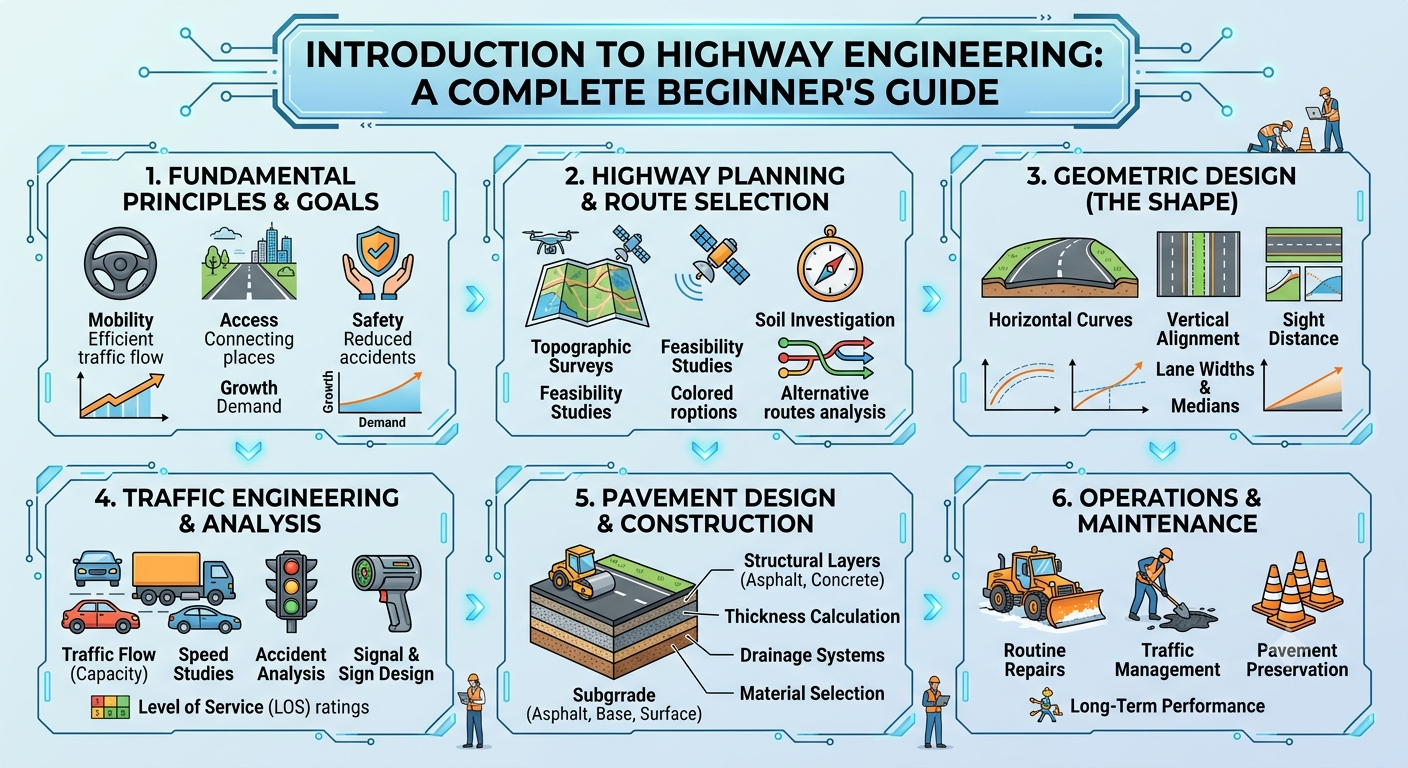
Modern transportation depends heavily on roads and highways. A well-designed highway does more than connect two locations; it supports economic activity, improves accessibility, reduces travel time, strengthens regional connectivity, and provides a safer movement corridor for people and goods. Behind every successful highway project lies a combination of surveying, traffic analysis, geometric design, pavement engineering, drainage, construction management, and maintenance.
This Introduction to Highway Engineering provides a practical foundation for understanding how highway projects are planned, designed, constructed, operated, and maintained. Highway engineering forms an important branch of civil and transportation engineering because it brings together several technical disciplines to create safe, efficient, durable, and economical road infrastructure.
The subject covers much more than drawing a road alignment. Engineers must understand traffic characteristics, terrain, soil conditions, materials, environmental constraints, road safety, drainage requirements, construction methods, and long-term maintenance.
Whether you are a civil engineering student learning the fundamentals, a site engineer working on pavement construction, a consultant preparing highway designs, or a contractor managing field operations, understanding these principles will help you make better engineering decisions.
What Is Highway Engineering?
Highway engineering is a specialized field of civil and transportation engineering concerned with the planning, geometric design, construction, operation, maintenance, rehabilitation, and management of highways and road networks.
It combines engineering theory with practical field requirements. A highway engineer must consider how vehicles behave, how drivers perceive the road, how pavement responds to traffic and climate, and how construction can be completed safely and economically.
A highway project normally progresses through several stages:
- Project identification and feasibility
- Traffic and transportation studies
- Route and corridor selection
- Reconnaissance and surveys
- Preliminary and detailed design
- Land acquisition and utility coordination
- Preparation of drawings and specifications
- Tendering and procurement
- Highway construction
- Quality control and quality assurance
- Opening and operation
- Maintenance and rehabilitation
The objective is not simply to build a road. The real objective is to develop a transportation facility that performs reliably throughout its design life.
Why Highway Engineering Is Important
Highways are among the most visible components of national infrastructure. Their quality directly influences transportation costs, road safety, economic development, and access to essential services.
Economic Development
Efficient highways allow agricultural products, industrial goods, construction materials, and consumer products to move between production centers and markets.
A poorly designed or deteriorated road increases vehicle operating costs, fuel consumption, travel time, and maintenance expenses. A properly engineered highway can produce substantial economic benefits over its service life.
Connectivity and Accessibility
Road networks connect cities, towns, villages, industrial areas, ports, airports, agricultural regions, and commercial centers.
Highway development can also improve access to hospitals, schools, emergency services, and employment opportunities.
Road Safety
Safety must be considered from the earliest planning stage rather than treated as an additional feature after construction.
Highway engineering addresses safety through:
- Appropriate sight distance
- Safe horizontal and vertical alignment
- Adequate lane and shoulder widths
- Proper intersections
- Traffic signs and pavement markings
- Roadside safety features
- Adequate drainage
- Lighting where required
- Pedestrian and cyclist facilities
- Work-zone traffic management
Efficient Transportation
A highway should allow traffic to move smoothly while maintaining acceptable safety and comfort.
Geometric design, pavement condition, intersection control, access management, and traffic operations all influence highway efficiency.
Main Components of Highway Engineering
Highway engineering is multidisciplinary. Several technical areas must work together before a road can perform successfully.
Highway Planning
Planning establishes what transportation facility is required and why it is needed.
Engineers study existing traffic, future development, population growth, freight movement, land use, environmental constraints, and available funding.
Traffic forecasting is particularly important because the highway should accommodate expected demand during its design period.
Highway Surveying
Surveying provides the physical information required for engineering design.
Typical surveys include:
- Topographic survey
- Cadastral survey
- Traffic survey
- Soil investigation
- Geological investigation
- Hydrological survey
- Drainage survey
- Utility survey
- Environmental assessment
Modern highway projects may also use GNSS/GPS, total stations, drones, LiDAR, GIS, and digital terrain models.
Geometric Design
Geometric design determines the physical shape and dimensions of a highway.
Important elements include:
- Design speed
- Carriageway width
- Lane width
- Shoulder width
- Horizontal curves
- Vertical curves
- Superelevation
- Gradients
- Sight distance
- Intersections
- Interchanges
- Median design
- Roadside elements
A successful geometric design balances safety, vehicle performance, driver expectations, terrain, construction cost, and environmental impacts.
Pavement Engineering
Pavement engineering focuses on designing and constructing the structural layers that support traffic.
Common pavement types include:
- Flexible pavement
- Rigid pavement
- Composite pavement
A typical flexible pavement may contain:
Subgrade → Sub-base → Base Course → Binder Course → Wearing Course
Each layer performs a specific structural and drainage-related function.
Traffic Engineering
Traffic engineering deals with the movement of vehicles and road users.
It covers:
- Traffic volume
- Speed studies
- Traffic composition
- Capacity analysis
- Intersection performance
- Parking
- Traffic signals
- Signs and markings
- Pedestrian movement
- Road safety
- Traffic control
Traffic data forms an important input for highway planning and geometric design.
Highway Drainage
Water is one of the major causes of premature road deterioration. Effective drainage prevents water from accumulating on or beneath the pavement.
Highway drainage can include:
- Side drains
- Catch drains
- Cross-drainage structures
- Culverts
- Kerb and channel systems
- Median drainage
- Subsurface drainage
- Roadside channels
The drainage system should safely collect, convey, and discharge runoff without damaging the highway or surrounding property.
Highway Classification
Roads can be classified using different criteria, depending on the country’s road administration system and the purpose of the classification.
Classification by Function
Functional classification commonly considers how a road serves traffic within a transportation network.
Typical categories include:
- Expressways
- Freeways
- Arterial roads
- Collector roads
- Local roads
Arterials generally carry larger traffic volumes over relatively longer distances. Collector roads gather and distribute traffic between local roads and higher-order facilities. Local roads primarily provide property access.
Classification by Pavement Type
From a pavement perspective, highways can be grouped into:
Flexible Pavements
Flexible pavements generally use bituminous or asphalt surfacing over granular or stabilized layers.
Their structural behavior depends on the combined strength of several layers.
Rigid Pavements
Rigid pavements primarily use Portland cement concrete slabs. The slab distributes wheel loads over a relatively broad area.
Joints, load transfer, subgrade support, temperature effects, and concrete properties are important design considerations.
Composite Pavements
Composite systems combine features of flexible and rigid pavement structures.
They may be used where rehabilitation or specific structural requirements make a combined pavement system appropriate.
Fundamental Highway Design Parameters
Highway design depends on several controlling parameters. Engineers should not select dimensions independently because one design decision can influence another.
Design Speed
Design speed is a selected speed used to establish important geometric design features.
It influences:
- Horizontal curve radius
- Superelevation
- Sight distance
- Vertical curve requirements
- Roadside design
- Driver expectations
Higher design speeds generally require flatter curves and greater sight distances.
Sight Distance
Sight distance represents the length of roadway visible to a driver under specified conditions.
One important concept is stopping sight distance (SSD).
A simplified relationship can be expressed as:
SSD = 0.278 V t + V² / (254 f)
Where:
- V = vehicle speed in km/h
- t = perception-reaction time in seconds
- f = coefficient of longitudinal friction
The equation demonstrates an important engineering principle: braking distance increases approximately with the square of speed.
Superelevation
Superelevation is the transverse slope provided on a horizontal curve by raising the outer edge of the pavement.
A commonly used relationship is:
e + f = V² / (127 R)
Where:
- e = superelevation rate
- f = side friction factor
- V = speed in km/h
- R = curve radius in metres
The exact values and limiting criteria should always be taken from the governing design standard.
Horizontal Alignment
Horizontal alignment describes the highway’s position in plan.
It consists of:
- Tangents
- Circular curves
- Transition curves
The alignment should provide a smooth driving path rather than sudden changes in direction.
Engineers also evaluate terrain, property impacts, drainage, intersections, environmental constraints, and construction costs when selecting an alignment.
Vertical Alignment
Vertical alignment describes changes in roadway elevation.
It consists primarily of:
- Grades
- Summit curves
- Valley curves
Vertical curves provide a gradual transition between different grades.
Adequate vertical alignment is important for sight distance, comfort, drainage, heavy-vehicle operation, and construction cost.
Highway Route Selection
Selecting a highway corridor is one of the most consequential decisions in a road project.
Reconnaissance Study
The first investigation generally examines broad corridor alternatives.
Engineers review:
- Topography
- Existing roads
- Rivers and watercourses
- Mountains and steep terrain
- Settlements
- Agricultural land
- Industrial areas
- Protected areas
- Geological conditions
- Major utilities
The goal is to identify feasible alternatives before investing heavily in detailed surveys.
Preliminary Survey
Promising alternatives undergo more detailed investigation.
Survey teams collect topographic information, soil data, drainage information, and other field measurements.
Alternative alignments can then be compared technically and economically.
Final Alignment
The final alignment should provide an appropriate balance between:
- Travel efficiency
- Safety
- Construction cost
- Land acquisition
- Environmental impact
- Earthwork
- Drainage
- Maintenance
- Future expansion
The shortest route is not necessarily the best route. A slightly longer corridor may provide substantially better terrain, drainage, safety, or construction conditions.
Highway Traffic Studies
Traffic information is fundamental to highway design.
Volume
Traffic volume represents the number of vehicles passing a specific point during a defined period.
Common measurements include:
- Hourly traffic volume
- Daily traffic volume
- Average Daily Traffic (ADT)
- Annual Average Daily Traffic (AADT)
Traffic counts help determine existing demand and support future traffic forecasting.
Composition
Traffic composition identifies the types of vehicles using the road.
Typical categories include:
- Passenger cars
- Motorcycles
- Buses
- Light commercial vehicles
- Heavy trucks
- Multi-axle vehicles
Heavy vehicles have a significant influence on pavement loading.
Design Traffic
For pavement design, engineers often need to estimate cumulative traffic over the design period.
A simplified traffic-growth relationship is:
Future Traffic = Present Traffic × (1 + r)ⁿ
Where:
- r = annual growth rate
- n = number of years
Actual pavement design requires more detailed treatment of axle loads, vehicle classes, lane distribution, and cumulative loading.
Pavement Structure and Materials
The pavement must transfer traffic loads to the subgrade without excessive deformation or distress.
Subgrade
The subgrade is the prepared natural soil or improved foundation beneath the pavement structure.
Its strength and moisture condition significantly influence pavement performance.
Common evaluation parameters include:
- California Bearing Ratio (CBR)
- Resilient modulus
- Soil classification
- Moisture condition
- Compaction characteristics
Granular Layers
Sub-base and base layers provide structural support and may also contribute to drainage.
Aggregates should satisfy applicable requirements for:
- Gradation
- Strength
- Durability
- Cleanliness
- Shape
- Abrasion resistance
Bituminous Layers
Asphalt or bituminous materials are widely used in flexible pavement construction.
The performance of asphalt pavement depends on aggregate properties, binder characteristics, mixture design, compaction, temperature, traffic, drainage, and construction quality.
Concrete Pavement
Rigid pavement uses concrete slabs designed to withstand repeated wheel loading and environmental stresses.
Important factors include:
- Concrete strength
- Slab thickness
- Joint spacing
- Load transfer
- Subbase support
- Temperature and moisture effects
- Construction quality
Highway Construction Process
A highway moves from design drawings to physical infrastructure through a carefully controlled construction sequence.
Site Preparation
Initial activities may include:
- Clearing and grubbing
- Removal of unsuitable materials
- Establishment of construction limits
- Utility protection or relocation
- Setting out
- Temporary drainage
- Access arrangements
Earthwork
Earthwork establishes the required formation level.
Major operations include:
- Excavation
- Embankment construction
- Borrow material placement
- Spreading
- Moisture conditioning
- Compaction
- Slope formation
Compaction control is critical because poorly compacted soil can later produce settlement and pavement distress.
Subgrade Preparation
The finished formation must meet specified requirements for level, crossfall, density, and strength.
Weak areas should be identified and treated before pavement layers are placed.
Sub-base and Base Construction
Materials are spread in controlled layers and compacted to specified requirements.
Field density testing, gradation checks, moisture control, and level verification help maintain consistency.
Asphalt or Concrete Construction
For flexible pavement, asphalt layers are placed using suitable paving equipment and compacted within the required temperature range.
For rigid pavement, concrete production, transportation, placement, vibration, finishing, curing, and joint construction require close quality control.
Finishing Works
The final stage may include:
- Road markings
- Traffic signs
- Guardrails
- Delineators
- Lighting
- Drainage finishing
- Landscaping
- Safety barriers
- Roadside works
Before opening the highway, engineers inspect the completed facility against drawings, specifications, safety requirements, and contract conditions.
Highway Drainage and Its Engineering Importance
A highway without effective drainage can deteriorate rapidly.
Water can enter pavement layers through cracks, joints, shoulders, or surface defects. Saturated granular materials may lose strength, while repeated traffic can accelerate deformation and structural failure.
Surface Drainage
Surface drainage removes water from the pavement and roadside.
Cross slope or camber helps water flow toward drainage facilities.
Subsurface Drainage
Where groundwater or infiltrated water threatens pavement performance, subsurface drainage may be necessary.
Drainage layers, edge drains, filter materials, and perforated pipes can be incorporated into appropriate designs.
Culverts and Cross-Drainage
Where natural watercourses cross the highway, engineers may provide culverts or larger drainage structures.
Hydraulic capacity, inlet and outlet conditions, debris, erosion, and flood behavior must be considered.
Highway Safety Engineering
Safety should influence every stage of a highway project.
A technically strong pavement can still produce poor results if the road layout creates unexpected conflicts.
Common Safety Measures
Important measures include:
- Clear sight distance
- Appropriate curve design
- Safe intersection geometry
- Proper signage
- Pavement markings
- Roadside delineation
- Crash barriers where warranted
- Pedestrian crossings
- Median treatment
- Speed management
- Work-zone protection
Road Safety Audit
A Road Safety Audit is a systematic examination of a road project from a safety perspective.
It can be performed at different project stages, including planning, preliminary design, detailed design, construction, and existing-road operation.
The objective is to identify potential crash risks before they become costly operational problems.
Highway Maintenance and Rehabilitation
Highway engineering does not end when construction is complete.
Roads require continuous inspection and maintenance throughout their service life.
Routine Maintenance
Routine activities may include:
- Drain cleaning
- Shoulder maintenance
- Vegetation control
- Crack sealing
- Pothole repairs
- Sign maintenance
- Pavement marking renewal
Periodic Maintenance
Periodic treatments can include:
- Asphalt overlays
- Surface treatments
- Milling and resurfacing
- Joint repairs
- Structural rehabilitation
Pavement Condition Monitoring
Engineers may evaluate:
- Cracking
- Rutting
- Roughness
- Skid resistance
- Deflection
- Surface defects
Preventive maintenance is usually more effective than waiting until a pavement reaches severe structural failure.
Highway Engineering Standards and Guidelines
Highway engineers should design and construct roads according to the standards and specifications applicable to the project jurisdiction.
IRC Guidelines
In India and projects influenced by Indian practice, the Indian Roads Congress (IRC) publishes standards and guidelines covering areas such as geometric design, pavement design, traffic engineering, road safety, materials, and highway construction.
Engineers should always use the latest applicable edition specified by the project authority.
AASHTO Guidance
The American Association of State Highway and Transportation Officials (AASHTO) provides widely referenced guidance for highway geometric design, pavement engineering, materials, transportation planning, and structural considerations.
AASHTO publications are commonly used internationally, although project-specific requirements and local standards take precedence.
ICE and Professional Engineering Practice
The Institution of Civil Engineers (ICE) contributes to professional knowledge, engineering competence, infrastructure practice, project management, and continuing professional development.
Engineers should distinguish between technical guidance, contractual specifications, statutory requirements, and mandatory national standards. The governing project documents always determine which requirements apply.
Practical Highway Engineering Example
Consider a proposed two-lane highway connecting a developing town with an industrial area.
The engineering team should not immediately begin pavement design.
First, planners establish the project’s transportation need. Traffic engineers then collect traffic data and develop forecasts.
Surveyors investigate the available corridor. The design team studies terrain, drainage, soil conditions, utilities, settlements, and environmental constraints.
After selecting a feasible alignment, engineers establish design speed and geometric parameters. Horizontal and vertical alignments are developed while checking sight distance, gradients, curves, intersections, and earthwork.
Next, pavement engineers evaluate the subgrade and expected traffic loading. Appropriate pavement materials and layer thicknesses are selected using the governing design method.
Drainage structures are designed alongside the highway rather than added as an afterthought.
During construction, site engineers verify line, level, layer thickness, material quality, moisture content, and compaction. Quality-control teams conduct laboratory and field tests.
Finally, safety features, road markings, signs, drainage facilities, and other finishing works are inspected before opening.
This example demonstrates a central principle of highway engineering: every component is interconnected.
Practical Recommendations for Civil Engineering Students
Students can build a strong foundation by studying highway engineering as a complete system rather than memorizing isolated formulas.
Focus on Fundamentals
Understand:
- Traffic flow
- Surveying
- Geometric design
- Soil mechanics
- Pavement materials
- Pavement design
- Drainage
- Construction methods
- Road safety
Once the principles are clear, design equations become much easier to understand.
Study Real Road Projects
Look at actual highway drawings, cross sections, pavement reports, traffic studies, and construction photographs.
Try to identify why engineers selected a particular alignment, pavement type, drainage system, or intersection layout.
Learn Engineering Software
Depending on your career direction, useful tools may include:
- Civil 3D
- OpenRoads
- AutoCAD
- GIS software
- Pavement analysis tools
- Traffic simulation software
- Surveying and GNSS software
Software should support engineering judgment rather than replace it.
Practical Recommendations for Highway Engineers
Experienced engineers should maintain a strong connection between design assumptions and field conditions.
Always verify:
- Survey control
- Existing ground levels
- Soil conditions
- Material sources
- Drainage paths
- Utility locations
- Traffic assumptions
- Construction tolerances
- Safety requirements
A drawing can be technically correct yet unsuitable if actual site conditions differ significantly from the assumptions used during design.
Field observations should therefore feed back into engineering decisions.
Practical Recommendations for Contractors and Site Engineers
Construction quality depends heavily on site control.
Contractors should pay particular attention to:
- Material approval
- Equipment calibration
- Moisture control
- Layer thickness
- Compaction
- Temperature during asphalt work
- Concrete curing
- Drainage installation
- Survey checks
- Testing frequency
- Work-zone safety
Do not rely only on final testing. Quality should be controlled during each construction operation.
Good documentation is equally important. Daily records, inspection requests, test results, survey records, material approvals, and as-built information provide valuable evidence of construction quality.
Common Mistakes in Highway Engineering
Several mistakes can undermine an otherwise promising highway project.
Ignoring Drainage
Poor drainage is a frequent contributor to pavement deterioration.
Designing Only for Existing Traffic
A highway should normally account for appropriate future demand rather than serving only today’s traffic.
Excessive Earthwork
An alignment that ignores terrain can dramatically increase excavation, embankment, retaining structures, and project costs.
Treating Safety as an Add-On
Safety should be integrated into alignment, intersections, roadside design, signing, marking, and construction planning.
Neglecting Maintenance
A road with no realistic maintenance strategy can deteriorate much faster than expected.
Future Trends in Highway Engineering
Highway engineering is evolving rapidly as technology, environmental requirements, and transportation patterns change.
Important developments include:
- Intelligent Transportation Systems
- Connected vehicles
- Autonomous vehicle infrastructure
- Drone-based surveying
- LiDAR mapping
- Digital twins
- Building Information Modeling (BIM)
- Artificial intelligence
- Predictive pavement maintenance
- Recycled pavement materials
- Low-carbon construction
- Smart traffic management
- Electric vehicle infrastructure
Future highways will increasingly operate as intelligent transportation assets rather than simply physical pavement corridors.
Frequently Asked Questions About Highway Engineering
What is highway engineering?
Highway engineering is a branch of civil and transportation engineering concerned with planning, surveying, geometric design, pavement design, construction, operation, safety, maintenance, and rehabilitation of highways.
Why is highway engineering important?
It helps engineers develop transportation facilities that are safe, efficient, durable, economical, and suitable for current and future traffic requirements.
What are the main components of highway engineering?
Major components include transportation planning, surveying, traffic engineering, geometric design, pavement engineering, drainage, construction, road safety, maintenance, and rehabilitation.
What is geometric design in highway engineering?
Geometric design determines the physical layout of a highway, including horizontal alignment, vertical alignment, lane width, sight distance, curves, gradients, intersections, shoulders, and related features.
What is the difference between flexible and rigid pavement?
Flexible pavement generally uses bituminous layers over granular or stabilized layers, while rigid pavement primarily uses a concrete slab to distribute traffic loads.
What is stopping sight distance?
Stopping sight distance is the minimum distance required for a driver to perceive a hazard, react, and safely stop the vehicle under specified design conditions.
Which standards are used in highway engineering?
The applicable standards depend on the project location and authority. Commonly referenced systems include IRC publications, AASHTO guidance, national highway standards, local specifications, and professional engineering guidance.
What does a highway engineer do?
A highway engineer may work on route selection, surveys, geometric design, pavement design, drainage, construction supervision, quality control, traffic studies, road safety, maintenance, and rehabilitation.
What software is useful for highway engineering?
Commonly used tools include CAD and civil infrastructure platforms, GIS, surveying software, traffic analysis applications, and pavement design programs. The appropriate software depends on the project’s requirements.
Is highway engineering only about road construction?
No. Highway engineering covers the entire life cycle of a road, from transportation planning and corridor selection through design, construction, operation, maintenance, rehabilitation, and eventual upgrading or replacement.
Conclusion
A strong understanding of the Introduction to Highway Engineering provides the foundation for designing and managing safer, more durable, and more efficient transportation infrastructure. Highway engineering is not limited to pavement construction. It combines transportation planning, surveying, traffic analysis, geometric design, pavement engineering, drainage, road safety, construction management, and maintenance into one interconnected discipline.
For civil engineering students, mastering these fundamentals creates a foundation for advanced highway and transportation studies. For practicing engineers, the same principles help connect design decisions with real field conditions. Contractors and site engineers can use them to improve construction quality, while consultants and government agencies can apply them when evaluating infrastructure projects and long-term transportation needs.
Successful highways come from more than good drawings or strong materials. They require sound engineering judgment, reliable data, appropriate standards, effective construction control, and continuous maintenance. When these elements work together, a highway becomes more than a paved route—it becomes a long-term transportation asset that supports communities, commerce, and economic development.

Kamran Malik is a passionate civil engineering writer and researcher who specializes in construction, transportation, structural engineering, and infrastructure topics. Through his articles on CivilEngineerings.com, he simplifies complex engineering concepts and shares practical insights, industry trends, and educational resources for students, professionals, and engineering enthusiasts.