
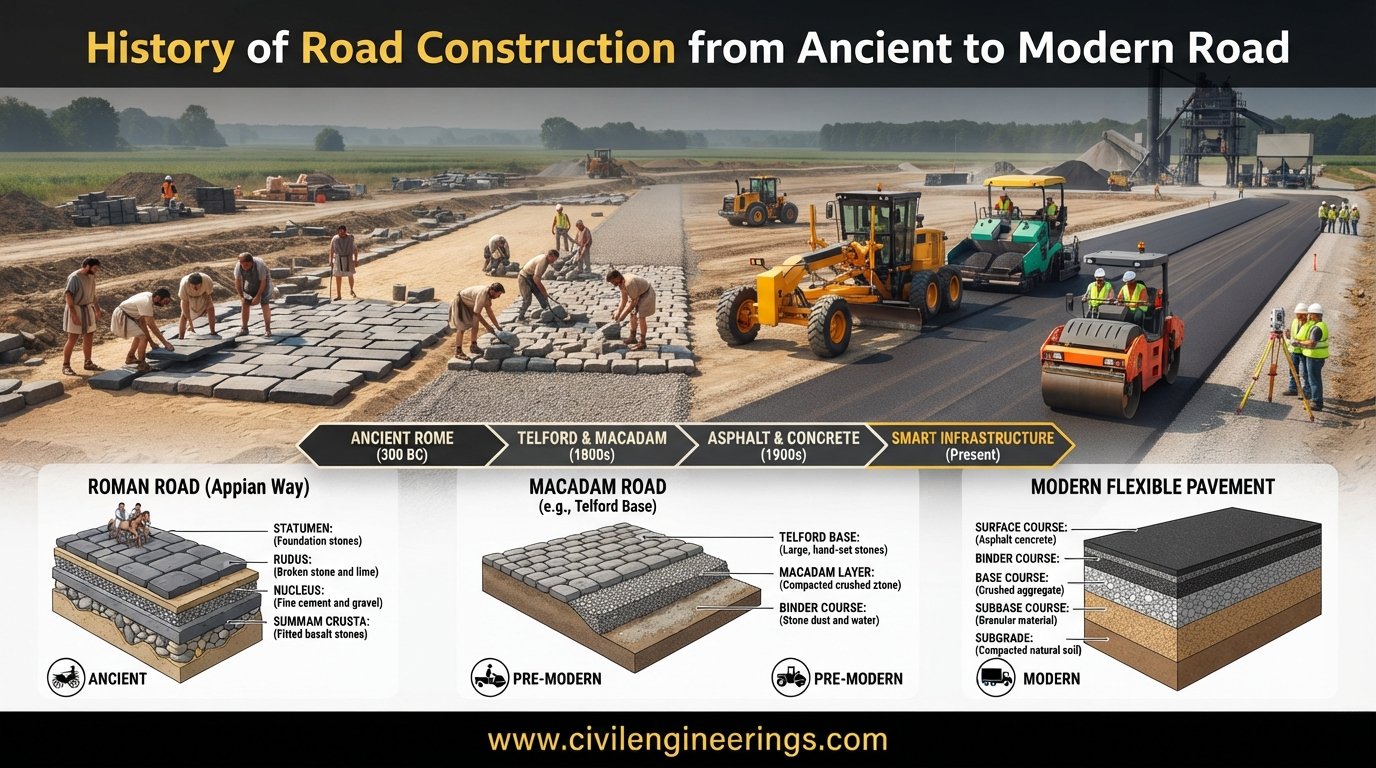
Roads are among the oldest forms of infrastructure created by human civilization. Long before asphalt plants, motor graders, GPS machines, and intelligent transportation systems existed, people were already improving natural paths to move goods, armies, animals, and people more efficiently. The methods changed dramatically, but the engineering objective remained surprisingly familiar: provide a stable, safe, durable, and well-drained route between two locations.
The History of Road Construction is therefore much more than a story about old stone paths. It is the story of how civil engineering developed alongside transportation. From compacted earth tracks and stone-paved Roman highways to macadam roads, asphalt pavements, concrete highways, and modern smart roads, each period introduced solutions to problems faced by its own generation.
For civil engineering students, highway engineers, contractors, and infrastructure professionals, understanding this evolution helps explain why modern pavement structures, drainage systems, geometric design, materials testing, and construction standards exist today. This article follows that development from ancient civilizations to modern highway engineering while highlighting the practical lessons that historical road builders still offer engineers.
The Earliest Roads and Ancient Transportation Routes
The first roads were not engineered highways in the modern sense. They developed from repeated movement along natural routes. Hunters, traders, farmers, armies, and migrating communities gradually created recognizable paths across relatively favorable terrain.
As settlements became larger and trade increased, natural tracks were no longer sufficient. People began clearing vegetation, filling depressions, improving drainage, and strengthening surfaces with locally available materials.
Roads in Mesopotamia and Early Civilizations
Some of the earliest organized transportation routes appeared in the ancient civilizations of Mesopotamia. Early cities required connections to agricultural areas, neighboring settlements, religious centers, and trading locations.
Construction techniques were basic but purposeful. Builders used compacted soil, gravel, stones, and other available materials to improve travel conditions.
The underlying engineering principle was already visible:
Weak natural ground + repeated traffic + water = deterioration.
Ancient builders learned that removing unsuitable material and adding stronger layers could significantly improve a route’s performance.
Roads of the Indus Valley Civilization
The Indian subcontinent has an especially important place in the history of road development. Evidence from the Indus Valley Civilization, dating to approximately 2800 BC, demonstrates organized urban planning and transportation infrastructure. The Indian Roads Congress notes that road development on the subcontinent can be traced back to this period.
Cities such as Mohenjo-daro and Harappa demonstrated sophisticated planning, including organized streets and drainage. Although these urban streets should not be confused with modern highways, their planning reveals an important concept that remains fundamental to road engineering: transportation infrastructure must work together with drainage and urban development.
Persian and Other Long-Distance Routes
Large empires needed reliable routes for communication, administration, commerce, and military movement. The Persian Royal Road became one of the notable ancient long-distance routes, linking important parts of the Persian Empire.
Similarly, extensive transportation networks developed in China and across Central Asia. The Silk Road was not a single engineered highway but a broad network of interconnected routes. It enabled movement of commodities, technologies, cultural practices, and ideas across enormous distances. The FHWA’s historical material also describes the Silk Road as a vast network rather than a conventional single road.
These early systems demonstrate an important transition: roads were becoming strategic infrastructure, not simply paths created by local travelers.
Roman Roads and the Development of Systematic Road Engineering
The Romans transformed road construction into a highly organized engineering activity. Their road network supported military operations, administration, trade, communication, and movement throughout the empire.


Why Roman Roads Were Significant
Roman engineers understood that a durable road required more than a hard surface. They developed layered construction systems, drainage arrangements, surveying techniques, bridges, retaining structures, and route planning.
The Institution of Civil Engineers notes that Roman roads in Britain covered about 4,100 km and frequently connected military sites. It also emphasizes that pavement engineering has a direct relationship with travel, trade, communication, and economic development. (Institution of Civil Engineers (ICE))
A typical high-quality Roman road could contain several structural layers. The exact arrangement varied according to terrain and locally available materials, so there was no single universal Roman pavement specification. (Istrianet)
Typical Roman Road Construction Layers
A simplified Roman pavement structure included:
- Prepared foundation or subgrade – The natural ground was excavated and compacted.
- Statumen – A foundation layer made from relatively large stones.
- Rudus – Coarser aggregate or rubble, often bound with lime-based material.
- Nucleus – A finer, compacted structural layer.
- Summum dorsum or surface paving – Carefully fitted stone blocks formed the wearing surface.
This layered approach resembles a basic principle used in modern pavement engineering: distribute wheel loads through progressively stronger or appropriately graded structural layers before stresses reach the subgrade.
Roman Roads and Drainage
One of the most valuable lessons from Roman construction is the importance of drainage.
Road surfaces were commonly shaped with a crossfall or crown so rainwater could move away from the traffic surface. Side drainage channels helped prevent water from remaining within the pavement structure.
This principle remains central today. Water entering a pavement can reduce subgrade strength, accelerate deformation, promote stripping in asphalt layers, and contribute to frost-related deterioration in suitable climates.
Surveying and Route Alignment
Roman surveyors used instruments such as the groma to establish alignments and geometric relationships. Engineers also constructed bridges and other structures when terrain demanded them.
Some Roman roads were remarkably direct, although terrain, geology, watercourses, and construction practicality influenced individual routes.
The lesson for today’s highway engineer is straightforward: good alignment begins with accurate surveying and an understanding of terrain.
Were Roman Roads Better Than Modern Roads?
It is tempting to claim that Roman roads were more durable than today’s highways. The comparison, however, is misleading.
ICE points out that surviving Roman roads represent selected examples rather than the entire historical road network. Modern highways also carry dramatically heavier and faster traffic, including heavy commercial vehicles that impose loads far beyond those experienced by typical Roman carts. (Institution of Civil Engineers (ICE))
Modern pavement therefore solves a different engineering problem. It must accommodate high axle loads, high speeds, tire-pavement interaction, drainage requirements, environmental effects, construction tolerances, and enormous traffic volumes.
Road Construction During the Medieval Period
After the decline of the Roman Empire, many parts of Europe experienced reduced investment in centralized road infrastructure. Some Roman routes remained in use, while others deteriorated.
Local roads were commonly constructed from earth, gravel, stone, timber, or combinations of locally available materials.
Problems With Medieval Roads
Poor drainage was a major cause of deterioration. Heavy rainfall could turn unpaved routes into mud, while repeated wheel loads produced ruts.
Road maintenance often depended on local communities, landowners, or authorities. Without consistent engineering standards, construction quality varied substantially.
The situation illustrates a principle still relevant to highway maintenance:
A road is not a one-time construction product. It is an infrastructure asset requiring continuous inspection, drainage management, repair, and renewal.
Growth of Trade and Improved Roads
As commerce expanded, better transportation routes became increasingly important. Bridges, causeways, ferries, and improved carriage roads gradually developed.
By the eighteenth century, increasing trade, postal services, industrial activity, and carriage traffic created pressure for more reliable road systems.
This demand helped prepare the ground for the major advances of the eighteenth and nineteenth centuries.
The Turnpike Era and the Professionalization of Road Building
The development of turnpikes marked an important stage in road infrastructure management. Turnpike trusts were established to collect tolls and use the revenue for road improvement and maintenance.
In the United States, the Philadelphia and Lancaster Turnpike, chartered in 1792, became an important early example of a crushed-stone road. FHWA identifies it as the first American road covered with a layer of crushed stone. (Federal Highway Administration)
This period introduced an important connection between:
road quality → travel efficiency → economic activity → funding for maintenance.
Roads were increasingly viewed as economic infrastructure rather than merely local public works.
Telford, McAdam, and the Evolution of Macadam Roads
The late eighteenth and early nineteenth centuries produced major improvements in road engineering, particularly through the work of Thomas Telford and John Loudon McAdam.


Thomas Telford’s Contribution
Thomas Telford promoted stronger foundations, improved drainage, carefully selected materials, and better road geometry.
His approach recognized that a durable road required attention to the foundation rather than simply placing material on the existing ground.
Telford’s work also demonstrated the importance of combining structural design with route selection, drainage, gradients, and construction quality.
John McAdam and Macadam Construction
John Loudon McAdam developed a simpler crushed-stone road construction method that became highly influential.
Instead of relying on huge foundation stones throughout the pavement, his approach emphasized a prepared and well-drained formation followed by carefully graded layers of smaller broken stone.
The objective was to create a dense, stable surface through interlocking aggregate and compaction.
The modern term macadam comes directly from McAdam’s road-building work. ICE identifies bituminous macadam as a pavement material associated with McAdam’s name.
Why Macadam Was Important
Macadam construction represented a major shift toward scientific material selection.
Engineers increasingly considered:
- aggregate size;
- aggregate cleanliness;
- compaction;
- drainage;
- subgrade condition;
- road camber;
- traffic loading; and
- maintenance requirements.
These concepts became building blocks of modern pavement engineering.
The Arrival of Motor Vehicles and Modern Pavement
The invention and rapid adoption of automobiles fundamentally changed road construction.
Horse-drawn vehicles generally imposed relatively modest loads and traveled at low speeds. Motor vehicles introduced greater speed, heavier wheel loads, higher traffic volumes, and new safety requirements.
Road surfaces now needed to provide:
- adequate skid resistance;
- smoother riding quality;
- structural capacity;
- resistance to rutting and cracking;
- improved drainage;
- predictable geometry; and
- reliable performance under repeated traffic.
The development of asphalt and bituminous materials became especially important.
Asphalt and Bituminous Pavements
Modern flexible pavement commonly uses asphalt mixtures containing mineral aggregates bound with bituminous binder.
A simplified flexible pavement structure may include:
Wearing course → binder/base layers → granular base → subbase → compacted subgrade
Each layer performs a different structural and functional role.
The basic load-transfer concept can be represented as:
Wheel load → asphalt surface → base → subbase → subgrade
As the load spreads through the pavement, the stress transmitted to the subgrade decreases.
Pavement Design Becomes Analytical
Road design gradually moved away from purely empirical craftsmanship toward testing and analytical methods.
Engineers began measuring:
- traffic volume;
- axle loads;
- soil strength;
- aggregate properties;
- moisture conditions;
- pavement deflection;
- material durability; and
- environmental effects.
One common modern traffic concept is equivalent single axle load, or ESAL, used in traditional pavement design approaches to represent the damaging effect of different axle configurations.
Conceptually:
Equivalent traffic = Σ(number of axle applications × load equivalency factor)
The exact calculation depends on the selected pavement design methodology and applicable standard.
This transition from experience-based construction to measured engineering is one of the most important developments in the history of road construction.
Road Engineering in the Twentieth Century
The twentieth century transformed road construction from localized projects into large-scale national infrastructure programs.
Automobiles became widespread. Trucks increased freight capacity. Cities expanded. Governments invested heavily in highways.
In the United States, the Federal Highway Administration traces the development of federal highway involvement through predecessor agencies beginning in the late nineteenth and early twentieth centuries. Its highway history also records the Interstate System launched under President Eisenhower in 1956. (Federal Highway Administration)
Development of Highway Standards
Large road networks required consistency.
Engineers needed standardized approaches for:
- geometric design;
- pavement materials;
- aggregate testing;
- drainage;
- bridges and culverts;
- traffic signs;
- road markings;
- construction specifications;
- quality control; and
- maintenance.
AASHTO’s history reflects this professional standardization movement. The organization began as AASHO in 1914 and later became AASHTO in 1973, expanding its focus from state highway officials toward transportation more broadly.
Development of Road Engineering in India
Road engineering in India also became progressively organized during the twentieth century.
The Jayakar Committee was established in 1927 to consider systematic road development. The Indian Roads Congress was subsequently established in 1934, with its inaugural meeting attended by 73 engineers.
The Nagpur Road Plan, formulated in 1943, became an important milestone in systematic road planning in India. Following independence, road development expanded through national and state programs, with classifications including National Highways, State Highways, district roads, and village roads.
For engineers working in South Asia, this history is particularly valuable because today’s road specifications, pavement practices, and highway classifications developed through decades of institutional experience.
From Traditional Highways to Modern Road Construction
Modern highway construction combines lessons accumulated over thousands of years with advanced materials, machinery, surveying, computing, and quality-control systems.


Modern Highway Construction Process
A typical major highway project may involve:
- Feasibility and corridor studies
- Topographic and cadastral surveys
- Geotechnical investigation
- Traffic studies
- Route selection
- Environmental and social assessment
- Detailed geometric design
- Pavement design
- Drainage and hydraulic design
- Utility coordination
- Earthwork and embankment construction
- Subgrade preparation
- Subbase and base construction
- Asphalt or concrete pavement construction
- Road furniture and safety installations
- Quality assurance and testing
- Final inspection and commissioning
- Maintenance and asset management
Unlike ancient road builders, modern engineers can use total stations, GNSS, LiDAR, drones, BIM, pavement-management systems, laboratory testing, finite-element analysis, and intelligent construction equipment.
Yet the fundamental engineering principles remain familiar: stable foundation, appropriate materials, effective drainage, controlled geometry, adequate load capacity, and continuous maintenance.
What Engineers Can Learn From the History of Road Construction
Historical road construction provides practical lessons that remain relevant on modern projects.
Lesson 1: Drainage Is a Structural Requirement
Many premature pavement failures begin with water-related problems.
Engineers should design:
- side drains;
- longitudinal drains;
- cross-drainage structures;
- culverts;
- subsoil drainage where necessary;
- suitable crossfall; and
- erosion protection.
A technically excellent pavement can deteriorate rapidly if water is allowed to remain within the pavement or subgrade.
Lesson 2: The Subgrade Controls Pavement Performance
Ancient engineers improved weak ground with stronger layers. Modern engineers do the same through earthwork, stabilization, replacement, compaction, and engineered pavement layers.
Before construction, determine:
- soil classification;
- moisture condition;
- bearing capacity;
- CBR or other relevant strength parameters;
- groundwater conditions; and
- settlement risk.
Lesson 3: Use Materials Appropriate to the Environment
There is no universal road material that works equally well everywhere.
Material selection should consider:
- traffic loading;
- climate;
- drainage;
- aggregate quality;
- binder characteristics;
- freeze-thaw exposure where applicable;
- availability;
- construction technology; and
- lifecycle cost.
Lesson 4: Construction Quality Matters as Much as Design
A well-designed pavement can fail when contractors ignore layer thickness, moisture, density, temperature, joint preparation, or material specifications.
Field quality control should verify:
Specified requirement → Test result → Acceptance decision
Typical checks include aggregate gradation, moisture content, compaction, asphalt temperature, asphalt density, concrete strength, layer thickness, and surface regularity, depending on pavement type.
Lesson 5: Roads Must Be Designed for Their Actual Traffic
Roman engineers designed for the traffic of their era. Modern engineers must design for today’s traffic and reasonably forecast future demand.
A highway carrying heavy trucks requires a fundamentally different pavement structure from a lightly trafficked rural road.
Traffic forecasting should consider:
- current average daily traffic;
- heavy vehicle percentage;
- axle loading;
- traffic growth;
- lane distribution;
- directional distribution; and
- design life.
Practical Recommendations for Students, Engineers, and Contractors
For Civil Engineering Students
Do not study road history as a collection of dates alone. Connect every historical development to an engineering problem.
For example:
Roman camber → drainage principle
Macadam aggregate → material gradation and interlock
Motor vehicle growth → pavement structural demand
Highway standards → consistency and quality control
This approach makes highway engineering concepts easier to understand.
For Highway and Site Engineers
When reviewing a pavement design or construction site, always look beyond the wearing surface.
Check the complete pavement system, drainage, earthwork, shoulders, slopes, utilities, traffic management, and environmental conditions.
Historical experience repeatedly shows that a road performs as a system, not as an isolated asphalt or concrete layer.
For Contractors
Construction quality should begin before the paver or roller reaches the site.
Confirm:
- approved material sources;
- equipment calibration;
- laboratory test requirements;
- survey controls;
- layer thickness;
- compaction targets;
- asphalt temperature requirements;
- weather limitations;
- drainage arrangements; and
- inspection hold points.
Good construction planning reduces rework and protects both project cost and pavement life.
IRC, AASHTO, and ICE: Their Role in Modern Road Engineering
Historical development eventually led to professional institutions and standardized engineering practice.
The Indian Roads Congress (IRC) provides a major technical framework for road and highway engineering in India and has played a central role in developing guidance for road design, materials, pavement engineering, bridges, traffic engineering, and construction practices. Its institutional history goes back to the road-development initiatives of the 1920s and its formation in 1934. (Indian Register of Companies)
AASHTO has played a comparable standardization role in the United States and internationally. Its transportation material specifications and testing standards provide structured requirements and test methods used across highway engineering practice. (AASHTO Store)
The Institution of Civil Engineers (ICE) has also contributed significantly to professional development and the advancement of civil engineering knowledge. Its modern pavement-engineering resources continue to connect historical road development with contemporary pavement design and infrastructure practice. (Institution of Civil Engineers (ICE))
Engineers should always use the latest applicable edition of the relevant code, specification, contract document, and national authority requirements rather than relying on historical versions.
The Future of Road Construction
The history of road construction does not end with asphalt highways.
Today’s industry is moving toward:
- recycled pavement materials;
- low-carbon construction;
- warm-mix asphalt;
- intelligent compaction;
- automated machine control;
- drone-based surveying;
- digital twins;
- connected infrastructure;
- electric-vehicle charging corridors;
- autonomous-vehicle infrastructure;
- smart traffic management;
- climate-resilient pavement;
- predictive maintenance; and
- data-driven asset management.
The fundamental challenge remains unchanged: build transportation infrastructure that provides safe movement at an acceptable lifecycle cost.
The difference is that engineers now have substantially better tools for understanding and solving the problem.
Frequently Asked Questions About the History of Road Construction
1. What is the History of Road Construction?
The history of road construction describes the development of transportation routes from natural trails and compacted earth paths to engineered stone roads, macadam surfaces, asphalt pavements, concrete highways, and modern intelligent transportation infrastructure.
2. Who Built the First Roads?
There was no single inventor of the first road. Early roads developed independently in different civilizations as people improved frequently used paths. Ancient Mesopotamian, Indus Valley, Persian, Chinese, and Roman societies all contributed to road development.
3. Why Are Roman Roads Important in Highway Engineering?
Roman roads are important because they demonstrated systematic route planning, layered construction, drainage, surveying, bridges, and durable pavement techniques. Their methods illustrate principles that remain relevant to modern pavement engineering.
4. What Did John McAdam Contribute to Road Construction?
John Loudon McAdam developed a crushed-stone road construction approach that emphasized a prepared formation, drainage, and properly sized stone layers. His methods strongly influenced nineteenth-century road construction and gave rise to the term macadam.
5. What Is a Macadam Road?
A macadam road is a road constructed primarily using compacted layers of broken stone. Later developments introduced bituminous binders, leading to forms of bituminous macadam and eventually modern asphalt pavement systems.
6. When Did Modern Highway Engineering Develop?
Modern highway engineering developed progressively during the nineteenth and twentieth centuries. The growth of automobiles, trucks, scientific material testing, pavement research, standardized design methods, and government highway programs accelerated this development.
7. Why Is Drainage Important in Road Construction?
Drainage prevents water from accumulating on or within the pavement structure. Excess water can weaken subgrade soil, accelerate pavement deterioration, cause erosion, and reduce the service life of a road.
8. How Did Automobiles Change Road Construction?
Automobiles introduced higher speeds, greater traffic volumes, rubber tires, heavier vehicles, and new safety requirements. These changes encouraged smoother surfaces, improved geometric design, stronger pavement structures, better skid resistance, and more systematic traffic engineering.
9. What Is the Role of IRC in Road Engineering?
The Indian Roads Congress develops and promotes technical guidance, standards, and professional knowledge related to roads, highways, bridges, traffic engineering, pavement materials, and transportation infrastructure in India. Its origins date to the road-development initiatives of the late 1920s and its establishment in 1934. (Indian Register of Companies)
10. What Can Modern Engineers Learn From Ancient Roads?
Modern engineers can learn the importance of good drainage, durable materials, stable foundations, appropriate route selection, careful surveying, layer-by-layer construction, and regular maintenance. Ancient solutions should not simply be copied, but their underlying engineering principles remain valuable.
Conclusion
The History of Road Construction demonstrates how transportation infrastructure evolved in response to changing human needs, technology, materials, vehicles, and economic activity. Early civilizations improved natural tracks; Roman engineers introduced systematic layered roads and drainage; medieval societies maintained and adapted existing routes; and engineers such as Telford and McAdam transformed road construction through better foundations, materials, and construction methods.
The arrival of motor vehicles created an entirely new engineering challenge and accelerated the development of asphalt pavements, pavement testing, geometric design, traffic engineering, and standardized highway construction. Organizations such as IRC, AASHTO, and ICE helped transform accumulated experience into professional knowledge and engineering guidance.
For today’s civil engineers and contractors, the most valuable lesson is that road construction has always been about solving practical problems through sound engineering. Materials and machinery will continue to evolve, but foundations, drainage, structural capacity, safety, quality control, and maintenance will remain essential.
Understanding where road engineering came from makes it easier to understand where the modern highway industry is going.

Kamran Malik is a passionate civil engineering writer and researcher who specializes in construction, transportation, structural engineering, and infrastructure topics. Through his articles on CivilEngineerings.com, he simplifies complex engineering concepts and shares practical insights, industry trends, and educational resources for students, professionals, and engineering enthusiasts.