
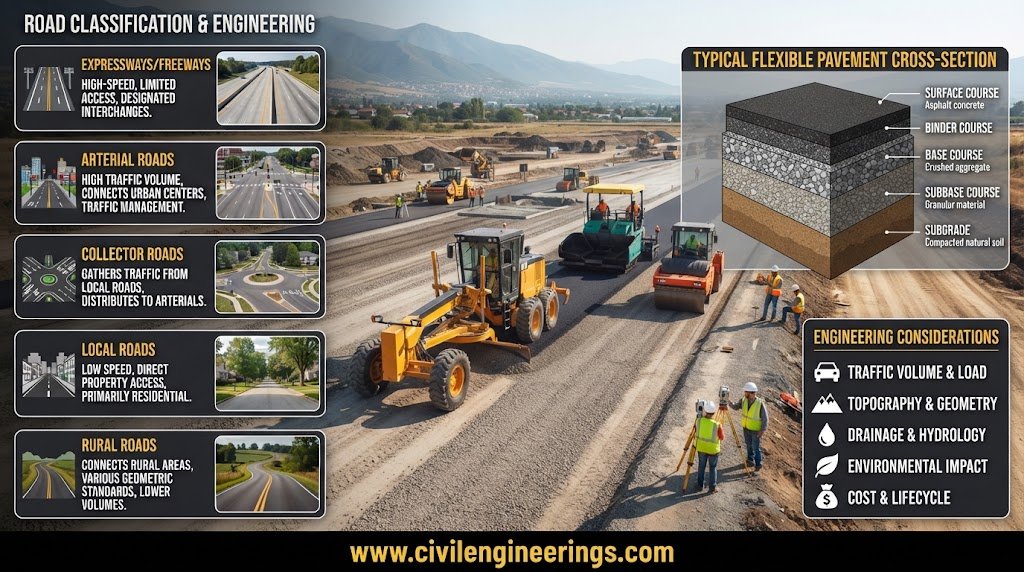
Roads form the backbone of modern transportation systems. From a narrow rural access road to a multi-lane expressway, every roadway serves a particular movement pattern, traffic demand, land-use requirement, and engineering purpose. Understanding these differences is essential for selecting suitable design standards, pavement structures, drainage systems, safety treatments, and maintenance strategies.
The Types of Roads used in a transportation network are not classified by appearance alone. Engineers consider traffic volume, function, location, speed, access control, pavement type, terrain, and administrative importance when deciding how a road should be planned and designed.
For civil engineering students, highway engineers, contractors, consultants, and infrastructure professionals, road classification provides the foundation for many engineering decisions. It influences geometric design, carriageway width, intersection spacing, pavement thickness, right-of-way requirements, and traffic management.
This guide explains the major Types of Roads, their classification systems, applications, engineering characteristics, advantages, limitations, and practical considerations. It also connects conventional road classifications with modern highways, sustainable infrastructure, and internationally recognized engineering practices.
What Are Types of Roads?
Types of roads refer to the different categories of roadways classified according to their function, traffic capacity, location, access control, construction characteristics, or administrative importance.
A road may belong to more than one classification at the same time. For example, a roadway can be a rural arterial road, a paved road, and a two-lane highway simultaneously.
Road classification helps engineers answer several important questions:
- What type of traffic will use the road?
- How much traffic must it carry?
- What operating speed is appropriate?
- How much access should adjacent properties receive?
- What pavement structure is required?
- What road width and right-of-way should be provided?
- Which design standards should engineers apply?
In practice, classification should reflect the road’s function rather than simply its physical appearance.
Classification of Roads by Function
Functional classification is one of the most important approaches used in highway and transportation engineering. It considers how a road performs within the overall transportation network.
Expressways
Expressways provide high-speed movement over relatively long distances with strong access control.
They normally have:
- Divided carriageways
- Grade-separated intersections
- Controlled access
- Median separation
- Limited direct property access
- High design speeds
- Carefully designed interchanges
Expressways are particularly useful when traffic demand is high and uninterrupted movement is important.
An expressway may connect major cities, industrial centers, ports, airports, or strategic economic zones.
Engineering consideration: Because access is controlled, interchange spacing, acceleration lanes, deceleration lanes, sight distance, median design, and emergency stopping facilities require careful attention.
Freeways
A freeway is a highly controlled-access roadway designed for continuous, high-speed traffic movement.
Unlike conventional roads, freeways generally eliminate at-grade intersections. Traffic enters and leaves through ramps connected to interchanges.
Typical features include:
- Full access control
- Grade-separated junctions
- Multiple lanes
- Divided carriageways
- High design speed
- Entry and exit ramps
- Roadside safety barriers
- Advanced traffic management systems
Freeways are especially effective for major intercity and metropolitan traffic corridors.
Arterial Roads
Arterial roads carry relatively large volumes of traffic between major destinations.
Their principal function is mobility rather than direct property access.
Examples include:
- Urban arterial roads
- Rural arterial highways
- Major city boulevards
- Regional connecting routes
Arterials usually have wider carriageways and stronger traffic-control measures than local streets.
In urban areas, engineers must balance mobility with pedestrian crossings, public transport, intersections, roadside development, and access management.
Collector Roads
Collector roads provide a transition between local roads and arterial roads.
They collect traffic from smaller streets and transfer it toward higher-capacity routes.
Their characteristics normally fall between local and arterial roads.
Collectors may serve:
- Residential neighborhoods
- Small commercial areas
- Rural settlements
- Institutional areas
- Industrial districts
A good collector system reduces unnecessary traffic on local streets while distributing vehicles efficiently toward the arterial network.
Local Roads
Local roads primarily provide access to properties rather than long-distance movement.
Examples include:
- Residential streets
- Small village roads
- Access streets
- Neighborhood roads
- Minor rural roads
Their design generally emphasizes:
- Property access
- Low to moderate traffic
- Lower operating speeds
- Pedestrian safety
- Drainage
- Parking management where applicable
A common mistake is to design local roads as miniature highways. Excessive width or speed can encourage undesirable vehicle behavior and increase construction and maintenance costs.
Classification of Roads by Location
Another common approach divides roads according to their geographical setting.


Urban Roads
Urban roads operate within cities and built-up areas. Their design must accommodate much more than vehicle traffic.
Engineers often need to consider:
- Pedestrians
- Cyclists
- Public transportation
- Parking
- Utility corridors
- Drainage
- Commercial access
- Traffic signals
- Intersections
- Street lighting
Urban road engineering is therefore closely connected with transportation planning and land-use planning.
Rural Roads
Rural roads connect villages, agricultural areas, towns, industrial locations, and regional centers.
Traffic volumes can vary significantly. Some rural roads carry heavy freight traffic, while others mainly serve agricultural or local movements.
Important rural-road considerations include:
- Terrain
- Soil conditions
- Drainage
- Agricultural access
- Heavy vehicles
- Roadside hazards
- Long stretches between intersections
- Pavement maintenance
Mountain Roads
Mountain roads present some of the most challenging highway engineering conditions.
Their design must address:
- Steep gradients
- Sharp curves
- Rock slopes
- Landslides
- Snow or ice where applicable
- Surface drainage
- Retaining structures
- Limited right-of-way
Horizontal alignment and vertical alignment require particularly careful coordination.
Village and Settlement Roads
Village roads connect settlements with nearby towns, markets, agricultural areas, and major transportation routes.
Their importance can be greater than their traffic volume suggests because they may provide access to:
- Schools
- Healthcare facilities
- Markets
- Employment centers
- Agricultural production areas
Low-volume does not necessarily mean low importance.
Classification of Roads by Pavement Type
Roads can also be classified according to the structural pavement system used to support traffic.
Flexible Pavement Roads
Flexible pavement generally uses bituminous materials over granular or stabilized layers.
A typical structure may contain:
- Wearing or surface course
- Binder course
- Base course
- Subbase
- Compacted subgrade
The pavement distributes wheel loads through its layered structure.
Flexible pavement is widely used because it offers construction flexibility and can be maintained through overlays and localized rehabilitation.
Typical distresses include:
- Rutting
- Fatigue cracking
- Thermal cracking
- Potholes
- Ravelling
- Bleeding
Proper drainage, material quality, compaction, and pavement thickness are critical to performance.
Rigid Pavement Roads
Rigid pavements generally use Portland cement concrete slabs.
The slab provides significant flexural strength and distributes wheel loads over a relatively broad area.
Typical components include:
- Concrete slab
- Base or subbase
- Subgrade
- Joints
- Load-transfer systems where required
Rigid pavement is often suitable for heavy traffic locations where long-term structural performance is important.
Common concerns include:
- Joint deterioration
- Cracking
- Faulting
- Pumping
- Surface defects
Construction quality and curing have a major influence on concrete pavement performance.
Composite Pavement
Composite pavement combines characteristics of flexible and rigid pavement systems.
One common arrangement uses an asphalt layer over a concrete pavement or a concrete layer incorporated into a broader pavement rehabilitation system.
Composite solutions can be useful when engineers need to improve structural capacity while managing existing pavement conditions.
Classification by Traffic Volume
Traffic demand strongly influences road design.
Engineers commonly analyze traffic using measures such as:
- Average Annual Daily Traffic (AADT)
- Annual Average Daily Traffic
- Peak-hour volume
- Directional distribution
- Commercial vehicle percentage
- Equivalent axle loading
- Design-lane traffic
A simplified traffic relationship is:
where:
- = average traffic flow
- = total traffic volume
- = observation period
For pavement design, engineers need more than vehicle counts. Heavy vehicles produce significantly greater pavement loading than passenger cars, so axle-load characteristics are important.
Traffic growth can also be estimated using:
where:
- = future traffic
- = present traffic
- = annual growth rate
- = number of years
The actual design methodology should follow the selected national or project-specific standard.
Classification by Access Control
Access control determines how easily vehicles can enter or leave a roadway.
Controlled-Access Roads
Controlled-access roads restrict direct connections to adjacent properties.
Access normally occurs through designated interchanges or junctions.
Benefits include:
- Higher operating speeds
- Better traffic flow
- Reduced conflict points
- Improved safety
- Greater travel-time reliability
However, controlled access increases construction costs and requires careful interchange planning.
Partially Controlled-Access Roads
These roads allow some direct access but restrict or manage access at selected locations.
They can provide a practical compromise between mobility and roadside accessibility.
Access management may involve:
- Median openings
- Service roads
- Consolidated driveways
- Intersection spacing
- Turn restrictions
Uncontrolled-Access Roads
Local streets and minor roads commonly allow frequent property access.
They prioritize accessibility over uninterrupted traffic movement.
Classification by Road Construction Material
Roads may also be described according to their surface material.
Bituminous Roads
Bituminous roads use asphalt or bitumen-based pavement layers.
They are popular because they offer:
- Smooth riding quality
- Relatively fast construction
- Easy rehabilitation
- Good initial flexibility
Material selection, temperature, mixing, compaction, drainage, and traffic loading influence service life.
Concrete Roads
Concrete roads use cement concrete as the principal pavement layer.
They can provide:
- High structural capacity
- Long service life under appropriate conditions
- Strong resistance to deformation
- Good performance under heavy loading
Their construction requires accurate batching, placing, finishing, jointing, and curing.
Gravel Roads
Gravel roads use compacted aggregate rather than a conventional paved surface.
They remain important in:
- Low-volume rural networks
- Temporary access routes
- Mining areas
- Construction access
- Remote regions
Regular grading and drainage maintenance are essential.
Earth Roads
Earth roads primarily use locally available soil materials.
They are generally associated with very low-volume access routes. Their performance depends heavily on soil properties, rainfall, drainage, and maintenance.
Classification by Administrative Importance
Road authorities may classify roads according to their administrative or strategic role.


National Highways
National highways generally serve strategic transportation functions and connect major cities, regions, borders, ports, or economic centers.
They often carry substantial passenger and freight traffic.
Regional or Provincial Highways
These roads connect important locations within a province, state, or region.
Their function may include connecting:
- Secondary cities
- District headquarters
- Economic centers
- Agricultural regions
- Major national routes
District Roads
District-level roads usually provide connections among smaller communities and regional centers.
Their traffic demand can vary considerably.
Municipal or Local Roads
Municipal roads serve urban neighborhoods, local commercial areas, residential developments, and public facilities.
Local governments often have responsibility for their operation and maintenance, although arrangements vary by jurisdiction.
Classification by Number of Lanes
Lane configuration provides another practical description of road types.
Single-Lane Roads
Single-lane roads are typically used where traffic demand is very low or physical constraints make wider construction impractical.
Passing arrangements may be necessary depending on road length and traffic conditions.
Two-Lane Roads
Two-lane, two-way roads remain common throughout the world.
They normally contain:
- One lane for each direction
- Shoulders where appropriate
- Centerline markings
- Roadside drainage
- Traffic signs and delineation
Safety performance depends strongly on sight distance, alignment, speed management, pavement condition, and roadside hazards.
Multilane Roads
Multilane roads contain several lanes and can carry higher traffic volumes.
They may be:
- Undivided
- Divided
- Median-separated
Median design is particularly important because it influences safety, turning movements, drainage, and future widening.
Divided Highways
A divided highway separates opposing traffic streams using a median or physical barrier.
The separation can significantly reduce the severity and frequency of opposing-direction conflicts.
Median treatments include:
- Raised medians
- Concrete barriers
- Steel barriers
- Wide depressed medians
- Narrow medians
The appropriate solution depends on speed, available right-of-way, terrain, traffic demand, and safety requirements.
Road Classification and Highway Design
Road classification directly affects geometric design.
Once engineers establish the road’s function, they can determine appropriate design parameters such as:
- Design speed
- Lane width
- Shoulder width
- Horizontal curve radius
- Superelevation
- Stopping sight distance
- Vertical curve length
- Gradient
- Intersection spacing
- Clear zone requirements
For a horizontal curve, a simplified relationship between radius, speed, and lateral forces can be represented by:
where:
- = curve radius in metres
- = speed in km/h
- = superelevation expressed as a decimal
- = side-friction factor
The exact equation, coefficients, and limiting values should always follow the applicable design standard.
Classification also influences pavement design because a major freight corridor requires a substantially different structural solution from a low-volume residential street.
Road Types and Their Practical Applications
| Road Type | Primary Function | Typical Application |
|---|---|---|
| Freeway | High-speed mobility | Major intercity corridors |
| Expressway | Controlled high-speed movement | Urban and regional connections |
| Arterial | Major traffic movement | Cities and regional networks |
| Collector | Traffic distribution | Neighborhood and rural connections |
| Local road | Property access | Residential and minor areas |
| Rural road | Rural connectivity | Villages and agricultural regions |
| Mountain road | Terrain-specific access | Hilly and mountainous areas |
| Gravel road | Low-volume access | Remote and rural areas |
| Divided highway | High-capacity movement | Major traffic corridors |
| Service road | Local access alongside major road | Commercial and urban corridors |
The table demonstrates why no single road type can meet every transportation requirement.
Factors Engineers Should Consider When Selecting a Road Type
Selecting a road category requires a systematic engineering assessment.
Traffic Demand
Current and projected traffic determine the required capacity.
Engineers should examine traffic counts, vehicle classification, peak-hour demand, directional distribution, and growth trends.
Terrain
Flat, rolling, and mountainous terrain can require very different alignments and construction approaches.
Soil and Geotechnical Conditions
Subgrade strength, groundwater, expansive soils, settlement potential, and slope stability can significantly influence pavement and alignment decisions.
Drainage
Poor drainage can shorten pavement life dramatically.
Roadside ditches, cross drainage structures, culverts, stormwater systems, subsoil drainage, and appropriate crossfall should be integrated into the design.
Land Use
Urban commercial corridors require a different access strategy from agricultural roads or controlled-access highways.
Safety
Road classification should support safe operating conditions. Engineers should evaluate:
- Crash history
- Conflict points
- Sight distance
- Pedestrian movement
- Roadside hazards
- Speed environment
- Intersection design
Future Development
A road that performs adequately today may become overloaded after nearby development.
Future traffic, land use, public transport, utilities, and potential widening should therefore be considered during planning.
International Road Design Standards and References
Road classification and highway design practices differ between countries. Engineers should use the standards legally or contractually applicable to the project.
In the United States and many international projects, AASHTO publications provide widely recognized guidance for geometric design, pavement design, roadside safety, and transportation engineering.
In India and neighboring regions, IRC publications are widely used for highway planning, geometric design, pavement engineering, traffic control, and road safety.
The Institution of Civil Engineers (ICE) also provides professional guidance and knowledge resources relevant to infrastructure and transportation engineering.
These references should not be treated as interchangeable. A project team should establish the governing design code at the beginning of the project and maintain consistency throughout design, review, construction, and quality assurance.
Common Mistakes in Road Classification
Even experienced project teams can encounter problems when classification is established without adequate investigation.
Common mistakes include:
- Selecting a road type solely from existing road width.
- Ignoring future traffic growth.
- Providing excessive direct property access on major roads.
- Underestimating heavy-vehicle traffic.
- Neglecting drainage during pavement planning.
- Using inappropriate design speeds.
- Designing intersections without considering the road hierarchy.
- Ignoring pedestrian and cyclist requirements in urban areas.
- Selecting pavement materials without adequate subgrade investigation.
- Failing to coordinate road development with land-use planning.
Classification should be treated as an engineering decision, not merely an administrative label.
Practical Recommendations for Students, Engineers, and Contractors
For Civil Engineering Students
Learn road classification together with highway geometric design, traffic engineering, pavement engineering, and transportation planning.
When studying a road type, ask:
- What is its primary function?
- Who uses it?
- What traffic volume does it carry?
- What speed environment is appropriate?
- How should access be controlled?
- What pavement structure is suitable?
These questions help turn textbook definitions into engineering understanding.
For Highway Engineers and Consultants
Start with network function before selecting geometric parameters.
Review:
- Traffic forecasts
- Vehicle loading
- Terrain
- Geotechnical data
- Existing road conditions
- Land acquisition constraints
- Utility conflicts
- Drainage requirements
- Safety performance
- Future development
Do not finalize classification independently from the broader transportation network.
For Site Engineers
During construction, verify that the built road matches the approved design classification and drawings.
Pay close attention to:
- Formation levels
- Pavement layer thickness
- Material quality
- Compaction
- Crossfall
- Drainage
- Kerb and shoulder details
- Road markings
- Signage
- Construction tolerances
A correctly classified road can still fail if field execution does not meet the design requirements.
For Contractors
Construction planning should reflect the functional importance of the roadway.
Major highways may require strict traffic management, specialized equipment, quality-control laboratories, staged construction, and detailed inspection procedures.
For lower-volume roads, cost-effective local materials may be appropriate when they satisfy engineering requirements.
Future Trends in Road Classification
Road classification is evolving as transportation systems become more connected and technology-driven.
Modern classification increasingly considers factors beyond traditional traffic volume.
Future road planning may incorporate:
- Electric vehicle infrastructure
- Connected vehicle systems
- Autonomous vehicle readiness
- Intelligent transportation systems
- Smart traffic signals
- Dynamic lane management
- Digital traffic monitoring
- Climate resilience
- Low-carbon pavement materials
- Multimodal transportation
A road designed today may need to accommodate technologies and mobility patterns that were not considered when older road classifications were developed.
This makes functional flexibility and future-proof design increasingly important.
Frequently Asked Questions About Types of Roads
What are the main types of roads?
The main types include freeways, expressways, arterial roads, collector roads, local roads, rural roads, urban roads, divided highways, two-lane roads, gravel roads, and concrete or bituminous paved roads.
What is the difference between an arterial road and a collector road?
An arterial road primarily provides major traffic movement between important destinations. A collector road gathers traffic from local streets and distributes it toward arterial routes.
What is the difference between a highway and a freeway?
A highway is a broad term for an important public road designed to carry traffic over a distance. A freeway is a specific type of high-capacity highway with controlled access and grade-separated intersections.
Why is road classification important in civil engineering?
Classification establishes the intended function of a road and helps engineers determine appropriate design speed, lane configuration, access control, pavement requirements, drainage, intersections, and safety treatments.
What are flexible and rigid roads?
Flexible roads generally use asphalt or bituminous pavement layers, while rigid roads primarily use cement-concrete slabs. Their structural behavior, construction methods, maintenance requirements, and design approaches differ.
Which type of road is best for heavy traffic?
For very high traffic volumes and long-distance movement, controlled-access expressways or freeways may be appropriate. Heavy traffic alone does not determine the final road type; terrain, access requirements, network function, and project economics also matter.
What is a collector road used for?
A collector road connects local roads with arterial roads. It collects and distributes traffic while generally providing more mobility than local streets.
Are gravel roads considered highways?
A gravel road can serve as a public highway or road depending on the jurisdiction and its administrative classification. Surface material does not by itself determine whether a road is a highway.
How does traffic volume affect road classification?
Traffic volume influences the required capacity, lane configuration, pavement structure, intersection design, and access control. However, functional importance and network role must also be considered.
Which standards are used for road design?
The applicable standard depends on the country and project. Commonly referenced systems include AASHTO in the United States and international projects, IRC in India, and various national highway standards elsewhere. Professional guidance from organizations such as ICE can also support engineering practice.
Conclusion
Understanding the Types of Roads is fundamental to successful highway and transportation engineering. Roads are not simply strips of pavement; they are carefully classified components of a larger transportation network. Their function determines how traffic should move, how much access should be provided, what design speed is appropriate, and what level of structural and safety performance is required.
Freeways and expressways prioritize high-speed mobility, while arterials move significant traffic between major destinations. Collectors distribute traffic, and local roads focus primarily on property access. Urban, rural, mountain, gravel, flexible, rigid, divided, and multilane roads introduce additional classifications based on location, pavement, geometry, and operational characteristics.
For engineers and project teams, the most important principle is to classify a road according to its intended function and future role, not merely its existing physical form. Traffic forecasting, terrain, soil conditions, drainage, safety, land use, maintenance, and future development should all influence the final decision.
When road classification is integrated properly with geometric design, pavement engineering, traffic management, and construction quality, it creates infrastructure that is safer, more economical, durable, and better suited to long-term transportation needs.
