
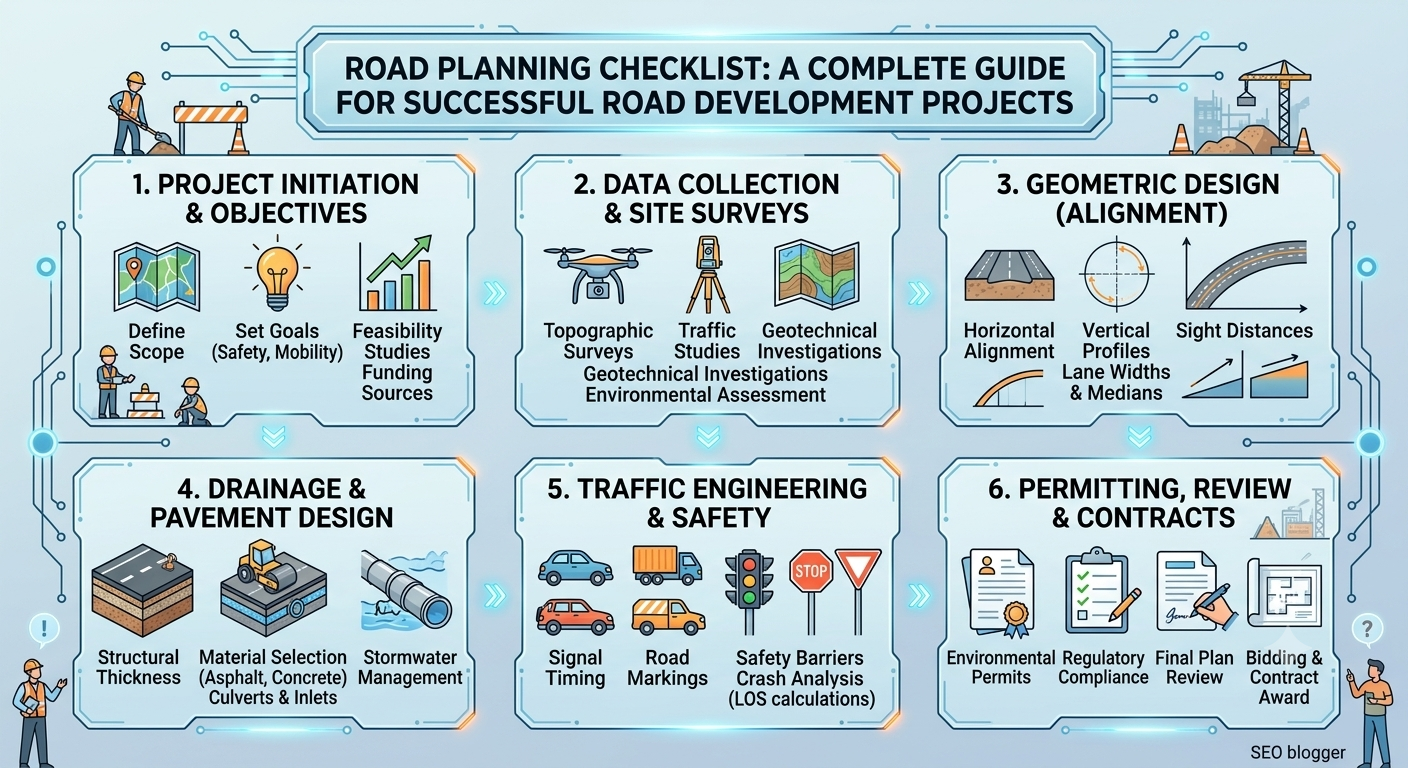
Road planning is the foundation of every successful transportation project. Before excavation begins or pavement materials are delivered, engineers must evaluate numerous technical, environmental, economic, and safety factors. A structured Road Planning Checklist helps ensure that every critical task is completed before construction starts, reducing project risks, minimizing delays, and improving the long-term performance of the roadway.
Whether the project involves a rural access road, an urban street, a national highway, or an expressway, careful planning determines its success. Decisions made during the planning stage influence construction costs, pavement durability, traffic safety, environmental sustainability, and future maintenance requirements. Missing even one important consideration can result in costly redesigns, legal disputes, drainage failures, or premature pavement deterioration.
This guide provides a detailed Road Planning Checklist based on practical highway engineering principles, real-world project experience, and internationally recognized best practices. It is designed to help civil engineers, transportation professionals, contractors, project managers, and engineering students understand the essential steps involved in planning a road project effectively.
What Is a Road Planning Checklist?
A Road Planning Checklist is a structured document that outlines the essential activities, investigations, approvals, and engineering analyses required before road construction begins. It acts as a roadmap for project teams, ensuring that no critical aspect of planning is overlooked.
Rather than focusing only on the physical design of the roadway, a planning checklist considers technical feasibility, traffic requirements, environmental impacts, land availability, project costs, and regulatory compliance. It enables engineers to make informed decisions while reducing uncertainties during construction.
An effective checklist typically includes:
- Project objectives
- Traffic analysis
- Site surveys
- Soil investigation
- Route selection
- Environmental assessment
- Preliminary design
- Utility coordination
- Budget planning
- Risk management
- Regulatory approvals
Using a systematic checklist promotes consistency, improves coordination among stakeholders, and increases the likelihood of delivering a safe, durable, and cost-effective roadway.
Why Road Planning Is Essential
Every successful road begins with thorough planning. Without a clear strategy, even technically sound construction methods may fail to produce a reliable transportation facility.
Road planning allows engineers to evaluate multiple alternatives before committing to a final design. It also identifies potential challenges early, when they are easier and less expensive to resolve.
Key Benefits of Road Planning
- Reduces construction risks.
- Improves traffic safety.
- Optimizes project costs.
- Enhances pavement performance.
- Supports environmental sustainability.
- Minimizes delays and design revisions.
- Facilitates efficient resource allocation.
- Ensures compliance with engineering standards.
A well-prepared planning process creates a strong foundation for every subsequent phase of the project.
Components of an Effective Road Planning Checklist
Road planning follows a logical sequence in which each activity builds upon the previous one. Completing these steps in order allows engineers to gather accurate information and make technically sound decisions.
Step 1: Define Project Objectives
The first item on any Road Planning Checklist is establishing clear project objectives. These objectives define the purpose of the proposed road and guide every planning decision that follows.
Project goals may include:
- Improving regional connectivity.
- Reducing traffic congestion.
- Supporting industrial development.
- Providing access to rural communities.
- Enhancing road safety.
- Reducing travel time.
- Increasing freight movement efficiency.
Engineering Considerations
Engineers should identify:
- Expected road classification
- Design speed
- Target service life
- Future traffic growth
- Available project funding
- Construction timeline
Clearly defined objectives help avoid unnecessary scope changes during later stages.
Practical Example
Suppose a municipality experiences rapid residential development on its outskirts. Existing roads become congested during peak hours, increasing travel times and accident risks. The project objective may be to construct a four-lane arterial road that improves traffic flow while accommodating projected population growth over the next 20 years.
Step 2: Conduct Traffic Demand Assessment
Accurate traffic forecasting is essential for determining the size and capacity of the proposed roadway.
Transportation engineers collect and analyze traffic data to understand both current conditions and future demand.
Information Typically Collected
- Average Daily Traffic (ADT)
- Peak Hour Volume (PHV)
- Vehicle classification
- Heavy truck percentage
- Traffic growth rate
- Travel patterns
- Seasonal traffic variations
Survey Methods
Common traffic surveys include:
- Manual traffic counts
- Automatic traffic counters
- Origin–Destination surveys
- Speed studies
- Axle load surveys
Why Traffic Analysis Matters
Reliable traffic data helps engineers:
- Determine the number of lanes required.
- Design intersections and interchanges.
- Select appropriate pavement thickness.
- Improve traffic safety.
- Estimate future maintenance needs.
Engineering Principle
Highway capacity should accommodate projected traffic demand throughout the design life while maintaining acceptable levels of service.
Step 3: Perform Site Investigation and Topographic Survey
A detailed understanding of existing site conditions is necessary before developing engineering designs.
Data Collected During Site Investigation
- Ground elevations
- Existing roads
- Buildings
- Rivers and streams
- Utility lines
- Drainage patterns
- Vegetation
- Property boundaries
Survey Equipment
Modern surveys commonly use:
- Total Stations
- GNSS/GPS receivers
- Digital levels
- Drones (UAVs)
- LiDAR systems
Importance of Accurate Surveys
Reliable survey information enables engineers to:
- Select economical alignments.
- Estimate earthwork quantities.
- Design drainage systems.
- Minimize construction conflicts.
- Improve project accuracy.
Example
If a survey identifies a flood-prone area along the proposed route, engineers may adjust the alignment or increase embankment heights to reduce flood risk.
Step 4: Carry Out Geotechnical Investigation
The strength and stability of the subsoil have a direct impact on pavement performance.
A geotechnical investigation determines whether the existing ground can safely support the proposed roadway.
Objectives
- Assess soil strength.
- Identify weak or expansive soils.
- Measure groundwater conditions.
- Determine bearing capacity.
- Evaluate settlement potential.
Common Field Investigations
- Borehole drilling
- Trial pits
- Standard Penetration Test (SPT)
- Cone Penetration Test (CPT)
Laboratory Testing
Typical laboratory tests include:
- Grain Size Analysis
- Atterberg Limits
- Moisture Content Test
- Proctor Compaction Test
- California Bearing Ratio (CBR)
- Consolidation Test
Practical Application
If soil tests reveal low bearing capacity, engineers may recommend:
- Soil stabilization using lime or cement.
- Removal and replacement of unsuitable material.
- Geosynthetic reinforcement.
- Increased pavement thickness.
Early identification of poor soil conditions significantly reduces the risk of future pavement failures.
Step 5: Evaluate Environmental and Social Considerations
Modern transportation projects must balance infrastructure development with environmental protection and community needs.
Evaluating environmental and social factors during planning helps reduce long-term impacts and supports sustainable development.
Environmental Factors
Planning teams assess:
- Wetlands
- Forests
- Wildlife habitats
- Watercourses
- Air quality
- Noise levels
- Flood-prone areas
Social Considerations
Important community-related issues include:
- Property acquisition
- Population displacement
- Access to schools and hospitals
- Local businesses
- Cultural heritage sites
- Public consultation
Mitigation Strategies
Common measures include:
- Wildlife crossings
- Noise barriers
- Stormwater management systems
- Reforestation programs
- Erosion and sediment control
- Dust suppression during construction
Engineering Perspective
Considering environmental and social factors at an early stage reduces approval delays, improves public acceptance, and supports responsible infrastructure development.
Simple Road Planning Flow Diagram
Project Need
      │
      ▼
Project Objectives
      │
      ▼
Traffic Assessment
      │
      ▼
Topographic Survey
      │
      ▼
Geotechnical Investigation
      │
      ▼
Environmental Evaluation
      │
      ▼
Proceed to Preliminary Design
Step 6: Route Selection and Highway Alignment
Selecting the most suitable route is one of the most important tasks in the road planning process. The chosen alignment directly influences construction costs, travel efficiency, road safety, environmental impact, and future maintenance requirements.
Rather than selecting the shortest path, engineers compare several alternatives to identify the route that provides the best balance between technical feasibility, economic viability, and environmental sustainability.
Factors Considered During Route Selection
Topography
Natural terrain affects earthwork quantities, drainage requirements, and construction complexity. Gentle slopes generally reduce excavation and embankment costs.
Geology
The alignment should avoid unstable soil, fault zones, landslide-prone areas, and regions with poor bearing capacity whenever practical.
Hydrology
Watercourses, floodplains, wetlands, and seasonal drainage channels require careful evaluation to minimize flooding risks and protect pavement performance.
Existing Infrastructure
Engineers assess nearby utilities, railways, airports, bridges, pipelines, and existing highways to avoid unnecessary conflicts.
Land Use
The selected corridor should minimize impacts on residential areas, agricultural land, commercial developments, and environmentally sensitive locations.
Practical Example
When evaluating two potential alignments, one route may be shorter but require several expensive bridges, while another may be slightly longer yet avoid major structures and reduce long-term maintenance costs. Engineers compare these alternatives before selecting the preferred alignment.
Step 7: Preliminary Geometric Design
Once the alignment has been selected, preliminary geometric design begins. This stage establishes the physical characteristics of the roadway to ensure safe and efficient vehicle movement.
A well-designed geometry improves driving comfort, reduces accident risks, and accommodates future traffic growth.
Main Design Elements
- Design speed
- Lane width
- Shoulder width
- Horizontal curves
- Vertical curves
- Gradients
- Cross slope (camber)
- Sight distance
- Median width
Engineering Principles
Geometric design should:
- Provide consistent driver expectations.
- Minimize sharp curves.
- Maintain adequate stopping sight distance.
- Ensure smooth transitions between curves and tangents.
- Reduce vehicle operating costs.
Practical Application
On mountainous terrain, engineers may introduce wider curves and climbing lanes to improve safety and traffic flow while maintaining acceptable gradients for heavy vehicles.
Step 8: Drainage and Utility Planning
Water is one of the leading causes of pavement deterioration. Effective drainage planning is therefore an essential component of every road project.
At the same time, planners must coordinate existing and proposed utility services to avoid costly conflicts during construction.
Surface Drainage Components
- Side drains
- Kerb and gutter systems
- Median drains
- Catch basins
- Stormwater channels
Cross-Drainage Structures
Where roads intersect natural watercourses, engineers may incorporate:
- Culverts
- Box culverts
- Small bridges
- Causeways
Utility Coordination
Planning also includes identifying and protecting:
- Water supply pipelines
- Sewer lines
- Gas pipelines
- Electrical cables
- Fiber optic networks
- Telecommunications infrastructure
Best Practice
Drainage systems should be designed to handle expected storm events while preventing water from infiltrating pavement layers and weakening the subgrade.
Step 9: Cost Estimation and Budget Planning
Accurate budgeting helps ensure that a project remains financially viable throughout its lifecycle.
Engineers prepare preliminary cost estimates using design quantities, local material prices, labor costs, equipment requirements, and construction schedules.
Typical Cost Components
- Land acquisition
- Earthworks
- Pavement materials
- Drainage structures
- Bridges and culverts
- Utility relocation
- Traffic safety installations
- Environmental mitigation
- Construction supervision
- Contingency allowances
Importance of Cost Planning
A realistic budget enables project owners to:
- Secure funding.
- Compare design alternatives.
- Prioritize project phases.
- Reduce financial risks.
- Improve procurement planning.
Engineering Consideration
Life-cycle cost analysis is often more valuable than comparing only initial construction costs. A slightly higher upfront investment in quality materials may significantly reduce maintenance expenses over the road’s service life.
Step 10: Risk Assessment and Regulatory Approvals
Every infrastructure project faces technical, financial, environmental, and operational risks. Identifying these risks before construction allows project teams to develop appropriate mitigation strategies.
Common Project Risks
- Unstable soil conditions
- Extreme weather
- Construction delays
- Material shortages
- Utility conflicts
- Environmental objections
- Budget overruns
- Traffic management challenges
Risk Mitigation Measures
- Conduct detailed investigations.
- Prepare contingency plans.
- Allocate emergency budgets.
- Schedule work according to seasonal conditions.
- Monitor project progress regularly.
- Maintain effective communication among stakeholders.
Regulatory Approvals
Before construction begins, approval may be required from relevant authorities responsible for:
- Environmental protection
- Land acquisition
- Utility coordination
- Transportation planning
- Local government administration
Obtaining approvals early helps prevent unnecessary interruptions during construction.
Practical Road Planning Checklist
The following checklist summarizes the essential planning activities before construction begins.
| Planning Activity | Completed |
|---|---|
| Define project objectives | □ |
| Forecast traffic demand | □ |
| Complete topographic survey | □ |
| Conduct geotechnical investigation | □ |
| Evaluate environmental impacts | □ |
| Assess social impacts | □ |
| Finalize route alignment | □ |
| Prepare preliminary geometric design | □ |
| Plan drainage systems | □ |
| Coordinate utilities | □ |
| Estimate project costs | □ |
| Prepare project budget | □ |
| Identify project risks | □ |
| Obtain required approvals | □ |
| Review construction readiness | □ |
Using a standardized checklist helps improve coordination among planners, designers, contractors, and project owners while reducing the possibility of overlooking critical tasks.
Best Practices for Effective Road Planning
Successful road planning requires technical expertise, collaboration, and attention to detail. The following practices contribute to better project outcomes:
- Begin planning with reliable traffic and population data.
- Carry out comprehensive field investigations before design.
- Consider future traffic growth rather than current demand alone.
- Integrate drainage planning into the earliest design stages.
- Evaluate multiple route alternatives objectively.
- Use high-quality survey and geotechnical data.
- Engage local stakeholders throughout the planning process.
- Maintain complete project documentation.
- Incorporate sustainable construction principles where feasible.
- Review plans through multidisciplinary engineering teams before approval.
Practical Recommendations
Civil Engineers
- Verify all survey and geotechnical information before preparing design drawings.
- Coordinate closely with transportation, environmental, and structural specialists.
- Review design assumptions regularly as new project data becomes available.
- Prioritize long-term pavement performance over short-term cost savings.
Contractors
- Study planning documents thoroughly before mobilization.
- Identify potential construction constraints early.
- Maintain communication with project consultants regarding design clarifications.
- Follow approved specifications without unauthorized modifications.
Engineering Students
- Develop a strong understanding of traffic engineering, surveying, and pavement design.
- Learn how planning decisions influence construction quality and maintenance costs.
- Visit active road projects to observe planning concepts in practice.
- Study both successful projects and common planning failures to strengthen engineering judgment.
General Discussion of IRC, AASHTO, and ICE Practices
Leading highway engineering organizations emphasize a systematic planning process to achieve safe, durable, and sustainable road infrastructure.
General principles commonly reflected in guidance from IRC, AASHTO, and ICE include:
- Base planning decisions on reliable traffic forecasts and engineering data.
- Conduct detailed topographic, hydrological, and geotechnical investigations before design.
- Design pavements according to anticipated traffic loading and subgrade characteristics.
- Incorporate effective drainage systems to protect pavement performance.
- Consider environmental, social, and economic impacts during route selection.
- Apply quality assurance throughout planning, design, and construction.
- Prioritize road safety through appropriate geometric design and traffic control measures.
- Evaluate long-term maintenance requirements as part of lifecycle planning.
These principles support infrastructure that is resilient, cost-effective, and capable of meeting future transportation demands.
Frequently Asked Questions (FAQs)
1. What is a Road Planning Checklist?
A Road Planning Checklist is a structured list of engineering, environmental, financial, and regulatory activities that should be completed before road construction begins.
2. Why is traffic forecasting important during road planning?
Traffic forecasting helps determine the required road capacity, pavement design, intersection layout, and future expansion needs.
3. What surveys are typically conducted before designing a road?
Engineers commonly perform topographic surveys, traffic surveys, geotechnical investigations, hydrological assessments, and utility mapping.
4. How does soil investigation influence road planning?
Geotechnical investigations identify soil strength and groundwater conditions, enabling engineers to design stable pavement foundations and reduce future maintenance problems.
5. Why should environmental impacts be evaluated during planning?
Early environmental assessment helps protect natural resources, reduces approval delays, and supports sustainable infrastructure development.
6. What role does drainage play in road planning?
Proper drainage prevents water accumulation, protects pavement layers, minimizes erosion, and extends the service life of the roadway.
7. Why is route selection considered one of the most critical planning decisions?
The selected alignment affects construction costs, traffic safety, environmental impacts, travel efficiency, and long-term maintenance requirements.
8. How can a Road Planning Checklist improve project performance?
A checklist ensures that essential planning activities are completed systematically, reducing errors, improving coordination, and minimizing project risks.
9. Who benefits from using a Road Planning Checklist?
Civil engineers, transportation planners, contractors, consultants, project managers, government agencies, and engineering students all benefit from a structured planning approach.
10. Which engineering standards are commonly considered during road planning?
Many projects follow guidance based on nationally adopted standards and recognized engineering practices, including those published by IRC, AASHTO, and ICE, depending on the project’s location and applicable regulations.
Conclusion
A well-prepared Road Planning Checklist is the foundation of every successful road development project. Careful planning ensures that technical investigations, traffic assessments, environmental evaluations, route selection, drainage design, budgeting, and regulatory approvals are completed before construction begins. Each stage contributes to a safer, more economical, and longer-lasting roadway while reducing the likelihood of costly design changes and construction delays. Engineers who follow a structured planning process can make informed decisions, optimize available resources, and improve the overall quality of transportation infrastructure. Contractors benefit from clearer project requirements, while engineering students gain valuable insight into the complete project lifecycle. Whether the project involves a local access road or a major highway, applying a comprehensive Road Planning Checklist helps deliver infrastructure that meets engineering standards, serves communities effectively, and remains reliable throughout its intended design life. Thorough planning today creates stronger, safer, and more sustainable roads for future generations.

Kamran Malik is a passionate civil engineering writer and researcher who specializes in construction, transportation, structural engineering, and infrastructure topics. Through his articles on CivilEngineerings.com, he simplifies complex engineering concepts and shares practical insights, industry trends, and educational resources for students, professionals, and engineering enthusiasts.