
Introduction
Every safe, durable, and efficient road begins with a well-designed Road Cross Section. Engineers use a road cross section to define the width, shape, and arrangement of every structural and functional element across a roadway. This drawing guides construction teams, supports drainage, improves safety, and ensures the pavement performs as expected throughout its design life.
A properly designed Road Cross Section balances traffic demand, pavement strength, environmental conditions, construction costs, and future maintenance. It also helps engineers allocate sufficient space for traffic lanes, shoulders, medians, sidewalks, drainage systems, and utility corridors. Without an accurate cross section, even a technically sound highway alignment can experience drainage failures, pavement distress, traffic congestion, and safety issues.
This guide explains the concept of a road cross section, its major components, engineering principles, practical applications, and best practices. Whether you are a civil engineering student, highway designer, contractor, or site engineer, understanding this topic will strengthen your knowledge of modern road engineering.
What Is a Road Cross Section?
A Road Cross Section is a vertical slice taken perpendicular to the road centerline. It shows the arrangement, dimensions, and elevations of every element from one edge of the roadway to the other.
Unlike a road plan that displays the alignment from above, a cross section illustrates the road’s width, pavement layers, shoulders, drainage features, embankments, and surrounding ground levels.
Purpose of a Road Cross Section
A well-prepared road cross section helps engineers:
- Define pavement width.
- Establish lane configurations.
- Design effective drainage.
- Calculate earthwork quantities.
- Improve traffic safety.
- Optimize construction costs.
- Ensure compliance with design standards.
Road cross sections serve as essential construction drawings throughout the project lifecycle.
Why Is a Road Cross Section Important?
The road cross section directly influences the safety, performance, and durability of a roadway. Every component works together to support traffic loads and manage surface water effectively.
Key Benefits
Improves Safety
Clearly defined lanes, shoulders, medians, and sidewalks reduce the likelihood of traffic conflicts and provide recovery space for vehicles.
Enhances Drainage
Proper cross slopes and drainage channels move rainwater away from the pavement, reducing the risk of hydroplaning and pavement deterioration.
Increases Pavement Life
Efficient load distribution and water management help preserve pavement strength and extend service life.
Supports Accurate Construction
Contractors use cross-sectional drawings to build the roadway according to approved dimensions and elevations.
Simplifies Maintenance
Maintenance teams can easily identify roadway components and perform repairs without disrupting adjacent features.
Types of Road Cross Sections
Road engineers prepare different types of cross sections during planning, design, and construction.
1. Typical Cross Section
A typical cross section illustrates the standard layout that repeats along most sections of the road.
It includes:
- Lane widths
- Shoulder dimensions
- Median width
- Pavement layers
- Side slopes
- Drainage features
Engineers use this drawing as the primary reference during construction.
2. Existing Cross Section
An existing cross section represents current ground conditions before construction begins.
Surveyors prepare these drawings using field survey data.
Existing cross sections help engineers:
- Estimate excavation volumes.
- Identify natural drainage paths.
- Evaluate terrain conditions.
- Compare existing and proposed ground levels.
3. Proposed Cross Section
A proposed cross section shows the final design after grading and construction.
It indicates:
- Finished road levels
- Pavement structure
- Drainage systems
- Earthwork limits
- Embankments
- Cut slopes
Construction teams rely on these drawings throughout the project.
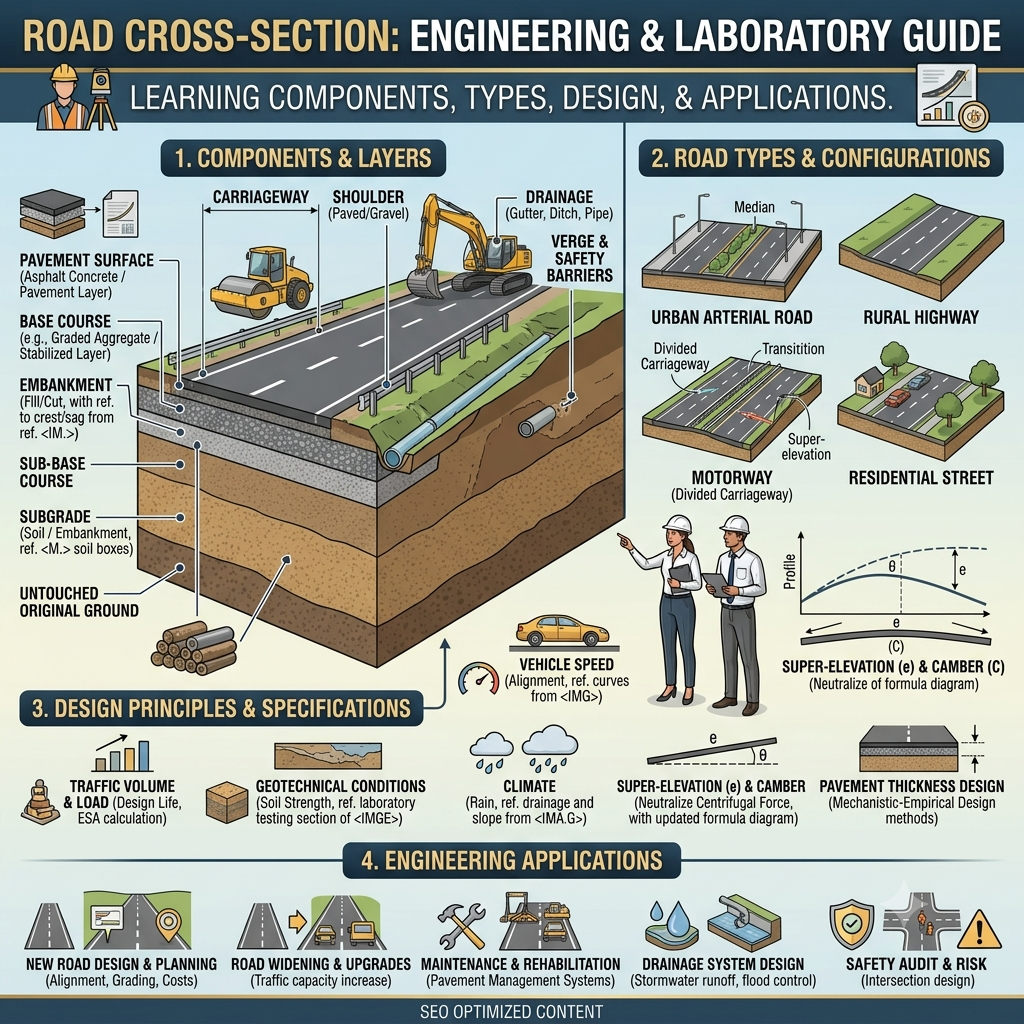
Components of a Road Cross Section
Every road cross section includes several structural and functional elements. Each component contributes to roadway safety, stability, and operational efficiency.
1. Right of Way (ROW)
The Right of Way (ROW) represents the total land reserved for the road and its associated infrastructure.
It typically accommodates:
- Carriageway
- Shoulders
- Medians
- Sidewalks
- Utility corridors
- Drainage channels
- Future road widening
A sufficient ROW allows future expansion without extensive land acquisition.
2. Carriageway
The carriageway forms the portion of the road used by moving vehicles.
Its width depends on:
- Traffic volume
- Design speed
- Road classification
- Vehicle composition
A two-lane highway generally provides one lane for each direction, while expressways may include multiple lanes separated by a median.
3. Traffic Lanes
Traffic lanes organize vehicle movement and improve operational efficiency.
Standard lane widths vary depending on design standards and roadway type.
Proper lane dimensions:
- Improve traffic flow.
- Reduce side-swipe collisions.
- Increase driver comfort.
- Support heavy commercial vehicles.
4. Shoulders
Shoulders occupy the area immediately beside the carriageway.
Functions of Shoulders
- Emergency parking
- Vehicle recovery
- Structural support
- Maintenance access
- Drainage improvement
Paved shoulders often enhance safety on high-speed highways.
5. Median
The median separates opposing traffic streams.
Depending on roadway classification, medians may be:
- Raised
- Depressed
- Painted
- Landscaped
Advantages
- Reduces head-on collisions
- Controls turning movements
- Accommodates future widening
- Improves driver comfort
- Provides space for lighting and barriers
6. Kerbs
Kerbs define the boundary between the carriageway and adjacent facilities.
They help:
- Guide drainage flow
- Protect sidewalks
- Improve roadway appearance
- Separate traffic from pedestrians
Urban roads commonly use concrete kerbs.
7. Sidewalks
Sidewalks provide dedicated space for pedestrians.
Proper sidewalk design improves:
- Public safety
- Accessibility
- Urban mobility
- Walkability
Pedestrian facilities should remain continuous and unobstructed.
8. Cycle Tracks
Many modern highways and urban roads include cycle tracks to encourage sustainable transportation.
Separated bicycle lanes:
- Improve cyclist safety.
- Reduce conflicts with vehicles.
- Support environmentally friendly travel.
9. Side Slopes
Road embankments and cuttings require stable side slopes to prevent erosion and slope failure.
The slope ratio depends on:
- Soil type
- Height of embankment
- Drainage conditions
- Stability requirements
Vegetation often protects slopes against erosion.
10. Drainage System
Drainage remains one of the most important elements of a road cross section.
Common drainage features include:
- Side drains
- Kerb drains
- Catch basins
- Culverts
- Median drains
An efficient drainage system removes surface water quickly and protects pavement layers from moisture damage.
11. Embankment or Cutting
Roads rarely follow natural ground exactly.
Engineers construct:
Embankments
Where the roadway lies above existing ground.
Cuttings
Where excavation lowers high ground to achieve the required road level.
Proper earthwork improves visibility, reduces gradients, and enhances ride quality.
Road Cross Section Diagram
Typical Highway Cross Section
                 ROAD RIGHT OF WAY (ROW)
|-----------------------------------------------------------------------|

 Drain   Shoulder   Lane   Lane   Median   Lane   Lane   Shoulder   Drain
   |         |        |      |       |        |      |        |         |
 __|_________|________|______|_______|________|______|________|_________|__
             ←-------- Carriageway --------→

                Cross Slope (Camber)
                     ↘        ↙

================ Asphalt Surface =================
================ Base Course =====================
================ Sub-base ========================
================ Compacted Subgrade ==============
================ Natural Ground ==================
Reading the Diagram
- The Right of Way includes the entire transportation corridor.
- The Carriageway contains the traffic lanes.
- Shoulders provide structural support and emergency stopping space.
- The Median separates opposing traffic.
- Drains remove stormwater from the pavement.
- The Camber (cross slope) directs water toward the drainage system.
- The pavement structure distributes vehicle loads to the natural ground.
Engineering Principles Behind Road Cross Sections
Highway engineers follow several core engineering principles while designing a road cross section.
Structural Stability
Every pavement layer must distribute traffic loads efficiently to prevent excessive stresses on the subgrade.
Drainage Efficiency
Engineers provide adequate cross slopes and drainage facilities to remove water quickly from the pavement surface.
Traffic Safety
Lane widths, shoulders, medians, and clear zones should provide sufficient space for safe vehicle operation.
Economic Design
Designers balance construction costs, maintenance expenses, and long-term performance to achieve the most economical solution.
Future Expansion
Where possible, the cross section should allow future lane additions or utility installations without major reconstruction.
Practical Engineering Example
Imagine a proposed four-lane divided highway connecting two rapidly growing cities. Traffic forecasts indicate significant growth over the next twenty years, including a high percentage of heavy trucks.
The design team develops a Road Cross Section featuring four traffic lanes, paved shoulders, a landscaped median, lined side drains, and a wide Right of Way that accommodates future widening. Engineers also include cycle tracks and sidewalks near urban sections to improve safety for non-motorized users. This integrated design enhances traffic flow, supports long-term infrastructure development, and reduces future reconstruction costs.
Key Takeaways
A well-designed Road Cross Section forms the backbone of every successful highway and roadway project. It defines the arrangement of structural and operational elements that ensure safety, durability, efficient drainage, and smooth traffic movement. Understanding the purpose of each component—from the carriageway and shoulders to the drainage system and Right of Way—helps engineers create resilient transportation infrastructure that meets present demands while accommodating future growth.
Design Considerations for a Road Cross Section
Designing an efficient Road Cross Section requires careful planning and sound engineering judgment. Every decision affects traffic operations, pavement performance, construction cost, maintenance requirements, and road safety. Highway engineers evaluate several technical factors before finalizing the cross-sectional layout.
1. Traffic Volume and Road Classification
Traffic demand determines the number of lanes, shoulder width, median type, and pavement thickness.
For example:
- Local roads usually require two lanes.
- Arterial roads often include four or six lanes.
- Expressways may include multiple carriageways with wide medians.
Designers also consider the percentage of heavy commercial vehicles because trucks impose greater loads on the pavement.
2. Design Speed
Design speed influences several cross-section elements, including:
- Lane width
- Shoulder width
- Median width
- Horizontal clearance
- Cross slope
- Safety zones
Higher design speeds require wider shoulders and improved roadside safety features.
3. Terrain Conditions
Topography significantly affects the road cross section.
Different terrain types require different design solutions.
Flat Terrain
- Lower earthwork costs
- Easier drainage design
- Simpler construction
Rolling Terrain
- Moderate cut-and-fill operations
- Balanced embankment design
Mountainous Terrain
- Retaining walls
- Steeper cut slopes
- Rock excavation
- Additional drainage structures
4. Soil Conditions
The strength of the foundation soil directly influences pavement design.
Weak soils may require:
- Soil stabilization
- Geotextiles
- Geogrids
- Additional pavement thickness
- Improved drainage
Strong foundation soils generally reduce construction costs.
5. Drainage Requirements
Water remains one of the greatest threats to pavement performance.
Engineers design road cross sections with adequate cross slopes, side drains, culverts, and stormwater channels to remove surface runoff quickly.
Poor drainage often leads to:
- Potholes
- Rutting
- Edge failures
- Pavement cracking
- Erosion
6. Climate and Weather
Local climate influences both pavement materials and cross-sectional design.
Engineers consider:
- Rainfall intensity
- Snowfall
- Flood potential
- Temperature variation
- Freeze-thaw cycles
These factors affect drainage capacity, pavement thickness, and material selection.
Best Practices for Designing a Road Cross Section
Experienced highway engineers follow proven practices to achieve safe, durable, and economical roads.
Conduct Accurate Surveys
Reliable topographic and geotechnical surveys provide the foundation for successful design.
Design Effective Drainage
Remove water quickly from the pavement surface and protect the subgrade from excessive moisture.
Provide Adequate Shoulders
Well-designed shoulders improve vehicle recovery, emergency stopping, and pavement edge support.
Maintain Consistent Cross Slopes
Uniform cross slopes improve drainage and driving comfort while reducing maintenance problems.
Consider Future Expansion
Reserve sufficient Right of Way to accommodate future traffic growth and utility installations.
Prioritize Road Safety
Include medians, guardrails, pedestrian facilities, and clear roadside zones wherever appropriate.
Use High-Quality Materials
Approved materials improve pavement strength, reduce maintenance, and extend service life.
Common Mistakes in Road Cross Section Design
Several avoidable mistakes reduce pavement performance and increase maintenance costs.
Inadequate Drainage
Poor drainage allows water to weaken pavement layers and the subgrade.
Narrow Shoulders
Insufficient shoulder width reduces safety and limits emergency stopping space.
Poor Earthwork Design
Improper cut and fill operations can cause slope instability and settlement.
Ignoring Traffic Growth
Designing only for current traffic often leads to congestion and expensive future widening.
Weak Subgrade Preparation
Poor compaction and untreated weak soils shorten pavement life.
Improper Median Design
An undersized or poorly planned median reduces operational efficiency and safety.
Practical Recommendations
Civil Engineers
- Verify survey and soil investigation reports before finalizing the cross section.
- Coordinate pavement, drainage, and structural designs to ensure compatibility.
- Review traffic forecasts for the entire design life.
- Inspect construction regularly to confirm compliance with design drawings.
Contractors
- Follow approved cross-sectional dimensions throughout construction.
- Check elevations frequently during grading.
- Protect drainage structures from construction debris.
- Compact every pavement layer according to project specifications.
Engineering Students
- Study standard highway cross-section drawings.
- Understand the purpose of each roadway component.
- Learn pavement layer functions and material properties.
- Visit construction sites to observe real-world applications.
Practical Applications of a Road Cross Section
Road cross sections serve many engineering purposes beyond construction.
Highway Projects
Engineers use cross sections to determine lane widths, embankment heights, and pavement structure.
Urban Streets
Designers integrate sidewalks, cycle tracks, parking lanes, utility corridors, and drainage systems.
Rural Roads
Cross sections focus on economical construction while providing adequate safety and drainage.
Road Rehabilitation
Engineers compare existing and proposed cross sections to evaluate widening requirements and pavement strengthening.
General Discussion of IRC, AASHTO, and ICE Practices
Highway agencies worldwide follow established engineering principles when preparing road cross sections. Although project requirements differ by country, organizations such as the Indian Roads Congress (IRC), AASHTO, and the Institution of Civil Engineers (ICE) promote similar best practices.
These principles generally include:
- Designing cross sections according to projected traffic demand.
- Providing sufficient lane and shoulder widths for safe operation.
- Ensuring effective surface and subsurface drainage.
- Considering future road expansion during planning.
- Designing stable embankments and cut slopes.
- Selecting durable pavement materials based on local conditions.
- Incorporating pedestrian and cyclist facilities where appropriate.
- Applying quality assurance throughout construction.
Following these established engineering practices improves safety, durability, and long-term value.
10 Frequently Asked Questions (FAQs)
1. What is a road cross section?
A road cross section is a vertical view across a roadway that shows the arrangement and dimensions of pavement layers, lanes, shoulders, medians, drainage systems, and other roadway elements.
2. Why is a road cross section important?
It provides the detailed layout needed for safe design, efficient drainage, accurate construction, and long-term pavement performance.
3. What is the difference between a road plan and a road cross section?
A road plan presents the roadway from above, while a road cross section displays the roadway as if sliced across its width, revealing structural and geometric details.
4. What are the main components of a road cross section?
Typical components include the Right of Way, carriageway, traffic lanes, shoulders, median, kerbs, sidewalks, drainage system, side slopes, and pavement layers.
5. How does cross slope improve road performance?
Cross slope directs rainwater toward drainage channels, preventing water accumulation and protecting pavement layers from moisture damage.
6. What factors influence road cross-section design?
Traffic volume, design speed, terrain, soil conditions, climate, drainage requirements, safety standards, and future expansion plans all influence the design.
7. Why are shoulders included in road cross sections?
Shoulders provide emergency stopping space, support pavement edges, improve drainage, and increase overall roadway safety.
8. What role does the median play?
The median separates opposing traffic, reduces head-on collisions, improves traffic flow, and provides space for future widening or safety barriers.
9. How does a road cross section help contractors?
Cross-sectional drawings guide excavation, grading, pavement construction, drainage installation, and quality control by providing exact dimensions and elevations.
10. Which engineering standards guide road cross-section design?
Engineers generally follow national highway standards and internationally recognized guidance, including recommendations published by IRC, AASHTO, and ICE, while adapting them to local regulations and project conditions.
Conclusion
A well-planned Road Cross Section forms the structural and functional foundation of every successful roadway project. It defines how traffic lanes, shoulders, medians, drainage systems, pavement layers, and roadside features work together to create a safe, durable, and efficient transportation corridor. Careful cross-section design improves drainage, increases pavement life, enhances road safety, and reduces long-term maintenance costs. Engineers must evaluate traffic demand, soil characteristics, terrain, climate, and future expansion requirements before finalizing the layout. Contractors must follow approved drawings precisely, while engineering students should understand the purpose of every component to build strong technical knowledge. By applying established engineering principles and recognized practices from organizations such as IRC, AASHTO, and ICE, professionals can design road infrastructure that delivers reliable performance for decades. A properly engineered Road Cross Section remains one of the most important elements in achieving sustainable, economical, and high-quality highway construction.
