
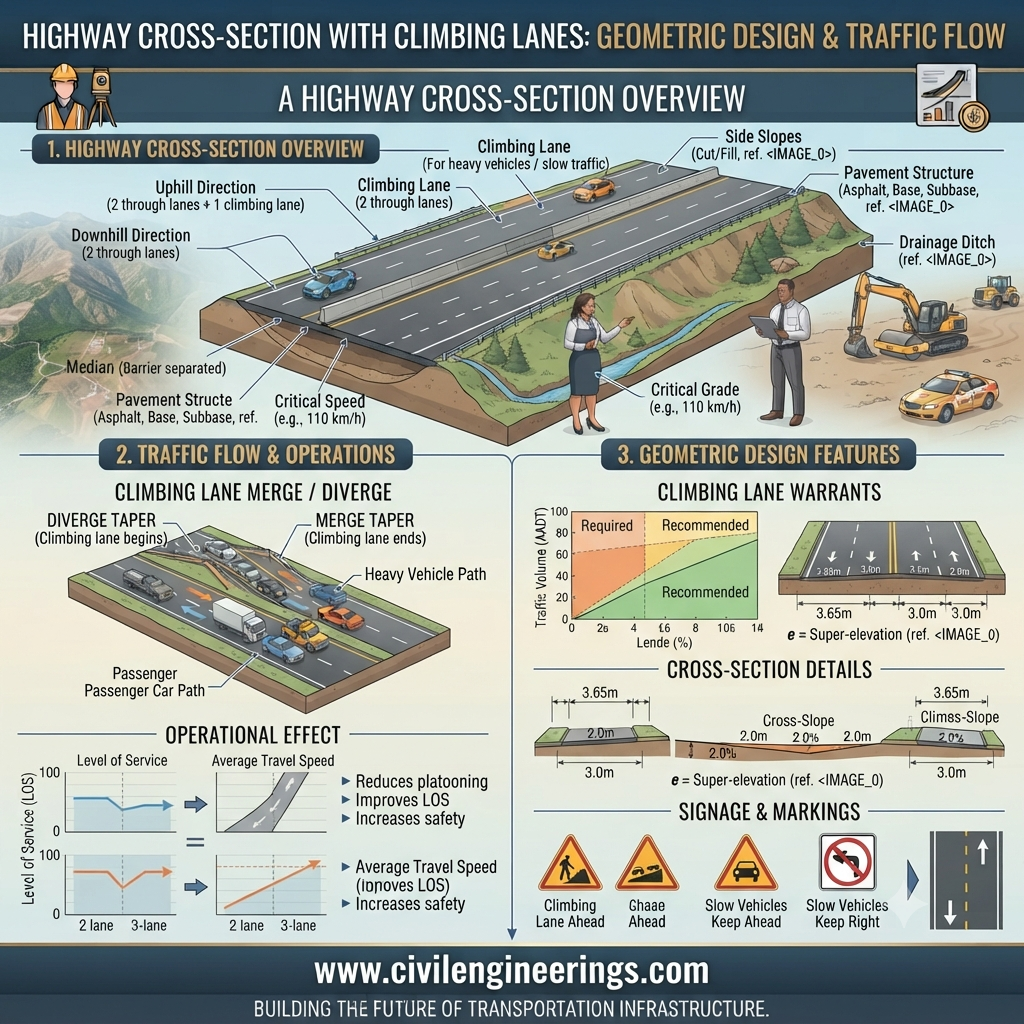
Introduction:
Steep highway gradients can significantly reduce the speed of heavy vehicles, creating long queues, increasing driver frustration, and raising the risk of overtaking accidents. One of the most effective solutions to this challenge is the use of Climbing Lanes. These additional traffic lanes allow slow-moving trucks, buses, and other heavy vehicles to travel without obstructing faster traffic, improving both safety and operational efficiency.
In modern Highway Engineering, Climbing Lanes are considered an essential element of geometric road design, especially on mountainous highways, expressways, and rural roads with sustained upgrades. Their proper planning requires a combination of Traffic Engineering, geometric design principles, terrain analysis, pavement design, and safety evaluation. Engineers must carefully assess traffic volume, heavy vehicle percentages, roadway gradients, and available right-of-way before determining whether a climbing lane is justified.
This comprehensive guide explains the purpose, design principles, benefits, engineering considerations, construction aspects, and practical applications of climbing lanes. Whether you are a civil engineering student, highway engineer, contractor, consultant, or infrastructure professional, this article provides practical knowledge supported by real-world engineering practices and internationally recognized highway design concepts.
What Are Climbing Lanes?
Definition
Climbing Lanes are additional traffic lanes constructed on uphill sections of highways to accommodate slow-moving heavy vehicles. They enable trucks, buses, and heavily loaded vehicles to travel at reduced speeds without interfering with faster passenger vehicles.
Unlike ordinary widening projects, climbing lanes are designed specifically to improve traffic flow on sustained upgrades where heavy vehicles experience substantial speed reductions due to gravity and vehicle weight.
These lanes are widely used in:
- Mountain highways
- National highways
- Rural arterial roads
- Expressways
- Freight corridors
- Industrial access roads
They play a significant role in Road Engineering, improving roadway capacity while reducing conflicts between different vehicle types.
Purpose
The primary objectives of Climbing Lanes include:
- Improving highway safety
- Reducing traffic congestion
- Minimizing dangerous overtaking
- Maintaining uniform traffic speed
- Increasing highway capacity
- Improving freight transportation efficiency
- Reducing travel delays
- Enhancing driver comfort
Without climbing lanes, slow heavy vehicles often create long vehicle platoons that increase driver impatience and risky overtaking maneuvers.
Why Are Climbing Lanes Needed?
Heavy vehicles lose speed rapidly while traveling uphill because of:
- High gross vehicle weight
- Limited engine power
- Increased rolling resistance
- Gravity acting against vehicle movement
- Long roadway gradients
Passenger cars generally maintain higher speeds on the same grade, creating a significant speed differential. This difference disrupts traffic flow and increases accident potential.
For example, a truck traveling at 30 km/h on a steep incline may be followed by cars traveling at 80 km/h. Without a dedicated climbing lane, faster vehicles are forced to queue behind the truck or attempt unsafe overtaking.
How Climbing Lanes Work
A climbing lane provides a dedicated uphill lane for slower vehicles while allowing faster vehicles to continue using the original traffic lane.
The lane typically begins before the steep section starts and continues until heavy vehicles regain acceptable operating speeds.
Basic Traffic Flow
Normal Highway

-----------------------------
| Lane 1 | Lane 2 |
-----------------------------

Steep Upgrade

-----------------------------------------
| Through Lane | Climbing Lane |
-----------------------------------------

Slow Trucks  ---> Climbing Lane

Fast Cars    ---> Through Lane
This arrangement minimizes speed conflicts and improves the overall efficiency of the highway.
Vehicle Performance on Grades
Heavy vehicles are more affected by gradients than passenger cars because their power-to-weight ratio is much lower.
As roadway gradient increases:
- Vehicle speed decreases
- Fuel consumption increases
- Engine temperature rises
- Travel time increases
- Driver fatigue becomes more significant
Transportation engineers evaluate these performance characteristics during highway planning to determine whether a climbing lane is warranted.
Engineering Design Principles of Climbing Lanes
Designing effective Climbing Lanes requires balancing safety, operational efficiency, terrain constraints, and construction costs.
Several engineering factors influence the final design.
Traffic Analysis
Traffic studies determine whether a climbing lane is economically and operationally justified.
Engineers evaluate:
- Average Daily Traffic (ADT)
- Peak Hour Volume
- Percentage of heavy vehicles
- Design speed
- Existing level of service
- Accident history
- Overtaking opportunities
A highway carrying a high percentage of trucks often benefits significantly from climbing lanes.
Gradient Considerations
The roadway gradient directly influences heavy vehicle performance.
Generally:
- Gentle slopes may not require climbing lanes.
- Moderate gradients require detailed traffic studies.
- Long, steep upgrades often justify additional lanes.
Engineers also consider:
- Grade length
- Vertical alignment
- Elevation changes
- Terrain classification
- Vehicle operating characteristics
The combination of grade percentage and grade length is more critical than either factor alone.
Geometric Design
Proper geometric design ensures that climbing lanes integrate safely with the existing highway.
Key design elements include:
- Lane width
- Shoulder width
- Horizontal alignment
- Vertical alignment
- Transition taper
- Merge length
- Sight distance
- Superelevation
- Drainage
The transition into and out of the climbing lane should be gradual to allow smooth lane changes without disrupting traffic flow.
Lane Width and Length
The width of a climbing lane is generally similar to the adjacent traffic lane to maintain driver comfort and consistency.
Its length depends on several factors, including:
- Gradient severity
- Heavy vehicle acceleration
- Design speed
- Truck operating characteristics
- Terrain conditions
- Traffic demand
A lane that is too short provides little operational benefit, while an unnecessarily long lane increases construction costs without proportional improvements.
Highway Cross-Section of a Climbing Lane
          Uphill Direction

 Shoulder   Through Lane   Climbing Lane   Shoulder
--------------------------------------------------------
|   2 m   |    3.5 m     |     3.5 m      |   2 m   |
--------------------------------------------------------

Slow Trucks  ---------------------------->

Fast Cars    ---------------------------->
This additional lane allows heavy vehicles to travel safely while maintaining efficient traffic flow for faster-moving vehicles.
Benefits of Climbing Lanes
Properly designed Climbing Lanes offer numerous operational and safety advantages.
Improved Road Safety
Separating slow and fast vehicles significantly reduces overtaking conflicts, rear-end collisions, and risky passing maneuvers on steep grades.
Better Traffic Flow
Climbing lanes minimize delays caused by slow-moving trucks, allowing passenger vehicles to maintain more consistent travel speeds and improving the highway’s overall level of service.
Increased Highway Capacity
By reducing platooning and traffic interruptions, climbing lanes enable a roadway to accommodate more vehicles efficiently without requiring full highway widening.
Reduced Driver Frustration
Drivers are less likely to become impatient when they can safely pass heavy vehicles, contributing to smoother and more predictable traffic operations.
Enhanced Freight Movement
Heavy trucks can climb grades at their natural operating speeds without pressure from faster traffic, improving safety for freight operators and supporting more reliable logistics.
Design Considerations
When planning Climbing Lanes, engineers should carefully evaluate:
- Terrain and topography
- Traffic demand
- Heavy vehicle percentage
- Road safety records
- Available right-of-way
- Environmental impacts
- Pavement design requirements
- Drainage design
- Future traffic growth
- Construction and maintenance costs
Each project should be supported by traffic studies, geometric design analysis, and economic evaluations to ensure the climbing lane delivers long-term operational benefits.
Engineering Calculations for Climbing Lanes
Although climbing lane design requires detailed traffic and geometric analyses, engineers often perform preliminary calculations to assess whether an additional lane is justified. These calculations estimate the impact of road gradients on heavy vehicle performance and traffic flow.
Basic Grade Formula
[
\text{Grade (%)} = \left(\frac{\text{Vertical Rise}}{\text{Horizontal Distance}}\right) \times 100
]
Where:
- Vertical Rise = Elevation difference (m)
- Horizontal Distance = Road length (m)
Example Calculation
Suppose a highway rises 45 m over a horizontal distance of 750 m.
[
\text{Grade}=\frac{45}{750}\times100=6%
]
A 6% uphill grade is considered relatively steep for heavy commercial vehicles. If this grade extends for several hundred meters or more, trucks may experience significant speed reductions, making a climbing lane a practical solution.
Factors Considered During Design
Engineers also evaluate:
- Design speed
- Percentage of heavy vehicles
- Average Daily Traffic (ADT)
- Traffic Level of Service (LOS)
- Speed reduction of loaded trucks
- Available sight distance
- Horizontal and vertical alignment
- Future traffic growth
Computer-based traffic simulation software is frequently used to verify the operational benefits before construction begins.
Construction Process of Climbing Lanes
Constructing a climbing lane follows the same principles as highway widening projects but requires additional attention to transitions, drainage, and traffic management.
1. Planning and Feasibility
Project planning includes:
- Traffic surveys
- Topographic surveys
- Geotechnical investigations
- Environmental assessments
- Utility identification
- Cost estimation
The objective is to confirm that a climbing lane provides measurable improvements in safety and traffic efficiency.
2. Surveying
Accurate surveying establishes the proposed alignment and ground levels.
Common survey equipment includes:
- Total Station
- GNSS/GPS receivers
- Digital Levels
- LiDAR scanners
- Drones (UAVs)
Survey data supports earthwork calculations and geometric design.
3. Earthwork
Earthwork operations may involve:
- Excavation
- Embankment construction
- Slope stabilization
- Rock cutting
- Soil compaction
Proper compaction ensures long-term pavement performance and minimizes settlement.
Earthwork Sequence
Survey
   │
Clearing & Grubbing
   │
Excavation
   │
Embankment
   │
Compaction
   │
Subgrade Preparation
4. Pavement Construction
Depending on project requirements, engineers may construct either flexible or rigid pavements.
Flexible Pavement Structure
 Asphalt Surface
-----------------------
 Binder Course
-----------------------
 Base Course
-----------------------
 Sub-base
-----------------------
 Compacted Subgrade
Rigid Pavement Structure
 Concrete Slab
-----------------------
 Base Layer
-----------------------
 Sub-base
-----------------------
 Compacted Subgrade
The climbing lane pavement should match the structural capacity of the adjacent roadway to ensure uniform performance.
Materials Used
Common construction materials include:
- Bitumen
- Asphalt mixtures
- Portland cement
- Crushed aggregates
- Sand
- Granular sub-base material
- Geotextiles
- Geogrids
- Lime stabilizers
- Cement stabilizers
- Reinforcement steel (where applicable)
Material selection depends on traffic loading, climate, soil conditions, and pavement type.
Construction Equipment
Typical equipment used during climbing lane construction includes:
- Excavators
- Bulldozers
- Motor graders
- Wheel loaders
- Dump trucks
- Asphalt pavers
- Concrete pavers
- Vibratory rollers
- Pneumatic rollers
- Water tankers
- Milling machines
- Survey instruments
Proper equipment selection improves construction quality and productivity while reducing project duration.
Quality Control and Testing
Quality assurance is essential to ensure the climbing lane performs safely throughout its design life.
Common Tests
CBR Test
- Evaluates subgrade strength for pavement design.
Standard or Modified Proctor Test
- Determines optimum moisture content and maximum dry density.
Marshall Stability Test
- Assesses asphalt mix stability and flow characteristics.
Core Test
- Confirms asphalt thickness and density after paving.
Density Test
- Verifies field compaction of soil and pavement layers.
Plate Load Test
- Measures bearing capacity of pavement foundations.
Slump Test
- Checks workability of concrete used in rigid pavements or drainage structures.
Regular testing reduces premature pavement failures and maintenance costs.
Practical Applications of Climbing Lanes
Climbing lanes are used across a wide range of transportation infrastructure projects.
Highways
Improve safety and maintain traffic flow on steep grades.
Expressways
Separate slow freight traffic from faster vehicles, improving travel reliability.
Rural Roads
Provide safer overtaking opportunities where road widening is limited.
Industrial Roads
Support heavy trucks transporting mining products, construction materials, and manufactured goods.
Airport Access Roads
Facilitate smooth movement of buses, fuel tankers, and cargo vehicles.
Smart City Infrastructure
Integrate with intelligent traffic management systems to optimize vehicle movement.
Sustainability in Climbing Lane Construction
Modern highway projects increasingly focus on environmental responsibility.
Recommended practices include:
- Using recycled asphalt pavement (RAP)
- Reusing excavated materials where feasible
- Incorporating warm-mix asphalt technologies
- Installing effective stormwater drainage systems
- Protecting natural vegetation during construction
- Reducing fuel consumption through efficient equipment operation
- Designing erosion and sediment control measures
- Implementing climate-resilient pavement solutions
Sustainable construction reduces environmental impacts while extending pavement life.
Modern Technologies
Advancements in digital engineering have transformed climbing lane planning and construction.
Building Information Modeling (BIM)
Improves coordination among design, construction, and maintenance teams.
Geographic Information Systems (GIS)
Analyze terrain, traffic patterns, and environmental constraints.
LiDAR
Produces highly accurate topographic models for geometric design.
Drones
Perform aerial surveys, monitor construction progress, and inspect completed work safely.
Artificial Intelligence (AI)
Supports traffic forecasting, pavement condition assessment, and maintenance planning.
IoT Sensors
Monitor pavement performance, traffic volumes, and environmental conditions in real time.
Digital Twins
Create virtual highway models for performance analysis throughout the infrastructure lifecycle.
These technologies improve decision-making, reduce project risks, and enhance asset management.
General Engineering Standards
While requirements vary by country, engineers generally refer to guidance from recognized organizations.
- IRC (Indian Roads Congress): Highway geometric design, traffic engineering, and road safety guidance.
- AASHTO: Widely recognized recommendations for geometric design, pavement design, and transportation planning.
- ASTM: Standardized testing methods for soils, aggregates, asphalt, and concrete.
- FHWA: Guidance on highway planning, traffic operations, and safety improvements.
- ICE: Professional engineering best practices and infrastructure management.
- ISO: International standards for quality management, environmental management, and construction processes.
Project-specific designs should always comply with the applicable national codes and local authority requirements.
Best Practices for
Engineers
- Conduct detailed traffic and speed studies before recommending a climbing lane.
- Design smooth tapers for safe lane transitions.
- Ensure adequate sight distance throughout the climbing section.
- Coordinate drainage design with pavement widening.
- Plan for future traffic growth during design.
Contractors
- Maintain strict quality control during earthwork and paving.
- Use calibrated construction equipment.
- Protect traffic with proper work-zone management.
- Verify compaction before placing successive pavement layers.
- Follow approved construction specifications.
Students
- Understand the relationship between gradient and vehicle performance.
- Practice geometric design calculations.
- Study real highway case studies.
- Learn the fundamentals of traffic engineering and pavement design.
- Develop proficiency with modern design software.
Consultants
- Balance construction costs with operational benefits.
- Evaluate long-term maintenance requirements.
- Incorporate sustainable engineering practices.
- Communicate recommendations clearly to project stakeholders.
Common Mistakes
Designing Lanes That Are Too Short
Short climbing lanes provide limited operational benefits because heavy vehicles may not regain speed before the lane ends.
Ignoring Future Traffic Growth
Designing solely for current traffic volumes can lead to early congestion and expensive upgrades.
Poor Drainage Design
Inadequate drainage accelerates pavement deterioration, leading to cracking, rutting, and reduced service life.
Insufficient Transition Length
Abrupt merges create unsafe driving conditions and increase the likelihood of side-swipe collisions.
Weak Quality Control
Poor compaction, substandard materials, or inadequate testing often result in premature pavement failures.
Frequently Asked Questions (FAQs)
1. What is the primary purpose of a climbing lane?
A climbing lane allows slow-moving heavy vehicles to travel uphill without obstructing faster traffic. This improves safety, reduces congestion, minimizes risky overtaking, and increases highway capacity on long or steep grades.
2. Where are climbing lanes commonly constructed?
They are commonly built on mountainous highways, expressways, rural roads, freight corridors, and industrial access roads where heavy vehicles experience substantial speed reductions on uphill sections.
3. How do engineers determine if a climbing lane is needed?
Engineers analyze traffic volume, heavy vehicle percentage, road gradient, grade length, vehicle speeds, accident history, and overall traffic performance to determine whether the benefits justify construction.
4. Do climbing lanes improve road safety?
Yes. By separating slow-moving trucks from faster vehicles, climbing lanes reduce overtaking conflicts, rear-end collisions, and driver frustration, creating a safer driving environment.
5. What pavement type is suitable for climbing lanes?
Both flexible (asphalt) and rigid (concrete) pavements may be used. The selection depends on traffic loading, climate, maintenance strategy, lifecycle cost, and local engineering practices.
6. Can existing highways be upgraded with climbing lanes?
Yes. Many highway widening projects add climbing lanes to improve traffic flow without constructing entirely new roadways. Feasibility depends on terrain, available right-of-way, and environmental considerations.
7. What technologies support climbing lane design?
Modern projects use BIM, GIS, LiDAR, drones, AI-based traffic analysis, and IoT sensors to improve planning, construction, monitoring, and long-term maintenance.
8. What maintenance is required?
Routine maintenance includes pavement inspections, crack sealing, resurfacing, drainage cleaning, shoulder repairs, pavement markings, and traffic sign maintenance to ensure safe operation.
9. Are climbing lanes environmentally sustainable?
When designed responsibly, climbing lanes can support sustainability through recycled materials, efficient drainage, erosion control, and modern construction methods that reduce emissions and resource consumption.
Conclusion
Climbing Lanes are a proven highway engineering solution for improving safety, traffic flow, and operational efficiency on steep uphill sections. By providing a dedicated lane for slow-moving heavy vehicles, they reduce overtaking conflicts, enhance travel reliability, and support the growing demands of freight transportation. Successful implementation depends on thorough traffic analysis, sound geometric design, durable pavement construction, effective drainage, and rigorous quality control. Modern tools such as BIM, GIS, LiDAR, drones, and AI further improve planning and lifecycle management, while sustainable construction practices help minimize environmental impacts. Whether you are a civil engineering student, highway engineer, contractor, or consultant, understanding the principles of Climbing Lanes will help you design safer, more efficient, and future-ready transportation infrastructure.
