
Introduction
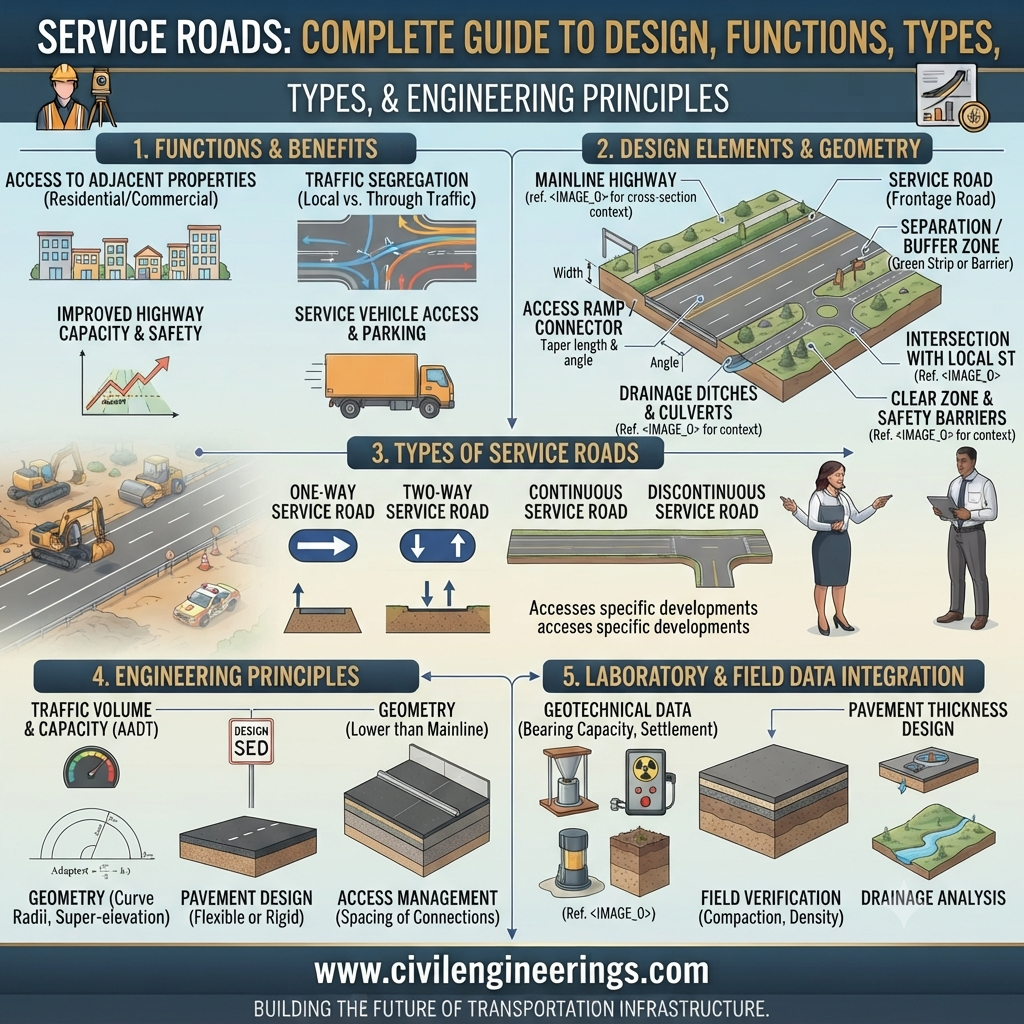
Modern highways and expressways must move traffic efficiently while maintaining safety for both high-speed vehicles and local traffic. One of the most effective engineering solutions for achieving this balance is the Service Roads system. Also known as frontage roads, service roads run parallel to major highways and provide access to adjacent properties, commercial areas, residential developments, industrial zones, and public facilities without disrupting through traffic.
In highway engineering, Service Roads play a crucial role in improving accessibility, reducing congestion, and enhancing road safety. They separate slow-moving local traffic from high-speed highway traffic, minimize direct access points to the main carriageway, and support orderly urban and suburban development. Engineers carefully plan their alignment, pavement structure, drainage, and intersections to ensure long-term performance and efficient traffic flow.
This guide explains the concept of service roads, their importance, design principles, types, components, and practical applications. Whether you are a civil engineering student, highway engineer, contractor, consultant, or infrastructure professional, this article provides valuable engineering insights supported by practical examples and industry best practices.
What Are Service Roads?
Service Roads are parallel roads constructed alongside highways, expressways, or major arterial roads to provide controlled access to nearby properties and local streets. They allow local traffic to enter and exit adjacent developments without directly interfering with high-speed traffic on the main highway.
These roads form an essential part of modern transportation planning because they improve mobility while reducing conflicts between different categories of vehicles.
Primary Purposes
- Provide access to adjacent properties.
- Reduce direct driveway connections to highways.
- Improve road safety.
- Separate local and through traffic.
- Support commercial and residential development.
- Enhance traffic efficiency on main highways.
Why Service Roads Are Important
As cities expand and traffic volumes increase, highways often become surrounded by residential, commercial, and industrial developments. Without service roads, frequent direct access to the highway would create congestion and increase accident risks.
Key Benefits
- Improved traffic flow
- Better road safety
- Reduced travel delays
- Easier property access
- Lower conflict points
- Enhanced freight movement
- Increased highway capacity
- Support for planned urban development
Practical Example
Consider a six-lane divided highway passing through a rapidly developing commercial corridor. If every shopping center and fuel station connects directly to the highway, vehicles continuously slow down to enter or exit properties, creating bottlenecks and increasing collision risks.
A parallel service road allows vehicles to access businesses without interrupting through traffic, resulting in smoother highway operations and improved safety.
Objectives and Functions of Service Roads
The design of Service Roads serves several operational and engineering objectives.
1. Access Management
Service roads reduce the number of direct access points to highways, improving traffic efficiency and minimizing conflicts.
2. Traffic Separation
They separate:
- High-speed highway traffic
- Local traffic
- Delivery vehicles
- Public transport
- Pedestrians (where facilities exist)
- Cyclists (in urban areas)
This separation improves both operational performance and safety.
3. Improved Safety
Fewer access points reduce:
- Rear-end collisions
- Side-impact crashes
- Sudden lane changes
- Traffic weaving
4. Support for Future Development
Engineers often construct service roads to accommodate future commercial and residential growth without requiring frequent modifications to the main highway.
Main Components of Service Roads
Properly designed service roads include several engineering elements that work together to ensure safe and durable operation.
Pavement Structure
Typical pavement layers include:
- Wearing Course
- Binder Course
- Base Course
- Sub-base
- Compacted Subgrade
Pavement Layer Diagram
 Asphalt Surface Course
========================
 Binder Course
========================
 Base Course
========================
 Granular Sub-base
========================
 Compacted Subgrade
========================
 Natural Ground
Carriageway
The carriageway accommodates vehicle movement and is designed according to expected traffic volumes and design speeds.
Shoulders
Shoulders provide:
- Emergency stopping space
- Structural support
- Drainage assistance
- Maintenance access
Drainage System
Efficient drainage protects the pavement by preventing water accumulation.
Common drainage features include:
- Side drains
- Culverts
- Kerb channels
- Catch basins
Footpaths and Cycle Tracks
Urban service roads often include pedestrian walkways and bicycle lanes to improve accessibility and encourage sustainable transportation.
Street Lighting
Lighting enhances visibility during nighttime operations, especially near intersections and commercial areas.
Service Road Cross-Section
Footpath | Shoulder | Lane | Lane | Shoulder | Drain
=====================================================
This simplified cross-section illustrates the typical arrangement of roadway elements. Actual dimensions vary according to project standards and traffic demand.
Types of Service Roads
Engineers select the appropriate type based on traffic demand, land availability, and surrounding development.
1. One-Way Service Roads
One-way service roads carry traffic in a single direction parallel to the highway.
Advantages
- Fewer conflict points
- Improved traffic flow
- Simplified intersections
- Higher operational efficiency
Applications
- Urban expressways
- Commercial corridors
- High-volume highways
2. Two-Way Service Roads
Two-way service roads accommodate traffic in both directions.
Advantages
- Better local accessibility
- Lower land requirements in some situations
- Simpler access to adjacent properties
Limitations
- Increased turning conflicts
- Lower operating speeds
- More complex intersection design
3. Continuous Service Roads
Continuous service roads extend along the entire length of a highway section, providing uninterrupted access.
Suitable For
- Urban highways
- Industrial zones
- Commercial developments
- Airports
Benefits
- Consistent access
- Improved connectivity
- Better traffic distribution
4. Discontinuous Service Roads
Discontinuous service roads exist only where access is necessary.
Typical Locations
- Near major intersections
- Commercial clusters
- Toll plazas
- Industrial entrances
Advantages
- Lower construction cost
- Reduced land acquisition
- Efficient use of available space
Engineering Principles of Service Road Design
Successful Service Roads depend on sound engineering principles that ensure safety, durability, and operational efficiency.
Geometric Design
Engineers design:
- Lane widths
- Horizontal curves
- Vertical curves
- Cross slopes
- Design speeds
- Sight distances
The geometry should encourage safe driving while accommodating expected vehicle types.
Drainage Design
Proper drainage prevents water from weakening the pavement structure and causing premature failures.
Design considerations include:
- Surface runoff
- Side drains
- Culvert sizing
- Longitudinal gradients
Traffic Engineering
Traffic engineers evaluate:
- Daily traffic volume
- Turning movements
- Access frequency
- Heavy vehicle percentages
- Future traffic growth
These factors influence lane requirements, intersection spacing, and pavement design.
Pavement Design
The pavement structure must withstand anticipated traffic loads and local environmental conditions.
Engineers select flexible or rigid pavement systems based on traffic demand, soil conditions, lifecycle costs, and maintenance requirements.
Practical Applications of Service Roads
Service roads serve a wide range of transportation and infrastructure projects.
Highways and Expressways
They improve access while preserving uninterrupted traffic flow on the main carriageway.
Urban Roads
They support commercial developments by providing safe entry and exit points for vehicles.
Industrial Areas
Heavy trucks use service roads to access factories, warehouses, and logistics hubs without disrupting highway operations.
Airports
Service roads connect terminals, cargo facilities, maintenance buildings, and parking areas while separating operational traffic from public roadways.
Smart Cities
Modern service roads integrate pedestrian facilities, cycling infrastructure, intelligent traffic systems, and utility corridors to support sustainable urban mobility.
Key Takeaways
Service Roads are a vital component of modern highway and urban transportation systems. By separating local traffic from high-speed highway traffic, they improve safety, reduce congestion, and provide efficient access to surrounding developments. Proper planning, geometric design, pavement engineering, drainage, and traffic analysis ensure that service roads operate efficiently and support future growth. Selecting the appropriate type—whether one-way, two-way, continuous, or discontinuous—depends on traffic demand, land availability, and surrounding land use. A well-designed service road enhances both highway performance and local accessibility, making it an indispensable element of sustainable transportation infrastructure.
Design Procedure for Service Roads
A successful Service Roads project begins with detailed planning and engineering analysis. Engineers must evaluate traffic demand, land use, soil conditions, drainage patterns, and future development before preparing the final design.
Step 1: Planning and Feasibility Study
The planning phase identifies the need for a service road and evaluates possible alternatives.
Major activities include:
- Traffic demand forecasting
- Land use assessment
- Utility mapping
- Cost estimation
- Environmental review
- Preliminary alignment selection
Step 2: Topographic and Geotechnical Survey
Surveyors establish the proposed alignment while geotechnical engineers investigate soil properties.
Typical investigations include:
- Topographic survey
- Soil boring
- California Bearing Ratio (CBR) Test
- Standard Proctor Test
- Groundwater assessment
Accurate survey data reduces construction risks and improves pavement performance.
Step 3: Geometric Design
Engineers determine:
- Design speed
- Lane width
- Shoulder width
- Horizontal curves
- Vertical curves
- Cross slope
- Turning radius
- Sight distance
Good geometric design improves comfort, visibility, and safety.
Step 4: Pavement Design
The pavement structure depends on traffic loading, subgrade strength, climate, and maintenance strategy.
Typical flexible pavement structure:
 Asphalt Wearing Course
=========================
 Binder Course
=========================
 Base Course
=========================
 Granular Sub-base
=========================
 Compacted Subgrade
For industrial areas or locations with frequent heavy truck traffic, engineers may choose rigid concrete pavement to improve durability and reduce maintenance.
Basic Engineering Calculation (Illustrative)
Although detailed pavement design follows national standards, engineers often begin with traffic loading and subgrade evaluation.
A simple relationship used during preliminary assessment is:
Traffic Capacity
[
Q = V \times D
]
Where:
- Q = Traffic flow (vehicles/hour)
- V = Average speed (km/h)
- D = Traffic density (vehicles/km)
Example
If:
- Average speed = 60 km/h
- Traffic density = 25 vehicles/km
Then:
Q = 60 × 25 = 1500 vehicles/hour
This calculation provides an initial estimate. Final design should always use approved traffic studies, pavement analysis, and applicable engineering standards.
Construction Process
After design approval, construction begins in a planned sequence to ensure quality and efficiency.
1. Site Preparation
Activities include:
- Clearing vegetation
- Removing unsuitable soil
- Utility relocation
- Temporary traffic management
2. Earthwork
Earthwork establishes the required formation level through cutting, filling, grading, and compaction.
Equipment commonly used:
- Excavators
- Bulldozers
- Motor graders
- Dump trucks
- Vibratory rollers
3. Subgrade Preparation
Engineers shape and compact the subgrade to achieve the required bearing capacity.
Quality depends on:
- Moisture content
- Density
- Uniformity
- Drainage
4. Sub-base and Base Construction
Aggregates are spread, graded, watered, and compacted in layers.
Quality checks ensure:
- Correct thickness
- Required density
- Proper gradation
5. Pavement Construction
Flexible pavements generally include:
- Prime coat
- Tack coat
- Binder course
- Wearing course
Rigid pavements require:
- Formwork
- Reinforcement (where applicable)
- Concrete placement
- Finishing
- Curing
6. Drainage Installation
Drainage systems protect the pavement from water damage.
Typical components:
- Side drains
- Kerb channels
- Catch pits
- Culverts
- Cross drains
7. Final Works
The project concludes with:
- Road markings
- Traffic signs
- Street lighting
- Landscaping
- Safety barriers
- Final inspection
Materials Used in Service Roads
Material selection influences pavement performance, maintenance needs, and project cost.
Common materials include:
- Bitumen
- Asphalt concrete
- Portland cement
- Crushed aggregates
- Sand
- Granular sub-base material
- Geotextiles
- Geogrids
- Soil stabilizers
- Reinforcement steel (where required)
Engineers select materials based on traffic loading, climate, availability, and lifecycle cost.
Construction Equipment
Efficient construction depends on modern machinery.
Common equipment includes:
- Excavators
- Motor graders
- Bulldozers
- Asphalt pavers
- Concrete pavers
- Vibratory rollers
- Pneumatic rollers
- Wheel loaders
- Water tankers
- Survey instruments
- Total stations
- GPS machine control systems
Proper equipment selection improves productivity and construction quality.
Quality Control and Testing
Quality assurance begins before construction and continues until project completion.
Common Tests
Soil
- California Bearing Ratio (CBR)
- Standard Proctor Test
- Field Density Test
- Moisture Content Test
Aggregates
- Los Angeles Abrasion Test
- Aggregate Impact Value
- Flakiness Index
- Water Absorption Test
Asphalt
- Marshall Stability Test
- Bitumen Content Test
- Core Density Test
Concrete
- Slump Test
- Compressive Strength Test
- Flexural Strength Test
Regular testing ensures compliance with project specifications and helps prevent premature pavement failures.
Sustainability in Service Road Projects
Modern highway projects increasingly emphasize sustainability.
Recommended practices include:
- Recycled asphalt pavement (RAP)
- Recycled concrete aggregates
- Warm-mix asphalt
- Permeable drainage systems
- Rainwater harvesting
- Native landscaping
- Carbon emission reduction strategies
- Energy-efficient LED lighting
- Climate-resilient pavement design
Sustainable practices reduce environmental impacts while improving long-term project value.
Modern Technologies
Digital technologies continue to transform road engineering.
Building Information Modeling (BIM)
Improves design coordination and clash detection.
Geographic Information Systems (GIS)
Supports route planning, land-use analysis, and asset management.
LiDAR
Provides highly accurate topographic data for planning and design.
Drones
Enable rapid site surveys, progress monitoring, and inspection.
Artificial Intelligence (AI)
Supports traffic prediction, maintenance planning, and pavement condition analysis.
IoT Sensors
Monitor pavement performance, traffic volumes, and environmental conditions in real time.
Digital Twins
Allow engineers to simulate, monitor, and optimize infrastructure throughout its lifecycle.
General Discussion of Engineering Standards
Highway agencies worldwide follow nationally adopted standards while drawing on internationally recognized engineering guidance.
Organizations such as IRC, AASHTO, ASTM, ICE, ISO, and FHWA provide recommendations on:
- Geometric design
- Pavement engineering
- Material quality
- Traffic safety
- Drainage
- Construction practices
- Maintenance management
Projects should always comply with the applicable local regulations and project specifications.
Best Practices for
Engineers
- Conduct detailed traffic studies before design.
- Validate geotechnical reports carefully.
- Design for future traffic growth.
- Integrate effective drainage into the initial design.
Contractors
- Follow approved construction drawings.
- Maintain proper compaction and moisture control.
- Use quality-approved materials.
- Perform routine quality inspections.
Students
- Study pavement layers and drainage systems.
- Learn field testing procedures.
- Understand geometric design principles.
- Visit active road projects to gain practical experience.
Consultants
- Coordinate with all project stakeholders.
- Review constructability before final approval.
- Encourage sustainable design solutions.
Project Managers
- Monitor project schedules closely.
- Maintain strong quality assurance systems.
- Manage risks proactively.
- Communicate effectively with contractors and authorities.
Common Mistakes
| Mistake | Consequence | Prevention |
|---|---|---|
| Poor drainage design | Water damage and potholes | Design adequate drainage systems |
| Weak subgrade preparation | Settlement and cracking | Ensure proper compaction and testing |
| Inadequate traffic forecasting | Capacity shortages | Use updated traffic studies |
| Low-quality materials | Reduced pavement life | Follow approved material specifications |
| Ignoring utility coordination | Construction delays | Complete utility mapping before work |
| Poor access spacing | Increased conflicts | Apply sound access management principles |
Frequently Asked Questions
1. What are Service Roads?
Service Roads are parallel roads that provide access to nearby properties, businesses, and local streets while separating local traffic from high-speed highway traffic. This arrangement improves safety, reduces congestion, and supports orderly land development.
2. Why are Service Roads important?
They improve accessibility, reduce direct highway access points, minimize traffic conflicts, and maintain smooth traffic flow on major roads. They also enhance safety for local residents and commercial developments.
3. Where are Service Roads commonly constructed?
Engineers commonly construct them along expressways, national highways, urban arterial roads, industrial corridors, airports, logistics parks, and rapidly developing commercial zones.
4. What is the difference between a Service Road and a frontage road?
In many countries, the terms are used interchangeably. Both refer to roads running parallel to a highway that provide local access while protecting through traffic from unnecessary interruptions.
5. Which pavement type is suitable for Service Roads?
Flexible asphalt pavement suits most urban and suburban service roads, while rigid concrete pavement is often preferred for industrial areas or locations carrying frequent heavy truck traffic.
6. How does drainage affect Service Roads?
Proper drainage prevents water from entering pavement layers, reducing the risk of rutting, potholes, and premature structural failure. Well-designed drainage significantly extends pavement life.
7. What quality tests are commonly performed during construction?
Common tests include the California Bearing Ratio (CBR), Proctor Compaction Test, Field Density Test, Marshall Stability Test, Slump Test, and Aggregate Abrasion Test to verify material quality and construction standards.
8. How do modern technologies improve Service Road projects?
Technologies such as BIM, GIS, LiDAR, drones, AI, IoT sensors, and Digital Twins improve planning, design accuracy, construction monitoring, asset management, and long-term maintenance.
Internal Linking Suggestions
Strengthen your website’s topical authority by linking to related articles:
- Highway Alignment
- Road Hierarchy and Functional Classification
- Pavement Design Basics
- Flexible vs. Rigid Pavement
- Highway Drainage Systems
- Earthwork in Road Construction
- Traffic Engineering Fundamentals
- Highway Surveying Methods
- Road Safety Features
- Highway Maintenance Strategies
Conclusion
Service Roads are a critical element of modern highway engineering because they balance mobility, accessibility, and safety within rapidly developing transportation corridors. By separating local traffic from high-speed highway vehicles, they reduce congestion, improve access to adjacent properties, and enhance overall network efficiency. Successful service road projects depend on careful planning, sound geometric and pavement design, reliable drainage, high-quality construction materials, and rigorous quality control. Engineers must also consider future traffic growth, sustainability, and emerging technologies such as BIM, GIS, LiDAR, and IoT to deliver durable infrastructure. Whether the project serves an urban expressway, industrial estate, airport, or smart city, well-designed Service Roads contribute to safer travel, lower maintenance costs, and sustainable development. Applying recognized engineering practices and continuous innovation ensures these roads remain valuable assets for communities and transportation networks for decades.
