
Introduction
Water is one of the most damaging factors affecting highway performance. When rainwater remains on a pavement surface, it can penetrate pavement layers, reduce skid resistance, accelerate surface deterioration, and contribute to potholes, cracking, stripping, and other failures. A properly designed cross slope in highway construction provides a simple but essential solution by directing surface runoff toward the pavement edge, shoulder, gutter, or drainage system.
Cross slope refers to the transverse inclination provided across the carriageway surface. Although the slope may appear small, its engineering importance is considerable. A few percentage points of gradient can determine whether rainfall drains quickly or remains on the pavement.
The correct cross slope depends on pavement type, road geometry, climate, surface characteristics, traffic conditions, drainage arrangements, and applicable highway standards. This guide explains the meaning of cross slope, its formula, typical values, types, design principles, construction methods, field measurement, common problems, and practical recommendations. It also discusses how cross slope interacts with camber, superelevation, shoulder drainage, and pavement performance.
What Is Cross Slope in Highway?
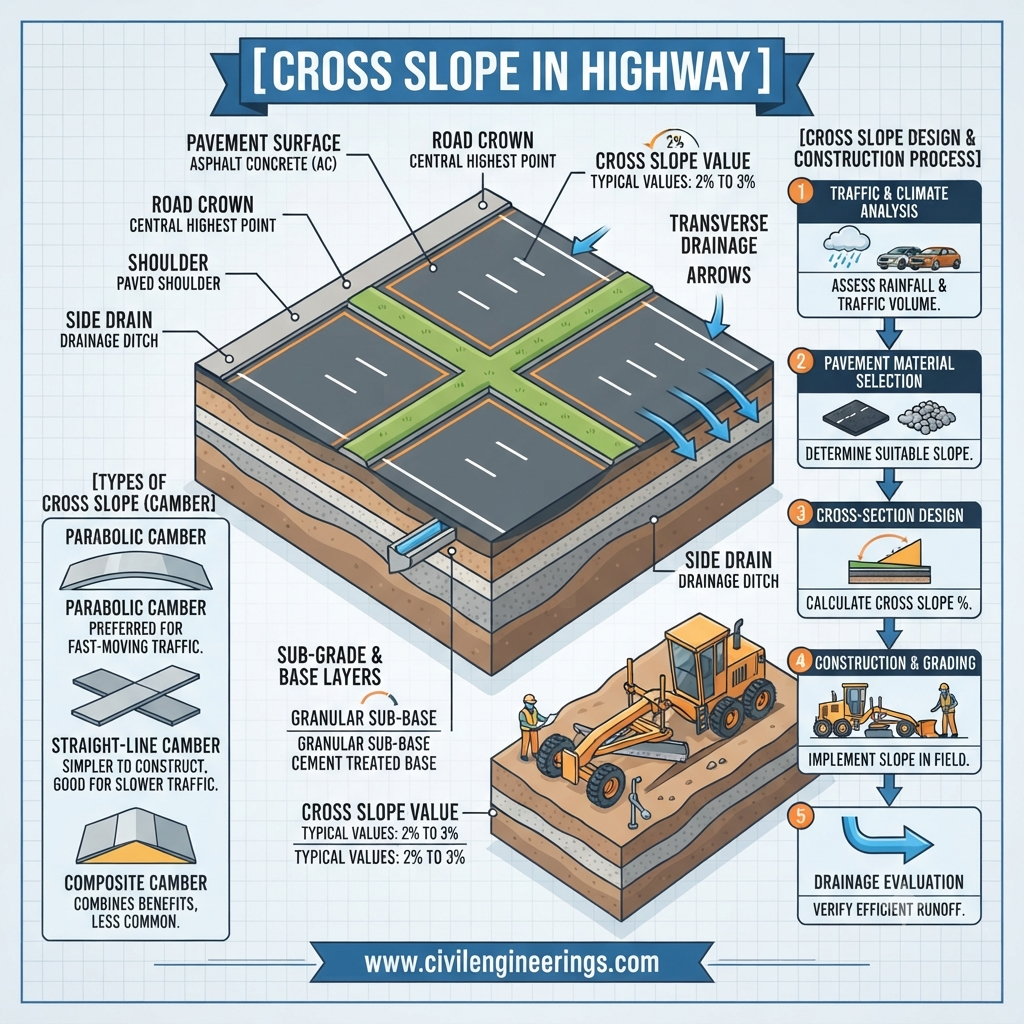
Cross slope in highway is the transverse gradient provided across the road surface from the crown or high point toward the pavement edges to facilitate drainage of rainwater.
It is normally expressed as a percentage or as a ratio.
For a conventional two-lane road with a central crown, both traffic lanes generally slope downward from the centerline toward their respective edges. On a divided highway, each carriageway may have its own crown or drainage arrangement.
The basic purpose is straightforward: move water away from the traveled surface as quickly and safely as practical.
A cross slope should be large enough to provide effective drainage but not so steep that it creates vehicle-control problems, uncomfortable lateral movement, or difficulties in construction and maintenance.
Cross Slope Versus Camber
The terms cross slope and camber are often used interchangeably, particularly in traditional highway engineering literature. However, they can have slightly different practical meanings.
Camber commonly describes the transverse curvature or slope intentionally given to a road surface for drainage. Cross slope is the more general engineering term for the transverse gradient of a pavement surface.
For example, if a pavement falls 2 cm vertically over a horizontal distance of 1 m:
Thus, the pavement has a 2 percent transverse slope.
Why Cross Slope Matters
A highway pavement is continuously exposed to rainfall, surface runoff, vehicle loading, temperature changes, and environmental conditions. Poor transverse drainage can allow water to remain near wheel paths or pavement edges.
An effective cross slope helps:
- Remove rainwater from the pavement.
- Reduce standing water.
- Improve wet-weather skid resistance.
- Reduce water infiltration into pavement layers.
- Minimize hydroplaning risk.
- Protect pavement materials from moisture-related damage.
- Improve road safety.
- Support efficient roadside drainage.
- Increase pavement serviceability and durability.
Cross slope is therefore not simply a geometric detail. It forms an important connection between highway geometric design, pavement engineering, road drainage, and traffic safety.
Cross Slope Formula
The cross slope can be calculated using the vertical difference in elevation divided by the horizontal distance.
Where:
- = cross slope (%)
- = difference in elevation between two points
- = horizontal distance between the points
Example Calculation
Suppose a pavement edge is 0.06 m lower than the centerline over a transverse distance of 3.0 m.
Therefore, the pavement cross slope is 2 percent.
The same calculation can be applied during construction using design levels from the approved road profile and cross-section drawings.
Converting Cross Slope to Ratio
A 2 percent cross slope means:
It can also be represented approximately as:
Similarly:
- 1% = approximately 1:100
- 2% = approximately 1:50
- 2.5% = approximately 1:40
- 3% = approximately 1:33.3
The percentage form is commonly easier for highway design calculations and drawings.
Types of Cross Slope in Highway
Different pavement configurations require different transverse drainage arrangements. The most appropriate type depends on road width, carriageway configuration, terrain, drainage facilities, and horizontal alignment.
Straight or Plane Cross Slope
A straight cross slope uses a relatively uniform transverse gradient across the pavement.
For example, a lane may have a consistent 2 percent fall from the crown toward the pavement edge.
This arrangement is simple to design, set out, and construct. It is widely used where straightforward surface drainage is appropriate.
Two-Way Cross Slope
In a conventional crowned road, the pavement has a high point near the centerline.
Both sides fall away from the center.
A simplified cross-section can be represented as:
                 Crown
                   ▲
                   │
        2%         │         2%
          \        │        /
           \_______│_______/
            Drainage edges
This arrangement allows water from both halves of the carriageway to move toward the outside edges.
One-Way Cross Slope
A one-way cross slope directs water toward one side of the carriageway.
It is frequently associated with divided roads, one-way carriageways, bridge decks, special pavement configurations, and certain urban drainage arrangements.
The drainage direction must be coordinated carefully with kerbs, gutters, inlets, channels, and stormwater systems.
Composite Cross Slope
A composite cross slope combines different transverse slopes or geometric elements across the roadway.
It may occur where lanes, shoulders, medians, auxiliary lanes, and drainage facilities have different design requirements.
Such arrangements require careful checking because abrupt changes in cross slope can affect drainage and vehicle behavior.
Cross Slope on Shoulders
Shoulders normally receive their own transverse slope.
The shoulder slope should allow water to move away from the traveled lane without causing undesirable ponding at the pavement interface.
However, the relationship between pavement and shoulder slopes must be controlled. A large difference in slope can create a step or abrupt surface transition, particularly after maintenance overlays.
Typical Cross Slope Values
There is no single cross slope value suitable for every highway. Designers should always follow the governing project specification and applicable road authority standard.
As a general engineering concept, paved highway surfaces often use transverse slopes around 1.5% to 2.5%, with approximately 2% being a common design value for many conventional pavement situations.
The final value can vary according to:
- Flexible or rigid pavement.
- Asphalt or concrete surfacing.
- Surface texture.
- Road classification.
- Rainfall intensity.
- Pavement width.
- Drainage system.
- Urban or rural environment.
- Highway authority requirements.
- Horizontal alignment.
- Superelevation requirements.
For actual design, engineers should verify the adopted value against the applicable edition of IRC, AASHTO, project specifications, and local road authority requirements.
Flexible Pavement
Flexible pavements commonly use a moderate cross slope to drain rainfall efficiently while maintaining acceptable vehicle operating conditions.
The surface should have sufficient regularity and slope to prevent localized depressions.
Rigid Pavement
Concrete pavements also require adequate transverse drainage. Joint layout, slab geometry, surface finishing, drainage provisions, and cross slope must work together.
Poor drainage around concrete pavement can contribute to moisture-related problems beneath slabs and near joints.
Urban Roads
Urban roads often have kerbs, gutters, stormwater inlets, footpaths, parking lanes, and utility covers. Consequently, cross slope must be coordinated with the entire streetscape.
A pavement may technically have the correct average slope but still drain poorly if a kerb, inlet, utility cover, or construction irregularity creates a low point.
Factors Affecting Cross Slope Design
Selecting an appropriate cross slope requires more than choosing a standard percentage.
Rainfall and Climate
Regions experiencing intense rainfall require efficient surface drainage. The designer should consider rainfall intensity and the capacity of the downstream drainage system.
However, increasing cross slope indefinitely is not an appropriate solution. Pavement slope, drainage capacity, longitudinal grade, and hydraulic design must work together.
Pavement Surface
Surface texture influences how rapidly water leaves the pavement.
Dense asphalt, open-graded surfaces, concrete, and other pavement types may behave differently under rainfall. Surface irregularities can also create local water pockets despite an apparently correct average cross slope.
Pavement Width
A wider carriageway increases the transverse distance water may need to travel before reaching an edge.
For this reason, drainage design becomes increasingly important on multilane facilities.
Longitudinal Gradient
Cross slope and longitudinal grade operate together.
A roadway with both longitudinal and transverse slope produces a resultant drainage path. Engineers should evaluate the actual direction and speed of runoff rather than considering transverse slope independently.
Traffic and Safety
Excessive cross slope can affect lateral vehicle movement, particularly for motorcycles, bicycles, heavy vehicles, and vehicles traveling near pavement edges.
The selected value should balance drainage performance with safe and comfortable vehicle operation.
Horizontal Curves
In horizontal curves, the pavement normally requires superelevation rather than the normal crown arrangement.
The transition between normal cross slope and superelevation must be designed carefully to avoid drainage problems and undesirable changes in pavement geometry.
Cross Slope and Superelevation
C slope and superelevation are related but serve different primary purposes.
Cross slope is mainly provided to facilitate pavement drainage under normal roadway conditions.
Superelevation is the transverse inclination introduced on horizontal curves to help counteract the lateral acceleration experienced by vehicles.
For a straight section, a typical crowned cross-section may look like:
             Crown
               ▲
               │
        \      │      /
         \     │     /
          \____│____/
On a superelevated curve, the entire carriageway may slope predominantly toward one side.
The transition between these conditions should be gradual. Poor transition design can produce abrupt grade changes, drainage issues, uncomfortable vehicle movement, or problems with pavement construction.
Cross Slope Design in Highway Engineering
A practical cross-slope design procedure can be organized into several stages.
Review the Highway Classification
First identify whether the facility is a local road, collector, arterial road, expressway, or major highway.
Road classification influences geometric standards, design speed, lane configuration, drainage requirements, and applicable design criteria.
Establish the Road Cross-Section
Determine:
- Number of lanes.
- Lane widths.
- Median arrangement.
- Shoulder width.
- Kerb and gutter arrangement.
- Sidewalks or pedestrian facilities.
- Drainage channels.
- Pavement type.
The cross slope should then be incorporated into the complete typical cross-section.
Select the Design Slope
Select the transverse slope according to pavement type, project standards, environmental conditions, and drainage requirements.
Do not select a value simply because it was used on another project.
Calculate Design Elevations
Once the slope is known, calculate elevations at lane lines, pavement edges, shoulders, and drainage points.
For a 3.5 m lane with a 2 percent slope:
The edge of the lane would therefore be 70 mm below the reference high point over that 3.5 m horizontal distance.
Coordinate With Drainage Design
The pavement profile must connect logically with:
- Side drains.
- Gutters.
- Catch basins.
- Culverts.
- Median drainage.
- Stormwater pipes.
- Outfalls.
A mathematically correct cross slope is ineffective if the receiving drainage system cannot carry the runoff.
Cross Slope During Road Construction
Maintaining the specified cross slope during construction requires accurate surveying and careful control of pavement levels.
Survey Control
The survey team establishes horizontal and vertical control points. Design elevations are then transferred to the construction area.
Modern highway projects may use:
- Total stations.
- GNSS/GPS surveying.
- Digital levels.
- Machine-control systems.
- 3D construction models.
Subgrade Preparation
The cross slope begins at the formation or subgrade level.
If the subgrade profile is incorrect, subsequent pavement layers may struggle to achieve the required final geometry without excessive material variation.
Granular Layers
Subbase and base layers must maintain the specified transverse profile.
The grader operator should not focus only on achieving the correct thickness. Both thickness and geometry matter.
Asphalt or Concrete Surfacing
During final surfacing, paving equipment should maintain the design cross slope continuously.
Stringline systems, automatic grade control, 3D machine control, or other approved systems can improve accuracy.
Field Verification
Engineers should verify finished levels using survey equipment or an approved pavement profiling method.
Measurements should cover:
- Centerline.
- Lane lines.
- Pavement edges.
- Shoulder edges.
- Drainage points.
- Superelevation transition areas.
The measured elevations can then be compared with design values.
Common Cross Slope Problems
Incorrect cross slope is often associated with construction control problems rather than design theory.
Insufficient Cross Slope
If the slope is too flat, water may remain on the pavement.
Potential consequences include:
- Ponding.
- Reduced skid resistance.
- Hydroplaning risk.
- Moisture infiltration.
- Accelerated pavement deterioration.
Excessive Cross Slope
An overly steep slope can create undesirable lateral forces and may affect vehicle comfort and control.
It can also create difficulties where pavement meets shoulders, kerbs, entrances, or adjoining surfaces.
Irregular Cross Slope
A road may have the correct average slope while containing local depressions.
These irregularities are particularly problematic because water accumulates at isolated locations.
Incorrect Drainage Direction
Construction errors can occasionally reverse the intended drainage direction.
This is especially serious around medians, kerbs, bridge decks, intersections, and superelevation transitions.
Cross Slope Loss After Resurfacing
Overlay work can change pavement geometry.
If contractors place asphalt without controlling final elevations, the new surface may produce ponding or an undesirable transition to existing pavement and shoulders.
Practical Example of Cross Slope Design
Consider a two-lane paved highway with:
- Lane width = 3.5 m
- Cross slope = 2%
- Crown located at the centerline
The transverse fall from the centerline to the outside edge of one lane is:
Therefore, the pavement edge should be 70 mm lower than the centerline, assuming the lane is measured directly across the slope.
If both lanes have the same configuration, the elevation difference between the two pavement edges would theoretically be:
This simple calculation is useful when checking road cross-sections, setting survey levels, and reviewing construction drawings.
Relationship Between Cross Slope and Road Drainage
Cross slope should never be designed in isolation.
Surface runoff follows the resultant gradient created by the combination of longitudinal and transverse slopes. Therefore, drainage behavior depends on the three-dimensional road surface.
For example, on a road with a significant longitudinal gradient, water may travel diagonally toward the pavement edge rather than directly across the carriageway.
At intersections and sag vertical curves, drainage becomes more complex because the longitudinal grade can approach zero. These locations require special attention to prevent water accumulation.
Drainage at Intersections
Intersections can contain multiple pavement planes. The designer must establish grading so water flows toward appropriate inlets rather than across traffic lanes.
Detailed grading plans are often more important than relying on a typical cross-section alone.
Drainage at Sag Points
At a sag vertical curve, longitudinal drainage is naturally reduced near the low point. Cross slope must provide an effective path toward drainage structures.
Catch basins and stormwater inlets may be required depending on the road drainage design.
Standards and Engineering References
Cross slope design should follow the standard applicable to the jurisdiction and project.
IRC
The Indian Roads Congress (IRC) publishes standards and guidelines covering highway geometric design, pavement engineering, drainage, and road construction. Engineers working on projects governed by Indian practice should consult the relevant current IRC documents rather than relying on a generic cross-slope value.
AASHTO
The American Association of State Highway and Transportation Officials (AASHTO) provides widely used guidance for geometric design, pavement design, drainage, and roadway engineering in the United States and internationally.
AASHTO guidance should be applied together with the requirements of the relevant state or project authority.
ICE
The Institution of Civil Engineers (ICE) provides professional engineering knowledge and guidance relevant to infrastructure and transportation engineering. Its publications and professional resources can support broader engineering practice, although the project-specific road authority remains the controlling source for mandatory design requirements.
The key principle is simple: use the governing project specification first, then supplement it with recognized engineering guidance.
Best Practices for Cross Slope Design and Construction
Experienced highway teams can prevent many drainage problems through a few consistent practices.
- Establish cross slope during the earliest geometric design stage.
- Coordinate pavement grading with the drainage design.
- Verify the design against the current governing standard.
- Avoid relying exclusively on typical cross-sections at complex locations.
- Maintain accurate survey benchmarks and control points.
- Check subgrade, subbase, base, and finished surface elevations.
- Inspect transitions into superelevation carefully.
- Pay special attention to intersections and sag points.
- Verify drainage paths after pavement construction.
- Check resurfacing projects for changes in existing drainage.
- Avoid abrupt slope changes between pavement and shoulder.
- Record as-built levels for quality assurance and future maintenance.
Practical Recommendations for Civil Engineering Students
Students should learn to view cross slope as part of a larger highway system rather than memorizing a single percentage.
Practice calculating elevation differences from cross slopes. Draw typical road cross-sections and identify the crown, pavement edge, shoulder, and drainage direction.
Students should also study the relationship between:
- Camber.
- Cross slope.
- Superelevation.
- Longitudinal gradient.
- Pavement drainage.
- Highway geometric design.
For design assignments, always show the calculation rather than writing only the final slope value.
Practical Recommendations for Highway Engineers
Highway engineers should review the complete three-dimensional geometry of the roadway.
During design reviews, inspect drainage paths in plan, profile, and cross-section. Particular attention should be given to transition zones, intersections, bridge approaches, median openings, and locations where existing pavement meets new construction.
During construction, do not wait until final paving to discover geometric errors. Check each pavement layer progressively.
Digital terrain models and 3D machine-control data can be particularly useful on complex projects.
Practical Recommendations for Contractors
Contractors should treat cross slope as a quality-control parameter, not merely a drawing dimension.
Before paving, confirm the survey control and verify the underlying layer. Paving equipment should be calibrated and operated using the approved grade-control system.
After paving, conduct level checks at representative locations and investigate any area where water remains after rainfall or controlled drainage testing.
If the finished pavement does not drain correctly, correcting the problem early is usually less costly than waiting until pavement defects develop.
Frequently Asked Questions
What is the main purpose of cross slope in a highway?
The main purpose is to provide transverse drainage so rainwater can move away from the pavement surface toward the road edge, gutter, drain, or other collection system.
What is a common cross slope for paved roads?
A cross slope around 2 percent is commonly used for many conventional paved road applications, but the actual value depends on pavement type, road authority standards, drainage conditions, and geometric design.
Is cross slope the same as camber?
They are closely related terms. Camber traditionally describes the transverse shape or slope provided for drainage, while cross slope is a broader engineering term for transverse pavement gradient.
How is highway cross slope calculated?
Use:
For example, a 50 mm fall over 2.5 m gives a 2 percent cross slope.
Why is excessive cross slope undesirable?
An excessively steep cross slope can affect vehicle stability, lateral movement, ride comfort, and the transition between the pavement and adjacent facilities. The selected slope must balance drainage and operational requirements.
Does cross slope apply to road shoulders?
Yes. Shoulders normally have their own transverse slope, which should be coordinated with the pavement slope and drainage system.
What happens if the highway has insufficient cross slope?
Water can remain on the pavement, increasing the possibility of ponding, hydroplaning, reduced skid resistance, moisture-related pavement deterioration, and premature maintenance.
Is cross slope required on a superelevated road?
The normal crown may not remain on a superelevated section. Instead, the carriageway is rotated to provide the required superelevation. The transition between normal cross slope and superelevation must still provide acceptable drainage and vehicle operation.
How do engineers check cross slope in the field?
Engineers can compare surveyed pavement elevations across a known transverse distance and calculate the actual slope. Digital levels, total stations, GNSS equipment, pavement profilers, and approved automated systems can assist with verification.
Can resurfacing change the cross slope?
Yes. Incorrect overlay thickness or poor grade control can alter the existing cross-section. Resurfacing should therefore include a review of existing levels, drainage paths, tie-ins, and final design elevations.
Conclusion
A properly designed Cross Slope in Highway is a small geometric feature with a major influence on pavement drainage, highway safety, durability, and maintenance performance. Its fundamental purpose is to guide rainfall away from the traveled surface, but achieving reliable drainage requires much more than selecting a percentage from a standard table.
Engineers must consider pavement type, rainfall, road width, longitudinal gradient, drainage facilities, shoulders, intersections, superelevation, and construction tolerances. The cross slope should form part of an integrated three-dimensional highway design.
For students, understanding the basic formula and drawing accurate cross-sections provides a strong foundation in highway engineering. For engineers and consultants, careful coordination between geometric design and drainage is essential. Contractors must maintain the specified profile throughout subgrade, granular layers, and final surfacing.
Ultimately, good cross-slope design is about controlling water before it becomes a pavement problem. When design standards, surveying, construction quality control, and drainage engineering work together, the result is a safer, more durable, and more maintainable highway.
