
Introduction
Every successful road, highway, airport, embankment, and building foundation starts with strong and stable soil. Soil strength depends on several engineering properties, but moisture content remains one of the most critical factors. Even high-quality construction materials can fail when soil contains excessive or insufficient water.
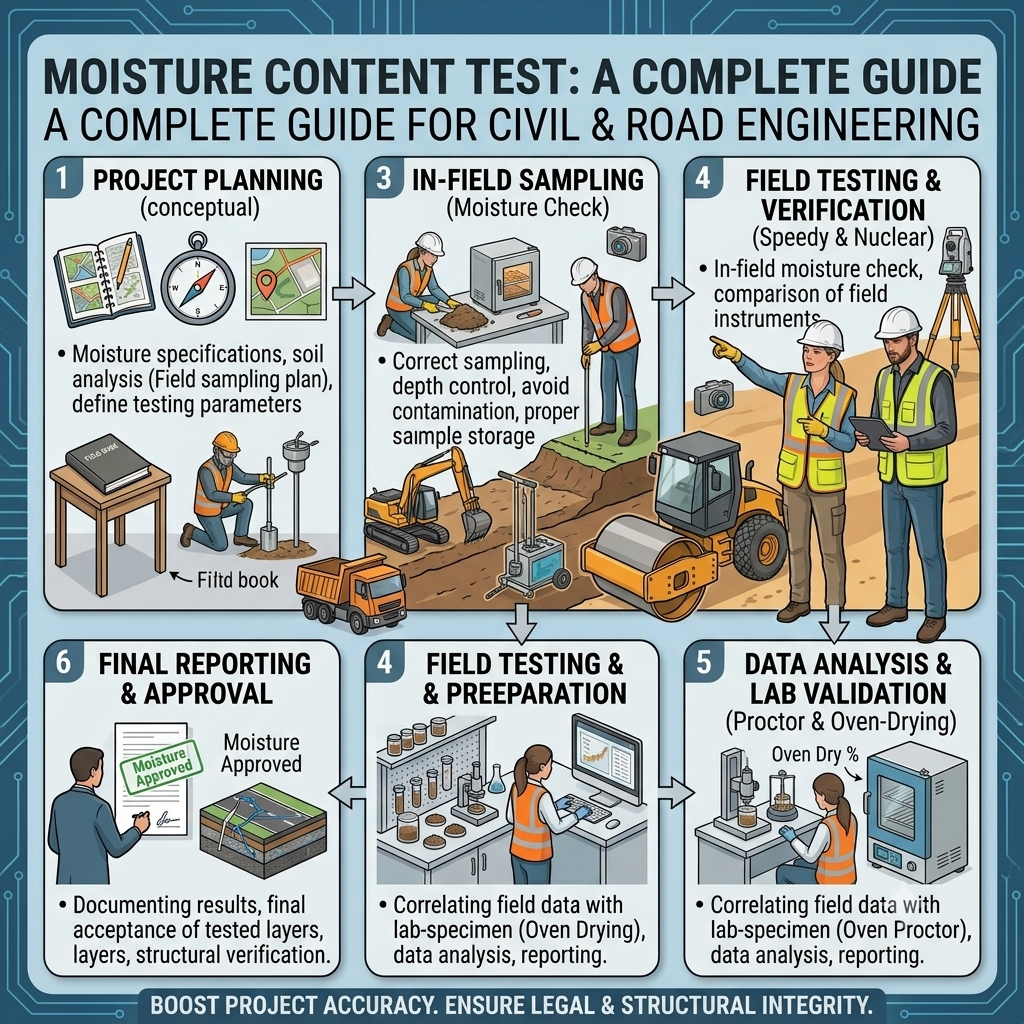
The Moisture Content Test helps engineers determine the amount of water present in a soil sample. This simple but essential laboratory and field test supports soil compaction, pavement design, earthwork quality control, and foundation construction. Accurate moisture measurement allows engineers to achieve optimum compaction, improve load-bearing capacity, and reduce future settlement or pavement failures.
Road construction projects require strict control over moisture levels because every pavement layer depends on proper compaction. Contractors perform moisture testing throughout construction to ensure that embankments, subgrades, sub-bases, and base courses meet design specifications.
This comprehensive guide explains the Moisture Content Test, its engineering principles, testing methods, practical applications, and industry best practices. Whether you are a civil engineer, contractor, site supervisor, or engineering student, understanding this test will improve your knowledge of soil mechanics and highway construction.
What is a Moisture Content Test?
The Moisture Content Test determines the percentage of water present in a soil sample compared with its dry weight. Engineers use this value to evaluate soil condition before compaction, pavement construction, and foundation work.
Water significantly influences soil behavior. Dry soil often lacks cohesion, while overly wet soil loses strength and becomes unstable. Proper moisture control allows soil particles to rearrange efficiently during compaction, creating a dense and durable foundation.
Moisture content is usually expressed as a percentage using the following relationship:
Moisture Content (%) = (Weight of Water ÷ Weight of Dry Soil) × 100
This parameter serves as a key input for many geotechnical and pavement engineering decisions.
Why is Moisture Content Important in Civil Engineering?
Moisture directly affects the engineering properties of soil. Accurate moisture measurement helps engineers construct safe, durable, and economical infrastructure.
Major Benefits
- Achieves optimum soil compaction.
- Improves bearing capacity.
- Reduces settlement.
- Prevents pavement cracking.
- Increases embankment stability.
- Enhances road performance.
- Improves foundation reliability.
- Supports quality control during construction.
In highway projects, even small variations in moisture can reduce pavement performance and shorten service life. Routine testing allows construction teams to maintain consistent quality.
Objectives of the Moisture Content Test
Engineers perform the Moisture Content Test to achieve several technical objectives.
Primary Objectives
- Measure water present in soil.
- Determine suitability for compaction.
- Support earthwork quality control.
- Verify field moisture against laboratory requirements.
- Improve pavement performance.
- Assist in embankment construction.
- Evaluate foundation conditions.
- Reduce future maintenance costs.
Moisture testing also supports laboratory experiments such as the Proctor Compaction Test and California Bearing Ratio (CBR) Test.
Engineering Principles Behind Moisture Content
Soil consists of three primary components:
- Soil particles
- Water
- Air
Water occupies the void spaces between soil particles. As moisture increases, the arrangement of these particles changes, affecting strength, density, permeability, and compressibility.
Relationship Between Moisture and Compaction
During compaction:
- Low moisture prevents particles from moving into a dense arrangement.
- Optimum moisture allows particles to slide and interlock efficiently.
- Excessive moisture fills voids and reduces soil strength.
This relationship forms the basis of the Proctor Compaction Test, where engineers identify the Optimum Moisture Content (OMC) that produces the Maximum Dry Density (MDD).
Types of Moisture in Soil
Water exists in soil in different forms. Each type influences soil behavior differently.
1. Gravitational Water
Gravitational water occupies large voids and drains under the influence of gravity.
Characteristics
- Moves freely through soil.
- Does not contribute significantly to soil cohesion.
- Common after heavy rainfall.
- Leaves the soil quickly in coarse-grained materials.
2. Capillary Water
Capillary water remains in small soil pores because of surface tension.
Characteristics
- Provides moisture to fine-grained soils.
- Increases apparent cohesion.
- Influences compaction behavior.
- Plays an important role in pavement performance.
3. Hygroscopic Water
Hygroscopic water forms a thin film around individual soil particles.
Characteristics
- Strongly adheres to particles.
- Cannot drain under gravity.
- Exists even in dry soil.
- Difficult to remove without heating.
Understanding these moisture forms helps engineers predict soil behavior under varying environmental conditions.
Methods of Moisture Content Test
Several laboratory and field methods determine soil moisture. The selection depends on project requirements, equipment availability, and desired accuracy.
1. Oven Dry Method
The Oven Dry Method remains the standard laboratory procedure because it delivers highly accurate results.
Equipment
- Drying oven
- Metal moisture container
- Balance
- Desiccator
- Soil sample
Advantages
- High accuracy
- Internationally accepted
- Suitable for all soil types
- Widely used in laboratories
Limitations
- Requires several hours.
- Needs laboratory facilities.
- Not suitable for rapid field testing.
2. Sand Bath Method
The Sand Bath Method provides faster moisture determination when laboratory equipment is unavailable.
Procedure Overview
- Heat sand in a metal tray.
- Place the soil sample in the heated sand.
- Continue heating until moisture evaporates.
- Record the final dry weight.
Applications
- Remote construction sites
- Small field laboratories
- Preliminary moisture checks
3. Infrared Moisture Meter Method
Infrared radiation dries the soil sample rapidly while simultaneously measuring weight loss.
Advantages
- Fast results
- Good accuracy
- Portable equipment
- Suitable for quality control
Common Uses
- Highway construction
- Earthwork inspection
- Material testing laboratories
4. Calcium Carbide (Speedy) Method
The Speedy Moisture Tester offers rapid field measurements.
The equipment mixes soil with calcium carbide inside a sealed chamber. Water reacts with calcium carbide to produce acetylene gas. The gas pressure indicates the moisture content.
Advantages
- Very fast
- Portable
- Ideal for field work
- Popular in road construction
Limitations
- Slightly less accurate than the Oven Dry Method.
- Requires careful handling of chemicals.
5. Microwave Oven Method
Engineers sometimes use microwave ovens for rapid drying under controlled conditions.
Advantages
- Quick drying
- Low equipment cost
- Suitable for small projects
Limitations
- Requires operator experience.
- Excessive heating may damage some soil samples.
Comparison of Moisture Testing Methods
| Method | Accuracy | Speed | Field Use | Laboratory Use |
|---|---|---|---|---|
| Oven Dry Method | Excellent | Slow | No | Yes |
| Sand Bath Method | Good | Medium | Yes | Limited |
| Infrared Moisture Meter | Very Good | Fast | Yes | Yes |
| Calcium Carbide Method | Good | Very Fast | Excellent | Limited |
| Microwave Oven Method | Good | Fast | Limited | Yes |
Soil Moisture Movement Diagram
                Rainfall
                   │
                   ▼
        -----------------------
        Top Soil Surface
        -----------------------
          ↓ Gravitational Water
        -----------------------
          ↔ Capillary Water
        -----------------------
      Hygroscopic Water Film
      Around Soil Particles
        -----------------------
          Soil Skeleton
Moisture Content and Compaction Relationship
Dry Soil
   │
   ▼
Add Water
   │
   ▼
Better Particle Rearrangement
   │
   ▼
Optimum Moisture Content (OMC)
   │
   ▼
Maximum Dry Density (MDD)
   │
   ▼
Excess Water
   │
   ▼
Reduced Soil Strength
Key Takeaways
The Moisture Content Test forms the foundation of soil quality assessment in civil and highway engineering. Accurate moisture determination allows engineers to achieve proper compaction, improve pavement performance, increase bearing capacity, and minimize settlement. Several laboratory and field methods are available, each offering different levels of accuracy, speed, and practicality. Understanding soil moisture behavior and selecting the appropriate testing method help engineers make informed decisions throughout planning, design, and construction.
Step-by-Step Moisture Content Test Procedure (Oven Dry Method)
The Oven Dry Method is the most widely accepted laboratory procedure for determining soil moisture content because it provides consistent and accurate results. Many geotechnical laboratories use this method as the reference standard for comparing other moisture testing techniques.
Equipment Required
- Drying oven (maintained at 105–110°C)
- Moisture container with lid
- Digital weighing balance
- Desiccator
- Tongs
- Soil sample
Testing Procedure
Step 1: Collect a Representative Soil Sample
Collect a clean soil sample from the required depth. Remove roots, organic matter, stones, and other unwanted materials.
Step 2: Weigh the Empty Container
Record the weight of the clean, dry moisture container.
Notation: W₁
Step 3: Add Wet Soil
Place the wet soil into the container and weigh it again.
Notation: W₂
Step 4: Dry the Sample
Place the container inside the oven and dry the sample at 105–110°C for approximately 24 hours or until it reaches a constant weight.
Step 5: Cool the Sample
Remove the container using tongs and allow it to cool inside a desiccator. Cooling prevents the soil from absorbing moisture from the surrounding air.
Step 6: Record the Final Weight
Weigh the container with the dry soil.
Notation: W₃
Step 7: Calculate Moisture Content
Determine the moisture content using the standard formula.
Moisture Content Formula
[
\text{Moisture Content (%)}=\frac{\text{Weight of Water}}{\text{Weight of Dry Soil}}\times100
]
Where:
- Weight of Water = W₂ − W₃
- Weight of Dry Soil = W₃ − W₁
Sample Calculation
Given
- Empty container (W₁) = 40 g
- Container + Wet Soil (W₂) = 165 g
- Container + Dry Soil (W₃) = 145 g
Solution
Weight of Water
= 165 − 145
= 20 g
Weight of Dry Soil
= 145 − 40
= 105 g
Moisture Content
= (20 ÷ 105) × 100
= 19.05%
Result: The soil moisture content is 19.05%.
Factors Affecting Moisture Content
Several natural and construction-related factors influence the amount of water present in soil.
1. Rainfall
Heavy rainfall increases soil moisture and often reduces bearing capacity if drainage is inadequate.
2. Soil Type
Clay retains more moisture than sand because of its fine particle size and larger surface area.
3. Groundwater Level
High groundwater tables increase moisture in nearby soils and can affect pavement performance.
4. Drainage Conditions
Poor drainage allows water to accumulate, weakening embankments and pavement foundations.
5. Weather Conditions
Hot weather accelerates evaporation, while cold or humid conditions slow the drying process.
6. Vegetation
Plants absorb water through their root systems, changing the moisture content of surrounding soil.
Practical Applications in Road Engineering
The Moisture Content Test supports nearly every stage of highway and road construction.
Subgrade Preparation
Engineers verify that the soil is close to the Optimum Moisture Content (OMC) before compaction.
Embankment Construction
Field technicians monitor moisture levels to achieve the specified density and prevent settlement.
Pavement Construction
Moisture testing ensures that each pavement layer provides adequate support for traffic loads.
Earthwork Quality Control
Contractors use moisture testing to confirm compliance with project specifications.
Foundation Construction
Engineers evaluate soil moisture before placing footings, retaining walls, and bridge foundations.
Soil Stabilization
The test helps determine the effectiveness of lime, cement, or chemical stabilization treatments.
Advantages of the Moisture Content Test
- Simple testing procedure.
- Essential for quality control.
- Supports proper soil compaction.
- Improves pavement performance.
- Reduces construction defects.
- Increases pavement service life.
- Assists in laboratory and field investigations.
- Supports geotechnical design decisions.
- Minimizes maintenance costs.
Limitations of the Moisture Content Test
- The Oven Dry Method requires several hours.
- Field methods may provide slightly lower accuracy.
- Improper sampling affects reliability.
- Some soils containing gypsum or organic materials require special consideration.
- Incorrect drying temperatures may alter test results.
Despite these limitations, the Moisture Content Test remains one of the most reliable and widely used soil tests in civil engineering.
Common Mistakes to Avoid
Many inaccurate results occur because of avoidable errors during sampling or testing.
Common Mistakes
- Collecting a non-representative soil sample.
- Using dirty or wet moisture containers.
- Recording incorrect weights.
- Removing the sample before complete drying.
- Allowing the sample to absorb atmospheric moisture before weighing.
- Using an uncalibrated balance.
- Heating the sample above the recommended temperature.
- Mixing different soil samples in one container.
Careful attention to testing procedures improves accuracy and repeatability.
Best Practices
- Collect representative soil samples from the required depth.
- Use clean and properly labeled containers.
- Calibrate weighing equipment regularly.
- Maintain the oven temperature within the specified range.
- Store dried samples in a desiccator before weighing.
- Record measurements immediately.
- Perform duplicate tests when high accuracy is required.
- Follow approved laboratory procedures and project specifications.
- Maintain complete test records for quality assurance.
Practical Recommendations
Civil Engineers
- Compare field moisture with the laboratory-determined Optimum Moisture Content before approving compaction.
- Review moisture trends throughout earthwork operations.
- Integrate moisture test results with density and CBR test data for better decision-making.
Contractors
- Check moisture before every compaction operation.
- Add water gradually to dry soil and mix thoroughly.
- Aerate excessively wet soil before compaction.
- Protect prepared layers from unexpected rainfall.
Engineering Students
- Understand the relationship between moisture content and soil strength.
- Practice laboratory calculations using real test data.
- Observe field testing during highway construction projects.
- Learn how moisture influences pavement performance and foundation behavior.
General Discussion of IRC, AASHTO, and ICE Practices
Recognized engineering organizations such as the Indian Roads Congress (IRC), the American Association of State Highway and Transportation Officials (AASHTO), and the Institution of Civil Engineers (ICE) emphasize the importance of moisture control throughout earthwork and pavement construction.
Their guidance generally promotes:
- Determining moisture content before compaction.
- Achieving compaction near the laboratory-established Optimum Moisture Content.
- Performing regular field quality control tests.
- Using representative sampling techniques.
- Maintaining proper documentation during construction.
- Combining moisture testing with density, strength, and compaction verification.
Following these widely accepted engineering practices improves pavement durability, construction quality, and long-term performance.
Frequently Asked Questions (FAQs)
1. What is the Moisture Content Test?
The Moisture Content Test determines the percentage of water present in a soil sample relative to its dry weight.
2. Why is moisture content important in road construction?
Proper moisture enables effective soil compaction, increases bearing capacity, and reduces the risk of pavement settlement and cracking.
3. Which method provides the most accurate moisture content result?
The Oven Dry Method is generally considered the most accurate laboratory procedure and serves as the reference method for many projects.
4. What is the optimum moisture content (OMC)?
OMC is the moisture level at which soil reaches its maximum dry density during compaction.
5. How does excessive moisture affect soil?
Too much water reduces soil strength, lowers stability, increases deformation, and can lead to pavement failures.
6. Can engineers perform moisture testing on-site?
Yes. Portable methods such as the Calcium Carbide (Speedy) Test and infrared moisture meters allow rapid field measurements.
7. How often should moisture testing be performed during construction?
Testing frequency depends on project specifications, but engineers typically perform moisture checks whenever soil conditions change or before each compaction operation.
8. Which soil retains the highest moisture?
Clay soils generally retain more moisture than sandy or gravelly soils because of their finer particles and higher surface area.
9. Does moisture content affect pavement life?
Yes. Proper moisture control improves compaction quality, enhances pavement support, and extends the service life of road structures.
10. Is the Moisture Content Test required for every road project?
Most highway and earthwork projects include moisture testing because it forms a key part of geotechnical investigation and construction quality control.
Conclusion
The Moisture Content Test is one of the most important soil tests in civil engineering, geotechnical engineering, and highway construction. It provides the information needed to achieve proper compaction, improve soil strength, and create stable foundations for roads, embankments, and structures. By accurately measuring the amount of water present in soil, engineers can determine whether conditions are suitable for construction or whether corrective actions such as drying, watering, or soil stabilization are necessary. Regular moisture testing also supports quality assurance, minimizes construction defects, and extends the service life of pavement systems. When combined with density testing, CBR evaluation, and compaction control, the Moisture Content Test becomes an essential tool for building durable and reliable infrastructure. Engineers, contractors, and students who understand this test can make better technical decisions, improve construction quality, and contribute to safer, longer-lasting transportation networks.

Kamran Malik is a passionate civil engineering writer and researcher who specializes in construction, transportation, structural engineering, and infrastructure topics. Through his articles on CivilEngineerings.com, he simplifies complex engineering concepts and shares practical insights, industry trends, and educational resources for students, professionals, and engineering enthusiasts.