
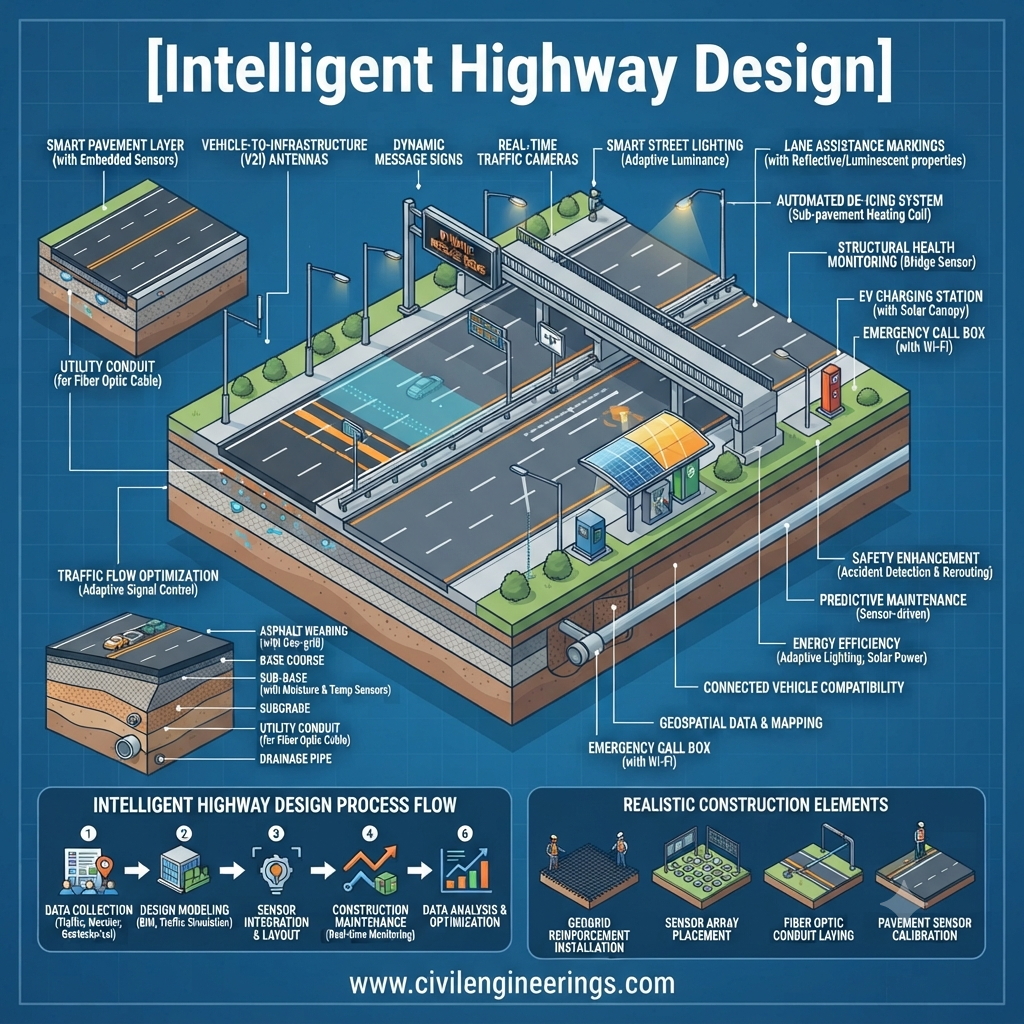
Introduction
Modern transportation networks face growing challenges. Rapid urbanization, increasing traffic volumes, climate change, and rising safety concerns demand more than traditional road engineering solutions. Highways must now become intelligent systems capable of monitoring traffic, communicating with vehicles, predicting maintenance needs, and responding to changing road conditions in real time. This is where Intelligent Highway Design transforms the future of transportation infrastructure.
Intelligent Highway Design combines civil engineering, transportation planning, digital technologies, communication systems, and artificial intelligence to create roads that improve mobility, safety, and sustainability. Instead of functioning as static infrastructure, intelligent highways continuously collect, analyze, and share information to optimize traffic operations and reduce accidents.
This comprehensive guide explains the principles, components, technologies, engineering considerations, design process, benefits, challenges, and future trends of Intelligent Highway Design. Whether you are a civil engineering student, highway engineer, contractor, consultant, researcher, or infrastructure professional, this article provides practical insights, engineering concepts, and best practices that support modern highway development.
What is Intelligent Highway Design?
Intelligent Highway Design is the process of planning, designing, constructing, and operating highways equipped with advanced communication technologies, sensors, automation systems, and data analytics to improve traffic efficiency, road safety, infrastructure management, and environmental performance.
Unlike conventional highways, intelligent highways continuously gather information from vehicles, road sensors, weather stations, surveillance cameras, and traffic management centers. Engineers analyze this information to make informed operational decisions.
The concept integrates:
- Highway Engineering
- Transportation Engineering
- Intelligent Transportation Systems (ITS)
- Internet of Things (IoT)
- Artificial Intelligence (AI)
- Geographic Information Systems (GIS)
- Big Data Analytics
- Vehicle-to-Infrastructure (V2I) Communication
Why Intelligent Highways Matter
Transportation systems worldwide experience increasing congestion and accident rates. Traditional road infrastructure alone cannot efficiently manage modern traffic demands.
Intelligent highways help solve these problems by:
- Reducing traffic congestion
- Improving travel time reliability
- Preventing accidents
- Enhancing emergency response
- Supporting autonomous vehicles
- Lowering fuel consumption
- Reducing greenhouse gas emissions
- Improving road asset management
Governments worldwide are investing heavily in smart transportation infrastructure because efficient road networks directly contribute to economic growth.
Objectives of Intelligent Highway Design
The primary objectives include:
1. Improve Road Safety
Real-time monitoring helps identify hazards before accidents occur.
Examples include:
- Wrong-way driving detection
- Speed monitoring
- Collision warning systems
- Fog detection
2. Increase Traffic Efficiency
Adaptive traffic management optimizes vehicle movement during peak hours.
Benefits include:
- Reduced travel time
- Lower delays
- Better lane utilization
3. Reduce Maintenance Costs
Smart sensors continuously monitor pavement conditions.
Engineers can schedule maintenance before major failures develop.
4. Support Sustainable Transportation
Intelligent systems reduce:
- Fuel consumption
- Carbon emissions
- Vehicle idling
- Air pollution
5. Enhance Emergency Response
Connected highways immediately notify emergency services after serious incidents.
This significantly reduces emergency response time.
Core Components of Intelligent Highways
Roadside Sensors
Sensors continuously collect information about:
- Traffic volume
- Vehicle speed
- Axle loads
- Pavement condition
- Weather
- Visibility
Common sensor types include:
- Inductive loop detectors
- Radar sensors
- LiDAR
- Infrared sensors
- Fiber optic sensors
Smart Cameras
High-definition cameras monitor:
- Traffic incidents
- Vehicle classification
- Lane discipline
- Pedestrian activity
Artificial Intelligence processes live video feeds to detect abnormal situations automatically.
Variable Message Signs (VMS)
Electronic message boards provide drivers with:
- Traffic updates
- Accident alerts
- Weather warnings
- Speed recommendations
- Detour information
Communication Networks
Reliable communication enables data exchange between:
- Vehicles
- Highway infrastructure
- Traffic management centers
Communication technologies include:
- 5G
- Fiber optics
- DSRC
- Cellular V2X
Traffic Management Centers (TMC)
These centers act as the brain of intelligent highways.
Operators monitor:
- Traffic flow
- CCTV footage
- Weather conditions
- Emergency incidents
AI software assists decision-making.
Engineering Design Principles
Successful Intelligent Highway Design follows several engineering principles.
Safety First
Every intelligent feature should improve driver safety.
Designers evaluate:
- Driver behavior
- Visibility
- Human factors
- Emergency accessibility
Reliability
Systems must operate continuously under:
- Heavy traffic
- Extreme temperatures
- Rainfall
- Snow
- Dust
- Power interruptions
Redundant communication systems improve reliability.
Scalability
Smart highways should accommodate future technologies without major reconstruction.
Infrastructure must support:
- Future sensors
- Additional communication devices
- Autonomous vehicle integration
Interoperability
Equipment from different manufacturers should work together seamlessly.
International communication standards improve compatibility.
Cybersecurity
Digital highways require secure communication systems.
Protection includes:
- Encryption
- Firewalls
- Secure authentication
- Data privacy protocols
Intelligent Highway Design Process
Step 1: Traffic Data Collection
Engineers collect:
- Traffic counts
- Origin-destination surveys
- Speed data
- Crash history
- Vehicle classification
Reliable data forms the foundation of intelligent design.
Step 2: Site Investigation
Field investigations examine:
- Existing road geometry
- Utilities
- Drainage
- Environmental constraints
- Communication infrastructure
Step 3: Needs Assessment
Engineers identify operational problems such as:
- Congestion
- High accident rates
- Poor visibility
- Weather-related incidents
Step 4: Technology Selection
Appropriate technologies are selected based on project objectives.
Examples include:
- Adaptive lighting
- Smart intersections
- Traffic sensors
- Dynamic lane management
Step 5: System Integration
All technologies are connected into a centralized traffic management system.
Integration ensures efficient information sharing.
Step 6: Testing and Commissioning
Before opening the highway:
- Communication systems are tested.
- Sensors are calibrated.
- Cameras are verified.
- Emergency response systems are evaluated.
Key Technologies Used
Internet of Things (IoT)
IoT devices connect thousands of sensors throughout the highway network.
Real-time information improves operational decisions.
Artificial Intelligence
AI analyzes enormous datasets.
Applications include:
- Traffic prediction
- Incident detection
- Maintenance planning
- Driver behavior analysis
Digital Twins
A digital twin creates a virtual highway model.
Engineers simulate:
- Traffic growth
- Pavement deterioration
- Emergency scenarios
- Expansion planning
Autonomous Vehicle Infrastructure
Future highways support self-driving vehicles through:
- Lane guidance
- Roadside communication
- High-definition mapping
Smart Pavement Monitoring
Embedded sensors measure:
- Temperature
- Moisture
- Pavement strain
- Deflection
- Cracking
Maintenance becomes predictive rather than reactive.
Practical Applications
Intelligent highways serve numerous real-world purposes.
Smart Toll Collection
Electronic toll systems eliminate stopping delays.
Benefits include:
- Faster travel
- Lower emissions
- Reduced congestion
Dynamic Speed Limits
Speed limits automatically adjust based on:
- Rain
- Fog
- Traffic density
- Construction activities
Incident Management
Automatic detection systems immediately identify:
- Accidents
- Vehicle breakdowns
- Debris
- Wrong-way vehicles
Emergency teams receive alerts instantly.
Weather Monitoring
Road weather stations monitor:
- Wind
- Ice
- Rainfall
- Snow
- Surface temperature
Drivers receive advance warnings.
Freight Management
Smart highways optimize truck movement through:
- Weigh-in-motion systems
- Freight tracking
- Logistics coordination
Benefits of Intelligent Highway Design
The advantages extend across the transportation sector.
Improved Road Safety
Continuous monitoring significantly reduces accident risks.
Reduced Congestion
Adaptive traffic management minimizes delays.
Lower Operating Costs
Predictive maintenance reduces repair expenses.
Increased Infrastructure Life
Condition monitoring prevents premature pavement failure.
Better Environmental Performance
Reduced congestion lowers emissions and fuel consumption.
Enhanced User Experience
Drivers receive accurate travel information in real time.
Better Decision-Making
Transportation agencies rely on live operational data instead of estimates.
Challenges and Limitations
Despite its advantages, Intelligent Highway Design presents several challenges.
High Initial Investment
Smart infrastructure requires substantial capital.
Cybersecurity Risks
Connected infrastructure becomes vulnerable to cyber threats.
Technology Obsolescence
Rapid innovation may require regular system upgrades.
Skilled Workforce Requirements
Successful implementation depends on trained engineers, IT specialists, and maintenance teams.
Data Management
Millions of data points require secure storage, processing, and analysis.
Best Practices for Engineers
Highway professionals should consider the following recommendations:
- Integrate Intelligent Transportation Systems during early planning.
- Design communication infrastructure for future expansion.
- Conduct comprehensive traffic impact assessments.
- Use high-quality sensors with proven reliability.
- Develop preventive maintenance programs.
- Implement strong cybersecurity measures.
- Ensure interoperability between all intelligent systems.
- Monitor system performance using key performance indicators (KPIs).
- Train operations staff continuously.
- Coordinate with government agencies, emergency responders, and utility providers.
Future Trends
The future of Intelligent Highway Design is rapidly evolving.
Emerging innovations include:
- AI-driven traffic control
- Fully connected autonomous corridors
- Wireless electric vehicle charging lanes
- Solar-powered highways
- Smart pavement capable of self-monitoring
- Drone-assisted highway inspections
- Edge computing for real-time analytics
- Vehicle-to-Everything (V2X) communication
- Digital twins for lifecycle management
- Carbon-neutral transportation infrastructure
These advancements will make highways safer, greener, and more efficient while supporting increasingly connected mobility systems.
General Guidance from IRC, AASHTO, and ICE
Leading engineering organizations provide valuable guidance that supports Intelligent Highway Design:
- IRC (Indian Roads Congress) encourages integrating Intelligent Transportation Systems with highway planning, road safety measures, traffic management, and maintenance strategies.
- AASHTO (American Association of State Highway and Transportation Officials) promotes performance-based highway design, asset management, resilience, geometric design consistency, and technology integration to improve transportation efficiency.
- ICE (Institution of Civil Engineers) emphasizes sustainable infrastructure, digital engineering, lifecycle asset management, climate resilience, and innovation in transportation projects.
Although specific project requirements vary by country, engineers should always follow applicable national standards, local regulations, and project specifications alongside internationally recognized best practices.
Frequently Asked Questions (FAQs)
1. What is Intelligent Highway Design?
It is the design of highways equipped with smart technologies such as sensors, communication systems, AI, and traffic management tools to improve safety, efficiency, and sustainability.
2. How is an intelligent highway different from a traditional highway?
Traditional highways are passive transportation facilities, while intelligent highways actively monitor conditions, communicate information, and support automated traffic operations.
3. What technologies are commonly used in intelligent highways?
Common technologies include IoT sensors, AI, CCTV cameras, LiDAR, radar, fiber optics, V2I communication, digital twins, and smart traffic management systems.
4. Why are intelligent highways important for road safety?
They detect incidents quickly, warn drivers in real time, manage traffic dynamically, and enable faster emergency response.
5. Can intelligent highways support autonomous vehicles?
Yes. They provide communication infrastructure, digital mapping support, lane guidance, and real-time traffic information essential for connected and autonomous vehicles.
6. What are the biggest challenges in implementing intelligent highways?
Major challenges include high investment costs, cybersecurity concerns, technology integration, maintenance, and the need for skilled personnel.
7. How do smart sensors improve highway maintenance?
Sensors monitor pavement conditions continuously, allowing engineers to identify deterioration early and schedule preventive maintenance before severe damage occurs.
8. What role does artificial intelligence play in intelligent highways?
AI analyzes traffic patterns, predicts congestion, detects incidents, optimizes traffic signals, supports maintenance planning, and improves operational efficiency.
9. Which professionals benefit from learning Intelligent Highway Design?
Civil engineers, transportation engineers, consultants, contractors, researchers, government engineers, planners, and infrastructure managers all benefit from understanding smart highway systems.
10. What is the future of Intelligent Highway Design?
The future includes AI-powered traffic management, connected autonomous vehicle corridors, smart pavements, digital twins, renewable energy integration, and resilient transportation infrastructure.
Conclusion
Intelligent Highway Design represents the next generation of transportation engineering by combining traditional civil engineering practices with advanced digital technologies. Instead of serving only as physical roadways, modern highways now function as connected, data-driven infrastructure that improves safety, enhances traffic efficiency, supports predictive maintenance, and reduces environmental impacts. As urban populations expand and mobility demands continue to rise, intelligent highways will become an essential component of sustainable transportation systems.
For engineers, contractors, consultants, researchers, and students, understanding Intelligent Highway Design is no longer optional—it is a valuable professional skill. Successful projects require careful planning, reliable communication networks, robust cybersecurity, and adherence to recognized engineering standards such as those promoted by IRC, AASHTO, and ICE. By integrating innovative technologies with sound engineering principles, transportation professionals can deliver highways that are safer, smarter, more resilient, and prepared to meet the evolving needs of future generations.
