
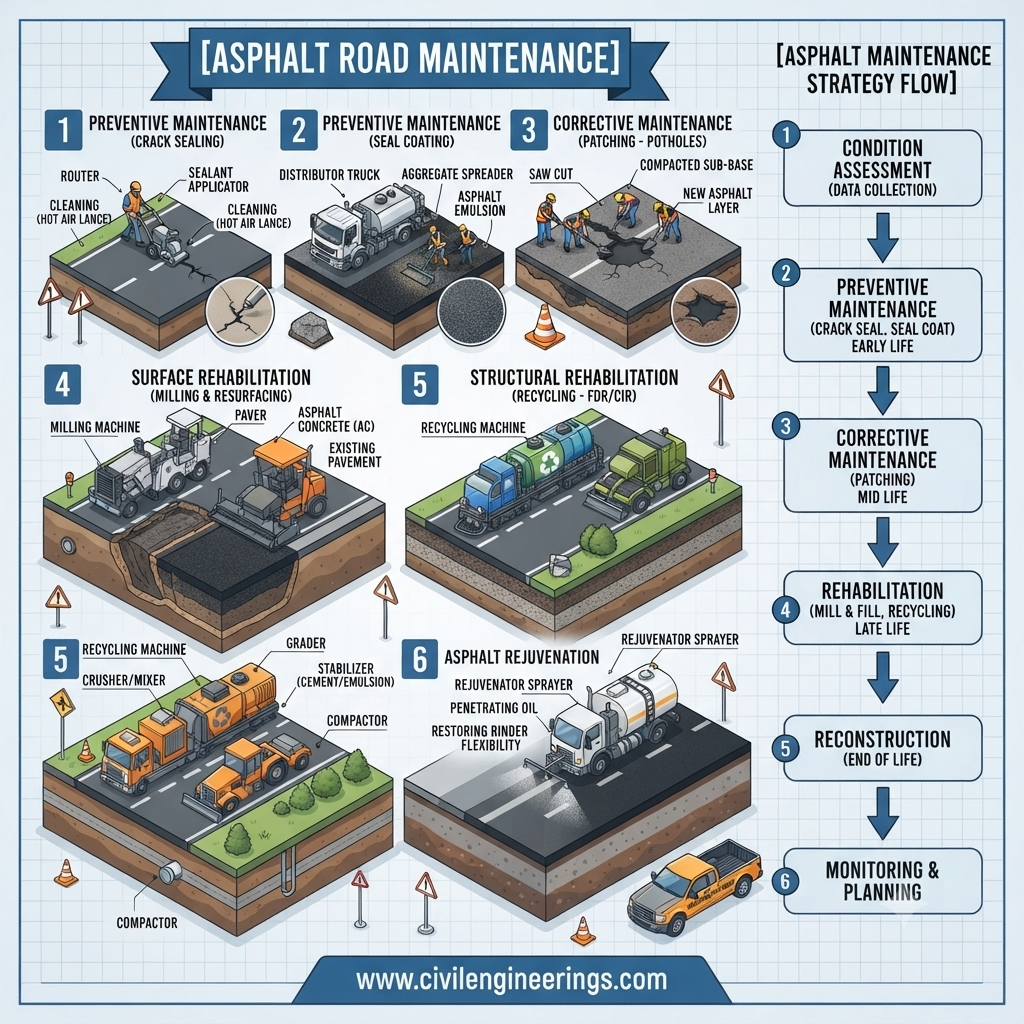
Asphalt roads carry millions of vehicles every day, yet even a well-designed pavement gradually deteriorates under traffic, weather, moisture, temperature changes, and repeated loading. Small cracks can become potholes, minor surface defects can develop into structural failures, and poor drainage can shorten pavement life dramatically. This is why Asphalt Road Maintenance is not simply a repair activity—it is a planned engineering process for preserving pavement performance, safety, ride quality, and investment.
Effective maintenance begins with identifying the cause and severity of pavement distress. Engineers then select an appropriate treatment, prepare the affected area correctly, apply suitable materials, and monitor performance afterward. Preventive treatments such as crack sealing and surface treatments can often delay expensive rehabilitation when applied at the right time. (Federal Highway Administration)
This guide explains asphalt pavement inspection, common defects, maintenance methods, repair procedures, drainage considerations, equipment, quality control, engineering calculations, standards, and practical recommendations for students, engineers, contractors, and infrastructure professionals.
What Is Asphalt Road Maintenance?
Asphalt Road Maintenance is the systematic inspection, preservation, repair, and rehabilitation of asphalt pavement so that the roadway continues to provide acceptable structural capacity, riding quality, skid resistance, drainage, and safety.
Maintenance may range from routine activities such as cleaning drainage facilities and sealing small cracks to corrective work such as pothole patching, localized repairs, milling, and asphalt overlays. FHWA describes routine pavement maintenance as work performed regularly to preserve the highway system or respond to specific conditions and events. (Federal Highway Administration)
A useful way to understand pavement maintenance is to divide it into three levels:
Routine Maintenance
Routine maintenance deals with relatively small defects before they become major failures.
Typical activities include:
- Crack filling and sealing
- Pothole patching
- Shoulder maintenance
- Drainage cleaning
- Pavement marking maintenance
- Localized surface repairs
- Cleaning debris from pavement
Preventive Maintenance
Preventive maintenance aims to extend pavement service life while the pavement is still in reasonably good structural condition.
Common treatments include:
- Fog seals
- Chip seals
- Slurry seals
- Microsurfacing
- Crack sealing
- Thin asphalt overlays
- Surface treatments
These treatments are most effective when the pavement still has sufficient structural capacity. Once structural failure becomes widespread, preventive maintenance may no longer be appropriate. (DOT ROSA P.)
Corrective Maintenance and Rehabilitation
Corrective maintenance addresses significant pavement deterioration.
Examples include:
- Full-depth patching
- Deep localized repairs
- Milling and resurfacing
- Asphalt overlays
- Base-course reconstruction
- Subgrade improvement
- Partial or complete pavement reconstruction
The important engineering principle is simple: repair the cause, not only the visible symptom.


Why Asphalt Road Maintenance Is Important
A road does not suddenly fail in most cases. Pavement deterioration normally develops progressively. Timely maintenance interrupts this deterioration cycle and can reduce the need for expensive rehabilitation.
Extends Pavement Service Life
Water entering cracks can reach lower pavement layers and weaken the supporting structure. Sealing suitable cracks helps reduce moisture infiltration. Crack treatment is specifically intended to prevent water and other materials from entering pavement cracks. (Pavement Interactive)
Improves Road Safety
Damaged asphalt can create:
- Potholes
- Rutting
- Uneven surfaces
- Reduced skid resistance
- Loose aggregate
- Water ponding
These conditions can affect vehicle control and increase road-user risk.
Reduces Long-Term Costs
A relatively small preventive treatment can sometimes postpone a much more expensive rehabilitation project. However, engineers must select treatments according to pavement condition rather than applying the same treatment everywhere.
Protects Drainage and Pavement Structure
Standing water is one of the major enemies of asphalt pavement. Poor drainage can accelerate stripping, base weakening, pothole development, and deformation.
Maintains Ride Quality
Rutting, settlement, patches, potholes, and surface deformation reduce ride comfort. Regular pavement condition surveys allow agencies to identify deterioration before it significantly affects users.
Common Asphalt Pavement Distresses
Correct diagnosis is the foundation of successful maintenance. Applying the wrong treatment can waste money and allow the underlying problem to continue.
Longitudinal Cracking
Longitudinal cracks run approximately parallel to the road centerline. They may develop because of:
- Construction joints
- Pavement movement
- Reflection cracking
- Settlement
- Environmental stresses
- Structural deficiencies
Small, non-structural cracks may be candidates for crack sealing or filling, depending on their characteristics.
Transverse Cracking
Transverse cracks generally run across the traffic lane. Temperature-related movement and asphalt aging are common contributors.
Crack sealing can help prevent water infiltration when the crack type and pavement condition are suitable.
Alligator or Fatigue Cracking
Alligator cracking appears as interconnected cracks resembling reptile skin. It is often associated with repeated traffic loading and inadequate structural support.
Extensive fatigue cracking usually indicates a deeper structural problem. Simply filling the cracks rarely provides a durable solution. Area repair, structural overlay, or reconstruction may be necessary.
Potholes
Potholes are localized pavement failures involving loss of surface and/or underlying material. Moisture, traffic, freeze-thaw action, poor drainage, and progressive cracking can contribute to their development.
Proper pothole repair requires removal of defective material, cleaning, appropriate material placement, and adequate compaction. FHWA maintains specific guidance on pothole repair and asphalt pavement maintenance. (Federal Highway Administration)
Rutting
Rutting is a longitudinal depression formed in wheel paths.
Possible causes include:
- Weak asphalt mixture
- Excessive traffic loading
- Poor compaction
- Weak base or subgrade
- Permanent deformation in asphalt layers
- Inadequate pavement design
Minor surface rutting may sometimes be addressed through milling and resurfacing, while deep structural rutting requires investigation of lower layers.
Raveling
Raveling occurs when aggregate particles progressively loosen from the pavement surface.
Common causes include:
- Poor aggregate bonding
- Aging binder
- Inadequate compaction
- Moisture damage
- Poor mix design
- Construction deficiencies
Early-stage surface deterioration may respond to an appropriate surface treatment.
Bleeding
Bleeding occurs when excess asphalt binder rises toward the pavement surface, producing a dark, shiny appearance.
It can reduce surface texture and skid resistance. The appropriate repair depends on the severity and underlying cause.
Asphalt Road Maintenance Inspection Process
A good maintenance program starts with reliable pavement condition information.
Step 1: Conduct a Visual Survey
Inspect the road systematically and record:
- Crack type
- Crack severity
- Crack density
- Pothole dimensions
- Rut depth
- Raveling
- Bleeding
- Surface deformation
- Drainage condition
- Previous repair locations
Photographs and GPS-referenced records can improve maintenance planning.
Step 2: Measure Pavement Condition
Engineers may use condition indicators such as:
- International Roughness Index (IRI)
- Rut depth
- Crack percentage
- Skid resistance
- Pavement Condition Index (PCI)
- Deflection measurements
A simplified pavement condition concept can be expressed as:
PCI = 100 − Deduct Values
The actual PCI calculation involves standardized distress types, severity levels, and density relationships rather than simply subtracting raw distress quantities.
Step 3: Investigate Structural Condition
When visual evidence indicates structural deterioration, engineers may use:
- Falling Weight Deflectometer (FWD)
- Dynamic Cone Penetrometer (DCP)
- Core sampling
- Material testing
- Ground-penetrating radar
- Deflection measurements
- Subgrade investigation
Step 4: Identify the Root Cause
Before choosing a treatment, determine whether the problem originates from:
- Surface aging
- Asphalt mixture
- Base course
- Subbase
- Subgrade
- Drainage
- Traffic loading
- Construction quality
- Utility excavation
- Environmental effects
This principle is strongly emphasized in pavement maintenance guidance: repairing the surface without correcting the underlying cause can result in repeated failures. (Government of British Columbia)
Major Asphalt Road Maintenance Methods


Different pavement defects require different treatments. The objective is not to select the most expensive method but the most technically appropriate treatment for the pavement condition.
Crack Sealing
Crack sealing is one of the most common preventive maintenance techniques.
The general process includes:
- Identify suitable cracks.
- Clean the crack thoroughly.
- Route the crack when specified.
- Remove dust, vegetation, and loose particles.
- Apply approved sealant.
- Finish the sealant properly.
- Control traffic until the treatment is ready.
Sealants commonly include modified or rubberized asphalt materials.
Crack sealing is particularly useful for suitable longitudinal, transverse, reflection, and block cracks. Extensive fatigue cracking normally requires a more substantial treatment. (Pavement Interactive)
Crack Filling
Crack filling places a bituminous material into suitable cracks, particularly where movement is limited.
The distinction between sealing and filling depends on the crack behavior, width, pavement condition, material, and agency specification.
Pothole Repair
A durable pothole repair generally involves:
- Inspecting the failed area.
- Removing loose and deteriorated material.
- Cutting or trimming the repair boundary when required.
- Cleaning the excavation.
- Applying tack coat where specified.
- Placing appropriate asphalt material.
- Compacting the repair.
- Checking the finished surface.
The repair should tie into sound pavement and provide adequate drainage.
Patch Repair
Patching may be:
- Surface patching
- Partial-depth patching
- Full-depth patching
The selection depends on how deeply the deterioration extends.
A full-depth repair becomes necessary when the failure involves substantial asphalt and supporting pavement layers.
Asphalt Milling
Milling removes a controlled thickness of existing asphalt.
It can be used to:
- Correct surface irregularities
- Remove deteriorated asphalt
- Restore profile
- Correct localized rutting
- Prepare the surface for an overlay
- Maintain existing elevations
Milling must be controlled carefully so that the remaining pavement is not unnecessarily weakened.
Asphalt Overlay
An asphalt overlay places a new asphalt layer over an existing pavement.
Before overlay construction, engineers should assess:
- Existing pavement condition
- Structural capacity
- Drainage
- Surface profile
- Cracking
- Existing pavement thickness
- Traffic loading
- Level constraints
Reflection cracking should also be considered when significant cracks exist in the underlying pavement.
Chip Seal
A chip seal applies a bituminous binder followed by aggregate chips.
It can provide waterproofing, surface renewal, and improved texture when correctly designed and constructed.
Slurry Seal
Slurry seal combines fine aggregate, asphalt emulsion, mineral filler, water, and additives where required.
It is generally intended for relatively sound pavement requiring surface preservation rather than structural reconstruction.
Microsurfacing
Microsurfacing is a polymer-modified, controlled-setting emulsion treatment containing aggregate and other components.
It can be used for surface preservation and certain shallow surface defects. Treatment selection should follow project specifications and pavement-condition requirements.
Asphalt Road Maintenance Procedure: Practical Workflow
A professional maintenance operation should follow a controlled sequence.
Pavement Condition Assessment
Document existing defects before work begins.
Treatment Selection
Match the treatment to the distress mechanism.
For example:
| Distress | Possible Treatment |
|---|---|
| Small suitable cracks | Crack sealing/filling |
| Isolated potholes | Patching |
| Surface oxidation | Fog seal or suitable surface treatment |
| Surface wear | Surface treatment or overlay |
| Moderate rutting | Milling/overlay after investigation |
| Extensive fatigue cracking | Structural rehabilitation |
| Weak subgrade | Reconstruction or stabilization |
| Drainage-related failure | Drainage correction + pavement repair |
This table is a general engineering guide. Final treatment selection should follow project specifications, pavement testing, and site conditions.
Surface Preparation
Surface preparation often determines whether a repair lasts.
Remove:
- Dust
- Mud
- Loose aggregate
- Vegetation
- Standing water
- Unsound asphalt
Material Placement
Materials should comply with the project specification. Asphalt temperature, aggregate gradation, binder characteristics, mixing, transportation, and placement procedures all influence performance.
Compaction
Compaction is critical for asphalt pavement durability.
A simplified field compaction concept is:
Relative Compaction (%) = Field Density / Target Density × 100
For example, if field density is 2.32 Mg/m³ and target density is 2.40 Mg/m³:
Relative Compaction = (2.32 / 2.40) × 100 = 96.7%
Actual acceptance requirements depend on the applicable specification and mix/design method.
Final Inspection
Inspect:
- Surface smoothness
- Joint quality
- Repair edges
- Compaction
- Drainage
- Thickness where applicable
- Pavement markings
- Traffic safety measures
Drainage and Asphalt Pavement Maintenance
Drainage deserves special attention because many pavement failures are accelerated by water.
Engineers should inspect:
- Side drains
- Catch basins
- Culverts
- Cross-drainage structures
- Road shoulders
- Kerb inlets
- Outfalls
- Pavement crossfall
- Low points
The basic drainage principle is straightforward: water should leave the pavement system quickly and safely.
A road with excellent asphalt materials can still deteriorate prematurely if water remains trapped in the pavement layers.
For this reason, drainage investigation should accompany maintenance planning whenever deterioration patterns suggest moisture-related damage. (Government of British Columbia)
Asphalt Maintenance Equipment
The equipment selected depends on the maintenance treatment.
Common equipment includes:
Inspection Equipment
- Measuring wheels
- Crack-width gauges
- Straightedges
- Rut-depth gauges
- GPS devices
- Digital cameras
- Pavement condition survey vehicles
Repair Equipment
- Air compressors
- Crack sealing machines
- Asphalt cutters
- Milling machines
- Asphalt pavers
- Rollers
- Plate compactors
- Asphalt distributors
- Infrared repair equipment
- Spray-injection pothole patching equipment
Laboratory and Testing Equipment
Depending on project requirements:
- Core drilling equipment
- Density gauges
- Marshall or gyratory testing equipment
- Aggregate testing equipment
- Binder testing equipment
- FWD equipment
Equipment should be calibrated, properly operated, and matched to the maintenance treatment.
Quality Control in Asphalt Road Maintenance
Quality control should continue from inspection through final acceptance.
Important checks include:
Material Quality
Verify that asphalt mixtures, aggregates, binders, emulsions, sealants, and other materials meet specified requirements.
Temperature Control
Hot-mix asphalt must be produced, transported, placed, and compacted within appropriate temperature limits established by the project specification and mixture characteristics.
Surface Preparation
Poor cleaning can compromise bonding and reduce repair durability.
Compaction
Verify that asphalt achieves the required density and that rollers are operated using an appropriate pattern.
Thickness
For overlays and structural repairs, verify installed thickness against design requirements.
Joint Construction
Poor longitudinal and transverse joints can become early deterioration points.
Documentation
Record:
- Location
- Date
- Weather
- Material quantity
- Material temperature
- Equipment used
- Test results
- Crew
- Repair type
- Before-and-after condition
A strong documentation system makes future maintenance planning much easier.
Asphalt Road Maintenance Cost Factors
Maintenance cost varies considerably from project to project.
Major cost factors include:
- Road width
- Treatment type
- Pavement condition
- Traffic volume
- Asphalt quantity
- Binder prices
- Aggregate availability
- Transport distance
- Labor
- Equipment
- Traffic management
- Drainage requirements
- Utility conflicts
- Project location
- Working season
A useful estimating relationship is:
Quantity of Asphalt = Area × Thickness × Density
For example, consider a 1,000 m² repair area with a compacted asphalt thickness of 0.05 m and assumed compacted density of 2.35 t/m³:
Volume = 1,000 × 0.05 = 50 m³
Asphalt quantity = 50 × 2.35 = 117.5 tonnes
This is a basic quantity estimate. Actual construction quantities must account for design requirements, wastage, field conditions, and specification tolerances.
Preventive Asphalt Maintenance Strategy
The best maintenance program is proactive rather than purely reactive.
A practical strategy includes:
- Establish a pavement inventory.
- Perform regular condition surveys.
- Rank pavement sections by condition.
- Identify distress mechanisms.
- Monitor drainage.
- Apply preventive treatments at the appropriate stage.
- Prioritize safety-critical defects.
- Maintain detailed treatment histories.
- Review treatment performance.
- Update the maintenance plan annually.
Pavement preservation works best when agencies treat roads before deterioration reaches an advanced structural stage. FHWA and pavement maintenance references distinguish preservation treatments from rehabilitation and reconstruction approaches. (Federal Highway Administration)
Common Asphalt Maintenance Mistakes
Even technically simple maintenance operations can fail when basic principles are ignored.
Repairing Without Finding the Cause
Patching a pothole without addressing water infiltration or structural weakness may only provide temporary relief.
Sealing Unsuitable Cracks
Not every crack should receive the same treatment. Severe fatigue cracking may require structural intervention rather than conventional crack sealing.
Poor Surface Cleaning
Dust and debris can prevent proper adhesion.
Inadequate Compaction
Insufficient density can accelerate deformation, moisture damage, and premature deterioration.
Ignoring Drainage
A resurfacing project may fail early if drainage problems remain unresolved.
Using One Treatment Everywhere
Road sections experience different traffic, climate, drainage, and structural conditions. Maintenance should therefore be condition-based.
Practical Recommendations for Students, Engineers, and Contractors
For Civil Engineering Students
Students should learn to connect pavement distress with its underlying mechanism. Do not memorize repair methods alone. Study why cracking, rutting, raveling, and potholes develop.
Practice:
- Pavement distress identification
- Asphalt quantity calculations
- Compaction calculations
- Pavement condition surveys
- Basic pavement design concepts
- Drainage assessment
For Highway Engineers
Use condition data to prioritize maintenance instead of relying solely on visual impressions.
Before approving a treatment, consider:
- Traffic loading
- Structural capacity
- Climate
- Drainage
- Pavement age
- Existing distress
- Material availability
- Expected treatment life
- Life-cycle cost
For Site Engineers
Pay close attention to field execution.
Verify:
- Cleaning
- Tack coat application
- Asphalt temperature
- Layer thickness
- Joint preparation
- Roller operation
- Compaction
- Finished levels
- Traffic control
For Contractors
Construction quality is directly connected to pavement performance. Maintain properly calibrated equipment, qualified operators, trained crews, material records, and inspection documentation.
Avoid treating maintenance as a purely production-driven activity. A faster repair is not necessarily a better repair.
For Government Agencies and Consultants
Develop network-level pavement management systems that combine condition data, traffic information, treatment history, and budget constraints.
Prioritize maintenance according to risk, pavement condition, road importance, and life-cycle cost rather than simply responding to public complaints.
IRC, AASHTO, and ICE Considerations
Asphalt maintenance projects should follow the applicable national specification, contract documents, and highway authority requirements.
IRC (Indian Roads Congress) publications are particularly relevant to road engineering practices in India and are also useful as regional technical references for South Asian highway professionals. Agencies should always use the latest applicable editions and project-specific specifications.
AASHTO publications provide widely used guidance for pavement materials, design, evaluation, testing, and maintenance practices. AASHTO-related procedures should be applied according to the relevant project requirements rather than copied without considering local conditions.
ICE (Institution of Civil Engineers) publications and professional guidance can support broader civil engineering practice, asset management, sustainability, risk management, and professional standards.
For U.S.-oriented maintenance practice, FHWA provides dedicated resources covering pavement maintenance, pothole repair, crack treatment, and pavement preservation. (Federal Highway Administration)
For Pakistan and other countries, engineers should prioritize the specifications issued by the relevant highway, transport, or works authority alongside applicable international guidance.
Frequently Asked Questions About Asphalt Road Maintenance
1. What is Asphalt Road Maintenance?
Asphalt Road Maintenance is the inspection, preservation, repair, and rehabilitation of asphalt pavement to maintain safety, structural performance, drainage, and acceptable riding quality.
2. How often should asphalt roads be maintained?
There is no universal maintenance interval. Inspection frequency should depend on traffic, climate, pavement age, drainage, construction quality, and observed deterioration.
3. What is the most common asphalt pavement maintenance problem?
Cracking and potholes are among the most frequently encountered defects, although rutting, raveling, bleeding, and surface deformation are also common.
4. Can crack sealing prevent potholes?
Properly selected crack sealing can reduce water infiltration through suitable cracks and may slow deterioration. However, it cannot solve a structural pavement failure. (Pavement Interactive)
5. What causes asphalt potholes?
Potholes can result from combinations of cracking, moisture infiltration, traffic loading, weakened pavement layers, drainage problems, environmental conditions, and progressive material loss.
6. When should an asphalt road be milled?
Milling is commonly considered when the existing surface has unsuitable profile, localized rutting, deteriorated asphalt, excessive surface defects, or elevation constraints before resurfacing.
7. Is asphalt overlay better than complete reconstruction?
Not always. An overlay can be effective when the existing pavement retains adequate structural capacity. Severe structural deterioration may require deeper rehabilitation or reconstruction.
8. Why is drainage important for asphalt pavement?
Effective drainage limits water accumulation and infiltration, helping protect asphalt, base, subbase, and subgrade layers from moisture-related deterioration.
9. What equipment is used for asphalt road maintenance?
Typical equipment includes asphalt pavers, rollers, milling machines, crack-sealing equipment, air compressors, asphalt distributors, compactors, cutting machines, and pavement inspection equipment.
10. What is the best asphalt maintenance method?
There is no single best method. The appropriate treatment depends on pavement condition, distress type, structural capacity, traffic, climate, drainage, available materials, and project economics.
Conclusion
Asphalt Road Maintenance is a fundamental part of modern highway and pavement management. A successful maintenance program does much more than fill potholes. It combines systematic inspection, distress diagnosis, preventive preservation, corrective repair, drainage management, material quality, construction control, and long-term performance monitoring.
The most important engineering lesson is to intervene at the right time. Small cracks can often be managed before they permit significant moisture infiltration, while deteriorated pavement may require milling, overlay, deep patching, or reconstruction. Treating every defect with the same repair method is rarely an effective strategy.
For engineers and contractors, quality preparation and compaction remain essential. For government agencies, reliable pavement-condition data and life-cycle planning can improve the value obtained from limited maintenance budgets. Students should focus on understanding the relationship between pavement distress, loading, materials, water, and structural behavior.
When maintenance decisions are based on sound engineering judgment and appropriate standards, asphalt roads can remain safer, smoother, more durable, and more economical throughout their service life. (Federal Highway Administration)
