
Introduction
Every successful highway project begins long before construction equipment arrives on site. It starts with careful planning, engineering analysis, and well-prepared technical records that guide every stage of development. Without proper documentation, even the best highway designs can face delays, budget overruns, construction errors, and regulatory challenges. That is why Highway Design Documentation plays a vital role in modern transportation engineering.
Highway design documentation is much more than a collection of drawings. It serves as the official engineering record that explains how a highway has been planned, analyzed, designed, reviewed, and approved. From traffic studies and geometric design to pavement calculations, drainage systems, and environmental assessments, every critical decision must be properly documented.
This comprehensive guide explains everything engineers, consultants, students, contractors, and government agencies need to know about Highway Design Documentation. You will learn its purpose, key components, documentation standards, engineering principles, best practices, and practical recommendations based on internationally recognized approaches such as IRC, AASHTO, and ICE guidelines. Whether you are preparing design reports or reviewing project submissions, this article will help you understand how professional documentation contributes to safe, economical, and sustainable highway infrastructure.
What is Highway Design Documentation?
Highway Design Documentation refers to the complete collection of engineering records prepared during the planning and design of a highway project. These documents describe every technical decision, calculation, assumption, design criterion, drawing, and specification required for project approval and construction.
The documentation provides evidence that the highway has been designed according to accepted engineering standards, safety requirements, environmental regulations, and client expectations.
Typical documentation includes:
- Project Design Report
- Geometric Design Report
- Traffic Study
- Pavement Design Report
- Hydrology and Drainage Report
- Soil Investigation Report
- Environmental Assessment
- Quantity Estimates
- Construction Drawings
- Technical Specifications
- Cost Estimates
- Design Calculations
Why Highway Design Documentation is Important
Proper documentation provides a reliable foundation for every phase of a highway project.
Its importance includes:
Ensures Design Accuracy
Every design calculation is recorded and can be verified during technical reviews.
Supports Regulatory Approval
Government agencies require complete documentation before granting construction approval.
Improves Construction Quality
Contractors rely on detailed drawings and specifications to execute work correctly.
Reduces Design Risks
Documented engineering decisions minimize misunderstandings and design conflicts.
Simplifies Future Maintenance
Maintenance engineers can understand original design assumptions decades after construction.
Supports Legal Protection
Proper documentation protects designers and clients during contractual or legal disputes.
Objectives of Highway Design Documentation
The primary objectives include:
- Document engineering decisions
- Demonstrate compliance with standards
- Improve communication among stakeholders
- Reduce construction uncertainty
- Support project budgeting
- Facilitate tendering
- Enable quality assurance
- Maintain project records
- Simplify future upgrades
- Improve project transparency
Major Components of Highway Design Documentation
1. Project Information
The documentation begins with basic project details:
- Project title
- Client information
- Consultant details
- Project location
- Highway classification
- Design speed
- Terrain classification
- Design life
2. Design Basis Report
This report explains the assumptions used throughout the project.
It generally includes:
- Applicable standards
- Design criteria
- Traffic assumptions
- Vehicle classifications
- Design speed
- Climate conditions
- Safety considerations
3. Topographic Survey Report
Survey information forms the foundation of every highway design.
Typical contents include:
- Existing ground levels
- Benchmark locations
- Contours
- Utilities
- Existing roads
- Structures
- Rivers
- Property boundaries
4. Traffic Engineering Report
Traffic studies determine future highway capacity.
The report normally contains:
- Existing traffic volume
- Origin-destination surveys
- Vehicle composition
- Traffic growth projections
- Level of Service (LOS)
- Peak hour analysis
5. Geometric Design Report
This report explains how the highway alignment has been designed.
It includes:
Horizontal Alignment
- Curves
- Tangents
- Transition curves
Vertical Alignment
- Gradients
- Crest curves
- Sag curves
Cross Section
- Lane width
- Shoulders
- Medians
- Side slopes
6. Pavement Design Report
The pavement report explains structural design decisions.
Typical sections include:
- Design traffic
- Axle load analysis
- Subgrade strength
- Material selection
- Layer thickness
- Pavement type
- Design life
7. Drainage Design Report
Water is one of the biggest threats to highway performance.
Documentation covers:
- Catchment analysis
- Runoff calculations
- Culvert design
- Side drains
- Cross drainage structures
- Stormwater management
8. Geotechnical Investigation Report
Soil conditions influence nearly every highway design decision.
The report includes:
- Borehole logs
- Soil classification
- Bearing capacity
- Groundwater table
- CBR values
- Laboratory testing
9. Environmental Documentation
Major highway projects require environmental studies.
Typical reports include:
- Environmental Impact Assessment
- Noise assessment
- Air quality study
- Wildlife impact
- Tree removal plans
- Mitigation measures
10. Road Safety Audit
Road safety documentation identifies potential hazards before construction.
It evaluates:
- Sight distance
- Junction safety
- Pedestrian facilities
- Sign visibility
- Road markings
- Crash risk
11. Quantity Estimation
Accurate quantity calculations support project budgeting.
Documentation includes:
- Earthwork quantities
- Pavement quantities
- Drainage items
- Concrete works
- Reinforcement
- Guardrails
- Signboards
12. Construction Drawings
Drawings communicate design information visually.
Typical drawings include:
- General layout
- Plan and profile
- Cross sections
- Pavement details
- Drainage layouts
- Intersection layouts
- Signage plans
- Utility relocation drawings
13. Technical Specifications
Specifications define material quality and workmanship.
Typical specifications cover:
- Earthworks
- Concrete
- Asphalt
- Aggregates
- Reinforcement
- Compaction
- Drainage
- Testing procedures
Engineering Principles Behind Highway Documentation
Professional documentation follows several engineering principles.
Accuracy
Every drawing and calculation should be technically correct.
Traceability
Every engineering decision should be traceable to design standards.
Consistency
Reports, drawings, and calculations must remain consistent throughout the project.
Completeness
Missing information often causes construction delays.
Compliance
Documentation must follow national and international highway standards.
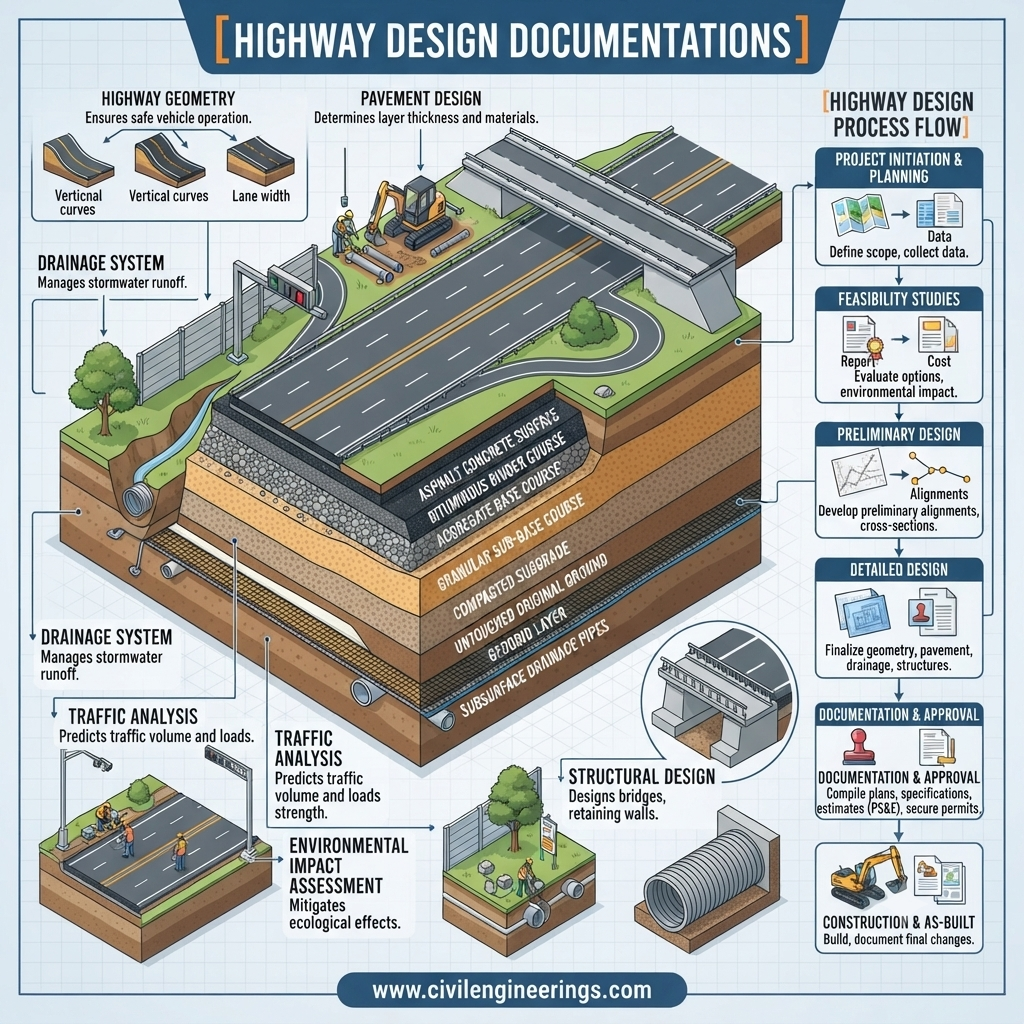
Highway Design Documentation Workflow
A simplified documentation workflow is shown below:
Project Planning
        │
        ▼
Survey & Investigation
        │
        ▼
Traffic Analysis
        │
        ▼
Geometric Design
        │
        ▼
Pavement Design
        │
        ▼
Drainage Design
        │
        ▼
Environmental Studies
        │
        ▼
Design Reports
        │
        ▼
Construction Drawings
        │
        ▼
Review & Approval
        │
        ▼
Tender Documents
        │
        ▼
Construction
Documentation Standards and Guidelines
Professional highway documentation generally follows recognised engineering standards.
IRC (Indian Roads Congress)
IRC provides detailed guidance on:
- Highway geometric design
- Pavement design
- Traffic engineering
- Road safety
- Bridge approaches
- Rural and urban roads
AASHTO
The American Association of State Highway and Transportation Officials publishes widely recognised guidance for:
- Highway geometry
- Pavement structures
- Traffic loading
- Drainage
- Safety design
ICE Guidance
The Institution of Civil Engineers promotes:
- Quality documentation
- Engineering professionalism
- Risk management
- Sustainable infrastructure
- Project management practices
Although specific requirements vary by country, the underlying principles of clarity, accuracy, and accountability remain consistent.
Common Documentation Challenges
Engineers often encounter several issues during documentation.
- Incomplete survey data
- Poor version control
- Inconsistent drawings
- Missing calculations
- Outdated standards
- Coordination problems between disciplines
- Inadequate review procedures
- Tight project schedules
These challenges can lead to redesign, construction delays, or contractual disputes if not addressed early.
Best Practices for Highway Design Documentation
Successful projects usually follow these best practices:
- Establish a standard documentation template.
- Use consistent file naming and version control.
- Verify all engineering calculations through independent checking.
- Coordinate drawings across all disciplines.
- Maintain a revision history.
- Reference the latest applicable standards.
- Include assumptions clearly.
- Conduct formal technical reviews before submission.
- Store digital records securely with regular backups.
- Ensure documentation remains up to date throughout the project lifecycle.
Practical Recommendations for
Highway Engineers
- Review calculations before finalising reports.
- Document every design assumption.
- Cross-check drawings with field survey data.
Contractors
- Study design reports before mobilisation.
- Clarify discrepancies before construction starts.
- Maintain site records for future revisions.
Civil Engineering Students
- Learn how to prepare professional engineering reports.
- Practise reading highway drawings.
- Understand the relationship between calculations and construction documents.
Consultants
- Adopt document management systems.
- Follow standard quality assurance procedures.
- Keep revision logs for every design submission.
Frequently Asked Questions (FAQs)
1. What is Highway Design Documentation?
It is the complete collection of engineering reports, drawings, calculations, and specifications used to design and construct a highway project.
2. Why is highway documentation important?
It ensures technical accuracy, regulatory compliance, construction quality, and long-term project traceability.
3. Which reports are included in highway design documentation?
Common reports include traffic studies, geometric design, pavement design, drainage analysis, geotechnical investigations, environmental assessments, and cost estimates.
4. Who prepares highway design documentation?
Civil engineers, highway engineers, transportation consultants, surveyors, geotechnical engineers, and environmental specialists collaborate to prepare it.
5. Which standards are commonly followed?
Projects often reference IRC, AASHTO, ICE guidance, and national highway authority standards applicable to the project location.
6. How does documentation improve construction quality?
Clear drawings, specifications, and calculations reduce ambiguity, minimise errors, and help contractors execute the design correctly.
7. What software is commonly used for highway design documentation?
Engineers frequently use AutoCAD Civil 3D, OpenRoads Designer, MicroStation, MX Road, GIS software, and document management platforms alongside spreadsheet and report-writing tools.
8. How often should design documents be updated?
Documents should be revised whenever design changes occur, with each revision recorded through a formal version control process.
9. What is the role of quality assurance in documentation?
Quality assurance involves independent reviews, checking calculations, verifying drawings, and ensuring consistency with project standards before submission.
10. Can poor documentation affect project costs?
Yes. Incomplete or inaccurate documentation can lead to redesign, construction delays, claims, material wastage, and higher overall project costs.
Conclusion
Highway Design Documentation is the backbone of every professionally managed highway project. It transforms engineering concepts into structured records that guide planning, design, procurement, construction, and long-term maintenance. Comprehensive documentation not only demonstrates compliance with recognized standards such as IRC, AASHTO, and ICE guidance but also improves communication between designers, contractors, consultants, and government agencies.
A well-documented project reduces technical uncertainty, strengthens quality control, and provides a dependable reference throughout the asset’s lifecycle. From survey data and traffic analysis to pavement design, drainage calculations, drawings, and specifications, each document contributes to safer and more efficient transportation infrastructure. Engineers who invest time in preparing accurate, organized, and thoroughly reviewed documentation are better equipped to deliver projects on schedule and within budget. As highway networks continue to expand and evolve, mastering Highway Design Documentation will remain an essential skill for civil engineering professionals committed to building resilient, sustainable, and high-performing roads.
