Traffic safety has become one of the greatest challenges for modern transportation systems. As cities expand and vehicle ownership continues to increase, speeding, aggressive driving, and pedestrian accidents have become common concerns. Engineers and transportation authorities must adopt practical solutions that improve road safety without significantly affecting traffic efficiency. This is where Traffic Calming Measures play a vital role.
Traffic calming is more than simply reducing vehicle speed. It is a comprehensive road engineering approach that improves safety, enhances community livability, protects vulnerable road users, and encourages sustainable transportation. Whether designing a residential street, school zone, commercial district, or urban neighborhood, selecting the right traffic calming strategy can significantly reduce crashes and improve driver behavior.
This article provides a detailed overview of Traffic Calming Measures, including their objectives, engineering principles, classifications, design considerations, common devices, calculations, standards, practical applications, advantages, challenges, and best practices. It is designed for civil engineering students, highway engineers, contractors, consultants, government agencies, researchers, and infrastructure professionals seeking practical and technical guidance.
What Are Traffic Calming Measures?
Traffic Calming Measures are physical, visual, and regulatory engineering treatments designed to reduce vehicle speeds, discourage unsafe driving behavior, and improve road safety for all users.
Unlike traditional traffic control that focuses on maintaining traffic flow, traffic calming emphasizes creating safer streets by influencing driver behavior through roadway design.
The primary goals include:
- Reducing vehicle speeds
- Lowering crash frequency and severity
- Improving pedestrian safety
- Encouraging cycling
- Enhancing neighborhood quality
- Reducing traffic noise
- Discouraging shortcut traffic
- Improving community accessibility
Why Traffic Calming Matters
Rapid urbanization has increased traffic volumes on roads originally designed for local access. Without appropriate engineering interventions, excessive speed often leads to severe accidents.
Studies worldwide consistently show that lower vehicle speeds significantly reduce pedestrian fatalities. Even a reduction of 10 km/h can greatly decrease crash severity.
Traffic calming also contributes to:
- Better environmental quality
- Increased walking activity
- Improved cyclist safety
- Reduced vehicle emissions from aggressive acceleration
- Better residential comfort
- Enhanced property values
Engineering Principles Behind Traffic Calming
Traffic calming is based on influencing driver perception rather than relying solely on enforcement.
Key engineering principles include:
Speed Reduction
Drivers naturally reduce speed when roadway geometry changes.
Examples:
- Narrow lanes
- Raised intersections
- Horizontal deflection
- Vertical deflection
Driver Awareness
Visual changes alert drivers that they are entering lower-speed environments.
Examples:
- Colored pavements
- Gateway treatments
- Landscape islands
- Decorative paving
Self-Enforcing Roads
Modern traffic calming aims to create roads where drivers naturally obey speed limits without constant police enforcement.
Conflict Reduction
Proper design minimizes conflict points between:
- Vehicles
- Pedestrians
- Cyclists
- Public transport
Objectives of Traffic Calming Measures
The major objectives include:
- Improve road safety
- Reduce speeding
- Minimize traffic accidents
- Protect vulnerable road users
- Reduce cut-through traffic
- Encourage active transportation
- Improve neighborhood livability
- Reduce noise pollution
- Improve intersection safety
- Increase driver attentiveness
Classification of Traffic Calming Measures
Traffic calming techniques are generally classified into four categories.
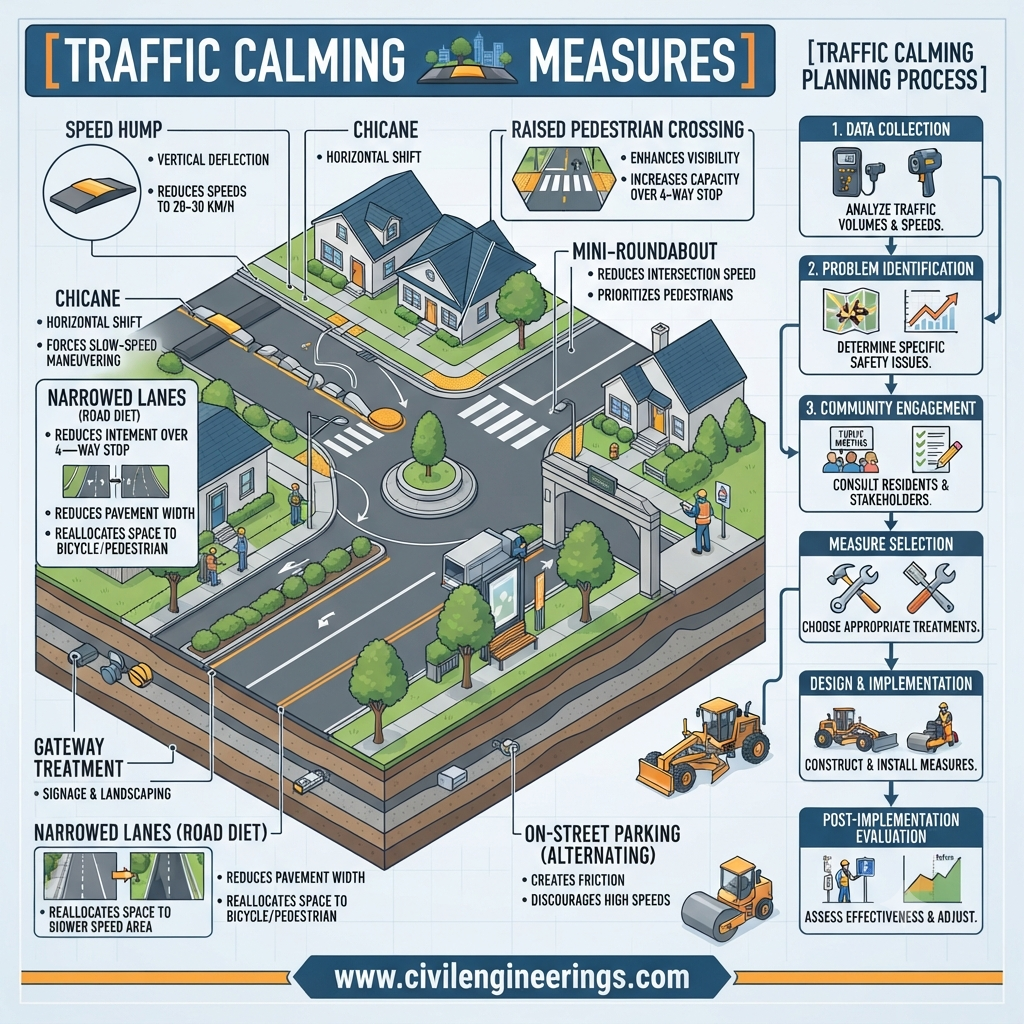
1. Vertical Deflection Measures
These physically force vehicles to reduce speed.
Examples:
- Speed humps
- Speed tables
- Raised pedestrian crossings
- Raised intersections
- Speed cushions
These are highly effective in residential streets.
2. Horizontal Deflection Measures
These require drivers to alter steering paths.
Examples:
- Chicanes
- Mini roundabouts
- Traffic circles
- Lateral shifts
- Curb extensions
These treatments reduce operating speed without creating excessive discomfort.
3. Road Narrowing Measures
Reducing available pavement width psychologically encourages slower driving.
Examples include:
- Neckdowns
- Chokers
- Median islands
- Lane narrowing
- Parking lanes
4. Visual Measures
Visual cues influence driver perception.
Examples:
- Colored pavement
- Gateway features
- Pavement markings
- Landscaping
- Street furniture
- Optical speed bars
Common Traffic Calming Devices
Speed Humps
Speed humps are rounded raised sections of pavement typically 75–100 mm high and 3.5–4.5 m long.
Typical speed:
20–30 km/h
Applications:
- Residential roads
- School zones
- Parking areas
Advantages:
- Low construction cost
- Highly effective
- Easy maintenance
Speed Tables
Speed tables have a flat top allowing larger vehicles to cross comfortably.
Applications:
- Urban collectors
- Bus routes
- Pedestrian crossings
Advantages:
- Comfortable for emergency vehicles
- Improved pedestrian accessibility
Raised Crosswalks
These combine pedestrian crossings with speed control.
Benefits include:
- Improved pedestrian visibility
- Reduced crossing distance
- Lower approach speed
Chicanes
A series of alternating curb extensions forces vehicles to follow an S-shaped path.
Benefits:
- Natural speed reduction
- Attractive streetscape
- Minimal maintenance
Mini Roundabouts
Mini roundabouts reduce intersection conflicts while maintaining traffic flow.
Advantages include:
- Fewer severe crashes
- Reduced delays
- Lower operating speed
Curb Extensions
Also called bulb-outs, curb extensions narrow the roadway at intersections.
Benefits:
- Shorter pedestrian crossings
- Better visibility
- Reduced turning speeds
Median Islands
Raised medians divide opposing traffic and provide pedestrian refuge.
Advantages:
- Improved crossing safety
- Better access control
- Reduced head-on collisions
Traffic Calming Design Process
A successful traffic calming project generally follows these steps.
Step 1
Collect traffic data
- Traffic volume
- Speed surveys
- Crash history
- Pedestrian counts
Step 2
Identify safety problems
Determine:
- High-speed locations
- Accident hotspots
- School zones
- Residential complaints
Step 3
Select suitable measures
Selection depends on:
- Road classification
- Traffic volume
- Emergency access
- Public transport routes
Step 4
Prepare engineering drawings
Include:
- Horizontal alignment
- Profiles
- Drainage
- Pavement markings
- Signage
Step 5
Construction
Ensure quality control during installation.
Step 6
Performance Evaluation
Monitor:
- Speed reduction
- Crash statistics
- Community feedback
- Maintenance needs
Engineering Design Considerations
Engineers should evaluate several factors before implementing traffic calming.
Design Speed
Target operating speed should match land use.
Typical examples:
Residential streets
20–30 km/h
Urban collectors
30–40 km/h
Commercial areas
30 km/h
School zones
20–25 km/h
Drainage
Raised devices should never obstruct drainage.
Provide:
- Side openings
- Scuppers
- Cross slopes
Emergency Access
Traffic calming should accommodate:
- Fire trucks
- Ambulances
- Police vehicles
Speed cushions often perform better than speed humps on emergency routes.
Accessibility
Design should comply with accessibility requirements.
Consider:
- Wheelchair users
- Pedestrians
- Cyclists
- Public transport users
Basic Engineering Formula
Although traffic calming is primarily geometric, speed relationships are often evaluated using stopping sight distance.
Stopping Sight Distance (SSD):
SSD = vt + V² / (2g(f + G))
Where:
- SSD = Stopping Sight Distance (m)
- V = Vehicle speed (m/s)
- t = Driver reaction time (s)
- g = Gravity (9.81 m/s²)
- f = Coefficient of friction
- G = Grade
Reducing vehicle speed through traffic calming directly lowers the required stopping distance, improving safety.
Typical Layout Diagram
-----------------------------
Road Approach

      Speed Hump

=========████========

Pedestrian Crossing

-----------------------------

Vehicle Direction →
Another example:
Lane
   \
    \____
         \
          \____
               \

Chicane Layout
Benefits of Traffic Calming Measures
Well-designed traffic calming programs provide numerous advantages.
Safety
- Reduced crashes
- Lower injury severity
- Better pedestrian protection
Operational
- Improved traffic discipline
- Better speed compliance
Environmental
- Less noise
- Lower emissions from aggressive driving
- Better streetscape
Social
- Safer neighborhoods
- Improved public health
- Increased walking and cycling
Challenges and Limitations
Traffic calming also presents several challenges.
- Increased travel time
- Possible emergency response delays
- Driver discomfort
- Public opposition
- Maintenance costs
- Snow removal challenges in cold regions
- Diversion of traffic to nearby streets
Proper planning minimizes these issues.
Practical Applications
Traffic calming measures are widely used in:
- Residential neighborhoods
- School zones
- University campuses
- Hospitals
- Shopping districts
- Parks
- Tourist areas
- Urban downtown streets
- Bicycle corridors
Best Practices for Engineers
Experienced highway engineers recommend:
- Conduct comprehensive traffic studies.
- Use speed surveys before design.
- Select measures based on road function.
- Involve local communities.
- Follow national design standards.
- Evaluate emergency access.
- Install proper signs and pavement markings.
- Monitor post-construction performance.
- Maintain drainage systems.
- Periodically inspect installed devices.
Recommendations for Civil Engineering Students
Students should:
- Study geometric design principles.
- Learn traffic engineering fundamentals.
- Practice speed survey analysis.
- Understand road safety audits.
- Review international traffic calming case studies.
- Become familiar with traffic simulation software.
Recommendations for Highway Engineers
Professional engineers should:
- Balance mobility and safety.
- Perform benefit-cost analysis.
- Consider future traffic growth.
- Integrate smart transportation technologies.
- Coordinate with urban planners.
- Conduct post-installation evaluations.
Recommendations for Contractors
Contractors should:
- Follow approved drawings precisely.
- Use quality construction materials.
- Maintain specified dimensions.
- Ensure smooth pavement transitions.
- Protect drainage systems.
- Install compliant signage and markings.
- Conduct quality assurance inspections before project handover.
IRC, AASHTO, and ICE Guidance
Although design practices differ among countries, several internationally recognized organizations provide valuable guidance.
Indian Roads Congress (IRC) publishes recommendations for urban street design, traffic management, pedestrian safety, and speed control measures.
AASHTO (American Association of State Highway and Transportation Officials) provides geometric design guidance, roadside safety recommendations, and roadway operational standards that support traffic calming initiatives.
The Institution of Civil Engineers (ICE) promotes sustainable transport planning, safe street design, and resilient infrastructure through professional guidance and best practices.
Engineers should always apply the latest national codes, local regulations, and municipal standards when designing or implementing traffic calming projects.
Frequently Asked Questions (FAQs)
1. What are Traffic Calming Measures?
Traffic Calming Measures are engineering techniques that reduce vehicle speeds and improve road safety through physical, visual, or regulatory roadway modifications.
2. Where are traffic calming devices commonly installed?
They are commonly used in residential streets, school zones, hospitals, commercial districts, parks, and urban neighborhoods.
3. Which traffic calming device is most effective?
The most suitable device depends on the road function, traffic volume, and safety objectives. Speed humps, speed tables, and raised crossings are among the most effective for reducing speed.
4. Do traffic calming measures affect emergency vehicles?
Some devices may increase response times. Speed cushions and carefully designed layouts help minimize these impacts.
5. Are traffic calming measures expensive?
Many treatments, such as speed humps and pavement markings, are relatively low-cost, while larger geometric changes require greater investment.
6. How is the success of traffic calming evaluated?
Engineers assess before-and-after vehicle speeds, crash data, traffic volumes, pedestrian activity, and community feedback.
7. Can traffic calming improve pedestrian safety?
Yes. Reduced vehicle speeds, shorter crossing distances, and enhanced visibility significantly improve pedestrian safety.
8. Are traffic calming measures suitable for highways?
They are generally intended for urban and local roads rather than high-speed highways, where different speed management strategies are applied.
9. What factors influence the choice of a traffic calming measure?
Road classification, traffic volume, design speed, land use, emergency access, public transport routes, and local regulations all influence selection.
10. How often should traffic calming installations be inspected?
Routine inspections should be carried out to check pavement condition, markings, signs, drainage, and overall effectiveness, with maintenance scheduled as needed.
Conclusion
Traffic Calming Measures have become an essential component of modern highway and urban road engineering. Rather than relying solely on enforcement, they reshape the roadway environment to encourage safer driving behavior, reduce vehicle speeds, and protect pedestrians, cyclists, and other vulnerable road users. When carefully planned, these treatments improve neighborhood livability while maintaining acceptable traffic operations.
Successful implementation requires sound engineering judgment, detailed traffic analysis, adherence to recognized standards such as IRC, AASHTO, and ICE guidance, and ongoing performance monitoring. Engineers must consider road function, design speed, emergency access, drainage, and community needs before selecting appropriate solutions. For students, understanding these principles builds a strong foundation in transportation engineering, while practitioners can apply them to create safer, more sustainable infrastructure. As cities continue to grow, Traffic Calming Measures will remain a key strategy for reducing crashes, enhancing mobility, and developing people-focused transportation networks that balance efficiency with long-term public safety.
