
Introduction
Every road should provide drivers with enough distance to recognize a hazard and stop their vehicles safely. Engineers call this critical design parameter Stopping Sight Distance (SSD). It directly influences highway safety, geometric design, vehicle operation, and accident prevention. A properly designed stopping sight distance allows drivers to react calmly and apply the brakes before reaching an obstacle.
Highway engineers consider Stopping Sight Distance one of the most important elements in geometric design because it determines the minimum visibility required on straight sections, horizontal curves, vertical curves, intersections, and mountainous roads. If a road fails to provide adequate sight distance, drivers face a greater risk of collisions, especially at higher speeds or during poor weather conditions.
This comprehensive guide explains the concept of Stopping Sight Distance, its components, influencing factors, engineering principles, practical applications, and design considerations. Whether you are a civil engineering student, highway designer, site engineer, or contractor, understanding SSD helps you create safer and more efficient transportation infrastructure.
What is Stopping Sight Distance?
Stopping Sight Distance (SSD) is the minimum length of roadway that remains visible to a driver so the vehicle can stop safely before reaching an object on the road.
In simple words, SSD represents the total distance a vehicle travels from the moment a driver notices a hazard until the vehicle comes to a complete stop.
A highway must always provide at least this minimum visible distance under normal driving conditions. If the available sight distance falls below the required value, drivers may not have enough time to avoid accidents.
Definition in Highway Engineering
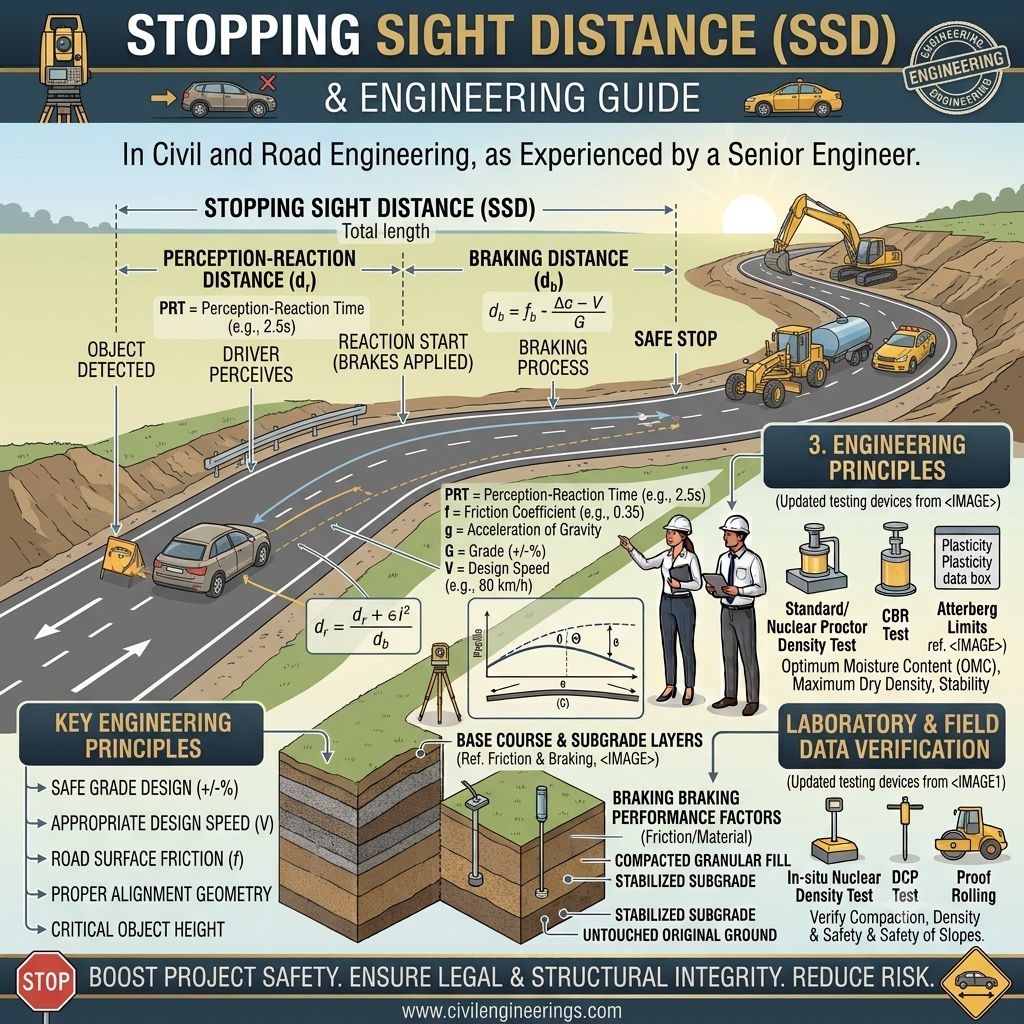
Stopping Sight Distance consists of two major parts:
- Perception-Reaction Distance – the distance traveled while the driver identifies a hazard and begins braking.
- Braking Distance – the distance traveled after the brakes are applied until the vehicle stops completely.
These two distances together determine the total stopping sight distance required for safe highway operation.
Why Stopping Sight Distance Matters
Road safety begins with good visibility. Even an experienced driver cannot avoid a collision if the road hides an obstacle beyond a curve or hillcrest.
Providing sufficient Stopping Sight Distance helps engineers achieve several important objectives:
- Reduce rear-end collisions.
- Improve driver confidence.
- Increase highway safety.
- Support higher design speeds.
- Improve visibility on curves and slopes.
- Reduce accident severity.
- Enhance nighttime driving safety.
Modern highways, expressways, and mountain roads all rely on SSD to maintain safe vehicle operation.
Components of Stopping Sight Distance
Stopping Sight Distance includes two independent distances that occur one after another.
1. Perception-Reaction Distance
Perception-Reaction Distance refers to the distance a vehicle travels while the driver detects a hazard, understands the situation, decides to stop, and moves the foot from the accelerator to the brake pedal.
Although this process appears instantaneous, it usually takes a few seconds.
Activities During Reaction Time
The driver:
- Sees the obstacle.
- Recognizes the danger.
- Decides to brake.
- Moves the foot to the brake pedal.
- Begins applying the brakes.
During this period, the vehicle continues moving at nearly the same speed because braking has not yet started.
Factors Affecting Reaction Distance
Several factors influence reaction distance:
- Driver alertness
- Fatigue
- Age
- Weather conditions
- Visibility
- Driver experience
- Road environment
- Speed of the vehicle
Practical Example
Suppose a car travels at 80 km/h. The driver notices a fallen tree ahead. Before the brakes engage, the vehicle continues moving forward while the driver reacts. This travel distance forms the perception-reaction distance.
2. Braking Distance
Braking Distance is the distance a vehicle travels after the brakes are applied until it stops completely.
Once the braking system begins reducing speed, friction between the tires and pavement slows the vehicle.
Factors Affecting Braking Distance
Braking distance depends on:
- Vehicle speed
- Tire condition
- Brake efficiency
- Pavement surface
- Road gradient
- Weather conditions
- Coefficient of friction
Engineering Principle
Braking distance increases rapidly with speed. Doubling the speed does not merely double the braking distance—it increases it much more because kinetic energy grows with the square of velocity.
This principle explains why high-speed highways require significantly longer sight distances.
Factors Affecting Stopping Sight Distance
Several engineering and environmental factors influence the required stopping sight distance.
Vehicle Speed
Vehicle speed has the greatest effect on SSD.
Higher speeds:
- Increase reaction distance.
- Increase braking distance.
- Require longer visible roadway.
Therefore, highways designed for high-speed traffic must provide greater sight distances.
Driver Reaction Time
Every driver requires time to recognize and respond to hazards.
Although experienced drivers often react more quickly, highway design uses standardized reaction times to accommodate a wide range of users and provide a safety margin.
Road Surface Condition
Road surface quality directly affects braking performance.
Dry Pavement
- Better tire grip
- Shorter braking distance
Wet Pavement
- Reduced friction
- Longer stopping distance
Snow or Ice
- Very low friction
- Significantly longer braking distance
Regular pavement maintenance helps preserve adequate friction and improve safety.
Road Gradient
Road slope changes the distance required to stop.
Ascending Grade
Vehicles slow naturally while climbing, reducing braking distance.
Descending Grade
Gravity increases vehicle momentum, requiring a longer stopping distance.
Engineers account for these effects when designing vertical alignments.
Tire and Brake Condition
Well-maintained tires and brakes provide better stopping performance.
Worn tires reduce traction, while poorly maintained braking systems increase stopping distance.
Routine vehicle maintenance supports highway safety.
Weather and Visibility
Environmental conditions also influence stopping sight distance.
Common factors include:
- Heavy rain
- Fog
- Dust storms
- Snowfall
- Night driving
Poor visibility makes it harder for drivers to detect hazards early, emphasizing the need for proper road lighting, signage, and clear sight lines.
Engineering Principles of Stopping Sight Distance
Highway designers apply SSD throughout the geometric design process to ensure safe vehicle operation.
Engineers evaluate SSD when designing:
- Horizontal curves
- Crest vertical curves
- Sag vertical curves
- Intersections
- Roundabouts
- Tunnel approaches
- Bridge approaches
The available sight distance should never be less than the required stopping sight distance for the selected design speed.
Vegetation, retaining walls, barriers, buildings, or roadside structures should not obstruct the driver’s line of sight.
Practical Application of Stopping Sight Distance
Consider a four-lane divided highway with a design speed of 100 km/h.
A truck loses part of its cargo, leaving debris on the roadway. Because the highway provides adequate stopping sight distance, an approaching driver detects the obstacle in time, reacts promptly, applies the brakes, and stops safely before reaching it.
If the available sight distance were shorter than the required SSD, the driver might notice the debris too late, increasing the likelihood of a collision.
This example demonstrates why SSD remains one of the most important safety criteria in highway design.
Highway Engineering Diagram
Components of Stopping Sight Distance
Driver
  │
  ▼
[Hazard Detected]
       │
       │  Perception-Reaction Distance
       │──────────────────────────────►
                           Brake Applied
                                 │
                                 │  Braking Distance
                                 │────────────────────►
                          Vehicle Stops Safely
Stopping Sight Distance Concept
Vehicle Direction
────────────────────────────────────────────────────────►

Car  ───────── Reaction Distance ─────────┬──────── Braking Distance ───────► Stop
                                          │
                                   Driver Applies Brake

Total Distance = Stopping Sight Distance (SSD)
Key Takeaways
Stopping Sight Distance (SSD) forms the foundation of safe highway geometric design. It combines perception-reaction distance and braking distance to determine the minimum visible roadway needed for a driver to stop safely before reaching an obstacle. Vehicle speed, road gradient, pavement condition, driver reaction time, tire quality, and weather conditions all influence the required SSD. Highway engineers incorporate this principle into the design of curves, intersections, bridges, and vertical alignments to reduce crash risk and improve driver safety. Understanding these fundamentals prepares engineers and students to apply SSD correctly in real-world highway projects and create safer transportation networks.
Stopping Sight Distance Formula
Highway engineers calculate Stopping Sight Distance (SSD) by adding the Perception-Reaction Distance (PRD) and the Braking Distance (BD).
Basic Concept
Stopping Sight Distance = Perception-Reaction Distance + Braking Distance
Although different highway authorities use slightly different equations and assumptions, the design philosophy remains the same. Engineers calculate the total distance a vehicle travels while the driver reacts to a hazard and while the brakes bring the vehicle to a complete stop.
Variables Considered
The calculation generally considers:
- Vehicle speed
- Driver reaction time
- Coefficient of friction
- Road gradient
- Acceleration due to gravity
Accurate values for these variables ensure a safe and reliable highway design.
Stopping Sight Distance on Different Road Grades
Road gradients significantly influence stopping distance because gravity affects vehicle movement.
SSD on a Level Road
A level road provides the standard design condition.
In this situation:
- Gravity does not assist or oppose vehicle movement.
- Braking performance depends mainly on pavement friction and brake efficiency.
- Designers use this condition as the baseline for many highway calculations.
SSD on an Ascending Gradient
Vehicles naturally lose speed while climbing an uphill road.
As a result:
- Gravity helps reduce vehicle speed.
- Braking distance decreases.
- Required stopping sight distance becomes shorter than on a level road.
Although uphill sections improve stopping performance, engineers still maintain adequate visibility for safety.
SSD on a Descending Gradient
Descending roads create more challenging braking conditions.
Gravity increases vehicle momentum, making it more difficult to stop quickly.
Consequently:
- Braking distance increases.
- Total stopping sight distance becomes longer.
- Drivers require additional visible roadway.
Mountain highways and steep downhill sections therefore require careful geometric design and enhanced safety measures.
Engineering Principles Used in SSD Design
Highway engineers apply several important principles while designing roads based on stopping sight distance.
Design for the Expected Speed
Roads should provide adequate sight distance for the selected design speed rather than the average operating speed. This approach improves safety even when traffic conditions vary.
Maintain an Unobstructed Line of Sight
Objects that block visibility reduce available sight distance.
Common obstructions include:
- Buildings
- Retaining walls
- Vegetation
- Cut slopes
- Advertising signs
- Bridge piers
Regular maintenance should remove vegetation and other obstacles that interfere with driver visibility.
Coordinate Horizontal and Vertical Alignment
Poor coordination between horizontal curves and vertical curves may hide hazards from approaching drivers.
Engineers design both alignments together to maintain continuous visibility throughout the roadway.
Consider All Road Users
Highway design should accommodate:
- Passenger vehicles
- Heavy trucks
- Buses
- Motorcycles
- Emergency vehicles
Designing for different vehicle types improves overall road safety.
Practical Applications of Stopping Sight Distance
Stopping Sight Distance influences almost every stage of highway design and operation.
Horizontal Curves
Engineers increase the radius of curves or remove sight obstructions to maintain adequate visibility.
Crest Vertical Curves
Drivers approaching the top of a hill must see hazards beyond the crest before reaching them.
Engineers determine curve lengths that provide sufficient stopping sight distance.
Sag Vertical Curves
Nighttime visibility depends on vehicle headlights.
Designers ensure that headlight illumination provides adequate stopping distance along sag curves.
Intersections
Drivers approaching intersections require sufficient sight distance to stop safely if another vehicle enters unexpectedly.
Work Zones
Temporary construction barriers, equipment, and stored materials should never obstruct the required stopping sight distance.
Common Mistakes in SSD Design
Several design and construction errors reduce available sight distance and increase accident risks.
Inadequate Survey Data
Poor topographic information can lead to incorrect curve designs and restricted visibility.
Ignoring Road Gradient
Designing downhill sections without accounting for increased stopping distance compromises safety.
Poor Vegetation Management
Trees, shrubs, and tall grass often block the driver’s line of sight if maintenance is neglected.
Incorrect Sign Placement
Large roadside signs positioned near curves may obstruct visibility.
Insufficient Maintenance
Damaged pavement surfaces reduce tire friction and increase braking distance.
Regular inspections help identify and correct these issues before they become safety hazards.
Best Practices for Highway Engineers
- Select appropriate design speeds based on road classification.
- Conduct detailed topographic surveys before finalizing alignments.
- Design horizontal and vertical curves together.
- Maintain adequate roadside clear zones.
- Remove visual obstructions during routine maintenance.
- Inspect pavement surface friction regularly.
- Provide effective drainage to prevent water accumulation.
- Install warning signs before sharp curves and steep grades.
- Review safety performance after construction.
- Update designs when traffic volumes increase significantly.
Practical Recommendations
Highway Engineers
- Verify that available sight distance always exceeds the required stopping sight distance.
- Evaluate SSD during every geometric design review.
- Consider future traffic growth while selecting design speeds.
- Use reliable field survey data and accurate digital terrain models.
Contractors
- Prevent construction materials from blocking driver visibility.
- Protect completed pavement surfaces from contamination.
- Follow approved alignment and grading plans precisely.
- Restore roadside vegetation only after confirming that it will not obstruct sight lines.
Civil Engineering Students
- Understand the relationship between speed, reaction time, and braking distance.
- Practice SSD calculations using different design speeds and road gradients.
- Study highway geometric design standards alongside real-world case studies.
- Visit highway projects to observe how engineers maintain visibility on curves and intersections.
General Discussion of IRC, AASHTO, and ICE Recommendations
Leading highway organizations such as the Indian Roads Congress (IRC), the American Association of State Highway and Transportation Officials (AASHTO), and the Institution of Civil Engineers (ICE) emphasize the importance of providing adequate stopping sight distance throughout the road network.
Although their design values and calculation methods may differ slightly, they share several common principles:
- Base SSD on the selected design speed.
- Consider driver perception and reaction time.
- Account for pavement friction and road gradients.
- Ensure unobstructed visibility along the roadway.
- Design horizontal and vertical alignments together.
- Perform regular maintenance to preserve available sight distance.
- Prioritize safety over minimum design requirements whenever practical.
These internationally accepted engineering practices contribute to safer, more reliable highways.
Frequently Asked Questions (FAQs)
1. What is Stopping Sight Distance?
Stopping Sight Distance is the minimum visible distance required for a driver to perceive a hazard, react, apply the brakes, and stop the vehicle safely before reaching the obstacle.
2. Why is Stopping Sight Distance important?
It reduces collision risks, improves driver confidence, and forms a fundamental safety requirement in highway geometric design.
3. What are the two components of SSD?
Stopping Sight Distance consists of Perception-Reaction Distance and Braking Distance.
4. Which factor affects SSD the most?
Vehicle speed has the greatest influence because higher speeds increase both reaction distance and braking distance.
5. How does a downhill slope affect SSD?
A descending gradient increases stopping distance because gravity assists vehicle motion, requiring a longer visible roadway.
6. Where do engineers apply SSD in highway design?
Engineers apply SSD to horizontal curves, vertical curves, intersections, bridge approaches, tunnels, and work zones.
7. How does pavement condition influence SSD?
Dry, well-maintained pavement provides higher friction and shorter braking distances, while wet or damaged surfaces increase stopping distance.
8. Can roadside objects reduce available SSD?
Yes. Vegetation, buildings, retaining walls, bridge piers, and improperly placed signs can obstruct the driver’s line of sight.
9. How can contractors help maintain SSD during construction?
Contractors should position equipment, barriers, and stored materials outside required sight triangles and keep temporary traffic control devices clearly visible.
10. Why should engineering students study SSD?
Understanding SSD strengthens knowledge of highway geometric design, road safety principles, and pavement engineering while preparing students for professional practice.
Conclusion
Stopping Sight Distance remains one of the most critical safety elements in highway engineering because it directly influences a driver’s ability to avoid collisions. Every highway should provide sufficient visibility for drivers to recognize hazards, react promptly, and stop safely under expected operating conditions. Engineers achieve this objective by carefully evaluating vehicle speed, reaction time, pavement friction, road gradient, and geometric alignment during the design process. Regular maintenance, proper vegetation control, effective drainage, and continuous safety inspections further preserve the available sight distance throughout the highway’s service life. By following recognized engineering principles and guidance from organizations such as IRC, AASHTO, and ICE, transportation professionals can design roads that deliver higher safety, improved traffic efficiency, and long-term reliability. For engineers, contractors, and students alike, mastering Stopping Sight Distance provides the technical foundation needed to create safer and more sustainable road infrastructure for future generations.
