
Introduction
Modern highways carry thousands of vehicles every day, often at high speeds. Without proper traffic separation, the risk of head-on collisions, unsafe overtaking, and traffic conflicts increases significantly. Highway engineers solve this challenge by incorporating medians into roadway design. A well-designed median separates opposing traffic streams, improves safety, provides space for future road expansion, and accommodates drainage, lighting, and landscaping.
Understanding What is Median Design? is essential for civil engineers, transportation professionals, contractors, and engineering students. Median design is not simply about placing a strip of land between carriageways. It requires careful evaluation of traffic volume, operating speed, roadway classification, right-of-way availability, safety requirements, drainage, maintenance, and future development.
Every highway project considers median design during the geometric design stage because the selected median influences driver behavior, accident rates, construction costs, and long-term road performance. Whether the median is depressed, raised, flush, or protected by barriers, it must function safely while meeting engineering standards and operational requirements.
This guide explains the concept of median design, its objectives, different types, design considerations, engineering principles, and practical applications using simple language and real-world examples.
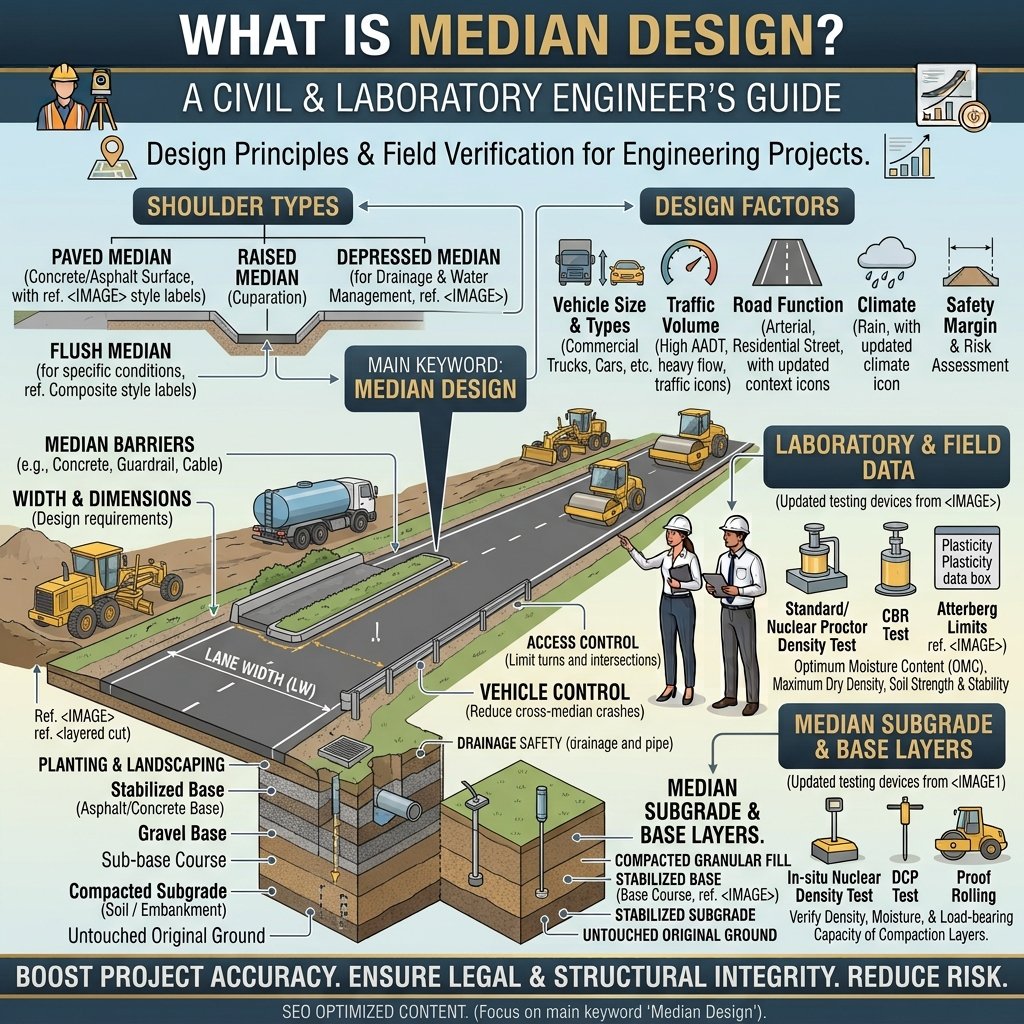
What is Median Design?
Median design is the process of planning, sizing, shaping, and constructing the central separator between two opposing directions of traffic on a divided roadway or highway. The median provides a physical or visual separation that improves road safety, traffic efficiency, and operational performance.
A median may consist of:
- A landscaped strip
- A concrete barrier
- A steel guardrail
- A depressed earth section
- A raised kerbed island
- A painted buffer zone
The choice depends on roadway classification, traffic speed, available right-of-way, accident history, and maintenance requirements.
From an engineering perspective, the median is an integral part of the highway cross-section. It contributes to traffic control, drainage, utility placement, and future widening while reducing the likelihood of crossover crashes.
Purpose of Median Design
Median design serves several important functions beyond separating traffic lanes.
1. Improve Road Safety
The primary purpose of a median is to prevent vehicles from crossing into opposing traffic lanes. This significantly reduces the risk of severe head-on collisions.
2. Separate Opposing Traffic
Physical separation minimizes driver confusion and improves traffic discipline, particularly on high-speed highways.
3. Provide Recovery Space
Wide medians offer drivers additional space to recover control if a vehicle leaves the travel lane.
4. Support Future Highway Expansion
Engineers often reserve sufficient median width to accommodate additional lanes when traffic demand increases.
5. Improve Drainage
Depressed medians can collect and convey stormwater, reducing water accumulation on the carriageway.
6. Enhance Road Appearance
Landscaped medians improve the visual quality of highways while helping reduce headlight glare from opposing vehicles.
Importance of Median Design in Highway Engineering
Median design directly affects the operational efficiency and safety of a roadway.
A properly designed median helps engineers achieve several transportation objectives.
Safety Benefits
- Reduces crossover crashes.
- Minimizes head-on collisions.
- Controls dangerous turning movements.
- Improves pedestrian refuge at crossings.
- Reduces glare from oncoming headlights.
Operational Benefits
- Improves traffic flow.
- Supports access management.
- Organizes turning movements.
- Reduces traffic conflicts.
- Enhances driver comfort.
Maintenance Benefits
- Provides space for utilities.
- Simplifies drainage maintenance.
- Accommodates lighting poles.
- Supports traffic sign installations.
Types of Road Medians
Highway engineers select the median type according to traffic conditions, available land, operating speed, and project budget.
1. Raised Median
A raised median consists of a kerbed island constructed above the pavement surface.
Typical Applications
- Urban roads
- Arterial streets
- Signalized intersections
- Commercial corridors
Advantages
- Controls turning movements.
- Improves pedestrian safety.
- Supports landscaping.
- Provides clear lane separation.
Limitations
- Higher construction cost.
- Limited emergency crossing opportunities.
2. Depressed Median
A depressed median lies below the roadway surface and usually contains grass or drainage channels.
Common Applications
- Rural highways
- Expressways
- Motorways
Advantages
- Excellent drainage.
- Reduced construction cost in wide rights-of-way.
- Better vehicle recovery area.
- Attractive appearance.
Limitations
- Requires more land.
- Regular vegetation maintenance.
3. Flush Median
A flush median remains level with the roadway and uses pavement markings or textured surfaces for separation.
Applications
- Urban streets
- Low-speed roads
- Limited right-of-way conditions
Advantages
- Low construction cost.
- Easy maintenance.
- Flexible traffic management.
Limitations
- Limited physical protection.
- Less effective at preventing crossover accidents.
4. Barrier Median
Barrier medians use concrete barriers or steel guardrails to prevent vehicles from crossing into opposing traffic.
Common Uses
- High-speed expressways
- Bridges
- Mountain highways
- Narrow medians
Advantages
- Highest level of safety.
- Prevents crossover crashes.
- Requires minimal width.
Limitations
- Higher installation cost.
- Impact repairs may be required after collisions.
5. Painted Median
Painted medians use road markings instead of physical structures.
Applications
- Urban intersections
- Temporary traffic management
- Low-speed roads
Advantages
- Economical.
- Easy to modify.
- Suitable for limited space.
Limitations
- Offers no physical protection.
- Less effective on high-speed roads.
Factors Affecting Median Design
Several engineering factors influence the final median design.
Traffic Volume
Higher traffic volumes generally require safer and more substantial median treatments.
Design Speed
As operating speed increases, engineers often provide wider medians or install barrier systems to reduce crash severity.
Road Classification
Expressways, freeways, arterial roads, and urban streets require different median configurations.
Available Right-of-Way
The available land often determines whether a wide depressed median or a narrow barrier median is feasible.
Terrain
Steep slopes, embankments, and mountainous areas influence median geometry and drainage design.
Drainage Requirements
Proper stormwater management is essential to prevent water accumulation and pavement deterioration.
Future Expansion
Many highway projects reserve median space for future lane additions to accommodate traffic growth.
Maintenance Considerations
Engineers select median treatments that balance safety, durability, and long-term maintenance costs.
Median Width Requirements
The ideal median width depends on traffic conditions, roadway type, and available space.
Narrow Medians
Typical uses:
- Urban expressways
- Bridges
- Constrained corridors
Usually protected with concrete barriers or steel guardrails.
Medium-Width Medians
Common on divided highways where moderate right-of-way is available.
These medians may include:
- Landscaping
- Lighting
- Drainage channels
Wide Medians
Often used on rural highways and motorways.
Benefits include:
- Improved vehicle recovery
- Better drainage
- Reduced glare
- Future road widening opportunities
Engineers determine the final width after evaluating safety, construction cost, operational efficiency, and land availability.
Highway Median Cross-Section Diagram
          Opposing Traffic
← ← ← ← ← ← ← ← ← ← ← ← ←

=============================
| Lane | Lane | Shoulder |
=============================
        │
        │
=============================
|      MEDIAN AREA         |
| Barrier / Grass / Drain  |
=============================
        │
        │
=============================
| Shoulder | Lane | Lane |
=============================

→ → → → → → → → → → → → →
This simplified cross-section illustrates how the median separates opposing traffic streams while providing space for safety features, drainage, or landscaping.
Functions of a Highway Median Diagram
               HIGHWAY MEDIAN

                     │
     ┌───────────────┼───────────────┐
     │               │               │
 Safety        Traffic Control    Drainage
     │               │               │
 Future       Headlight Glare   Landscaping
 Expansion      Reduction        Utilities
The diagram highlights the multiple engineering functions that a well-designed median performs within a highway system.
Key Takeaways
Understanding What is Median Design? is fundamental to highway engineering because the median influences safety, traffic operations, drainage, maintenance, and future roadway expansion. Engineers select the appropriate median type by evaluating traffic volume, design speed, right-of-way, terrain, and long-term operational needs. Whether using a raised, depressed, flush, barrier, or painted median, the objective remains the same: to create a safer, more efficient, and sustainable transportation corridor that serves road users for many years.
Median Design Principles
A successful median design balances safety, functionality, economy, and long-term maintenance. Highway engineers evaluate several geometric and operational factors before selecting the final median configuration.
1. Prioritize Road User Safety
Safety remains the primary objective of every median. The design should minimize the possibility of crossover crashes, reduce conflict points, and improve driver guidance.
Key safety measures include:
- Providing adequate median width.
- Installing crash barriers where necessary.
- Ensuring clear visibility at intersections.
- Maintaining obstacle-free recovery areas.
2. Design According to Highway Classification
Different roads require different median treatments.
- Urban roads generally use raised medians.
- Rural highways often include depressed medians.
- Expressways usually combine concrete barriers with narrow medians.
- Freeways may use wide landscaped medians where sufficient land exists.
Selecting the correct median type improves both safety and operational efficiency.
3. Consider Future Road Expansion
Traffic demand rarely remains constant throughout a highway’s service life.
Whenever land is available, engineers reserve sufficient median width for future lane additions. This strategy reduces reconstruction costs and minimizes disruption during future widening projects.
4. Ensure Effective Drainage
Stormwater should never accumulate within or around the median.
Good drainage design protects pavement layers, prevents erosion, and extends pavement life.
Typical drainage features include:
- Longitudinal drains
- Side drains
- Catch basins
- Culverts
- Grass-lined channels
5. Improve Driver Comfort
A properly designed median creates a clear visual separation between opposing traffic streams.
Landscaping, lighting, and barrier placement should guide drivers without creating distractions or visibility problems.
Materials Used in Median Construction
The choice of construction materials depends on roadway classification, traffic speed, climate, maintenance requirements, and project budget.
Concrete
Concrete is widely used for:
- Jersey barriers
- Raised medians
- Divider walls
Advantages include:
- High durability
- Low maintenance
- Excellent impact resistance
Reinforced Concrete
Reinforced concrete provides additional strength for high-speed roads and bridge medians where greater structural capacity is required.
Steel Guardrails
Steel barriers are suitable for:
- Mountain roads
- Curved alignments
- Embankments
- Narrow medians
They absorb collision energy while redirecting vehicles back toward the roadway.
Soil and Grass
Depressed medians commonly consist of compacted soil covered with grass.
Benefits include:
- Improved drainage
- Lower construction costs
- Attractive appearance
- Better environmental performance
Pavers and Decorative Blocks
Urban roads often use concrete pavers or decorative blocks to improve aesthetics while maintaining durability.
Landscaping in Median Design
Landscaping enhances both the appearance and functionality of highway medians.
Properly selected vegetation improves the driving environment while supporting environmental sustainability.
Advantages
- Reduces headlight glare
- Controls soil erosion
- Improves air quality
- Enhances urban aesthetics
- Lowers surface temperatures
- Supports biodiversity
Recommended Plants
Engineers generally select:
- Low-maintenance shrubs
- Native grasses
- Drought-resistant plants
- Ground cover vegetation
Large trees should be avoided in narrow medians because they may obstruct sight distance and increase collision severity.
Drainage Considerations
Effective drainage is one of the most important aspects of median design.
Water infiltration weakens pavement layers and accelerates deterioration.
Design Objectives
- Remove stormwater quickly.
- Prevent standing water.
- Protect pavement edges.
- Minimize erosion.
- Improve long-term pavement performance.
Common Drainage Features
- Surface channels
- Longitudinal drains
- Pipe culverts
- Catch basins
- Filter media
- Slope protection
Regular maintenance keeps these systems functioning effectively throughout the highway’s life.
Median Safety Features and Barrier Systems
Safety devices improve median performance by reducing crash severity and guiding traffic.
Concrete Barriers
Concrete barriers provide maximum protection on:
- Expressways
- Freeways
- Bridges
- High-speed corridors
Wire Rope Safety Barriers
Wire rope systems absorb collision energy and reduce injury severity.
They are particularly effective on wide medians.
Steel Guardrails
Steel guardrails suit roads with limited space or challenging terrain.
Reflective Delineators
Reflective markers improve nighttime visibility and help drivers recognize the median alignment during adverse weather.
Median Lighting
Lighting systems increase visibility and improve safety at:
- Intersections
- Interchanges
- Urban highways
- Pedestrian crossings
Common Median Design Mistakes
Even well-planned highway projects can experience safety and maintenance issues if median design principles are ignored.
Common mistakes include:
- Selecting an inappropriate median type.
- Providing insufficient median width.
- Ignoring future traffic growth.
- Installing barriers in unsuitable locations.
- Poor drainage planning.
- Using high-maintenance landscaping.
- Obstructing driver sight distance.
- Neglecting regular maintenance.
Avoiding these errors improves highway safety, reduces maintenance costs, and extends infrastructure life.
Practical Recommendations
Civil Engineers
- Base median selection on traffic studies and design speed.
- Coordinate drainage, utility, and landscaping designs during the planning stage.
- Consider future widening requirements.
- Conduct regular safety audits after construction.
Contractors
- Follow approved construction drawings and specifications.
- Maintain accurate line and level during median construction.
- Install barriers according to manufacturer guidelines.
- Protect completed median structures from construction traffic.
Engineering Students
- Study highway cross-sections thoroughly.
- Understand the purpose of each median type.
- Visit completed highway projects to observe real-world applications.
- Learn how drainage and safety systems integrate into median design.
General Discussion of IRC, AASHTO, and ICE Practices
Highway authorities around the world follow established engineering principles when designing medians. Organizations such as the Indian Roads Congress (IRC), the American Association of State Highway and Transportation Officials (AASHTO), and the Institution of Civil Engineers (ICE) emphasize:
- Selecting median widths based on road classification and traffic conditions.
- Providing effective separation between opposing traffic streams.
- Incorporating adequate drainage into median design.
- Installing safety barriers where crossover crashes present significant risks.
- Preserving clear sight distances for drivers.
- Designing medians that support long-term maintenance and future expansion.
- Integrating landscaping without compromising safety or visibility.
Following these widely accepted principles helps engineers deliver safer, more durable, and more efficient highway infrastructure.
Frequently Asked Questions (FAQs)
1. What is median design in highway engineering?
Median design is the engineering process of planning and constructing the central divider that separates opposing traffic while improving road safety, traffic flow, drainage, and future expansion opportunities.
2. Why is a median important on highways?
A median reduces head-on collisions, controls turning movements, provides space for safety barriers and drainage systems, and improves overall traffic efficiency.
3. Which type of median offers the highest level of safety?
Barrier medians, especially concrete barriers, provide the greatest protection against crossover crashes on high-speed roads.
4. What factors influence median design?
Engineers consider traffic volume, design speed, road classification, available right-of-way, terrain, drainage requirements, maintenance needs, and future expansion plans.
5. What is the difference between a raised and a depressed median?
A raised median sits above the pavement and commonly uses kerbs, while a depressed median lies below the roadway surface and often serves as both a separator and a drainage channel.
6. Can highways include landscaped medians?
Yes. Landscaped medians improve appearance, reduce glare, control erosion, and enhance environmental quality when designed with appropriate vegetation.
7. Why are concrete barriers used in narrow medians?
Concrete barriers prevent crossover crashes where available median width is too limited to provide a safe recovery area.
8. How does drainage affect median performance?
Proper drainage removes stormwater efficiently, protects pavement layers, prevents erosion, and extends the service life of the roadway.
9. Which engineering standards guide median design?
Engineers generally follow guidance from organizations such as IRC, AASHTO, and ICE, adapting their recommendations to local regulations and project requirements.
10. How does median design support future highway development?
A well-planned median can reserve space for additional lanes, utilities, or transportation systems, reducing future construction costs and disruptions.
Conclusion
Understanding What is Median Design? is essential for developing highways that are safe, efficient, and prepared for future transportation demands. A carefully designed median does far more than separate opposing traffic. It improves road safety, reduces conflict points, enhances drainage, accommodates utilities, supports landscaping, and provides flexibility for future expansion. Engineers must evaluate traffic volume, design speed, roadway classification, terrain, right-of-way availability, and maintenance requirements before selecting the most appropriate median type. Applying sound engineering principles together with recognized guidance from organizations such as IRC, AASHTO, and ICE helps create durable and reliable transportation infrastructure. Whether the project involves an urban arterial road, a rural divided highway, or a high-speed expressway, understanding What is Median Design? enables engineers, contractors, and students to make informed decisions that improve highway performance, reduce lifecycle costs, and enhance the safety and comfort of all road users.

Finding thhe right color or stain is very important and that’s
why we have samples available for most of our products.