
Introduction
Every safe and durable road depends on more than its pavement. A properly engineered shoulder improves structural support, enhances drainage, provides emergency stopping space, and increases overall highway safety. Although many people focus on the carriageway, transportation engineers recognize that shoulder performance directly influences pavement life and driver safety.
Shoulder Design plays a vital role in modern highway engineering. Engineers carefully determine the shoulder width, cross slope, materials, structural capacity, and drainage system according to traffic volume, design speed, terrain, and roadway classification. A well-designed shoulder protects pavement edges, reduces maintenance costs, supports occasional vehicle loads, and creates a recovery area for errant vehicles.
Whether the project involves an expressway, rural highway, urban arterial, or mountain road, shoulder design requires sound engineering judgment and careful planning. This guide explains the fundamental principles, design considerations, engineering practices, and practical applications of Shoulder Design for engineers, contractors, and civil engineering students.
What is Shoulder Design?
Shoulder Design is the engineering process of planning and constructing the portion of a roadway that lies immediately adjacent to the traffic lane. Engineers design this area to improve safety, support pavement edges, provide temporary stopping space, and facilitate drainage.
A road shoulder forms an integral part of the highway cross-section. Although vehicles do not use it continuously, the shoulder must safely accommodate emergency stops, maintenance vehicles, and occasional traffic movements.
A properly designed shoulder should:
- Support occasional vehicle loads.
- Protect the pavement edge from failure.
- Improve roadside safety.
- Drain rainwater efficiently.
- Provide space for maintenance operations.
- Enhance pavement durability.
Importance of Shoulder Design
Road shoulders perform several essential engineering functions that extend beyond providing extra space beside the pavement.
Without adequate shoulders, highways often experience:
- Edge cracking
- Surface deformation
- Water infiltration
- Reduced driver safety
- Higher maintenance costs
- Premature pavement failure
Major Benefits of Proper Shoulder Design
Improves Road Safety
Drivers gain additional recovery space during emergencies. This extra width reduces the likelihood of severe accidents.
Supports Pavement Structure
The shoulder strengthens the pavement edge by distributing wheel loads more evenly.
Enhances Drainage
Proper cross slopes allow rainwater to flow away from the pavement surface, reducing moisture damage.
Extends Pavement Life
Engineers reduce edge failures and water-related deterioration through proper shoulder construction.
Facilitates Maintenance
Maintenance crews can safely park equipment without disrupting traffic flow.
Functions of Road Shoulders
Every road shoulder serves multiple engineering purposes throughout the highway’s service life.
1. Emergency Stopping Area
Drivers can safely stop disabled vehicles outside the traffic lane, reducing congestion and collision risks.
2. Lateral Support
The shoulder provides structural support to pavement edges, preventing cracking and settlement.
3. Drainage Improvement
Proper shoulder grading directs runoff away from the pavement structure and minimizes water infiltration.
4. Roadway Safety
Shoulders provide recovery space for vehicles that unintentionally leave the travel lane.
5. Space for Future Widening
Highway authorities often use existing shoulders during future road expansion projects.
6. Accommodation for Maintenance
Road maintenance teams can operate equipment with minimal impact on traffic.
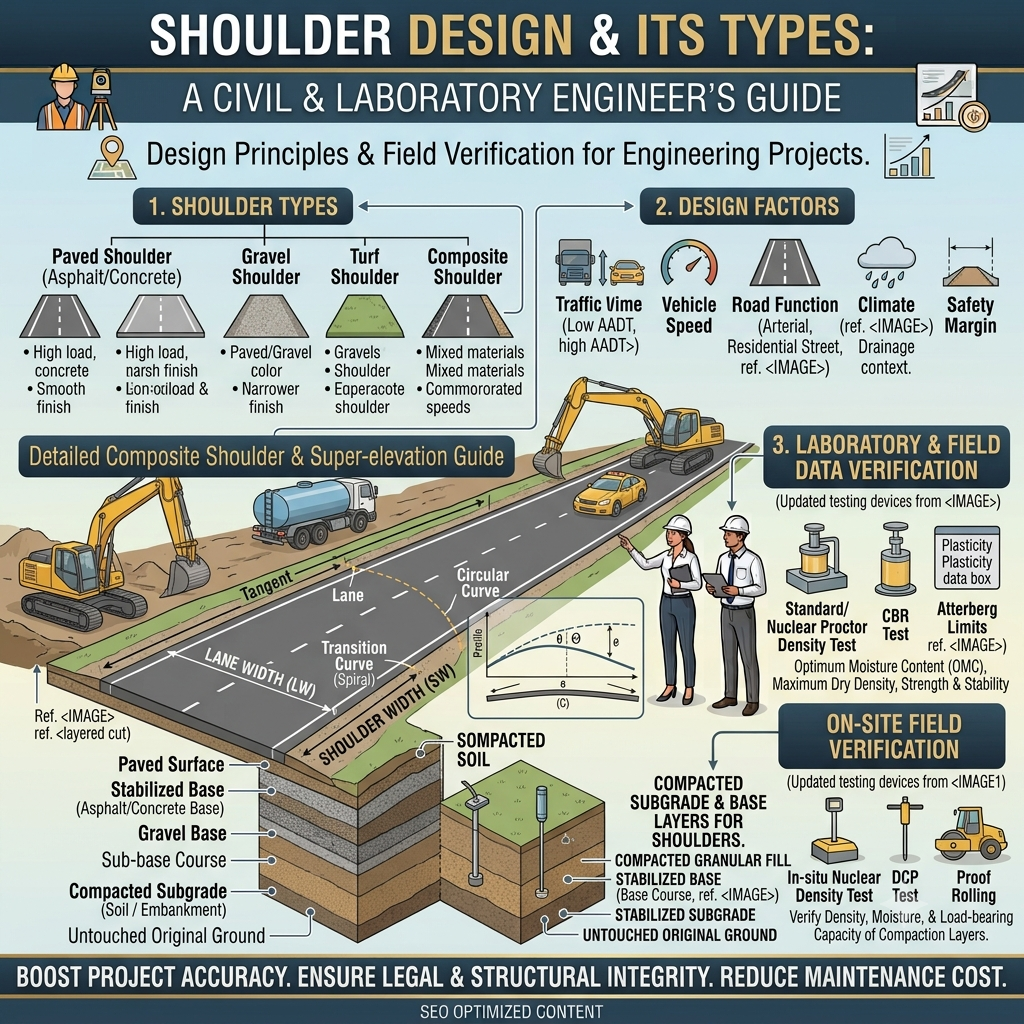
Types of Road Shoulders
Engineers select shoulder types according to traffic volume, climate, terrain, maintenance requirements, and project budget.
Paved Shoulder
Paved shoulders use asphalt or concrete materials similar to the main carriageway.
Advantages
- Excellent durability
- Low maintenance
- Better drainage
- Higher structural strength
- Improved cyclist safety
Applications
- Expressways
- National highways
- Urban freeways
- High-speed corridors
Gravel Shoulder
Gravel shoulders consist of compacted crushed aggregates placed beside the pavement.
Advantages
- Economical construction
- Easy maintenance
- Good drainage
- Simple repairs
Applications
- Rural highways
- Secondary roads
- Low-volume traffic routes
Earthen Shoulder
Earthen shoulders use compacted local soil with proper grading.
Advantages
- Lowest construction cost
- Easy construction
- Locally available materials
Limitations
- Susceptible to erosion
- Poor performance during heavy rainfall
- Frequent maintenance requirements
Applications
- Village roads
- Temporary roads
- Agricultural roads
Turf Shoulder
Turf shoulders contain grass-covered compacted soil.
Benefits
- Controls erosion
- Enhances aesthetics
- Improves environmental sustainability
- Reduces dust generation
Common Uses
- Scenic highways
- Parks
- Low-speed rural roads
Components of Shoulder Design
Several engineering elements determine the effectiveness of a road shoulder.
Shoulder Width
Width influences safety, structural support, and maintenance accessibility.
Engineers consider:
- Design speed
- Traffic volume
- Heavy vehicle percentage
- Terrain
- Road classification
Wider shoulders generally improve safety but increase construction costs.
Cross Slope
The shoulder must slope away from the pavement to remove stormwater quickly.
Proper cross slopes prevent:
- Water ponding
- Surface erosion
- Pavement weakening
- Hydroplaning
Typical shoulder slopes are slightly steeper than the adjacent pavement to ensure efficient drainage.
Structural Support
The shoulder should possess sufficient strength to carry occasional vehicle loads without excessive deformation.
Structural design depends on:
- Soil strength
- Traffic loading
- Material quality
- Compaction level
Surface Material
Material selection affects durability, maintenance, ride quality, and construction cost.
Common materials include:
- Asphalt
- Portland cement concrete
- Crushed stone
- Gravel
- Stabilized soil
Drainage System
Effective drainage protects both the shoulder and pavement from moisture damage.
Drainage components may include:
- Side drains
- Edge drains
- Ditches
- Culverts
- Filter layers
Shoulder Width Design
Selecting the appropriate shoulder width requires balancing safety, operational efficiency, and construction costs.
Factors Affecting Shoulder Width
Engineers evaluate:
- Design speed
- Traffic density
- Percentage of heavy vehicles
- Terrain characteristics
- Highway classification
- Available right-of-way
Engineering Considerations
High-speed highways generally require wider shoulders because drivers need additional recovery space during emergencies.
Urban roads often provide narrower shoulders due to land constraints, while rural highways frequently accommodate wider shoulders for agricultural vehicles and maintenance activities.
Cross Slope Design
Cross slope plays a crucial role in preventing water accumulation.
Engineers design the shoulder with a slightly steeper slope than the pavement to ensure efficient runoff.
Objectives of Shoulder Cross Slope
- Remove stormwater rapidly.
- Protect pavement layers.
- Prevent erosion.
- Maintain driving safety.
- Improve pavement longevity.
Design Considerations
Engineers assess:
- Annual rainfall
- Soil permeability
- Shoulder material
- Road geometry
- Drainage network
Engineering Diagram
Typical Highway Cross Section
                 Road Centreline
                        │
────────────────────────────────────────────
     Shoulder     Carriageway     Shoulder
   ____________  ______________  ____________
  /            \/              \/            \
 /              \              /              \
------------------------------------------------
      Sub-base      Base      Sub-base
------------------------------------------------
            Compacted Subgrade
------------------------------------------------
               Natural Ground
Shoulder Drainage Concept
         Rainfall
            ↓
──────────────────────────── Pavement
            ↘
             ↘ Water Flow
              ↘
        Shoulder Surface
              ↘
           Side Drain
              ↓
       Culvert / Channel
These simplified diagrams illustrate how the shoulder integrates with the pavement structure and directs surface water away from the roadway.
Key Takeaways
A well-planned Shoulder Design strengthens the pavement structure, improves road safety, enhances drainage, and reduces maintenance costs. Engineers must carefully select the shoulder type, width, cross slope, materials, and structural support according to traffic demand, roadway classification, climate, and site conditions. Every design decision influences the highway’s durability, operational efficiency, and long-term performance. By applying sound engineering principles during the planning and design stages, transportation professionals can create shoulders that protect the pavement, improve driver safety, and support sustainable road infrastructure for many years.
Shoulder Materials Used in Road Construction
Selecting the right shoulder material directly affects durability, maintenance costs, drainage efficiency, and structural performance. Engineers evaluate traffic volume, climate, subgrade conditions, and project budget before making a final selection.
1. Asphalt Shoulder
Asphalt shoulders offer flexibility and smooth riding quality. They match flexible pavements and simplify future widening projects.
Advantages
- High durability
- Smooth surface
- Easy maintenance
- Good waterproofing
- Suitable for high-speed highways
Applications
- Expressways
- National highways
- Urban motorways
2. Concrete Shoulder
Concrete shoulders provide excellent structural strength and resist deformation under heavy traffic.
Advantages
- Long service life
- High load-carrying capacity
- Minimal maintenance
- Excellent edge support
Applications
- Rigid pavements
- Industrial roads
- Freight corridors
3. Gravel Shoulder
Gravel remains a popular choice for low-volume roads because it provides adequate support at a lower construction cost.
Advantages
- Economical
- Easy to repair
- Good drainage
- Readily available materials
Limitations
- Dust generation
- Surface erosion
- Frequent grading requirements
4. Stabilized Soil Shoulder
Engineers often improve local soil with lime, cement, or chemical stabilizers to increase strength and reduce moisture sensitivity.
Benefits
- Cost-effective
- Improved bearing capacity
- Reduced plasticity
- Better long-term performance
Structural Design Principles
A road shoulder must withstand occasional vehicle loads while protecting the pavement edge from structural damage.
Key Engineering Principles
Adequate Load Distribution
The shoulder should spread wheel loads over a larger area to reduce stress on the pavement edge.
Edge Support
Strong shoulder construction minimizes edge cracking and prevents pavement breakup.
Uniform Compaction
Each construction layer should achieve the specified density to prevent differential settlement.
Moisture Control
Proper moisture conditioning during construction improves compaction and increases soil strength.
Material Compatibility
Shoulder materials should perform consistently with the adjacent pavement to avoid uneven settlement or cracking.
Drainage Considerations in Shoulder Design
Water is one of the most damaging factors affecting highway performance. Effective drainage protects both the shoulder and pavement from premature deterioration.
Surface Drainage
Surface runoff should flow quickly from the carriageway to the shoulder and then into roadside drains.
Subsurface Drainage
In areas with high groundwater or poor drainage, engineers may install:
- Perforated drainage pipes
- Filter aggregates
- Geotextiles
- Edge drains
Common Drainage Problems
- Water ponding
- Shoulder erosion
- Soft subgrade
- Pavement edge failures
- Frost damage in cold regions
Best Drainage Practices
- Maintain continuous cross slopes.
- Keep roadside ditches clean.
- Prevent water from infiltrating pavement layers.
- Inspect drainage systems regularly.
Shoulder Construction Process
Proper construction techniques ensure that the shoulder performs as designed throughout its service life.
1: Site Preparation
- Clear vegetation.
- Remove unsuitable materials.
- Grade the formation level.
2: Subgrade Preparation
- Moisture conditioning
- Compaction
- Density testing
3: Placement of Shoulder Material
Approved material is transported, spread evenly, and shaped according to design dimensions.
4: Compaction
Engineers compact each layer using suitable rollers until the specified density is achieved.
5: Surface Finishing
The finished shoulder receives the required cross slope, smoothness, and edge profile.
6: Quality Inspection
Engineers verify:
- Width
- Thickness
- Cross slope
- Density
- Surface level
- Material quality
Common Shoulder Design Mistakes
Many shoulder failures result from avoidable design or construction errors.
Inadequate Width
Narrow shoulders reduce recovery space and increase accident risks.
Poor Compaction
Insufficient compaction leads to settlement, rutting, and structural instability.
Improper Drainage
Standing water weakens pavement layers and accelerates shoulder deterioration.
Weak Materials
Using low-quality aggregates or poorly graded materials reduces service life.
Lack of Maintenance
Ignoring small defects often results in larger and more expensive repairs.
Uneven Surface Levels
Differences in elevation between the pavement and shoulder create safety hazards for drivers.
Maintenance and Rehabilitation
Routine maintenance preserves shoulder performance and extends pavement life.
Routine Maintenance Activities
- Crack sealing
- Vegetation control
- Drain cleaning
- Shoulder grading
- Pothole repair
- Edge restoration
Periodic Rehabilitation
Engineers may perform:
- Surface resurfacing
- Material replacement
- Soil stabilization
- Reconstruction of damaged sections
- Drainage improvements
Timely maintenance prevents minor defects from developing into major structural failures.
Best Practices for Effective Shoulder Design
Successful shoulder design depends on careful planning, quality construction, and regular maintenance.
- Select shoulder width according to roadway classification.
- Match shoulder strength with expected traffic loading.
- Provide efficient surface and subsurface drainage.
- Achieve specified compaction levels.
- Use durable, approved construction materials.
- Protect pavement edges from erosion.
- Inspect shoulders regularly after heavy rainfall.
- Repair defects before they expand.
- Consider future road widening during the design stage.
- Integrate roadside safety features where appropriate.
Practical Recommendations
Civil Engineers
- Review geotechnical reports before finalizing shoulder details.
- Design shoulders as part of the overall pavement system.
- Monitor drainage performance throughout the project.
- Specify materials that suit local environmental conditions.
Contractors
- Maintain proper moisture content during compaction.
- Verify shoulder width and cross slope at regular intervals.
- Protect completed shoulders from unnecessary construction traffic.
- Conduct quality checks before project handover.
Engineering Students
- Study the interaction between shoulders and pavement edges.
- Understand common field density and compaction tests.
- Visit construction sites to observe shoulder construction techniques.
- Compare different shoulder materials under varying traffic conditions.
General Discussion of IRC, AASHTO, and ICE Practices
Leading highway engineering organizations emphasize that shoulder design should complement the pavement structure rather than function as an isolated element.
General guidance commonly recommends:
- Selecting shoulder widths based on roadway function and traffic volume.
- Providing adequate cross slopes to ensure effective drainage.
- Designing shoulders with sufficient structural capacity to support occasional vehicle loads.
- Using durable materials compatible with the main pavement.
- Maintaining consistent construction quality through field testing and inspection.
- Incorporating safety features such as rumble strips, edge markings, and guardrails where appropriate.
- Planning regular maintenance to preserve long-term performance.
These principles help create safer, more durable, and cost-effective highways.
Frequently Asked Questions (FAQs)
1. What is shoulder design in highway engineering?
Shoulder design involves planning the width, material, cross slope, structural capacity, and drainage of the roadway area adjacent to the traffic lane to improve safety and pavement performance.
2. Why are road shoulders important?
Road shoulders provide emergency stopping space, support pavement edges, improve drainage, facilitate maintenance, and increase overall road safety.
3. Which material is best for highway shoulders?
The best material depends on traffic volume, climate, and budget. Asphalt and concrete shoulders suit high-volume highways, while gravel and stabilized soil work well on lower-volume roads.
4. How does shoulder width affect road safety?
Wider shoulders provide greater recovery space for drivers, reduce accident severity, and improve safety for maintenance activities and emergency stops.
5. Why is drainage essential in shoulder design?
Proper drainage prevents water accumulation, protects pavement layers, reduces erosion, and extends the service life of both the shoulder and the roadway.
6. What causes shoulder failures?
Common causes include poor compaction, inadequate drainage, weak materials, insufficient width, erosion, and lack of routine maintenance.
7. How often should road shoulders be inspected?
Engineers should inspect shoulders regularly, particularly after heavy rainfall, floods, or periods of high traffic, to identify erosion, settlement, and drainage issues.
8. Can shoulders support heavy vehicles?
Engineered shoulders can accommodate occasional heavy vehicles during emergencies or maintenance operations, but they are not intended for continuous traffic unless specifically designed for that purpose.
9. What role do shoulders play in pavement longevity?
Shoulders protect pavement edges, distribute loads more evenly, reduce moisture damage, and help prevent edge cracking, all of which contribute to a longer pavement service life.
Conclusion
Shoulder Design represents one of the most important elements of highway engineering because it directly influences road safety, pavement durability, drainage efficiency, and long-term maintenance costs. A properly designed shoulder does much more than provide extra roadside space. It supports pavement edges, offers a safe refuge for disabled vehicles, improves stormwater drainage, and increases the structural stability of the entire roadway. Engineers must evaluate traffic volume, roadway classification, soil conditions, climate, available materials, and future expansion plans before selecting the appropriate shoulder type and dimensions. High-quality construction, effective drainage, proper compaction, and routine maintenance further enhance shoulder performance throughout the highway’s service life. By applying recognized engineering principles and following accepted highway design practices, engineers and contractors can develop reliable roadside infrastructure that improves safety, extends pavement life, and delivers lasting value. Investing in well-planned Shoulder Design ultimately creates stronger, safer, and more sustainable roads for all users.
