
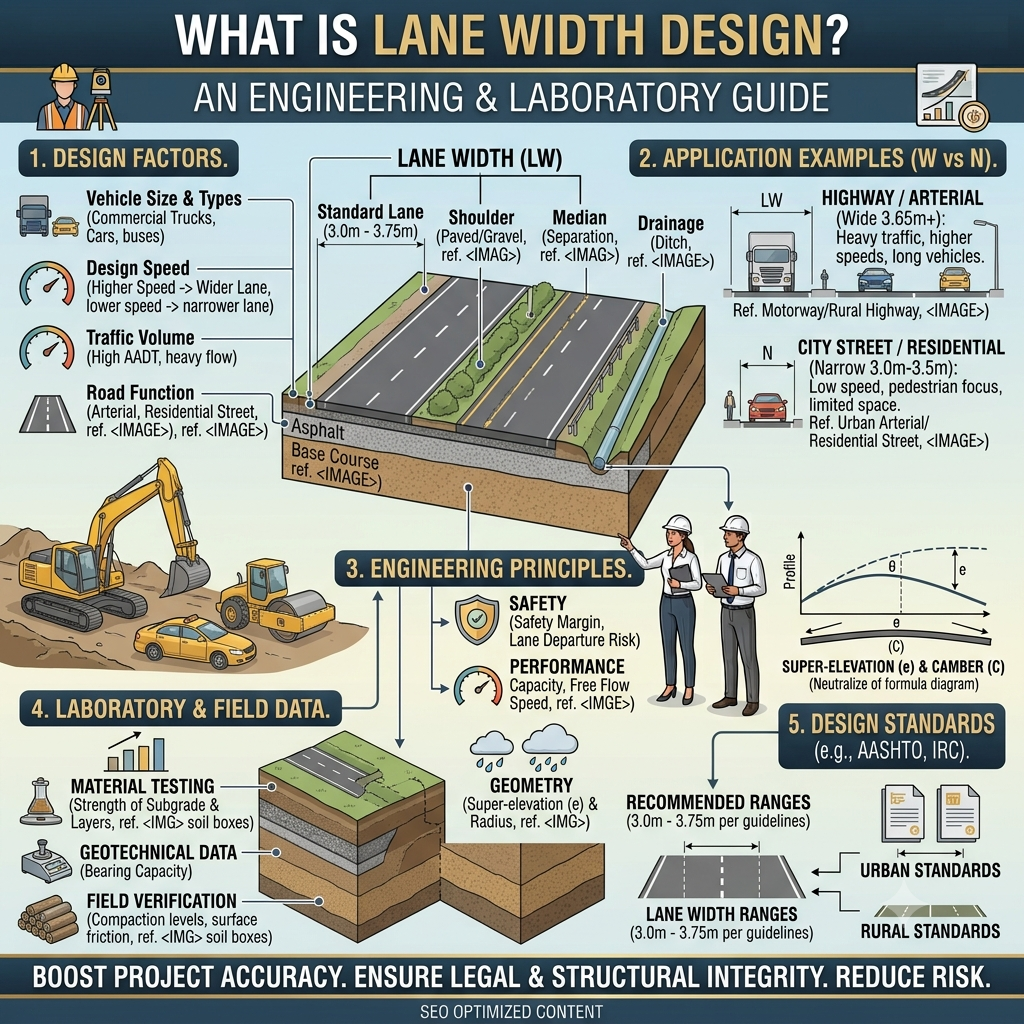
Introduction
Every safe and efficient road begins with a well-planned geometric design, and one of its most critical elements is Lane Width Design. Although lane width may appear to be a simple measurement, it directly affects traffic flow, road safety, vehicle operating speed, driver comfort, and pavement performance. A lane that is too narrow can increase side-swipe collisions, reduce traffic capacity, and create stress for drivers. On the other hand, an excessively wide lane may encourage higher vehicle speeds and increase construction costs without providing significant operational benefits.
Highway engineers determine lane widths after evaluating traffic volume, vehicle composition, design speed, road classification, terrain, and future transportation needs. Every decision requires a balance between safety, efficiency, land availability, and project economics.
This comprehensive guide explains the principles of Lane Width Design, engineering standards, influencing factors, design procedures, and practical applications. Whether you are a civil engineering student, highway designer, consultant, or contractor, this article will help you understand why proper lane width plays a vital role in modern transportation infrastructure.
What is Lane Width Design?
Lane Width Design is the process of determining the appropriate width of each traffic lane to provide safe, efficient, and comfortable vehicle movement. Highway engineers establish lane widths during the geometric design stage by considering traffic characteristics, vehicle dimensions, operating speed, and roadway function.
Each traffic lane must provide sufficient lateral clearance for vehicles while allowing drivers to maintain control under different operating conditions. Proper lane width also supports smooth overtaking, reduces conflicts between adjacent vehicles, and improves the overall capacity of the roadway.
Lane width does not remain the same for every road. A residential street, an urban arterial, and an expressway each require different design considerations because traffic composition and operating conditions vary significantly.
Why Lane Width Design is Important
Lane width influences nearly every aspect of road performance. Even a small change in lane dimensions can affect safety, traffic efficiency, construction costs, and long-term maintenance.
Benefits of Proper Lane Width Design
- Improves road safety.
- Reduces side-swipe collisions.
- Increases traffic capacity.
- Enhances driving comfort.
- Supports smooth traffic flow.
- Accommodates heavy vehicles.
- Reduces pavement edge damage.
- Improves overall highway performance.
When engineers optimize lane widths according to road function, drivers experience better visibility, fewer conflicts, and more consistent travel speeds.
Objectives of Lane Width Design
The primary objective of lane width design is to provide adequate space for vehicles while maximizing roadway efficiency and safety.
Major objectives include:
- Safe movement of all vehicle types.
- Efficient traffic operations.
- Comfortable driving conditions.
- Reduced accident risk.
- Improved roadway capacity.
- Cost-effective land utilization.
- Long-term pavement performance.
- Compatibility with future traffic growth.
A balanced design ensures that available road space is used effectively without compromising operational safety.
Factors Affecting Lane Width Design
Several engineering factors influence the selection of lane width. Highway designers evaluate each factor before finalizing geometric design drawings.
1. Traffic Volume
Traffic volume is one of the most important considerations.
Roads carrying large numbers of vehicles require sufficient lane width to minimize congestion and maintain smooth traffic movement.
High-volume highways generally use standard-width lanes to accommodate continuous traffic streams.
Low-volume local roads may safely operate with slightly narrower lanes where vehicle speeds remain low.
2. Vehicle Dimensions
Different vehicle types occupy different amounts of roadway space.
Engineers consider:
- Passenger cars
- Buses
- Heavy trucks
- Multi-axle trailers
- Agricultural equipment
- Emergency vehicles
Roads serving industrial areas or freight corridors usually require wider lanes because heavy vehicles occupy more lateral space and need additional maneuvering clearance.
3. Design Speed
Vehicle speed significantly influences lane width selection.
Higher operating speeds require additional lateral clearance because drivers have less reaction time and greater steering sensitivity.
For example:
- Residential streets with low design speeds may safely accommodate narrower lanes.
- Expressways carrying high-speed traffic typically require wider lanes to improve driver confidence and reduce collision risk.
4. Road Classification
Different road classifications serve different transportation functions.
Typical classifications include:
- Local Streets
- Collector Roads
- Arterial Roads
- National Highways
- Expressways
- Motorways
Higher-class roads usually adopt wider lanes to improve operational efficiency and support higher traffic volumes.
5. Terrain Conditions
Terrain influences roadway geometry and available construction space.
Level Terrain
Provides flexibility for standard lane widths.
Rolling Terrain
May require careful geometric adjustments while maintaining adequate lane dimensions.
Mountainous Terrain
Engineers often face land constraints, steep slopes, and difficult excavation conditions. In such cases, designers optimize lane width without compromising safety.
6. Urban and Rural Environment
Urban roads often operate within limited right-of-way, requiring careful allocation of available space among traffic lanes, medians, sidewalks, bicycle lanes, and utilities.
Rural highways generally have fewer space constraints and can accommodate wider shoulders and standard lane widths.
Engineers always evaluate surrounding land use before selecting final dimensions.
Standard Lane Widths
Although design standards vary by country and project requirements, highway engineers commonly adopt the following general lane widths:
| Road Type | Typical Lane Width |
|---|---|
| Residential Streets | 2.75–3.00 m |
| Urban Collector Roads | 3.00–3.25 m |
| Urban Arterial Roads | 3.25–3.50 m |
| Rural Highways | 3.50 m |
| Expressways | 3.50–3.75 m |
| Motorways | 3.75 m (where applicable) |
Actual dimensions depend on project-specific design criteria, traffic characteristics, and applicable national standards.
Lane Width Design Process
Highway engineers follow a systematic procedure when determining lane width.
Step 1: Traffic Analysis
Collect information on:
- Average Daily Traffic (ADT)
- Heavy vehicle percentage
- Peak-hour traffic
- Future traffic growth
Step 2: Vehicle Classification
Identify the dominant vehicle types expected to use the roadway.
Freight corridors require different design considerations than residential streets.
Step 3: Road Classification
Determine whether the road functions as:
- Local road
- Collector
- Arterial
- Highway
- Expressway
Road function directly influences lane width selection.
Step 4: Design Speed Selection
Choose the design speed based on:
- Terrain
- Traffic characteristics
- Functional classification
- Safety requirements
Higher speeds generally require wider lanes.
Step 5: Geometric Evaluation
Review:
- Horizontal curves
- Vertical alignment
- Shoulders
- Medians
- Roadside clear zones
All geometric elements must work together to provide a consistent driving experience.
Step 6: Safety Assessment
Evaluate:
- Crash history (for existing roads)
- Driver behavior
- Sight distance
- Overtaking opportunities
- Lateral clearance
Safety remains the highest priority throughout the design process.
Practical Engineering Example
Consider a proposed four-lane divided highway connecting two industrial cities.
Project Conditions
- High truck percentage
- Design speed: 100 km/h
- Flat terrain
- Heavy freight traffic
- Future traffic growth expected
Based on these conditions, engineers would typically select standard highway lane widths to accommodate large commercial vehicles, maintain stable vehicle paths, and support high-speed operations. Adequate shoulders and medians would also be incorporated to improve safety and provide recovery space for errant vehicles.
This example illustrates how traffic composition and operating speed influence lane width decisions.
Engineering Diagram – Typical Lane Width Arrangement
              Typical Highway Cross Section

     Shoulder     Lane      Lane      Median      Lane      Lane     Shoulder
   ─────────── ───────── ───────── ─────────── ───────── ───────── ───────────
      2.5 m       3.5 m     3.5 m      4.0 m      3.5 m     3.5 m      2.5 m

──────────────────────────────────────────────────────────────────────────────
                 Direction A                 |            Direction B
──────────────────────────────────────────────────────────────────────────────
Diagram Explanation
- Traffic lanes provide space for moving vehicles.
- Shoulders offer emergency stopping areas and structural support.
- Median separates opposing traffic streams and reduces head-on collision risks.
- Balanced lane widths improve safety, capacity, and driving comfort.
Key Takeaways
Lane Width Design forms the foundation of safe and efficient highway geometry. Engineers determine suitable lane widths by evaluating traffic volume, vehicle dimensions, operating speed, terrain, road classification, and surrounding land use. A properly designed lane improves traffic flow, enhances driver comfort, accommodates heavy vehicles, and minimizes crash risk. Understanding these principles enables engineers and transportation planners to create roadways that deliver long-term safety, operational efficiency, and sustainable infrastructure performance.
Lane Width Design for Different Road Types
Every road serves a different purpose, so highway engineers do not use a single lane width for every project. The function of the road, traffic characteristics, and design speed influence the final dimensions.
1. Residential Streets
Residential roads mainly serve local traffic with low operating speeds. Designers often adopt slightly narrower lanes because lower speeds reduce crash severity and available right-of-way may remain limited.
Design Considerations
- Low traffic volume
- Low design speed
- On-street parking
- Pedestrian activity
- Bicycle movement
2. Urban Collector Roads
Collector roads connect residential streets with arterial roads. They carry moderate traffic volumes and accommodate a mix of passenger cars, buses, cyclists, and service vehicles.
Design Priorities
- Efficient traffic movement
- Safe pedestrian crossings
- Public transport accessibility
- Adequate turning space at intersections
3. Urban Arterial Roads
Urban arterials transport large traffic volumes through cities. These roads require sufficient lane width to maintain smooth traffic flow while supporting buses and commercial vehicles.
Engineers also coordinate lane width with medians, sidewalks, cycle tracks, and utility corridors.
4. Rural Highways
Rural highways usually operate at higher speeds than urban roads. Wider lanes improve driver comfort and provide additional lateral clearance for heavy vehicles.
Typical features include:
- Wide shoulders
- Higher design speeds
- Long sight distances
- Limited roadside obstructions
5. Expressways and Motorways
Expressways carry heavy traffic at high operating speeds. Consistent lane widths help drivers maintain stable vehicle paths and reduce steering corrections.
Additional design elements include:
- Full access control
- Wide paved shoulders
- Central medians
- Grade-separated interchanges
- High-quality pavement surfaces
Urban vs. Rural Lane Width Design
Although both road types follow geometric design principles, engineers adjust lane widths according to operating conditions.
| Design Factor | Urban Roads | Rural Roads |
|---|---|---|
| Available Right-of-Way | Limited | More available |
| Operating Speed | Moderate | High |
| Heavy Vehicle Percentage | Moderate | Often higher |
| Pedestrian Activity | High | Low |
| Bicycle Traffic | Common | Less frequent |
| Shoulder Width | Narrower | Wider |
Urban projects often require careful space management, while rural highways prioritize operating efficiency and safety at higher speeds.
Effect of Lane Width on Road Safety
Lane width directly influences driver behavior and accident rates.
Adequate Lane Width
Properly designed lanes help:
- Reduce side-swipe collisions.
- Improve vehicle stability.
- Increase lateral clearance.
- Enhance driver confidence.
- Support safer overtaking maneuvers.
Narrow Lanes
Excessively narrow lanes may:
- Increase steering corrections.
- Create conflicts between adjacent vehicles.
- Reduce driver comfort.
- Increase crash potential for heavy vehicles.
Excessively Wide Lanes
Very wide lanes can encourage higher operating speeds, especially in urban areas where speed management is important. Engineers therefore balance safety, mobility, and traffic-calming objectives during design.
Effect of Lane Width on Traffic Capacity
Traffic capacity depends on several factors, including lane width.
Proper lane widths can:
- Improve traffic flow.
- Reduce vehicle interference.
- Support higher operating efficiency.
- Minimize congestion.
- Improve travel time reliability.
However, increasing lane width beyond practical engineering requirements does not always produce significant capacity improvements. Highway designers therefore evaluate cost, safety, and available space before making design decisions.
Engineering Principles Used in Lane Width Design
Professional highway engineers apply several engineering principles when determining lane widths.
Functional Classification
Road function determines design expectations.
Human Factors
Design should consider:
- Driver perception
- Reaction time
- Steering behavior
- Vehicle tracking
Vehicle Dynamics
Engineers evaluate:
- Turning movements
- Vehicle off-tracking
- Lateral clearance
- Operating speed
Safety Margin
Every design should provide reasonable recovery space for minor steering deviations while maintaining efficient roadway operations.
Common Lane Width Design Mistakes
Avoiding common design errors improves long-term roadway performance.
1. Ignoring Future Traffic Growth
Designs based only on current traffic may become inadequate within a few years.
2. Selecting Lane Width Without Traffic Analysis
Traffic composition significantly influences geometric requirements.
3. Neglecting Heavy Vehicles
Freight routes require sufficient lateral clearance.
4. Poor Coordination with Shoulders
Lane width and shoulder width should complement each other.
5. Inconsistent Lane Widths
Frequent changes in lane width may confuse drivers and reduce safety.
6. Ignoring Roadside Constraints
Design should consider bridges, retaining walls, utilities, drainage structures, and available right-of-way.
Best Practices for Lane Width Design
Experienced highway engineers follow several proven practices to achieve safe and efficient roadway designs.
- Conduct detailed traffic studies before beginning geometric design.
- Select lane widths according to road function rather than convenience.
- Consider future traffic growth and development plans.
- Coordinate lane width with shoulder and median design.
- Provide consistent lane widths throughout the corridor whenever practical.
- Review horizontal and vertical alignment together with lane dimensions.
- Ensure proper pavement markings and signage.
- Perform independent design reviews before final approval.
- Follow recognized highway engineering standards and local regulations.
- Prioritize road safety throughout every design stage.
Practical Recommendations
Highway Engineers
- Analyze traffic composition instead of relying only on average daily traffic.
- Coordinate geometric design with pavement, drainage, and traffic engineering teams.
- Verify available right-of-way before finalizing lane dimensions.
- Review designs using road safety audits.
Contractors
- Construct lanes according to approved design drawings.
- Verify pavement width during each construction stage.
- Maintain dimensional accuracy during paving operations.
- Check finished lane widths before project handover.
Civil Engineering Students
- Understand the relationship between lane width and design speed.
- Study highway geometric design standards.
- Learn field surveying techniques.
- Visit active highway projects to observe real construction practices.
- Practice roadway cross-section design using engineering software.
General Discussion of IRC, AASHTO, and ICE Guidance
Leading highway engineering organizations such as IRC (Indian Roads Congress), AASHTO (American Association of State Highway and Transportation Officials), and the Institution of Civil Engineers (ICE) emphasize that lane width should result from engineering analysis rather than fixed assumptions.
Their guidance generally encourages engineers to:
- Base lane width on functional road classification.
- Consider design speed and expected traffic volumes.
- Evaluate heavy vehicle percentages.
- Maintain consistent roadway geometry.
- Integrate shoulders, medians, drainage, and roadside safety features into the overall design.
- Conduct quality assurance throughout planning and construction.
These principles support safer, more durable, and more efficient transportation infrastructure.
Engineering Diagram – Lane Width and Road Components
                 Typical Two-Lane Highway Cross Section

   Shoulder      Traffic Lane      Center Line      Traffic Lane      Shoulder
 ───────────     ─────────────      ──────────      ─────────────     ───────────
    2.5 m            3.5 m              ||              3.5 m             2.5 m

══════════════════════════════════════════════════════════════════════════════════
          Edge Line        Vehicle Path        Vehicle Path        Edge Line
══════════════════════════════════════════════════════════════════════════════════
Diagram Explanation
- Traffic lanes provide sufficient operating space for vehicles.
- Shoulders improve safety by offering emergency stopping space.
- Center lines separate opposing traffic streams.
- Proper lane width helps drivers maintain safe lateral clearance and consistent vehicle positioning.
Frequently Asked Questions (FAQs)
1. What is lane width design in highway engineering?
Lane Width Design is the process of determining the appropriate width of traffic lanes to ensure safe, efficient, and comfortable vehicle movement based on traffic, speed, and roadway function.
2. Why is lane width important?
Proper lane width improves road safety, supports traffic capacity, accommodates heavy vehicles, and enhances driver comfort while reducing collision risks.
3. What factors affect lane width design?
Traffic volume, vehicle dimensions, design speed, road classification, terrain, surrounding land use, and future traffic growth all influence lane width selection.
4. What is the typical lane width for highways?
Many highways commonly use lane widths around 3.5 meters, although actual dimensions depend on project requirements and applicable design standards.
5. Can narrow lanes improve safety?
In some low-speed urban environments, slightly narrower lanes may help reduce vehicle speeds. However, excessively narrow lanes can create operational and safety issues, especially for heavy vehicles.
6. How does lane width affect traffic capacity?
Appropriate lane width improves traffic flow and reduces interference between vehicles. Capacity depends on several factors, so wider lanes alone do not always increase roadway performance.
7. How do engineers select the correct lane width?
Engineers analyze traffic data, design speed, vehicle types, road function, terrain, and safety requirements before determining suitable lane dimensions.
8. What standards guide lane width design?
Highway engineers commonly refer to national standards and internationally recognized guidance, including recommendations published by IRC, AASHTO, and ICE, while adapting designs to local regulations.
9. Does lane width influence construction cost?
Yes. Wider lanes require more pavement materials, earthwork, and right-of-way, which can increase project costs. Designers therefore balance performance, safety, and economy.
10. Why should lane widths remain consistent?
Consistent lane widths help drivers maintain predictable vehicle positioning, reduce steering adjustments, and create a safer driving environment.
Conclusion
Lane Width Design remains one of the most important elements of highway geometric design because it directly influences safety, operational efficiency, driver comfort, and long-term pavement performance. Highway engineers must evaluate traffic volume, vehicle dimensions, design speed, terrain, road classification, and future transportation demand before selecting appropriate lane widths. A balanced design provides sufficient lateral clearance without encouraging unnecessary speeds or increasing construction costs. Consistency in lane dimensions also improves driver confidence and supports smoother traffic operations across the entire roadway. By following sound engineering principles, conducting detailed traffic studies, and applying recognized practices from organizations such as IRC, AASHTO, and ICE, engineers can develop roadways that perform efficiently for decades. Whether you are designing a residential street, an urban arterial, or a high-speed expressway, understanding Lane Width Design helps create transportation infrastructure that is safe, economical, sustainable, and capable of meeting future mobility needs.

Kamran Malik is a passionate civil engineering writer and researcher who specializes in construction, transportation, structural engineering, and infrastructure topics. Through his articles on CivilEngineerings.com, he simplifies complex engineering concepts and shares practical insights, industry trends, and educational resources for students, professionals, and engineering enthusiasts.