
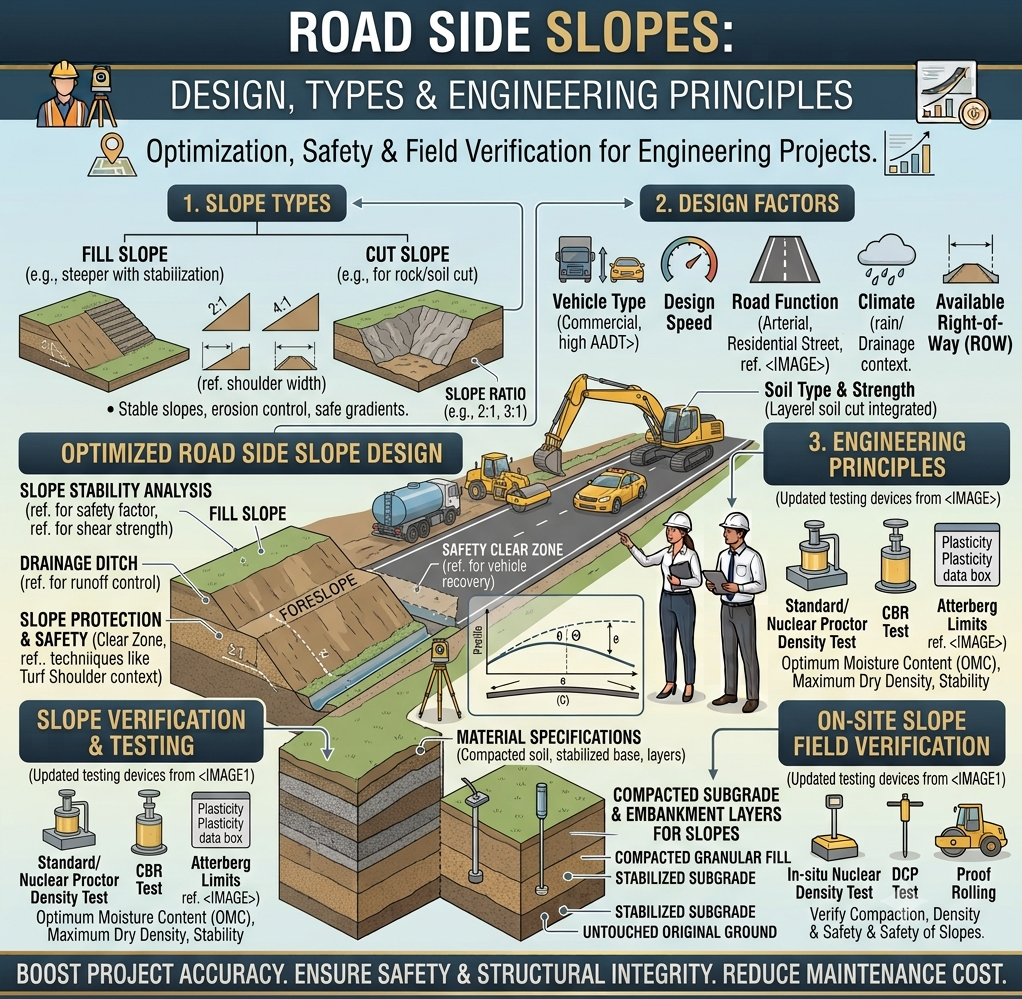
Introduction
Every road depends on more than its pavement to deliver long-term performance. The land beside the roadway plays an equally important role in maintaining stability, ensuring safety, and protecting the pavement structure. Well-designed Road Side Slopes support embankments, control erosion, improve drainage, and reduce the risk of landslides or slope failures. Engineers consider these slopes during the planning and design stages because poor slope geometry can lead to costly maintenance and serious safety hazards.
Road side slopes influence the structural integrity of highways, rural roads, expressways, and mountain roads. They also affect construction costs, environmental sustainability, and roadside safety. Selecting the correct slope angle, stabilization method, and drainage system requires careful evaluation of soil properties, topography, rainfall, traffic conditions, and available construction materials.
This comprehensive guide explains the design principles, types, influencing factors, and engineering practices related to Road Side Slopes. Whether you are a civil engineer, highway contractor, engineering student, or infrastructure professional, this article provides practical knowledge supported by accepted highway engineering concepts and industry best practices.
What Are Road Side Slopes?
Road Side Slopes are the inclined surfaces that extend from the edge of the roadway to the natural ground level. Engineers construct these slopes during cutting or filling operations to create a stable transition between the pavement and surrounding terrain.
Road side slopes serve several important purposes:
- Support roadway embankments.
- Maintain slope stability.
- Prevent soil erosion.
- Improve surface drainage.
- Reduce the risk of pavement edge failure.
- Enhance roadside safety.
- Blend the roadway with the natural landscape.
The design of these slopes depends on soil type, rock conditions, rainfall intensity, embankment height, traffic importance, and environmental considerations.
Importance of Road Side Slopes
Properly designed Road Side Slopes contribute significantly to the durability and safety of a road.
1. Structural Stability
Stable slopes support the embankment and prevent soil movement. This support protects the pavement from settlement and edge failures.
2. Effective Drainage
Slopes direct rainwater away from the pavement. Good drainage minimizes water infiltration into the subgrade and reduces the likelihood of pavement deterioration.
3. Erosion Control
Vegetated or protected slopes resist soil erosion caused by rainfall and surface runoff. This protection preserves the shape of the embankment and reduces maintenance costs.
4. Road User Safety
Gentle side slopes create a safer recovery area for vehicles that accidentally leave the roadway. Steep slopes increase accident severity and complicate rescue operations.
5. Environmental Protection
Well-planned slopes support vegetation, reduce sediment transport, and improve the visual appearance of the roadway corridor.
Types of Road Side Slopes
Engineers classify roadside slopes according to construction methods and terrain conditions.
1. Embankment Slopes
An embankment slope forms when engineers build the roadway above the existing ground level by placing compacted fill material.
Common Characteristics
- Constructed using selected earth or granular fill.
- Requires proper compaction.
- Includes drainage arrangements.
- Often protected with vegetation or erosion-control systems.
Applications
- Flood-prone areas
- Low-lying terrain
- River crossings
- Highway embankments
2. Cutting Slopes
A cutting slope develops when engineers excavate natural ground to achieve the required road elevation.
Features
- Common in hilly and mountainous regions.
- May expose soil or rock.
- Requires stability analysis.
- Often includes retaining or drainage structures.
Engineering Challenge
Excavated slopes can become unstable if groundwater, weathering, or weak geological layers reduce soil strength.
3. Fill Slopes
Fill slopes consist of engineered earth placed in layers and compacted to support the roadway.
Advantages
- Provides a stable foundation.
- Accommodates elevation changes.
- Improves alignment flexibility.
Important Considerations
- Layer thickness
- Moisture control
- Degree of compaction
- Settlement monitoring
4. Rock Slopes
Rock slopes occur where highways pass through rocky terrain. Engineers often excavate rock using controlled blasting or mechanical methods.
Common Protection Measures
- Rock bolts
- Wire mesh
- Shotcrete
- Rockfall barriers
- Drainage holes
Rock slope stability depends on joint orientation, weathering, groundwater, and geological conditions.
Factors Affecting Road Side Slope Design
Several engineering factors influence the design and stability of roadside slopes.
Soil Type
Different soils possess different shear strengths.
For example:
- Clay retains moisture and may lose strength during wet seasons.
- Sand drains quickly but may erode easily.
- Gravel offers excellent drainage and stability.
Slope Height
Higher slopes experience greater driving forces, increasing the likelihood of instability.
Engineers often reduce the slope angle or introduce benches for tall embankments and deep cuts.
Rainfall and Climate
Heavy rainfall increases soil moisture and pore-water pressure. These conditions reduce soil strength and accelerate erosion.
Designers therefore include adequate drainage systems in regions with high annual rainfall.
Groundwater Conditions
Groundwater weakens soil and increases hydrostatic pressure. Engineers investigate groundwater levels before finalizing slope geometry.
Traffic Loading
Heavy traffic generates repeated loads near pavement edges. Stable side slopes prevent edge deformation and preserve pavement performance.
Vegetation
Grass and shrubs strengthen the upper soil layer through root reinforcement while reducing erosion caused by rainfall.
Construction Quality
Poor compaction, unsuitable materials, or improper drainage can lead to slope failures even when the design is technically sound.
Engineering Principles of Road Side Slopes
Successful roadside slope design relies on geotechnical and highway engineering principles.
Shear Strength
The soil must resist the forces that attempt to move it downslope.
Engineers evaluate:
- Cohesion
- Internal friction angle
- Unit weight
- Moisture content
Factor of Safety
Engineers design slopes with an appropriate Factor of Safety (FoS) to ensure long-term stability under expected loading and environmental conditions.
A higher FoS provides greater resistance against slope failure.
Drainage Control
Drainage plays a critical role in slope performance.
Effective systems include:
- Side drains
- Catch drains
- Toe drains
- Surface channels
- Subsurface drains
Removing excess water improves stability and extends the service life of the roadway.
Compaction
Proper compaction increases soil density and shear strength while reducing settlement and permeability.
Compaction remains one of the most effective methods for improving embankment performance.
Erosion Resistance
Engineers protect slopes against erosion using vegetation, geotextiles, riprap, concrete blocks, or other stabilization techniques depending on site conditions.
Typical Road Side Slope Diagrams
Typical Road Embankment
                 Road Surface
=================================================
        Shoulder                Shoulder
------------------------------- ------------------

          \                    /
           \                  /
            \                /
             \              /
              \            /
               \          /
                \        /
                 \______/
             Natural Ground
Road Cutting Section
Natural Hill
^^^^^^^^^^^^^^^^^^^^^^^^^^^^^

      \                Road
       \=========================
        \
         \
          \
           \
            \
Typical Side Slope Components
        Pavement Edge
             │
             ▼
==============================
 Shoulder
------------------------------
   Side Slope
      \
       \
        \
         \
          \
           Toe Drain
____________________________
 Natural Ground
These simplified diagrams illustrate the relationship between the pavement, shoulder, side slope, and surrounding terrain. Actual slope geometry varies according to project requirements, soil characteristics, and design standards.
Key Takeaways
Road Side Slopes form an essential component of highway infrastructure. They provide structural support, improve drainage, control erosion, and enhance roadside safety. Successful slope design requires a thorough understanding of soil mechanics, hydrology, topography, and construction practices. Engineers evaluate factors such as soil type, slope height, groundwater, vegetation, and traffic loading before selecting appropriate slope angles and stabilization measures. By applying sound engineering principles during the planning and design stages, transportation agencies can reduce maintenance costs, improve road performance, and create safer, more resilient roadway corridors.
Road Side Slope Protection Methods
Even a properly designed slope requires protection against erosion, weathering, water infiltration, and soil movement. Engineers select slope protection methods according to soil type, slope angle, rainfall, groundwater conditions, traffic importance, and maintenance requirements.
1. Vegetative Protection
Vegetation provides one of the most economical and environmentally friendly methods for stabilizing roadside slopes.
Common Vegetation Types
- Turf grass
- Vetiver grass
- Native shrubs
- Ground cover plants
- Small trees (where appropriate)
Advantages
- Controls surface erosion
- Improves slope appearance
- Reduces runoff velocity
- Strengthens shallow soil through root systems
- Supports environmental sustainability
Best Application
Vegetative protection performs well on gentle slopes with moderate rainfall and stable soils.
2. Riprap Protection
Riprap consists of large, durable stones placed on the slope surface.
Benefits
- Resists flowing water
- Protects against scour
- Reduces erosion
- Requires minimal maintenance
Riprap is commonly used near rivers, culverts, bridge approaches, and drainage channels.
3. Geotextiles and Geogrids
Modern highway projects frequently use geosynthetics to improve slope performance.
Functions
- Soil reinforcement
- Separation of materials
- Filtration
- Drainage enhancement
- Erosion control
Geotextiles increase slope stability while reducing construction costs in weak soil conditions.
4. Retaining Structures
Where space is limited or slopes become too steep, engineers construct retaining systems instead of flattening the slope.
Common Retaining Systems
- Gravity retaining walls
- Reinforced concrete retaining walls
- Gabion walls
- Mechanically Stabilized Earth (MSE) walls
- Reinforced soil walls
These systems safely retain soil while minimizing the required right-of-way.
5. Rockfall Protection Systems
Mountain roads often pass through rocky terrain where loose rock fragments may fall onto the carriageway.
Typical protection measures include:
- Rock bolts
- Shotcrete
- Wire mesh
- Rockfall barriers
- Catch fences
- Scaling of loose rocks
These measures improve road safety by reducing rockfall hazards.
Road Side Slope Construction Procedure
A systematic construction process ensures stable and durable roadside slopes.
Step 1: Site Preparation
Construction begins with:
- Clearing vegetation
- Removing unsuitable soil
- Establishing construction benchmarks
- Marking slope limits
Step 2: Earthwork
Earthmoving equipment shapes the slope according to the approved drawings.
Common equipment includes:
- Excavators
- Bulldozers
- Motor graders
- Dump trucks
Step 3: Layered Compaction
For embankment slopes, fill material is placed in thin layers and compacted to the specified density.
Proper compaction:
- Increases strength
- Reduces settlement
- Improves slope stability
Step 4: Drainage Installation
Engineers install drainage systems before completing surface protection.
Drainage components may include:
- Side drains
- Catch drains
- Toe drains
- Culverts
- Surface channels
Step 5: Slope Protection
After shaping the slope, engineers install the selected stabilization system such as vegetation, riprap, geotextiles, or retaining structures.
Step 6: Final Inspection
The completed slope undergoes inspection to verify:
- Geometry
- Compaction
- Drainage
- Surface finish
- Protection measures
Common Road Side Slope Failures
Roadside slopes can deteriorate due to poor design, construction errors, or environmental factors.
1. Surface Erosion
Rainwater removes loose soil from the slope surface.
Causes
- Lack of vegetation
- Inadequate drainage
- High rainfall
- Poor soil quality
2. Slope Sliding
A mass of soil moves downward along a failure surface.
Common Causes
- Weak soil
- Excess groundwater
- Over-steep slopes
- Poor compaction
3. Settlement
Uneven settlement occurs when embankment fill lacks proper compaction or rests on weak foundations.
Settlement may cause:
- Shoulder deformation
- Pavement cracking
- Drainage problems
4. Rockfall
Weathering and geological discontinuities can loosen rocks on cut slopes.
Rockfall threatens:
- Motorists
- Roadside structures
- Maintenance workers
5. Drainage Failure
Blocked drains allow water to accumulate inside the slope, increasing pore-water pressure and reducing stability.
Routine maintenance prevents many drainage-related failures.
Inspection and Maintenance
Regular inspections help identify problems before they become major failures.
Inspection Checklist
- Surface erosion
- Cracks
- Bulging
- Settlement
- Vegetation health
- Drainage blockage
- Rockfall activity
- Retaining wall movement
Maintenance Activities
- Cleaning drains
- Repairing erosion damage
- Replacing damaged vegetation
- Removing loose rocks
- Regrading affected areas
- Repairing retaining structures
Preventive maintenance extends the service life of roadside slopes and reduces long-term repair costs.
Best Practices for Road Side Slopes
High-performing roadside slopes share several common characteristics:
- Conduct detailed geotechnical investigations before design.
- Match slope angles to soil and rock conditions.
- Maintain effective surface and subsurface drainage.
- Compact embankment fill in controlled layers.
- Protect exposed soil immediately after construction.
- Use vegetation wherever practical.
- Monitor slopes after heavy rainfall.
- Inspect drainage structures regularly.
- Address minor erosion before it develops into slope failure.
- Follow approved construction specifications and quality control procedures.
Practical Recommendations
Civil Engineers
- Base slope design on geotechnical investigation results rather than assumptions.
- Evaluate groundwater conditions carefully.
- Include erosion protection in every design.
- Consider future maintenance requirements during planning.
Contractors
- Use approved fill materials.
- Maintain proper moisture content during compaction.
- Avoid over-excavation beyond design limits.
- Protect completed slopes from uncontrolled runoff.
Engineering Students
- Learn the relationship between soil mechanics and slope stability.
- Study real-world slope failures to understand design limitations.
- Gain practical experience in field investigations.
- Familiarize yourself with erosion control techniques and drainage design.
General Discussion on IRC, AASHTO, and ICE Practices
Leading highway engineering organizations such as the Indian Roads Congress (IRC), the American Association of State Highway and Transportation Officials (AASHTO), and the Institution of Civil Engineers (ICE) emphasize the importance of safe and durable roadside slope design.
Their guidance generally recommends:
- Carrying out detailed geotechnical and topographic investigations.
- Designing slopes according to soil strength and site conditions.
- Providing adequate drainage to reduce water-related failures.
- Applying erosion-control measures immediately after construction.
- Performing regular inspections and maintenance throughout the roadway’s service life.
- Incorporating roadside safety into slope design, particularly on high-speed highways.
These engineering principles support resilient infrastructure and reduce long-term maintenance costs.
Frequently Asked Questions (FAQs)
1. What are Road Side Slopes?
Road Side Slopes are inclined surfaces located beside a roadway that connect the pavement to the surrounding ground. They provide structural support, improve drainage, and reduce erosion.
2. Why are Road Side Slopes important?
They enhance roadway stability, prevent soil erosion, improve drainage, support embankments, and create safer recovery areas for vehicles.
3. What factors influence Road Side Slope design?
Key factors include soil type, slope height, rainfall, groundwater conditions, traffic loading, vegetation, and construction quality.
4. Which protection method works best for roadside slopes?
The best method depends on site conditions. Engineers may use vegetation, riprap, geotextiles, retaining walls, or rockfall protection systems.
5. What causes roadside slope failure?
Common causes include poor drainage, weak soils, inadequate compaction, excessive rainfall, erosion, groundwater pressure, and over-steep slopes.
6. How does vegetation improve slope stability?
Plant roots reinforce the upper soil layer, reduce runoff velocity, control erosion, and improve the environmental appearance of roadside areas.
7. Why is drainage essential for Road Side Slopes?
Drainage removes excess water from the slope, reduces pore-water pressure, limits erosion, and helps maintain long-term stability.
8. How often should roadside slopes be inspected?
Routine inspections should occur throughout the year, with additional inspections after heavy rainfall, flooding, earthquakes, or major storms.
9. Can geotextiles replace vegetation?
Geotextiles provide immediate erosion control and reinforcement, but engineers often combine them with vegetation to achieve long-term stability and environmental benefits.
10. Which engineering standards guide roadside slope design?
Highway agencies generally follow guidance from organizations such as IRC, AASHTO, and ICE while adapting designs to local regulations, climate, soil conditions, and project requirements.
Conclusion
Road Side Slopes play a vital role in the safety, durability, and long-term performance of every road and highway. They support embankments, protect pavement edges, control erosion, improve drainage, and reduce the risk of slope failures. Effective slope design begins with detailed geotechnical investigations and continues through proper material selection, drainage planning, compaction, and slope protection. Regular inspections and preventive maintenance further enhance stability and reduce lifecycle costs. Modern highway engineering also promotes sustainable practices by combining vegetation, geosynthetics, and environmentally responsible stabilization methods. By following sound engineering principles and the general recommendations of organizations such as IRC, AASHTO, and ICE, engineers and contractors can construct resilient roadside slopes that withstand environmental challenges and heavy traffic conditions. Whether you are designing a new highway or maintaining an existing roadway, understanding Road Side Slopes remains essential for building safe, reliable, and long-lasting transportation infrastructure.
