
Introduction
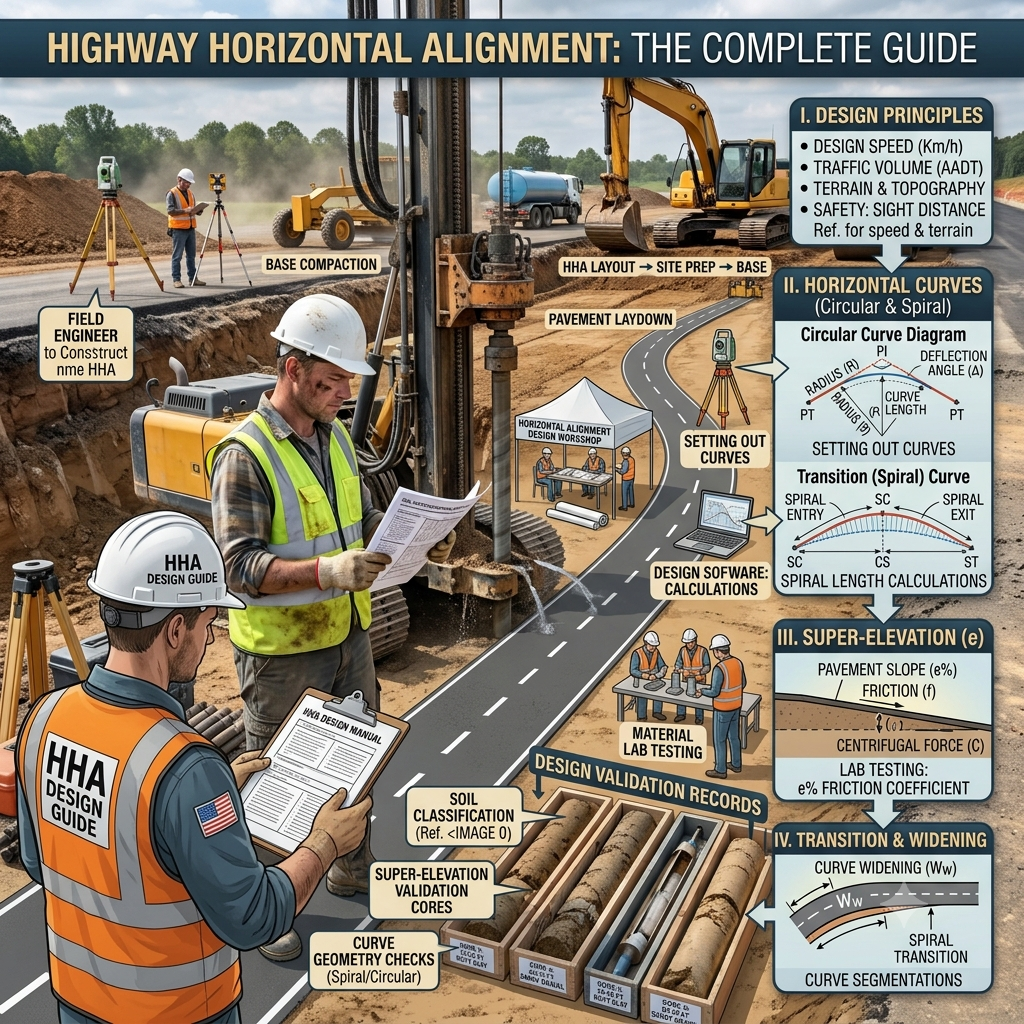
Highway Horizontal Alignment forms the backbone of every safe and efficient road network. It defines the path that a highway follows when viewed from above and directly influences vehicle stability, driver comfort, traffic flow, construction cost, and road safety. A well-designed horizontal alignment allows vehicles to move smoothly through straight sections and curves while maintaining the desired design speed.
Highway engineers carefully select the horizontal alignment during the planning and design stages by considering terrain, traffic volume, environmental constraints, land availability, construction feasibility, and future development. Poor alignment can increase accident risks, operating costs, and maintenance requirements. In contrast, an optimized alignment improves visibility, minimizes travel time, and reduces long-term lifecycle costs.
Understanding Highway Horizontal Alignment is essential for civil engineers, transportation engineers, contractors, surveyors, and engineering students. This guide explains the fundamental concepts, design elements, engineering principles, practical examples, and field recommendations used in modern highway projects.
What is Highway Horizontal Alignment?
Highway Horizontal Alignment refers to the layout of a road in the horizontal plane. It shows how the roadway changes direction using straight sections and different types of curves. Engineers design this alignment to provide a safe, comfortable, and economical route between two points.
Unlike vertical alignment, which controls gradients and elevation changes, horizontal alignment focuses on the direction of travel. Every curve, tangent, and transition must work together to guide drivers smoothly without sudden directional changes.
A good horizontal alignment balances engineering requirements with environmental, economic, and safety considerations.
Primary Objectives
- Provide safe vehicle movement.
- Maintain the selected design speed.
- Improve driver comfort.
- Minimize accident risks.
- Reduce construction costs.
- Fit naturally within the terrain.
- Support efficient drainage and future expansion.
Why Highway Horizontal Alignment Matters
Horizontal alignment affects nearly every aspect of highway performance. Even a small change in alignment can influence construction costs, travel efficiency, and maintenance requirements.
Benefits of Proper Alignment
- Enhances driving comfort.
- Improves traffic flow.
- Reduces fuel consumption.
- Minimizes vehicle wear and tear.
- Increases road safety.
- Reduces earthwork quantities.
- Improves visibility on curves.
- Supports efficient drainage design.
- Lowers long-term maintenance costs.
Practical Example
Imagine a highway passing through rolling hills. If engineers force the alignment to remain perfectly straight, the project may require deep excavations and high embankments, dramatically increasing costs.
Instead, a carefully designed alignment follows the natural terrain while maintaining safe curvature and acceptable design speeds. This approach reduces earthwork, protects the environment, and improves overall project efficiency.
Components of Highway Horizontal Alignment
A highway alignment consists of several geometric elements. Each component serves a specific engineering purpose and contributes to a smooth driving experience.
1. Tangent (Straight Section)
A tangent is a straight portion of the highway connecting two curves or extending between intersections.
Tangents provide clear visibility and allow drivers to travel comfortably at the design speed.
Characteristics
- Zero curvature
- Excellent sight distance
- Easy construction
- Lower maintenance requirements
- Comfortable driving conditions
Advantages
- Simple surveying and setting out.
- Lower construction complexity.
- Better overtaking opportunities.
- Improved drainage planning.
Engineering Consideration
Excessively long tangents may encourage speeding and reduce driver alertness. Designers often introduce gentle curves where appropriate to maintain driver attention and improve roadway aesthetics.
2. Circular Curve
A circular curve changes the direction of the roadway using a constant radius.
It connects two tangents smoothly while allowing vehicles to negotiate a change in direction.
Key Parameters
- Radius (R)
- Central angle (Δ)
- Tangent length (T)
- Curve length (L)
- External distance (E)
Applications
- Mountain highways
- Urban roads
- Bypass roads
- Interchanges
Engineering Principle
Larger curve radii support higher design speeds because they reduce the lateral forces acting on vehicles.
Simple Circular Curve Diagram
Tangent
-------------------------
                   \
                    \
                     )
                    )
                   )
                  /
-------------------------
      Tangent
3. Transition Curve
A transition curve provides a gradual change from a straight section to a circular curve. Instead of introducing full curvature instantly, the radius changes progressively, allowing drivers to adjust steering smoothly.
Modern highways frequently use spiral or clothoid transition curves because they improve safety and driving comfort.
Functions
- Gradually introduce centrifugal force.
- Improve passenger comfort.
- Allow smooth steering adjustments.
- Facilitate the development of superelevation.
- Reduce tyre wear.
Advantages
- Safer vehicle operation.
- Reduced skidding risk.
- Improved ride quality.
- Better appearance.
Transition Curve Diagram
Straight
------------------

      )
     )
    )
   ))
  )))
 )))))
(((((((( Circular Curve
4. Compound Curve
A compound curve consists of two or more circular curves with different radii that bend in the same direction.
Engineers use compound curves when site conditions prevent the use of a single-radius curve.
Typical Applications
- Mountain roads
- Urban constraints
- Valley crossings
- Limited right-of-way areas
Advantages
- Greater design flexibility.
- Better adaptation to difficult terrain.
- Reduced excavation requirements.
Considerations
Designers must carefully select the radii to ensure a smooth transition between curve segments and maintain consistent vehicle operation.
Compound Curve Diagram
Smaller Radius
      )
     )
    )

 Larger Radius
       ))
      ))
     ))
5. Reverse Curve
A reverse curve consists of two circular curves that bend in opposite directions and meet at a common tangent or transition.
Although reverse curves help navigate complex terrain, designers generally avoid them on high-speed highways unless adequate transition curves separate the opposing bends.
Applications
- Hill roads
- Urban street layouts
- Interchange ramps
- Service roads
Engineering Challenges
- Rapid steering changes.
- Increased driver workload.
- Higher risk of skidding without proper transitions.
- Greater need for accurate superelevation design.
Reverse Curve Diagram
      )
     )
    )

-----------

(
 (
  (
Engineering Principles of Highway Horizontal Alignment
Successful horizontal alignment depends on sound engineering judgment rather than simply connecting two points.
Design engineers focus on achieving a balance between safety, economy, comfort, and environmental compatibility.
Core Design Principles
- Maintain a consistent design speed throughout the alignment.
- Avoid sudden changes in curvature.
- Use transition curves before circular curves.
- Select curve radii appropriate for the design speed.
- Coordinate horizontal and vertical alignments for improved sight distance.
- Minimize unnecessary earthwork.
- Ensure adequate right-of-way for future expansion.
- Integrate drainage and roadside safety features into the alignment.
These principles create highways that perform efficiently throughout their design life.
Practical Design Example
Suppose engineers are designing a four-lane divided highway connecting two growing industrial cities. The proposed route crosses gently rolling terrain with a design speed of 100 km/h.
Instead of introducing sharp directional changes, the design team incorporates long tangents connected by transition curves and large-radius circular curves. This arrangement provides excellent visibility, reduces lateral acceleration, and supports comfortable travel at the selected speed. The alignment also follows natural contours where possible, reducing excavation volumes and preserving nearby agricultural land.
By applying sound horizontal alignment principles during the planning stage, the project achieves lower construction costs, improved safety, and better long-term performance.
Key Takeaways
Highway Horizontal Alignment determines the path a roadway follows in the horizontal plane and directly influences safety, comfort, construction efficiency, and operational performance. Tangents, circular curves, transition curves, compound curves, and reverse curves each serve a distinct engineering purpose. Selecting the appropriate combination of these elements allows engineers to create highways that accommodate design speeds, adapt to terrain, reduce construction costs, and provide a smooth driving experience. A well-planned alignment forms the foundation for durable, safe, and efficient transportation infrastructure.
Factors Affecting Highway Horizontal Alignment
Designing an efficient Highway Horizontal Alignment requires more than connecting two points on a map. Highway engineers evaluate technical, environmental, economic, and safety factors before selecting the final alignment.
1. Design Speed
Design speed controls almost every aspect of horizontal alignment. Higher design speeds require:
- Larger curve radii
- Longer transition curves
- Improved sight distance
- Smooth directional changes
Selecting a consistent design speed improves driving comfort and reduces accident risks.
2. Terrain
Terrain strongly influences the alignment of a highway.
Plain Terrain
- Longer tangents
- Larger-radius curves
- Lower construction costs
Rolling Terrain
- Moderate curves
- Balanced earthwork
- Controlled gradients
Mountainous Terrain
- Sharper curves
- More transition curves
- Retaining walls
- Tunnel and bridge considerations
Highway engineers strive to follow natural landforms wherever practical to reduce excavation and embankment work.
3. Traffic Volume
Future traffic projections determine the required highway capacity and influence alignment decisions.
High-volume highways generally require:
- Wider lanes
- Gentler curves
- Larger medians
- Better access control
- Higher design standards
Traffic forecasting should account for expected population growth, industrial development, and commercial transportation.
4. Road Safety
Safety remains the primary objective of highway geometric design.
Engineers improve safety by:
- Providing adequate sight distance
- Avoiding sudden changes in direction
- Using proper transition curves
- Maintaining consistent alignment
- Installing appropriate roadside safety features
A predictable alignment allows drivers to respond confidently under different driving conditions.
5. Land Availability
Available right-of-way often influences the final highway alignment.
Engineers aim to:
- Minimize property acquisition
- Reduce relocation of utilities
- Avoid densely populated areas
- Preserve agricultural land where feasible
Balancing engineering requirements with land constraints helps control project costs.
6. Environmental Considerations
Modern highway projects integrate environmental protection into the alignment selection process.
Designers evaluate:
- Forests
- Rivers
- Wetlands
- Wildlife habitats
- Protected areas
- Historical sites
Choosing an environmentally responsible alignment reduces ecological impacts and supports sustainable infrastructure development.
Superelevation in Highway Horizontal Alignment
When a vehicle travels around a curve, centrifugal force pushes it outward. Engineers introduce superelevation by raising the outer edge of the pavement to counteract this force.
Superelevation improves vehicle stability, especially on high-speed highways.
Objectives of Superelevation
- Reduce skidding
- Improve driver comfort
- Increase vehicle stability
- Minimize tyre wear
- Enhance safety during wet weather
Practical Example
On a high-speed expressway, engineers gradually raise the outer lane through the transition curve before reaching the circular curve. This gradual change allows vehicles to negotiate the bend safely without abrupt steering corrections.
Superelevation Diagram
        Outer Edge
          ________
         /       /
        /       /
_______/_______/________
     Inner Edge
Sight Distance Considerations
Adequate sight distance allows drivers to identify hazards and react safely.
Horizontal alignment directly affects visibility, especially on curves.
Types of Sight Distance
Stopping Sight Distance (SSD)
The minimum distance required for a driver to stop safely after identifying an obstacle.
Overtaking Sight Distance (OSD)
The distance required for one vehicle to overtake another safely.
Decision Sight Distance
Additional visibility provided at complex locations such as interchanges and intersections.
Improving Sight Distance
Engineers improve visibility by:
- Increasing curve radius
- Removing roadside obstructions
- Flattening side slopes
- Coordinating horizontal and vertical alignment
- Providing adequate clear zones
Extra Widening on Curves
Vehicles require additional pavement width while negotiating curves due to off-tracking and steering movements.
Heavy trucks occupy more road space than passenger vehicles, making extra widening essential on sharp curves.
Benefits of Extra Widening
- Improves traffic safety
- Reduces side-swipe collisions
- Enhances driver confidence
- Accommodates larger vehicles
- Improves traffic flow
Engineers determine widening requirements based on vehicle dimensions, curve radius, and traffic composition.
Coordination Between Horizontal and Vertical Alignment
Horizontal and vertical alignments should complement each other rather than function independently.
Poor coordination may create:
- Hidden dips
- Sudden crests
- Restricted visibility
- Driver confusion
- Unsafe driving conditions
Best Practice
Design curves and gradients together to create a smooth, continuous roadway that offers consistent visibility and predictable driving conditions.
Common Mistakes in Highway Horizontal Alignment Design
Several design errors can reduce highway performance and increase accident risks.
Common mistakes include:
- Selecting excessively sharp curves for the design speed
- Omitting transition curves
- Providing inadequate sight distance
- Ignoring drainage requirements
- Poor coordination between horizontal and vertical alignment
- Using inconsistent curve radii
- Failing to account for future traffic growth
- Neglecting roadside safety features
Careful design reviews and field verification help eliminate these issues before construction.
Best Practices for Highway Horizontal Alignment
Successful highway projects follow several proven engineering practices:
- Select a consistent design speed throughout the route.
- Use large-radius curves whenever feasible.
- Introduce transition curves before circular curves.
- Provide sufficient superelevation for design speed and climate.
- Maintain adequate stopping and overtaking sight distances.
- Coordinate horizontal and vertical alignments.
- Reduce unnecessary earthwork by following natural terrain.
- Design with future traffic growth in mind.
- Incorporate drainage and roadside safety features from the beginning.
- Verify alignment using field surveys and digital terrain models.
Field Recommendations
Civil Engineers
- Review survey data before finalizing the alignment.
- Confirm curve geometry using design software and field checks.
- Coordinate with geotechnical and drainage engineers during design.
- Conduct road safety audits before construction.
Contractors
- Verify setting-out points before earthwork begins.
- Follow approved alignment drawings precisely.
- Protect survey control points during construction.
- Monitor curve geometry throughout construction activities.
Engineering Students
- Understand the relationship between design speed and curve radius.
- Practice geometric design using real highway layouts.
- Learn the purpose of transition curves and superelevation.
- Visit active highway projects to observe alignment implementation in the field.
General Discussion of IRC, AASHTO, and ICE Practices
International highway engineering organizations provide comprehensive guidance for geometric road design.
Although requirements vary by country, the following principles remain common:
- Design alignments according to the selected design speed.
- Provide appropriate transition curves before circular curves.
- Ensure adequate stopping and overtaking sight distances.
- Apply suitable superelevation based on speed, curve radius, and local conditions.
- Coordinate horizontal and vertical alignments for driver comfort and safety.
- Consider long-term maintenance, drainage, and future expansion during design.
- Perform detailed field surveys and geotechnical investigations before finalizing the alignment.
- Prioritize road safety throughout the planning, design, construction, and maintenance stages.
These principles align with the general recommendations found in IRC, AASHTO, and ICE guidance for highway geometric design.
Frequently Asked Questions (FAQs)
1. What is Highway Horizontal Alignment?
Highway Horizontal Alignment is the layout of a road in the horizontal plane. It defines the roadway direction using tangents and curves to provide safe and efficient vehicle movement.
2. Why is horizontal alignment important?
It improves road safety, enhances driving comfort, supports design speed, reduces construction costs, and increases pavement performance.
3. What are the main elements of highway horizontal alignment?
The primary elements include tangents, circular curves, transition curves, compound curves, and reverse curves.
4. What is the purpose of a transition curve?
A transition curve gradually changes curvature between a straight section and a circular curve, allowing vehicles to adjust smoothly while developing superelevation.
5. Why is superelevation necessary on highway curves?
Superelevation counteracts centrifugal force, improves vehicle stability, reduces skidding, and enhances driver safety on curves.
6. What factors influence horizontal alignment design?
Design speed, terrain, traffic volume, safety requirements, environmental constraints, land availability, and construction costs all influence alignment selection.
7. What is extra widening on curves?
Extra widening provides additional pavement width on curves to accommodate vehicle off-tracking and improve traffic safety.
8. How does horizontal alignment affect road safety?
A well-designed alignment provides consistent curvature, adequate visibility, smooth transitions, and predictable driving conditions, reducing accident risks.
9. What happens if horizontal alignment is poorly designed?
Poor alignment can lead to restricted visibility, uncomfortable driving, increased vehicle operating costs, higher accident rates, and premature pavement deterioration.
10. Which standards guide highway horizontal alignment?
Engineers generally follow national highway design standards while applying internationally recognized geometric design principles consistent with IRC, AASHTO, and ICE guidance.
Conclusion
Highway Horizontal Alignment plays a fundamental role in the safety, efficiency, and long-term performance of every highway project. A carefully planned alignment combines tangents, transition curves, circular curves, proper superelevation, adequate sight distance, and coordinated geometric design to deliver smooth and predictable vehicle movement. Engineers must balance technical requirements with terrain, environmental conditions, traffic demand, and construction costs to achieve the best possible outcome. Applying accepted engineering practices, performing detailed field investigations, and following general guidance from organizations such as IRC, AASHTO, and ICE help create durable and safe transportation infrastructure. By mastering Highway Horizontal Alignment, civil engineers, contractors, and students can design road networks that improve mobility, reduce accidents, and support sustainable development for future generations.

Kamran Malik is a passionate civil engineering writer and researcher who specializes in construction, transportation, structural engineering, and infrastructure topics. Through his articles on CivilEngineerings.com, he simplifies complex engineering concepts and shares practical insights, industry trends, and educational resources for students, professionals, and engineering enthusiasts.