
Introduction
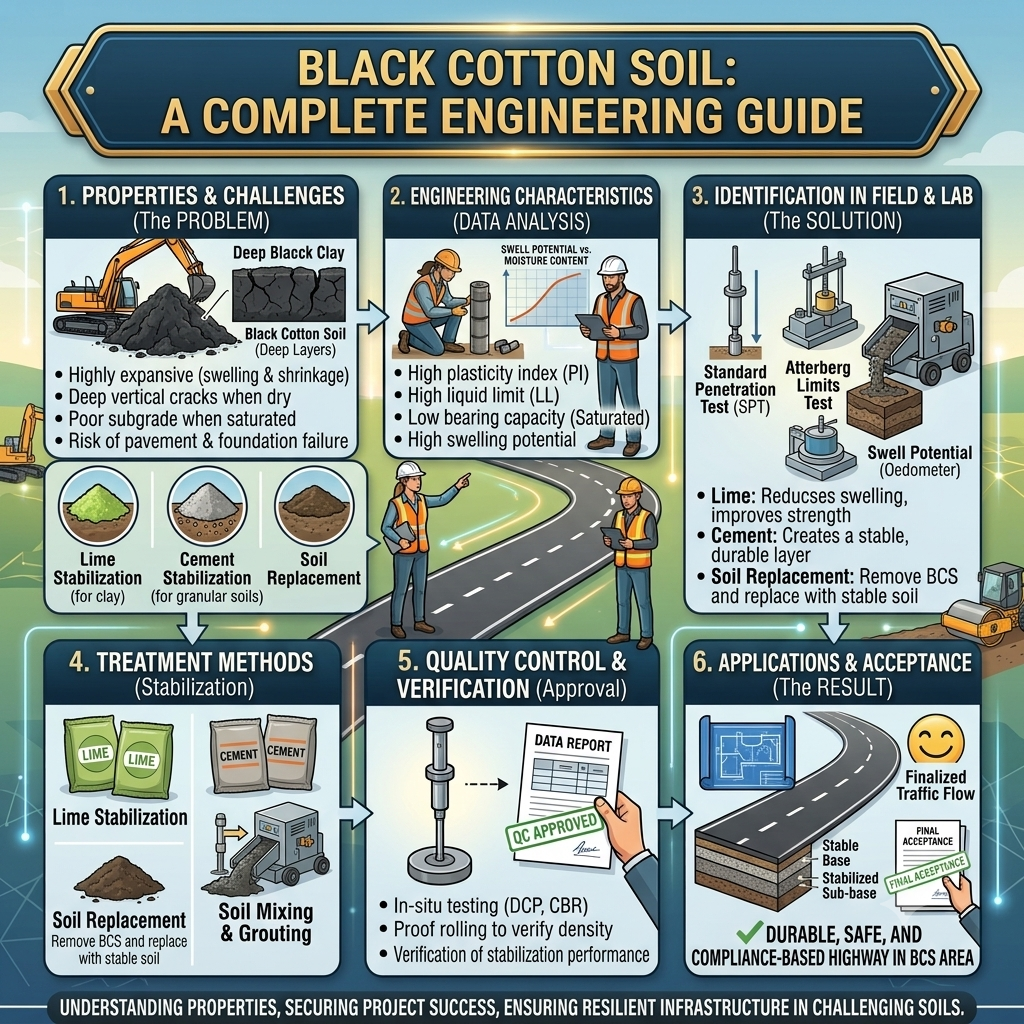
Black Cotton Soil presents one of the biggest challenges in civil and highway engineering. Engineers often encounter this expansive soil while constructing roads, highways, railways, foundations, embankments, canals, and residential buildings. Unlike ordinary soils, Black Cotton Soil expands significantly during the rainy season and shrinks during dry weather. This continuous volume change creates cracks, uneven settlements, pavement failures, and structural damage if engineers ignore its behavior during design and construction.
Understanding Black Cotton Soil helps engineers choose suitable foundation systems, pavement designs, and stabilization techniques before construction begins. Proper soil investigation, laboratory testing, and ground improvement methods can significantly improve structural performance while reducing maintenance costs.
This comprehensive guide explains the origin, engineering properties, identification methods, advantages, and practical applications of Black Cotton Soil. Whether you are a civil engineering student, site engineer, highway consultant, or contractor, this article provides valuable insights based on accepted engineering principles and industry best practices.
What is Black Cotton Soil?
Black Cotton Soil is a fine-grained, highly expansive clay soil that undergoes considerable swelling when it absorbs water and shrinks when it loses moisture. Engineers classify it as an expansive soil because its volume changes repeatedly with seasonal moisture variations.
The soil derives its name from its suitability for cotton cultivation. Farmers value it for agriculture because it retains moisture for long periods. However, the same characteristic creates serious engineering problems for roads, pavements, and building foundations.
The soil typically contains a high percentage of montmorillonite clay minerals, which absorb water rapidly and cause significant expansion.
Key Characteristics
- Dark black or dark grey color
- High clay content
- High shrink-swell potential
- Excellent water retention
- Deep shrinkage cracks during dry seasons
- Low permeability
- High plasticity
- Poor engineering performance without stabilization
Formation and Geological Origin
Black Cotton Soil forms through the weathering of basaltic rocks over thousands of years. Volcanic lava deposits gradually decompose under climatic and environmental conditions, producing clay-rich soil with high expansiveness.
The soil develops mainly in regions with alternating wet and dry seasons. Rainwater enters the clay structure during the monsoon, causing expansion. Dry weather removes moisture, resulting in shrinkage and surface cracking.
Factors Influencing Formation
- Basaltic parent rock
- Seasonal rainfall
- High clay mineral content
- Temperature variations
- Long-term weathering processes
This geological origin explains why Black Cotton Soil exhibits unique engineering behavior compared to sandy or gravelly soils.
Distribution of Black Cotton Soil
Black Cotton Soil occurs in several countries around the world. Large deposits exist in tropical and subtropical regions where basaltic rocks dominate.
Major Countries
- India
- Pakistan
- Ethiopia
- Sudan
- Australia
- South Africa
Major Regions in India
Large areas of Black Cotton Soil occur in:
- Maharashtra
- Madhya Pradesh
- Gujarat
- Karnataka
- Telangana
- Andhra Pradesh
Engineers working in these regions routinely consider expansive soil behavior during highway and foundation design.
Engineering Properties of Black Cotton Soil
The engineering performance of Black Cotton Soil depends on its physical, mechanical, and chemical properties. Understanding these characteristics helps engineers select appropriate construction techniques.
Physical Properties
Color
The soil generally appears black, dark grey, or dark brown due to iron compounds and organic matter.
Texture
It contains a high percentage of clay particles, giving it a smooth and sticky texture when wet.
Plasticity
Black Cotton Soil exhibits high plasticity. It deforms easily under load when moisture increases.
Water Retention
The soil absorbs and retains large amounts of water. This property benefits agriculture but complicates construction.
Shrinkage and Swelling
The soil expands after rainfall and contracts during dry weather. These repeated volume changes create differential movement beneath structures.
Mechanical Properties
Bearing Capacity
Black Cotton Soil generally provides low to moderate bearing capacity. Engineers often improve the soil before constructing highways or foundations.
Compressibility
The soil compresses significantly under sustained loads, especially when moisture content changes.
Shear Strength
Shear strength varies depending on water content. Wet soil loses strength rapidly, while dry soil becomes hard and brittle.
Permeability
Low permeability slows water movement through the soil, increasing moisture retention and prolonging swelling.
Chemical Characteristics
Black Cotton Soil commonly contains:
- Calcium
- Magnesium
- Iron
- Alumina
- Silica
The presence of expansive clay minerals, especially montmorillonite, governs its engineering behavior.
How to Identify Black Cotton Soil
Engineers identify Black Cotton Soil through both field observations and laboratory testing.
Field Identification
Several visual signs help identify Black Cotton Soil.
Appearance
The soil usually appears black or dark grey.
Surface Cracks
Wide cracks develop during hot and dry weather. Some cracks extend more than one meter below ground.
Sticky Nature
Wet soil sticks strongly to boots, tires, and construction equipment.
Hard Surface During Summer
Dry soil becomes extremely hard and difficult to excavate.
Laboratory Tests
Field observations should always be confirmed through laboratory investigations.
Atterberg Limits
These tests determine:
- Liquid Limit
- Plastic Limit
- Plasticity Index
High plasticity indicates expansive clay.
Free Swell Index Test
The Free Swell Index measures the soil’s expansion potential when submerged in water.
Differential Free Swell Test
Engineers use this test to estimate swelling severity.
California Bearing Ratio (CBR)
The CBR test evaluates subgrade strength for pavement design.
Standard Proctor Test
This test determines optimum moisture content and maximum dry density.
Shrinkage Limit Test
The shrinkage limit indicates how much the soil contracts upon drying.
Proper laboratory testing reduces uncertainty during pavement and foundation design.
Advantages of Black Cotton Soil
Although engineers often regard Black Cotton Soil as problematic, it offers several advantages under suitable conditions.
Excellent Moisture Retention
The soil stores water effectively, supporting crops during dry periods.
Agricultural Productivity
It provides favorable conditions for cotton, soybean, wheat, sugarcane, and pulses.
Availability
Large natural deposits reduce transportation costs for agricultural applications.
High Nutrient Content
The soil contains essential minerals that support plant growth.
Potential for Stabilization
Modern stabilization techniques can significantly improve its engineering performance for roads and foundations.
Engineering Diagrams:
1: Formation of Black Cotton Soil
          Basaltic Rock
                │
      Weathering Process
                │
                ▼
      Clay Mineral Formation
                │
      (Montmorillonite)
                │
                ▼
      Black Cotton Soil
                │
        Swells When Wet
                │
        Shrinks When Dry
2: Shrink–Swell Cycle
        Rainfall
           │
           ▼
 Water Absorption
           │
           ▼
 Soil Swelling
           │
           ▼
 Volume Increase
           │
───────────────
 Dry Weather
           │
           ▼
 Moisture Loss
           │
           ▼
 Soil Shrinkage
           │
           ▼
 Surface Cracks
3: Pavement Layers on Black Cotton Soil
==============================
 Asphalt Wearing Course
==============================
 Binder Course
==============================
 Base Course
==============================
 Granular Sub-base
==============================
 Stabilized Subgrade
==============================
 Black Cotton Soil
==============================
 Natural Ground
Key Takeaways
Black Cotton Soil is a highly expansive clay soil with unique engineering characteristics that demand careful investigation before construction. Its high plasticity, significant shrink–swell behavior, low permeability, and moisture sensitivity make it unsuitable for supporting pavements and foundations without proper treatment. However, engineers can successfully build durable infrastructure on Black Cotton Soil by understanding its properties, conducting detailed laboratory testing, and selecting appropriate stabilization techniques. A strong understanding of these fundamentals forms the basis for safe, economical, and long-lasting civil engineering projects.
Disadvantages of Black Cotton Soil
Although Black Cotton Soil supports agriculture effectively, it creates numerous engineering challenges. Its expansive nature demands careful planning, proper soil treatment, and continuous quality control throughout construction.
1. High Shrink–Swell Behavior
The greatest disadvantage of Black Cotton Soil is its tendency to expand after absorbing water and contract during dry periods. This continuous movement creates uneven ground conditions beneath roads and structures.
2. Low Bearing Capacity
The soil loses strength when saturated. Heavy loads can cause excessive settlement, making untreated Black Cotton Soil unsuitable for supporting highways, bridges, and large buildings.
3. Deep Surface Cracks
During hot weather, moisture evaporates and the soil shrinks. Wide cracks develop, allowing water to penetrate deeper into the ground during the next rainy season. This cycle accelerates pavement deterioration.
4. Construction Difficulties
Wet Black Cotton Soil becomes sticky and difficult to handle. Dry soil becomes extremely hard, increasing excavation time and equipment wear.
5. Higher Maintenance Costs
Roads built on untreated expansive soil often require frequent repairs because repeated volume changes damage the pavement structure.
Problems of Black Cotton Soil in Road Construction
Road engineers frequently encounter failures when highways are constructed directly on expansive clay without proper stabilization.
Common Problems
- Differential settlement
- Pavement cracking
- Rutting
- Edge failures
- Shoulder deformation
- Uneven riding surface
- Water infiltration
- Reduced pavement life
Practical Example
A two-lane highway constructed on untreated Black Cotton Soil may appear stable immediately after completion. However, after several seasonal wetting and drying cycles, longitudinal cracks and depressions can develop due to continuous expansion and shrinkage beneath the pavement.
Problems in Building Foundations
Foundations resting on expansive soil also experience significant movement.
Structural Problems
- Wall cracks
- Uneven floor settlement
- Tilted columns
- Distorted doors and windows
- Foundation heave
- Structural instability
These issues highlight the importance of conducting detailed geotechnical investigations before construction.
Soil Stabilization Methods for Black Cotton Soil
Engineers improve Black Cotton Soil using various stabilization techniques to increase strength, reduce swelling, and enhance durability.
1. Lime Stabilization
Lime reacts chemically with clay minerals and reduces plasticity.
Benefits
- Reduces swelling potential
- Improves workability
- Increases bearing capacity
- Enhances long-term strength
Lime stabilization remains one of the most widely used techniques for road subgrades on expansive soils.
2. Cement Stabilization
Cement binds soil particles together and creates a stronger, more stable layer.
Advantages
- Higher compressive strength
- Improved durability
- Better moisture resistance
- Reduced settlement
Engineers often select cement stabilization for heavily trafficked highways.
3. Fly Ash Stabilization
Fly ash, a by-product of thermal power plants, improves engineering properties when combined with lime or cement.
Benefits
- Sustainable construction
- Lower project cost
- Improved strength
- Reduced plasticity
4. Mechanical Stabilization
Mechanical stabilization modifies soil properties by blending Black Cotton Soil with suitable materials.
Common Materials
- Sand
- Gravel
- Crushed stone
- Granular soil
This method improves drainage and reduces expansive behavior.
5. Geosynthetics
Modern highway projects frequently use geotextiles and geogrids to reinforce weak subgrades.
Advantages
- Better load distribution
- Reduced settlement
- Improved pavement performance
- Increased service life
6. Proper Drainage Design
Controlling moisture fluctuations significantly reduces shrink–swell movement.
Recommended Drainage Measures
- Side drains
- Subsurface drains
- Longitudinal drains
- Proper cross slopes
- Well-maintained shoulders
Effective drainage protects both pavements and foundations from excessive moisture.
Practical Applications of Black Cotton Soil
Despite its challenges, Black Cotton Soil serves several important purposes when engineers manage it correctly.
Agriculture
The soil supports crops such as:
- Cotton
- Soybean
- Wheat
- Sugarcane
- Sorghum
- Pulses
Highway Construction
After stabilization, Black Cotton Soil can support:
- National highways
- State highways
- Rural roads
- Industrial roads
Railway Projects
Engineers stabilize expansive soil beneath railway embankments to improve long-term track stability.
Residential Construction
Proper foundation design allows safe construction of houses and commercial buildings in regions dominated by expansive clay.
Best Practices for Construction on Black Cotton Soil
Successful projects follow established engineering principles rather than relying on temporary solutions.
Recommended Best Practices
- Conduct detailed geotechnical investigations before design.
- Perform laboratory testing to determine swelling characteristics.
- Design pavements according to anticipated traffic loads and soil conditions.
- Stabilize expansive soil before construction.
- Maintain optimum moisture content during compaction.
- Achieve specified field density through proper compaction.
- Provide efficient surface and subsurface drainage.
- Monitor moisture changes during construction.
- Carry out regular quality control testing.
- Implement routine maintenance after project completion.
These practices reduce long-term maintenance costs and improve pavement performance.
Practical Recommendations
Civil Engineers
- Never design foundations without investigating soil properties.
- Select stabilization methods based on laboratory test results.
- Verify compaction through field density testing.
- Consider seasonal moisture variations during design.
Road Contractors
- Remove unsuitable soil where necessary.
- Follow specified compaction procedures.
- Protect prepared subgrades from rainfall before pavement placement.
- Maintain proper drainage throughout construction.
Engineering Students
- Study expansive soil behavior thoroughly.
- Learn laboratory testing procedures such as CBR, Atterberg Limits, and Free Swell Index.
- Visit highway construction sites located on Black Cotton Soil.
- Understand how stabilization techniques improve pavement performance.
General Discussion of IRC, AASHTO, and ICE Practices
Leading highway engineering organizations emphasize the importance of understanding expansive soils before construction.
General guidance commonly includes:
- Conduct comprehensive geotechnical investigations before design.
- Evaluate swelling potential through laboratory testing.
- Design pavement thickness based on subgrade strength and projected traffic loading.
- Improve weak subgrades using appropriate stabilization techniques.
- Ensure effective drainage to limit moisture variations.
- Follow approved material specifications and quality control procedures.
- Monitor field compaction throughout construction.
- Consider long-term maintenance during project planning.
These engineering principles help create safer, stronger, and more durable infrastructure on expansive soils.
Frequently Asked Questions (FAQs)
1. What is Black Cotton Soil?
Black Cotton Soil is a highly expansive clay soil that swells when wet and shrinks when dry due to its high montmorillonite mineral content.
2. Why is Black Cotton Soil considered problematic for construction?
Its shrink–swell behavior causes differential settlement, pavement cracking, foundation movement, and structural damage if left untreated.
3. Which laboratory test measures the swelling potential of Black Cotton Soil?
The Free Swell Index Test and Differential Free Swell Test commonly evaluate its swelling characteristics.
4. Can roads be constructed on Black Cotton Soil?
Yes. Engineers can safely construct roads after improving the soil through stabilization, proper drainage, and suitable pavement design.
5. Which stabilization method works best for Black Cotton Soil?
Lime stabilization is widely used because it reduces plasticity, limits swelling, and increases soil strength. The final selection depends on project requirements and laboratory results.
6. Why does Black Cotton Soil crack during summer?
Moisture evaporates from the soil during dry weather, causing shrinkage and the formation of deep surface cracks.
7. Which crops grow well in Black Cotton Soil?
Cotton, soybean, wheat, sugarcane, sorghum, and several pulses perform well because the soil retains moisture effectively.
8. How does drainage improve the performance of Black Cotton Soil?
Efficient drainage limits excessive moisture changes, reducing swelling, shrinkage, and pavement damage.
9. What is the role of geotextiles in expansive soils?
Geotextiles improve load distribution, reinforce weak subgrades, and reduce settlement beneath pavements.
10. Why should engineers investigate Black Cotton Soil before construction?
A detailed investigation identifies swelling potential, bearing capacity, and moisture sensitivity, enabling engineers to select suitable foundation and stabilization methods.
Conclusion
Black Cotton Soil remains one of the most challenging natural materials in civil and highway engineering because of its high shrink–swell potential, moisture sensitivity, and variable strength. Despite these challenges, engineers can successfully construct durable roads, highways, railways, and buildings by applying sound engineering principles and modern soil improvement techniques.
Comprehensive geotechnical investigations, laboratory testing, proper drainage design, effective compaction, and suitable stabilization methods significantly enhance the performance of expansive soils. Organizations such as IRC, AASHTO, and ICE also emphasize careful site evaluation, quality control, and long-term maintenance to improve infrastructure reliability. For engineers, contractors, and students, understanding the behavior of Black Cotton Soil is essential for selecting appropriate construction methods, minimizing maintenance costs, and ensuring the long-term safety and durability of transportation and structural projects. A scientific approach to soil investigation and stabilization transforms this challenging material into a reliable foundation for sustainable infrastructure development.
