
Introduction
Every successful civil engineering project starts with a clear understanding of the ground beneath it. Buildings, highways, bridges, dams, tunnels, and retaining structures all rely on stable soil and rock to perform safely throughout their design life. A well-planned Geotechnical Design process helps engineers evaluate ground conditions, select suitable foundations, control settlement, and minimize construction risks.
Geotechnical design combines geology, soil mechanics, rock mechanics, hydrology, and structural engineering to create safe and economical infrastructure. Engineers investigate the subsurface, analyze soil behavior, and develop solutions that match the project’s structural requirements. Without proper geotechnical design, even a perfectly designed structure can suffer from excessive settlement, slope failures, foundation movement, or water-related damage.
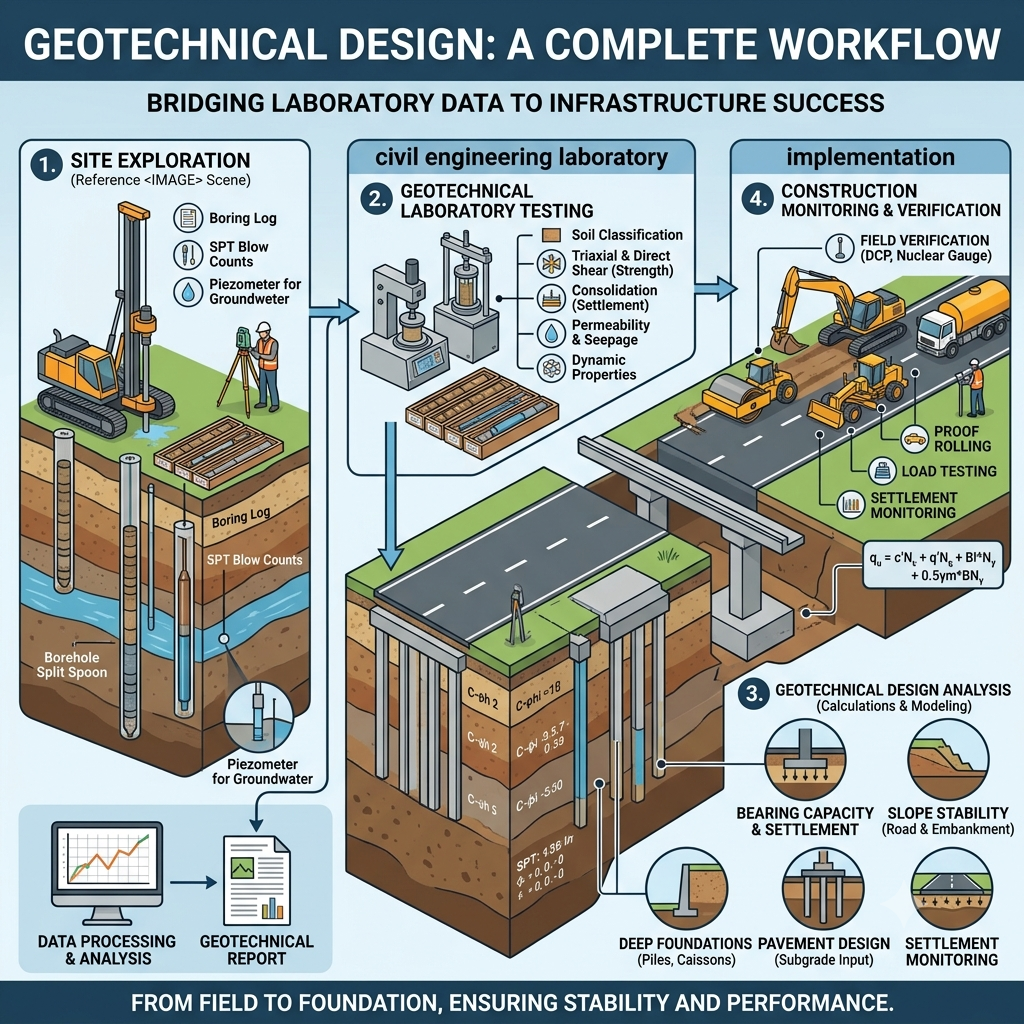
This comprehensive guide explains the fundamentals of Geotechnical Design, its engineering principles, field investigation methods, design process, practical applications, and best practices. Whether you are a civil engineer, contractor, or engineering student, understanding geotechnical design will strengthen your ability to deliver safe, durable, and cost-effective infrastructure.
What Is Geotechnical Design?
Geotechnical Design is the engineering process of evaluating soil, rock, groundwater, and subsurface conditions to design safe and economical foundations, earth structures, and underground works.
The process involves collecting field data, performing laboratory tests, analyzing ground behavior, and selecting suitable engineering solutions. It ensures that the ground can safely support structural loads throughout the intended service life of the project.
Geotechnical design applies to numerous infrastructure projects, including:
- Highways and expressways
- Bridges and flyovers
- Residential and commercial buildings
- Industrial facilities
- Airports
- Railways
- Dams and embankments
- Retaining walls
- Tunnels
- Ports and marine structures
Why Geotechnical Design Matters
The ground behaves differently from one location to another. Sandy soil, clay, gravel, and rock all respond differently to structural loads and environmental conditions. Engineers must understand these variations before construction begins.
A comprehensive geotechnical design helps to:
- Ensure structural stability
- Prevent foundation failures
- Minimize differential settlement
- Improve construction safety
- Optimize foundation costs
- Reduce maintenance expenses
- Increase service life
- Manage groundwater challenges
Practical Example
Imagine two identical buildings constructed with the same structural design. One stands on dense gravel, while the other rests on soft clay. Without appropriate geotechnical design, the building on clay may experience excessive settlement and cracking, even though both buildings share the same structural configuration.
Objectives of Geotechnical Design
Every geotechnical investigation supports specific engineering objectives.
The primary objectives include:
- Determining soil and rock properties
- Estimating bearing capacity
- Assessing settlement potential
- Evaluating groundwater conditions
- Selecting suitable foundation systems
- Designing stable slopes
- Supporting excavation safety
- Recommending ground improvement methods
- Reducing construction risks
- Ensuring long-term structural performance
These objectives allow engineers to make informed design decisions before construction begins.
Engineering Principles of Geotechnical Design
Successful geotechnical design relies on several fundamental engineering principles.
Soil Mechanics
Soil mechanics studies how soil responds to loads, moisture changes, and environmental conditions. Engineers evaluate properties such as density, shear strength, compressibility, and permeability to predict soil performance.
Rock Mechanics
Rock mechanics examines the behavior of intact rock and rock masses under different loading conditions. This principle becomes particularly important for tunnels, bridge foundations, and deep excavations.
Effective Stress Principle
The effective stress principle explains that the strength of soil depends on the stress carried by soil particles rather than the total stress alone. Groundwater pressure directly influences this behavior.
Shear Strength
Every soil possesses a maximum resistance to sliding, known as shear strength. Engineers evaluate this property to design foundations, slopes, and retaining walls.
Settlement Analysis
Settlement analysis estimates how much a structure will sink after construction. Accurate predictions help prevent cracking and uneven structural movement.
Groundwater Control
Groundwater affects soil strength, excavation stability, and foundation performance. Engineers incorporate drainage systems and dewatering methods into the design where necessary.
Step-by-Step Geotechnical Design Process
Step 1: Project Planning and Desk Study
Every geotechnical project begins with collecting existing information about the site.
Engineers review:
- Topographic maps
- Geological maps
- Previous site investigations
- Historical construction records
- Satellite imagery
- Hydrological data
- Seismic information
- Utility records
This preliminary study helps engineers identify potential ground challenges before fieldwork begins.
Benefits
- Reduces investigation costs
- Improves planning efficiency
- Identifies high-risk areas
- Supports borehole planning
Step 2: Site Reconnaissance
Site reconnaissance provides engineers with a first-hand understanding of existing ground conditions.
During the site visit, engineers observe:
- Surface drainage
- Existing structures
- Slopes
- Vegetation
- Rock outcrops
- Signs of erosion
- Water bodies
- Access conditions
They also document nearby construction activities that may influence the proposed project.
Field Observation Checklist
- Ground elevation
- Existing roads
- Utility services
- Surface cracks
- Standing water
- Unstable slopes
- Excavations
- Adjacent buildings
A detailed site inspection often reveals conditions that maps and reports cannot show.
Step 3: Geotechnical Site Investigation
The field investigation supplies the data needed for engineering analysis.
Engineers determine:
- Soil profile
- Rock depth
- Groundwater level
- Soil strength
- Engineering properties
Common Investigation Methods
Borehole Drilling
Engineers drill boreholes at selected locations to collect soil and rock samples from different depths.
Trial Pits
Trial pits allow direct observation of shallow soil layers and underground utilities.
Standard Penetration Test (SPT)
The SPT estimates soil density and relative strength by measuring the number of hammer blows required to drive a sampler.
Cone Penetration Test (CPT)
The CPT measures soil resistance continuously with depth, providing valuable information for foundation design.
Geophysical Surveys
Engineers may also use seismic or electrical methods to investigate large areas efficiently.
Geotechnical Investigation Flow Diagram
Project Planning
        │
        ▼
Desk Study
        │
        ▼
Site Reconnaissance
        │
        ▼
Boreholes & Trial Pits
        │
        ▼
Field Testing (SPT/CPT)
        │
        ▼
Laboratory Testing
        │
        ▼
Engineering Analysis
Step 4: Laboratory Testing
Laboratory testing determines the engineering characteristics of soil and rock samples collected during field investigations.
Common Soil Tests
- Moisture Content Test
- Grain Size Analysis
- Atterberg Limits
- Specific Gravity Test
- Standard Proctor Test
- Modified Proctor Test
- California Bearing Ratio (CBR)
- Direct Shear Test
- Triaxial Compression Test
- Consolidation Test
- Permeability Test
Rock Tests
- Unconfined Compressive Strength
- Point Load Test
- Slake Durability Test
- Rock Density Test
Why Laboratory Testing Matters
Laboratory results provide reliable design parameters that engineers use for:
- Foundation design
- Slope stability analysis
- Earth pressure calculations
- Pavement design
- Ground improvement planning
Step 5: Geotechnical Analysis and Soil Evaluation
Once engineers complete field and laboratory investigations, they analyze the collected data to determine the most suitable design solution.
This stage transforms raw data into engineering recommendations.
Engineers Evaluate
- Soil bearing capacity
- Settlement characteristics
- Groundwater conditions
- Slope stability
- Liquefaction potential
- Earth pressures
- Soil classification
- Foundation suitability
Typical Design Recommendations
Based on the analysis, engineers may recommend:
- Shallow foundations
- Deep foundations
- Raft foundations
- Pile foundations
- Soil stabilization
- Ground improvement
- Drainage systems
- Retaining structures
Practical Example
A proposed warehouse requires heavy foundations. The investigation reveals a thick layer of loose sand over dense gravel. Engineers recommend driven piles extending into the dense gravel layer to achieve the required bearing capacity and minimize settlement.
Key Takeaways
A successful Geotechnical Design begins with detailed planning, thorough field investigations, and accurate laboratory testing. Engineers use this information to understand soil behavior, evaluate groundwater conditions, estimate bearing capacity, and predict settlement before construction starts. These early stages reduce uncertainty, improve safety, and support economical design decisions. A strong geotechnical foundation allows every civil engineering project to perform reliably throughout its intended service life.
Step 6: Foundation Design
Foundation design converts geotechnical investigation results into practical engineering solutions. Engineers select a foundation system that safely transfers structural loads to the ground while controlling settlement and maintaining stability throughout the structure’s service life.
Types of Foundations
Shallow Foundations
Shallow foundations suit sites with strong soil near the surface. Common types include:
- Isolated footings
- Combined footings
- Strip footings
- Raft (mat) foundations
Applications
- Residential buildings
- Low-rise commercial structures
- Warehouses
- Small industrial facilities
Deep Foundations
Deep foundations transfer loads to stronger soil or rock located at greater depths.
Common types include:
- Driven piles
- Bored piles
- Drilled shafts
- Caissons
Applications
- High-rise buildings
- Bridges
- Marine structures
- Heavy industrial plants
Factors Influencing Foundation Selection
Engineers evaluate:
- Bearing capacity
- Settlement limits
- Groundwater level
- Structural loading
- Soil profile
- Construction cost
- Construction schedule
- Site accessibility
Foundation Selection Diagram
Ground Investigation
         │
         ▼
Soil Strength Evaluation
         │
         ▼
Load Assessment
         │
         ▼
Foundation Type Selection
         │
 ┌───────┴────────┐
 ▼                ▼
Shallow       Deep Foundation
Foundation
A suitable foundation design improves safety, reduces maintenance costs, and extends the life of the structure.
Step 7: Slope Stability Analysis
Many civil engineering projects involve natural or man made slopes. Engineers perform slope stability analysis to ensure these slopes remain safe during construction and throughout their operational life.
Objectives
- Prevent landslides
- Protect nearby structures
- Ensure worker safety
- Reduce erosion
- Improve long-term stability
Factors Affecting Slope Stability
- Soil type
- Slope angle
- Groundwater conditions
- Rainfall
- Seismic activity
- Vegetation
- Excavation activities
- Surface loading
Common Stabilization Methods
- Retaining walls
- Soil nailing
- Rock bolts
- Reinforced earth systems
- Geogrids
- Drainage systems
- Benching
- Vegetation cover
Practical Example
During highway construction in a hilly region, engineers identify a steep cut slope with weak shale. Instead of increasing excavation depth, they install rock bolts, wire mesh, and drainage channels to stabilize the slope and reduce the risk of failure.
Step 8: Earth Retaining Structure Design
Retaining structures hold back soil where changes in ground elevation occur. They play an essential role in highways, bridge approaches, basements, and hillside developments.
Common Retaining Structures
- Gravity retaining walls
- Reinforced concrete cantilever walls
- Counterfort retaining walls
- Mechanically Stabilized Earth (MSE) walls
- Sheet pile walls
- Gabion walls
Design Considerations
Engineers calculate:
- Active earth pressure
- Passive earth pressure
- Sliding resistance
- Overturning resistance
- Bearing pressure
- Drainage requirements
Importance of Drainage
Poor drainage increases hydrostatic pressure behind retaining walls, reducing stability. Engineers therefore provide:
- Weep holes
- Drainage blankets
- Filter media
- Perforated drain pipes
Effective drainage significantly improves retaining wall performance.
Step 9: Ground Improvement Techniques
Some construction sites contain weak soil that cannot safely support the proposed structure. Instead of replacing large volumes of soil, engineers often improve the existing ground.
Common Ground Improvement Methods
Mechanical Compaction
Rollers increase soil density and improve bearing capacity.
Dynamic Compaction
Heavy weights dropped repeatedly densify loose granular soils.
Soil Stabilization
Lime, cement, or fly ash improves weak clay soils.
Stone Columns
Stone columns strengthen soft ground while improving drainage.
Vibro Compaction
Vibrating probes densify loose sands below the surface.
Geosynthetics
Geotextiles and geogrids reinforce weak soils and improve load distribution.
Benefits
- Increased bearing capacity
- Reduced settlement
- Improved slope stability
- Faster construction
- Lower project costs
- Better long-term performance
Step 10: Construction Monitoring and Quality Control
Geotechnical design does not end when construction begins. Continuous monitoring verifies that field conditions match design assumptions.
Quality Control Activities
- Foundation inspection
- Field density testing
- Plate load testing
- Concrete quality testing
- Pile integrity testing
- Settlement monitoring
- Groundwater monitoring
- Slope movement observation
Monitoring Instruments
- Settlement plates
- Inclinometers
- Piezometers
- Crack gauges
- Extensometers
Regular monitoring allows engineers to identify potential problems early and implement corrective measures before significant damage occurs.
Best Practices in Geotechnical Design
Successful geotechnical projects follow proven engineering practices:
- Conduct comprehensive site investigations before design.
- Use sufficient boreholes to represent site conditions accurately.
- Perform laboratory tests on representative samples.
- Consider seasonal groundwater fluctuations.
- Evaluate both ultimate and serviceability limit states.
- Integrate drainage into every geotechnical solution.
- Review construction methods during the design stage.
- Monitor critical structures throughout construction.
- Document all field observations and test results.
- Update designs if site conditions differ from investigation findings.
Field Recommendations
Civil Engineers
- Never rely solely on nearby investigation reports.
- Review borehole logs before finalizing foundation designs.
- Coordinate with structural and highway engineers during design.
- Visit the construction site regularly to verify actual ground conditions.
- Maintain complete geotechnical documentation for future reference.
Contractors
- Follow approved excavation procedures.
- Protect exposed excavations from water infiltration.
- Avoid over-excavation below foundation levels.
- Compact engineered fill in specified layers.
- Report unexpected soil conditions immediately.
Engineering Students
- Build a strong understanding of soil mechanics.
- Learn how to interpret borehole logs and laboratory reports.
- Observe foundation construction on active sites.
- Practice reading geotechnical reports and design recommendations.
- Develop familiarity with common field testing methods.
Common Geotechnical Design Mistakes
Avoiding these mistakes improves project safety and reduces construction risks:
- Insufficient site investigation
- Poor borehole spacing
- Ignoring groundwater conditions
- Underestimating settlement
- Selecting inappropriate foundation systems
- Inadequate slope drainage
- Using inaccurate soil parameters
- Neglecting seismic considerations where applicable
- Failing to monitor construction performance
- Ignoring unexpected field conditions
General Discussion of IRC, AASHTO, and ICE Practices
Leading engineering organizations such as the Indian Roads Congress (IRC), American Association of State Highway and Transportation Officials (AASHTO), and the Institution of Civil Engineers (ICE) promote similar geotechnical principles for infrastructure projects.
Their guidance generally emphasizes:
- Thorough geotechnical investigations before design.
- Reliable laboratory and field testing.
- Appropriate foundation selection based on soil conditions.
- Proper drainage to protect soil strength.
- Continuous quality assurance during construction.
- Consideration of long-term performance and maintenance.
- Integration of geotechnical, structural, and transportation engineering throughout the project lifecycle.
Applying these principles improves safety, durability, and cost efficiency across a wide range of civil engineering projects.
Frequently Asked Questions (FAQs)
1. What is geotechnical design in civil engineering?
Geotechnical design is the process of analyzing soil, rock, and groundwater conditions to develop safe and economical foundations, slopes, retaining structures, and earthworks.
2. Why is site investigation important?
A site investigation provides accurate information about subsurface conditions, allowing engineers to design foundations that suit the site’s actual characteristics.
3. What tests are commonly performed during geotechnical investigations?
Common tests include the Standard Penetration Test (SPT), Cone Penetration Test (CPT), California Bearing Ratio (CBR), Atterberg Limits, Proctor Compaction Test, and Triaxial Compression Test.
4. How do engineers select the right foundation?
Engineers evaluate soil strength, groundwater conditions, structural loads, settlement limits, construction costs, and project requirements before selecting a suitable foundation.
5. What causes excessive settlement?
Weak soils, poor compaction, high groundwater levels, and inadequate foundation design commonly contribute to excessive settlement.
6. What is the purpose of ground improvement?
Ground improvement increases soil strength, reduces settlement, enhances stability, and allows safe construction on weak ground.
7. Why is groundwater important in geotechnical design?
Groundwater influences soil strength, excavation stability, foundation performance, and long-term durability. Proper drainage and dewatering strategies help control these effects.
8. Which projects require geotechnical design?
Almost every major civil engineering project requires geotechnical design, including highways, bridges, buildings, dams, tunnels, airports, ports, retaining walls, and railway infrastructure.
9. What role does quality control play during construction?
Quality control confirms that construction follows the approved design and that field conditions meet engineering specifications for safety and performance.
10. Can geotechnical problems be corrected after construction begins?
Yes, engineers can implement solutions such as soil stabilization, underpinning, drainage improvements, or foundation modifications. However, early investigation and proper design remain the most effective and economical approach.
Conclusion
Geotechnical Design forms the foundation of every successful civil engineering project. Accurate site investigations, reliable laboratory testing, sound engineering analysis, and well-planned foundation systems allow engineers to create structures that remain safe, durable, and economical throughout their service life. Every stage—from ground investigation and soil evaluation to slope stability, retaining structures, ground improvement, and construction monitoring—contributes to project success. Engineers who apply recognized geotechnical principles reduce construction risks, control settlement, improve structural performance, and optimize project costs. Whether you design highways, bridges, buildings, or industrial facilities, mastering Geotechnical Design enables you to make informed decisions that enhance safety, sustainability, and long-term infrastructure performance.
