
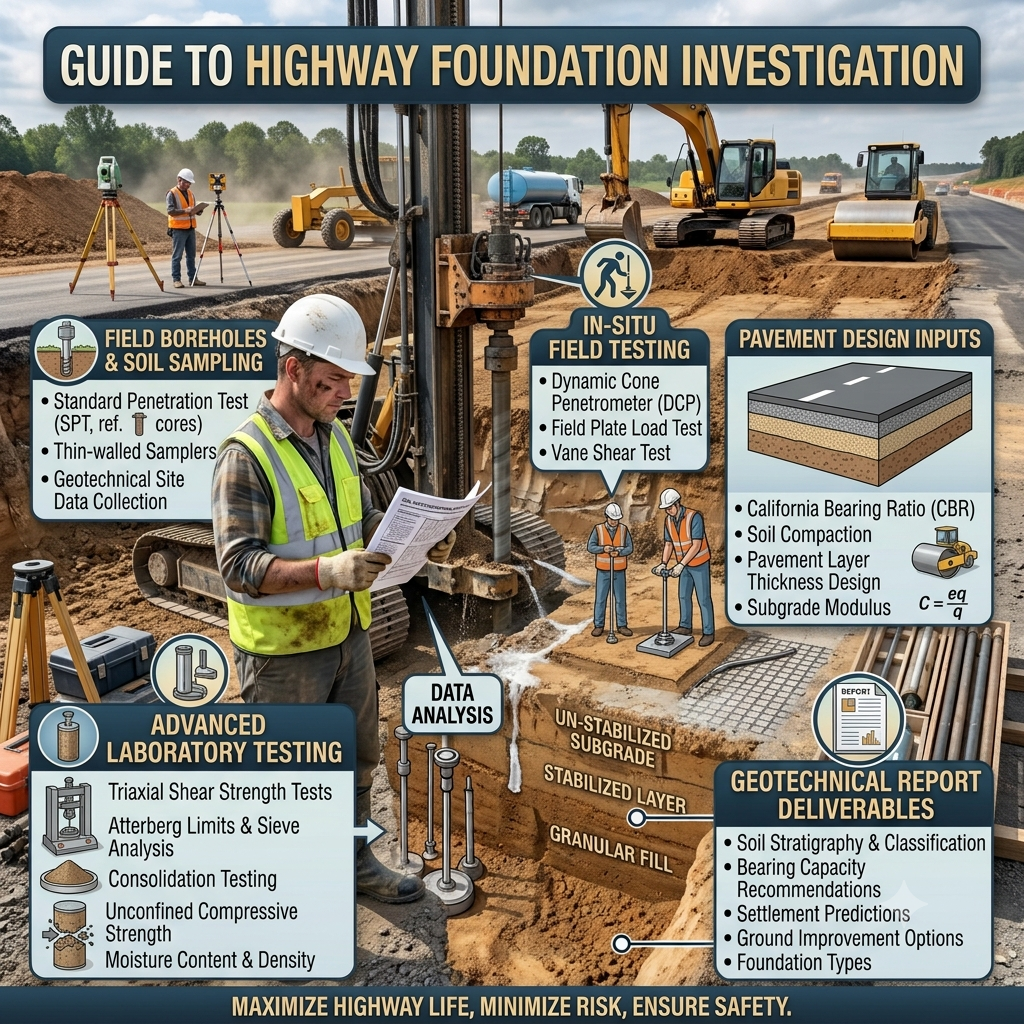
Introduction
Every durable highway begins with a strong foundation. Before engineers design pavement layers, bridges, culverts, retaining walls, or embankments, they must understand the ground that will support the entire structure. This critical process is known as Highway Foundation Investigation. It provides the information required to design safe, economical, and long-lasting transportation infrastructure.
A highway foundation investigation examines soil, rock, groundwater, and geological conditions along the proposed alignment. Engineers use the collected data to evaluate bearing capacity, settlement characteristics, slope stability, drainage conditions, and construction feasibility. Without proper investigation, a highway may experience pavement cracking, differential settlement, landslides, excessive maintenance costs, or structural failure.
Modern highway projects combine field exploration, laboratory testing, geotechnical analysis, and engineering judgment to produce reliable foundation designs. Transportation agencies around the world also emphasize detailed site investigations because accurate geotechnical data reduces construction risks and improves long-term pavement performance.
This guide explains every essential aspect of Highway Foundation Investigation, including engineering principles, field procedures, practical applications, and industry best practices for civil engineers, contractors, and engineering students.
What is Highway Foundation Investigation?
Highway Foundation Investigation is the systematic process of collecting, testing, and analyzing subsurface information before designing and constructing a highway. It enables engineers to understand the engineering behavior of soil and rock beneath the proposed roadway.
The investigation identifies:
- Soil type
- Rock profile
- Groundwater level
- Bearing capacity
- Compressibility
- Shear strength
- Settlement characteristics
- Drainage conditions
- Potential geotechnical hazards
The collected information supports the design of:
- Highway embankments
- Pavement foundations
- Bridges
- Culverts
- Retaining walls
- Slope stabilization systems
A thorough investigation reduces uncertainty and provides a solid foundation for safe highway construction.
Objectives of Highway Foundation Investigation
Every investigation aims to collect accurate information that supports efficient engineering design and construction.
Primary Objectives
- Determine the engineering properties of soil and rock.
- Evaluate foundation bearing capacity.
- Identify weak or problematic ground conditions.
- Estimate expected settlement.
- Assess groundwater conditions.
- Recommend suitable foundation solutions.
- Support pavement thickness design.
- Reduce construction risks and unexpected costs.
Practical Example
Suppose a proposed highway passes through an area containing soft clay deposits. The investigation may reveal low bearing capacity and high compressibility. Engineers can then recommend soil stabilization, geosynthetics, or ground improvement techniques before construction begins.
Without this information, the completed highway may develop severe settlement and pavement failure.
Why Highway Foundation Investigation is Important
The foundation carries every load transmitted from vehicles through the pavement structure. Weak ground cannot provide adequate support regardless of how strong the pavement surface appears.
A detailed investigation helps engineers:
- Improve pavement durability.
- Reduce maintenance costs.
- Prevent excessive settlement.
- Minimize slope failures.
- Improve drainage design.
- Select suitable construction methods.
- Optimize project costs.
- Enhance highway safety.
Consequences of Poor Investigation
Ignoring proper foundation investigation may result in:
- Pavement cracking
- Rutting
- Differential settlement
- Embankment instability
- Landslides
- Bridge foundation problems
- Water-related failures
- Costly reconstruction
Investing in geotechnical investigation during the planning stage often saves significant time and money throughout the highway’s service life.
Basic Engineering Principles
Highway foundation investigation relies on several fundamental geotechnical engineering principles.
Soil Mechanics
Engineers study soil behavior under different loading conditions to estimate strength, deformation, and stability.
Load Distribution
Vehicle loads transfer from the pavement surface through the base, sub-base, and subgrade to the underlying foundation. Every layer must provide adequate support to prevent excessive deformation.
Bearing Capacity
The foundation soil must safely support structural loads without experiencing shear failure or unacceptable settlement.
Settlement Analysis
Engineers estimate both immediate and long-term settlement to protect pavement performance and structural integrity.
Groundwater Control
Groundwater significantly influences soil strength and stability. High water tables may reduce bearing capacity and increase construction challenges.
Types of Highway Foundation Investigation
Different project stages require different levels of investigation.
Preliminary Investigation
Engineers conduct a preliminary investigation during project planning to understand general site conditions.
Activities include:
- Reviewing existing maps
- Studying geological reports
- Examining satellite imagery
- Visiting the proposed route
This stage identifies potential constraints and guides the detailed investigation.
Detailed Investigation
The detailed investigation provides the geotechnical data required for design.
Typical activities include:
- Borehole drilling
- Trial pits
- Soil sampling
- Rock sampling
- Laboratory testing
- Groundwater observation
- In-situ testing
Most design calculations rely on data collected during this phase.
Construction Stage Investigation
Unexpected conditions sometimes appear during construction.
Additional investigations may be required when contractors encounter:
- Hidden rock layers
- Weak soils
- High groundwater
- Sinkholes
- Buried utilities
These investigations help engineers modify designs without compromising safety.
Highway Foundation Investigation Process
Step 1: Desk Study and Project Review
Every successful investigation begins in the office before fieldwork starts.
Engineers collect available information from:
- Geological maps
- Topographic maps
- Previous investigation reports
- Aerial photographs
- Satellite imagery
- Hydrological records
- Existing utility plans
Benefits
A thorough desk study helps engineers:
- Understand regional geology.
- Identify possible hazards.
- Plan field investigations efficiently.
- Reduce unnecessary drilling.
Step 2: Site Reconnaissance
Engineers then visit the proposed highway alignment to verify information collected during the desk study.
During Site Reconnaissance Engineers Observe
- Existing roads
- Surface drainage
- Natural slopes
- Rock outcrops
- Vegetation
- Streams
- Erosion
- Existing structures
- Access routes
Practical Importance
Site reconnaissance often reveals conditions that maps cannot show, such as localized erosion, unstable slopes, or drainage problems.
These observations improve the accuracy of subsequent investigations.
Step 3: Geological Mapping
Geological mapping identifies the distribution of different soil and rock formations along the highway corridor.
Information Collected
- Soil boundaries
- Rock types
- Fault lines
- Weathered zones
- Landslide areas
- Groundwater seepage
- Natural drainage channels
Why Geological Mapping Matters
Geological information allows engineers to:
- Select stable alignments.
- Avoid problematic formations.
- Estimate excavation requirements.
- Design suitable foundations.
Step 4: Borehole Investigation
Borehole drilling provides direct information about subsurface conditions.
Engineers drill boreholes at predetermined intervals along the highway alignment.
Borehole Objectives
- Identify soil layers.
- Determine rock depth.
- Collect undisturbed soil samples.
- Measure groundwater levels.
- Perform field tests.
Typical Borehole Equipment
- Rotary drilling rigs
- Auger drills
- Core barrels
- Sampling tubes
- Water level indicators
The number and depth of boreholes depend on project size, terrain, and foundation complexity.
Step 5: Trial Pits and Test Trenches
Trial pits provide a direct visual inspection of shallow soil layers.
Unlike boreholes, they allow engineers to observe soil profiles in their natural condition.
Applications
Trial pits are commonly used for:
- Shallow foundation investigations
- Pavement rehabilitation projects
- Utility crossings
- Drainage structures
- Culvert foundations
Advantages
- Direct visual examination
- Easy soil sampling
- Rapid construction
- Cost-effective for shallow investigations
Limitations
- Limited investigation depth
- Unsuitable in high groundwater conditions
- Not appropriate for deep foundations
Highway Foundation Investigation Flow Diagram
Project Planning
        │
        ▼
Desk Study
        │
        ▼
Site Reconnaissance
        │
        ▼
Geological Mapping
        │
        ▼
Borehole Drilling
        │
        ▼
Trial Pits
        │
        ▼
In-Situ Testing
        │
        ▼
Laboratory Testing
        │
        ▼
Geotechnical Analysis
        │
        ▼
Foundation Design
Key Takeaways
A successful Highway Foundation Investigation begins with careful planning and systematic field exploration. Desk studies, site reconnaissance, geological mapping, borehole investigations, and trial pits provide the essential information needed to understand subsurface conditions. These activities enable engineers to identify weak soils, evaluate groundwater conditions, estimate bearing capacity, and develop safe foundation solutions. A well-executed investigation minimizes design uncertainty, reduces construction risks, and supports the long-term performance of highways and associated structures. These initial stages create the foundation for detailed testing, analysis, and engineering design.
Step 6: In-Situ Testing
After borehole drilling and trial pit excavation, engineers perform in-situ tests to evaluate soil strength and deformation under natural field conditions. These tests provide reliable data because they measure the soil without disturbing its original structure.
Common In-Situ Tests
Standard Penetration Test (SPT)
The Standard Penetration Test measures soil resistance by driving a split-spoon sampler into the ground using a standard hammer. Engineers use the SPT N-value to estimate soil density and bearing capacity.
Applications
- Foundation design
- Soil classification
- Settlement estimation
- Liquefaction assessment
Cone Penetration Test (CPT)
The Cone Penetration Test pushes a cone-shaped probe into the soil at a constant rate. Sensors continuously record cone resistance and sleeve friction.
Advantages
- Continuous soil profile
- Fast testing
- Accurate soil stratification
- Reliable design parameters
Plate Load Test
Engineers use the Plate Load Test to determine the bearing capacity and settlement characteristics of shallow foundations.
This test supports the design of:
- Highway embankments
- Bridge abutments
- Retaining walls
- Pavement foundations
Field Density Test
The Field Density Test confirms whether compacted soil meets the specified density requirements.
Common methods include:
- Sand Cone Method
- Nuclear Density Gauge
- Core Cutter Method (where applicable)
Proper compaction improves pavement performance and minimizes settlement.
Step 7: Groundwater Investigation
Groundwater significantly affects the behavior of soil beneath highways. Engineers evaluate groundwater conditions before finalizing the pavement and foundation design.
Information Collected
- Groundwater table depth
- Seasonal fluctuations
- Water pressure
- Flow direction
- Soil permeability
- Drainage characteristics
Why Groundwater Matters
High groundwater levels can:
- Reduce soil strength
- Increase settlement
- Cause pavement pumping
- Delay construction
- Accelerate pavement deterioration
Groundwater Control Measures
- Subsurface drainage systems
- Edge drains
- Filter layers
- Dewatering during construction
- Proper cross-drainage structures
A well-designed drainage system protects both the pavement and the underlying foundation.
Step 8: Laboratory Testing
Field samples collected during the investigation undergo laboratory testing to determine their engineering properties.
These tests provide the data required for foundation and pavement design.
Soil Tests
Grain Size Analysis
Determines the percentage of gravel, sand, silt, and clay present in the soil.
Atterberg Limits
Measures:
- Liquid Limit (LL)
- Plastic Limit (PL)
- Plasticity Index (PI)
These values help classify fine-grained soils and evaluate their engineering behavior.
Proctor Compaction Test
Determines:
- Maximum Dry Density (MDD)
- Optimum Moisture Content (OMC)
These values guide field compaction operations.
California Bearing Ratio (CBR)
The CBR test evaluates the supporting capacity of subgrade soil.
Higher CBR values generally indicate stronger pavement support.
Rock Tests
Where highways pass through rocky terrain, engineers perform tests such as:
- Uniaxial Compressive Strength
- Point Load Strength Index
- Slake Durability Test
- Rock Quality Designation (RQD)
These tests support the design of cut slopes, tunnels, and bridge foundations.
Step 9: Geotechnical Analysis
After completing field and laboratory investigations, geotechnical engineers analyze the collected data to develop safe and economical foundation recommendations.
Key Analyses
Bearing Capacity Analysis
Engineers calculate the allowable load that the soil can safely support without failure.
Settlement Analysis
This analysis estimates:
- Immediate settlement
- Consolidation settlement
- Differential settlement
Slope Stability Analysis
Engineers evaluate embankments and natural slopes to ensure long-term stability under traffic loads and rainfall conditions.
Pavement Support Evaluation
Subgrade strength data helps determine:
- Pavement thickness
- Material requirements
- Ground improvement needs
The analysis phase transforms raw data into practical engineering decisions.
Step 10: Geotechnical Investigation Report
The final deliverable of a Highway Foundation Investigation is the Geotechnical Investigation Report.
This document provides engineers, contractors, and project owners with all essential subsurface information required for construction.
Typical Contents
- Project overview
- Investigation methodology
- Borehole logs
- Geological profile
- Laboratory test results
- Groundwater observations
- Engineering analyses
- Design recommendations
- Construction precautions
A clear and well-organized report improves communication between all project stakeholders.
Highway Foundation Investigation Equipment
Field investigations require specialized equipment to obtain reliable data.
Common Equipment
- Rotary drilling rig
- Auger drilling machine
- Split-spoon sampler
- Shelby tube sampler
- Cone Penetration Test equipment
- Plate Load Test apparatus
- Water level indicator
- GPS equipment
- Total Station
- Automatic Level
- Core barrels
- Sample containers
Proper equipment selection improves the accuracy and efficiency of field investigations.
Common Foundation Problems and Engineering Solutions
| Problem | Likely Cause | Recommended Solution |
|---|---|---|
| Excessive settlement | Soft compressible soil | Soil replacement, preloading, stabilization |
| Low bearing capacity | Weak subgrade | Lime or cement stabilization, geosynthetics |
| Slope instability | Poor soil strength or steep slopes | Retaining walls, reinforced slopes, drainage |
| High groundwater | Shallow water table | Edge drains, dewatering, filter layers |
| Expansive clay | Moisture variation | Lime stabilization, moisture control |
| Erosion | Surface runoff | Riprap, vegetation, drainage channels |
Early identification of these issues significantly reduces construction delays and future maintenance costs.
Best Practices for Highway Foundation Investigation
- Begin investigations during the planning stage.
- Use qualified geotechnical professionals.
- Drill sufficient boreholes to represent site conditions.
- Combine field observations with laboratory testing.
- Monitor groundwater throughout different seasons when possible.
- Calibrate field equipment regularly.
- Record accurate borehole logs and field notes.
- Verify laboratory results before finalizing designs.
- Coordinate geotechnical findings with pavement and structural engineers.
- Update recommendations if unexpected ground conditions appear during construction.
Practical Field Recommendations
Civil Engineers
- Review borehole logs carefully before completing foundation design.
- Compare laboratory results with field observations.
- Confirm groundwater conditions before finalizing drainage design.
- Consider future traffic growth when designing pavement foundations.
Contractors
- Protect boreholes and test pits during investigation.
- Avoid disturbing sampling locations.
- Follow geotechnical recommendations during excavation.
- Report unexpected soil conditions immediately.
Engineering Students
- Learn to interpret borehole logs and soil profiles.
- Understand the purpose of each laboratory test.
- Visit geotechnical laboratories to observe testing procedures.
- Gain practical experience with field investigation equipment.
General Discussion of IRC, AASHTO, and ICE Practices
Highway agencies around the world emphasize comprehensive geotechnical investigations before construction. While project requirements differ by country, guidance from organizations such as the Indian Roads Congress (IRC), AASHTO, and the Institution of Civil Engineers (ICE) generally promotes the following principles:
- Conduct detailed subsurface investigations before design.
- Base pavement and foundation designs on reliable geotechnical data.
- Evaluate groundwater conditions throughout the project corridor.
- Carry out field and laboratory testing using recognized procedures.
- Document findings in a clear geotechnical report.
- Integrate geotechnical recommendations with drainage, pavement, and structural design.
- Review site conditions during construction and update recommendations when necessary.
Following these principles improves safety, durability, and lifecycle performance while reducing construction risks.
Frequently Asked Questions (FAQs)
1. What is Highway Foundation Investigation?
Highway Foundation Investigation is the process of exploring and evaluating soil, rock, and groundwater conditions to design safe and durable highway foundations.
2. Why is foundation investigation important before highway construction?
It identifies subsurface conditions, estimates bearing capacity, predicts settlement, and helps engineers select appropriate foundation and pavement designs.
3. Which field tests are commonly performed during a highway investigation?
Common field tests include the Standard Penetration Test (SPT), Cone Penetration Test (CPT), Plate Load Test, and Field Density Test.
4. What is the purpose of the California Bearing Ratio (CBR) test?
The CBR test measures the strength of subgrade soil and helps determine the required pavement thickness.
5. How does groundwater affect highway foundations?
Groundwater can reduce soil strength, increase settlement, weaken pavement support, and complicate construction if not managed properly.
6. What information does a geotechnical investigation report provide?
It includes borehole logs, soil profiles, laboratory test results, groundwater observations, engineering analyses, and design recommendations.
7. Which equipment is commonly used for highway foundation investigations?
Engineers use drilling rigs, augers, samplers, CPT equipment, Plate Load Test apparatus, Total Stations, GPS units, and groundwater monitoring tools.
8. How can engineers improve foundation performance in weak soils?
They may use soil stabilization, geosynthetics, controlled compaction, drainage improvements, preloading, or soil replacement depending on site conditions.
9. How often should investigations be updated during construction?
Engineers should review and update geotechnical information whenever unexpected soil conditions, groundwater changes, or design modifications occur.
10. Which organizations provide guidance for highway foundation investigations?
Organizations such as IRC, AASHTO, and ICE publish widely accepted guidance on investigation methods, geotechnical evaluation, pavement design, and construction practices.
Conclusion
A successful Highway Foundation Investigation forms the backbone of every durable and safe highway project. From desk studies and borehole drilling to in-situ testing, laboratory analysis, groundwater evaluation, and geotechnical reporting, every stage provides critical information for informed engineering decisions. Thorough investigations reduce uncertainty, prevent costly construction issues, improve pavement performance, and extend the service life of transportation infrastructure. Engineers who invest time in understanding subsurface conditions can design foundations that safely withstand traffic loads and environmental challenges for decades. Whether you are a civil engineer, contractor, or engineering student, mastering Highway Foundation Investigation strengthens your ability to deliver reliable, economical, and sustainable highway projects that meet modern engineering standards.

Kamran Malik is a passionate civil engineering writer and researcher who specializes in construction, transportation, structural engineering, and infrastructure topics. Through his articles on CivilEngineerings.com, he simplifies complex engineering concepts and shares practical insights, industry trends, and educational resources for students, professionals, and engineering enthusiasts.