
Introduction
Road intersections influence traffic flow, travel time, and road safety more than almost any other element of a transportation network. Traditional signalized and stop-controlled intersections often experience congestion, delays, and severe angle collisions, especially during peak traffic hours. Modern highway engineers increasingly recommend roundabouts because they improve traffic efficiency while reducing conflict points and vehicle speeds.
So, What is Roundabout Design? In simple terms, roundabout design is the engineering process of planning, analyzing, and constructing a circular intersection that allows vehicles to move continuously around a central island while yielding to circulating traffic. Unlike conventional intersections, a properly designed roundabout minimizes stopping, lowers crash severity, improves fuel efficiency, and enhances overall road safety.
Roundabout design requires a combination of transportation engineering, geometric design, traffic analysis, safety engineering, and environmental planning. Engineers must carefully determine the appropriate geometry, entry angles, lane configuration, central island dimensions, and vehicle paths to ensure safe and efficient traffic movement.
This guide explains What is Roundabout Design?, its components, engineering principles, types, practical applications, and the reasons why transportation agencies worldwide increasingly adopt roundabouts for modern road networks.
What is Roundabout Design?
Roundabout design is the process of planning and designing a circular intersection where vehicles travel in one direction around a central island and give priority to traffic already circulating within the roundabout.
Unlike traditional intersections controlled by traffic signals or stop signs, roundabouts encourage continuous traffic movement at lower speeds. This approach reduces delays, improves operational efficiency, and significantly decreases the likelihood of severe collisions.
A successful roundabout design balances several important objectives:
- Safe vehicle movement
- Efficient traffic flow
- Reduced vehicle delays
- Lower operating speeds
- Accommodation of large vehicles
- Safe pedestrian crossings
- Bicycle accessibility
- Long-term operational performance
The design process involves careful analysis of traffic demand, available land, vehicle characteristics, design speed, and surrounding infrastructure.
Why Roundabout Design Matters
Intersections are common locations for traffic conflicts because vehicles approach from different directions and perform various turning movements. A well-designed roundabout organizes these movements in a predictable manner, reducing conflict points and improving safety.
Key Benefits of Roundabout Design
- Improves traffic flow by reducing unnecessary stops.
- Reduces severe crashes by lowering vehicle speeds.
- Minimizes traffic delays during peak hours.
- Decreases fuel consumption and vehicle emissions.
- Enhances pedestrian safety through shorter crossing distances.
- Lowers long-term maintenance costs by eliminating signal equipment.
- Supports sustainable urban transportation.
For growing cities and expanding highway networks, roundabouts often provide a cost-effective and safer alternative to conventional intersections.
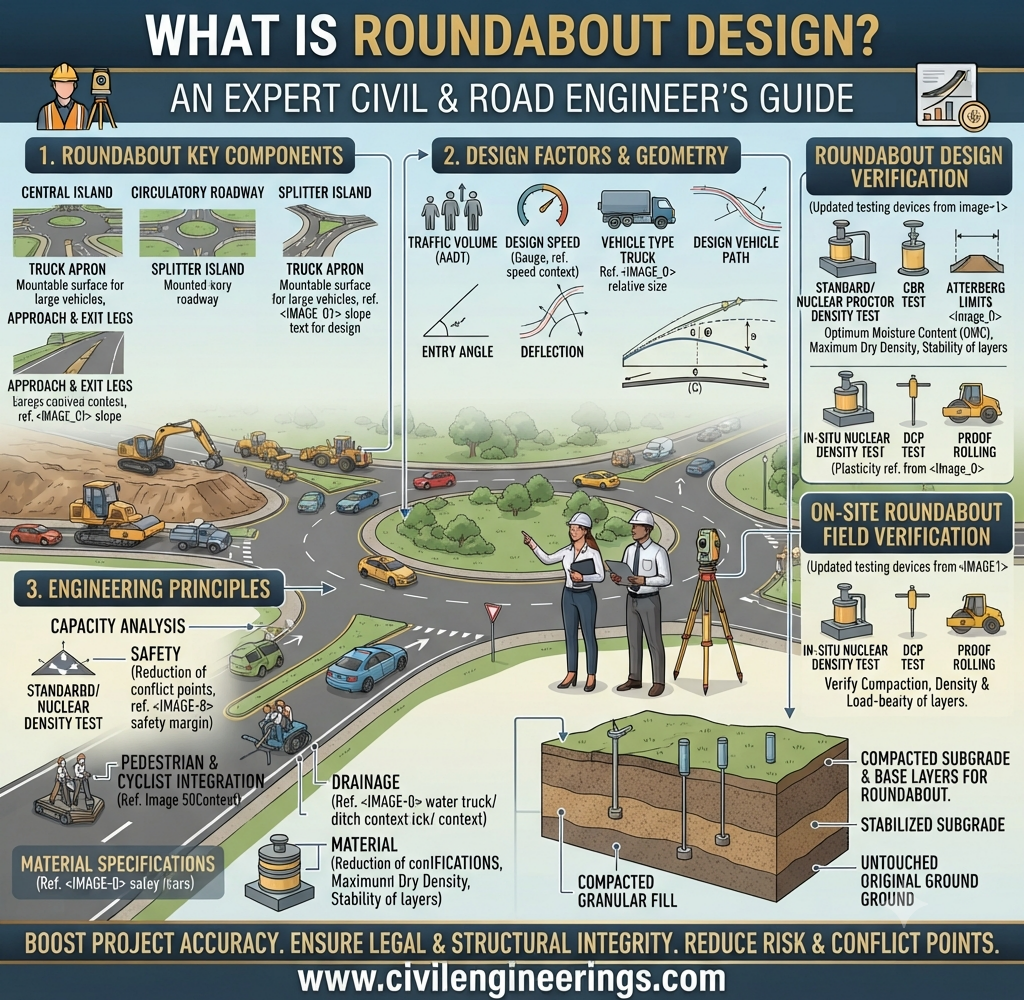
Main Components of a Roundabout
Each component of a roundabout serves a specific engineering function. Together, these elements create a safe and efficient intersection.
1. Central Island
The central island forms the core of every roundabout. Vehicles travel around this island rather than crossing through the center of the intersection.
Functions
- Controls vehicle paths.
- Reduces travel speeds.
- Guides traffic circulation.
- Provides landscaping opportunities.
- Improves driver awareness.
The island should remain highly visible and should not obstruct essential sight lines.
2. Circulatory Roadway
The circulatory roadway is the circular lane or lanes surrounding the central island.
Its width depends on:
- Traffic volume
- Design vehicle
- Number of lanes
- Expected turning movements
Engineers design this roadway to encourage smooth vehicle movement while maintaining safe operating speeds.
3. Entry and Exit Lanes
here is
Entry Design Objectives
- Reduce vehicle speed before entering.
- Provide adequate visibility.
- Create smooth merging conditions.
- Minimize conflict with circulating traffic.
Exit Design Objectives
- Allow comfortable vehicle departure.
- Prevent excessive speeds.
- Provide safe pedestrian crossings.
- Maintain traffic continuity.
Proper entry deflection is one of the most important features of modern roundabout design.
4. Splitter Islands
Splitter islands separate entering and exiting traffic.
Benefits
- Slow approaching vehicles.
- Improve driver awareness.
- Protect pedestrians.
- Organize traffic movement.
- Reduce head-on collision risk.
These islands also provide a safe refuge for pedestrians crossing one traffic direction at a time.
5. Truck Apron
Large trucks require additional turning space that passenger cars do not.
A truck apron is a slightly raised paved area surrounding the central island that accommodates the rear wheels of long vehicles while discouraging regular passenger vehicles from driving over it.
Truck aprons improve the operational performance of roundabouts serving industrial areas or freight corridors.
Types of Roundabouts
Transportation engineers select different roundabout configurations based on traffic demand, available land, and design objectives.
Mini Roundabout
Mini roundabouts are compact intersections commonly used in urban areas with limited space.
Characteristics
- Small central island
- Low construction cost
- Suitable for residential streets
- Low-speed operation
They work best where traffic volumes remain relatively low.
Single-Lane Roundabout
Single-lane roundabouts contain one circulating lane and one entry lane for each approach.
Advantages
- Simple navigation
- High safety performance
- Lower construction cost
- Reduced conflict points
- Easy maintenance
These roundabouts are widely used in suburban and rural locations.
Multi-Lane Roundabout
High-traffic corridors often require multi-lane roundabouts.
These facilities include two or more circulating lanes to accommodate greater traffic volumes.
Design Considerations
- Lane discipline
- Clear pavement markings
- Directional signs
- Appropriate lane widths
- Vehicle weaving analysis
Because of their complexity, engineers must carefully evaluate driver behavior and traffic capacity.
Turbo Roundabout
Turbo roundabouts use spiral lane arrangements that guide drivers into the correct exit lane before entering the intersection.
Benefits
- Reduced weaving
- Improved lane discipline
- Higher capacity
- Enhanced safety
- Better traffic efficiency
Turbo roundabouts have gained popularity in several countries due to their operational advantages.
Spiral Roundabout
A spiral roundabout gradually directs vehicles outward toward their intended exit.
The spiral geometry minimizes lane-changing within the circulatory roadway and improves traffic flow at busy intersections.
Engineering Principles of Roundabout Design
Successful roundabout design follows several key engineering principles.
Speed Control
Engineers intentionally reduce entry speeds through geometric design rather than relying solely on traffic signs.
Lower operating speeds reduce both crash frequency and crash severity.
Deflection
Entry alignment should force drivers to travel around the central island instead of driving directly through the intersection.
Proper deflection encourages yielding behavior and improves safety.
Capacity
Roundabouts must accommodate expected traffic demand throughout their design life.
Engineers estimate:
- Peak-hour traffic
- Turning movements
- Heavy vehicle percentage
- Future traffic growth
These factors determine lane requirements and overall geometry.
Sight Distance
Drivers must clearly see:
- Approaching vehicles
- Circulating traffic
- Pedestrians
- Cyclists
- Road signs
Adequate visibility supports safe decision-making and efficient traffic operations.
Vehicle Accommodation
Engineers design roundabouts to accommodate the largest expected design vehicle without compromising passenger vehicle safety.
Typical design vehicles include:
- City buses
- Fire trucks
- Tractor-semitrailers
- Delivery vehicles
- Agricultural equipment (where applicable)
Topic-Related Engineering Diagrams
Basic Roundabout Layout
                    Exit
                      ↑
               ─────────────
                    │
        Splitter Island
                    │
         ↖──────────────↗
      Entry        ○        Exit
                  Central
                  Island
         ↙──────────────↘
                    │
        Splitter Island
                    │
               ─────────────
                      ↓
                    Entry
Traffic Movement
        Vehicles Yield
             ↓
      ───────────────
      ↺  Circulatory  ↺
      ↺    Roadway    ↺
      ───────────────
             ↓
      Vehicles Exit
Practical Applications of Roundabout Design
Roundabouts are suitable for a wide range of transportation environments.
Common Applications
- Urban intersections
- Highway junctions
- Residential communities
- Industrial parks
- Commercial developments
- Airport access roads
- University campuses
- Hospital entrances
Real-World Example
A busy four-leg urban intersection with frequent right-angle crashes may benefit from replacing traffic signals with a single-lane roundabout. By lowering entry speeds and eliminating direct crossing conflicts, the roundabout can improve traffic flow, reduce injury crashes, and decrease vehicle delays without relying on signal control.
Key Takeaways
Understanding What is Roundabout Design? begins with recognizing that it is far more than creating a circular intersection. Effective roundabout design combines geometric design, traffic engineering, safety analysis, and operational planning to manage vehicle movements efficiently while minimizing conflict points. Key elements such as the central island, circulatory roadway, splitter islands, truck apron, and carefully designed entry and exit geometry work together to improve safety, reduce congestion, and support long-term transportation performance. Selecting the appropriate type of roundabout and applying sound engineering principles lays the foundation for a successful project.
Step-by-Step Roundabout Design Process
Designing a roundabout requires a systematic engineering approach. Each stage builds on the previous one to ensure that the final intersection operates safely, efficiently, and sustainably throughout its design life.
Step 1: Traffic Data Collection
The process begins with collecting accurate traffic information.
Engineers gather:
- Average Daily Traffic (ADT)
- Peak Hour Volume (PHV)
- Turning movement counts
- Heavy vehicle percentage
- Pedestrian and cyclist volumes
- Future traffic growth forecasts
Reliable traffic data allows engineers to estimate the capacity requirements and determine whether a roundabout is the most suitable intersection type.
Step 2: Site Investigation
A detailed site investigation provides information about existing conditions.
The investigation includes:
- Topographic survey
- Utility mapping
- Soil investigation
- Drainage assessment
- Existing road geometry
- Nearby buildings and property boundaries
Engineers also identify constraints such as bridges, overhead utilities, pipelines, and environmentally sensitive areas.
Step 3: Select the Appropriate Roundabout Type
Traffic demand and available land determine the most suitable roundabout configuration.
Typical options include:
- Mini Roundabout
- Single-Lane Roundabout
- Multi-Lane Roundabout
- Turbo Roundabout
- Spiral Roundabout
Each option offers different operational and safety characteristics.
Step 4: Geometric Design
Geometric design forms the core of the project.
Engineers determine:
- Inscribed Circle Diameter (ICD)
- Central island size
- Entry width
- Exit width
- Circulatory roadway width
- Entry curvature
- Exit curvature
- Splitter island dimensions
- Truck apron width
Every dimension influences operating speed and traffic performance.
Step 5: Capacity Analysis
Capacity analysis confirms that the proposed design can accommodate both current and future traffic demand.
Engineers evaluate:
- Entry capacity
- Delay
- Queue length
- Degree of saturation
- Peak-hour performance
- Future expansion requirements
Computer simulation software often assists in evaluating different design alternatives.
Step 6: Safety Assessment
Safety remains the highest priority during roundabout design.
Engineers review:
- Sight distance
- Pedestrian crossings
- Bicycle accommodation
- Speed consistency
- Lighting
- Signage
- Road markings
- Conflict points
Any safety deficiencies are corrected before finalizing the design.
Step 7: Drainage Design
Water must never accumulate inside a roundabout.
Engineers design drainage systems that quickly remove stormwater through:
- Side drains
- Catch basins
- Kerb inlets
- Underground pipes
- Cross drainage structures
Proper drainage protects pavement layers and improves driving safety.
Step 8: Final Design and Construction Drawings
The final design package includes:
- Plan drawings
- Cross-sections
- Pavement details
- Signage plans
- Lighting layout
- Landscape design
- Bill of Quantities (BOQ)
- Construction specifications
These documents guide contractors during construction.
Capacity Analysis in Roundabout Design
Capacity analysis determines whether the roundabout can handle expected traffic volumes while maintaining acceptable levels of service.
Factors Affecting Capacity
- Entry flow
- Circulating traffic
- Entry angle
- Lane width
- Heavy vehicle percentage
- Pedestrian activity
- Driver behavior
Higher circulating traffic generally reduces entry capacity because entering vehicles must yield.
Methods Used
Transportation engineers commonly use:
- Traffic simulation software
- Gap acceptance analysis
- Capacity models
- Peak-hour traffic forecasting
Accurate capacity analysis helps prevent congestion and ensures efficient operation.
Safety Considerations in Roundabout Design
One of the greatest advantages of roundabouts is their ability to reduce severe crashes.
Key Safety Features
- Lower vehicle speeds
- Fewer conflict points
- Reduced head-on collisions
- Elimination of high-speed right-angle crashes
- Improved pedestrian refuge
- Better driver awareness
Pedestrian Safety
Safe pedestrian design includes:
- Setback crossings
- Splitter islands
- Clear pavement markings
- Adequate lighting
- Tactile paving for visually impaired users
Cyclist Safety
Engineers may provide:
- Shared traffic lanes
- Dedicated bicycle ramps
- Shared-use pathways
- Bicycle bypass routes where appropriate
General Discussion of IRC, AASHTO, and ICE Guidance
Although design requirements vary by country and project type, recognized organizations such as the Indian Roads Congress (IRC), the American Association of State Highway and Transportation Officials (AASHTO), and the Institution of Civil Engineers (ICE) promote several common engineering principles for roundabout design.
These generally include:
- Selecting a design speed that encourages safe vehicle operation.
- Providing sufficient entry deflection to control approach speeds.
- Designing for the largest expected vehicle while maintaining safety for passenger cars.
- Ensuring adequate visibility at all approaches.
- Accommodating pedestrians and cyclists through dedicated facilities where required.
- Providing efficient surface drainage to protect pavement performance.
- Using clear pavement markings, directional signs, and lighting to improve driver guidance.
- Applying consistent quality control during design and construction.
These principles support safe, durable, and efficient roundabout operation across a wide range of traffic conditions.
Best Practices for Roundabout Design
Successful roundabout projects typically follow these best practices:
- Begin with detailed traffic and site investigations.
- Select the appropriate roundabout type for projected traffic demand.
- Maintain consistent operating speeds through geometric design.
- Design for heavy vehicles without compromising passenger vehicle safety.
- Provide highly visible pedestrian crossings.
- Install effective drainage systems.
- Use durable pavement materials and quality construction techniques.
- Include clear signage and pavement markings.
- Plan landscaping without obstructing sight distance.
- Conduct post-construction safety audits and operational reviews.
Practical Recommendations
Civil Engineers
- Verify traffic forecasts before finalizing the layout.
- Review swept-path analyses for large design vehicles.
- Coordinate closely with utility and drainage engineers.
- Perform independent road safety audits before construction.
Contractors
- Follow approved geometric layouts accurately.
- Maintain pavement tolerances during construction.
- Install signs and markings according to project specifications.
- Protect completed pavement from premature traffic loading.
Engineering Students
- Learn the relationship between geometry and vehicle speed.
- Study real-world roundabout layouts using aerial imagery.
- Practice vehicle swept-path analysis.
- Understand the purpose of each roundabout component before designing one.
Common Design Mistakes to Avoid
- Selecting an undersized inscribed circle diameter.
- Providing insufficient entry deflection.
- Ignoring future traffic growth.
- Designing inadequate drainage.
- Creating poor pedestrian crossing locations.
- Installing unclear road signs.
- Failing to accommodate large vehicles.
- Obstructing sight distance with landscaping or street furniture.
- Using inconsistent pavement markings.
Avoiding these mistakes improves both safety and operational performance.
Frequently Asked Questions (FAQs)
1. What is roundabout design?
Roundabout design is the engineering process of planning a circular intersection that safely manages traffic through controlled geometry, yielding rules, and continuous vehicle movement.
2. Why are roundabouts safer than traditional intersections?
Roundabouts reduce conflict points, lower vehicle speeds, and eliminate high-speed crossing movements, which significantly decreases the severity of crashes.
3. What is the purpose of the central island?
The central island guides traffic around the intersection, controls vehicle speeds, and improves traffic circulation.
4. When should engineers choose a multi-lane roundabout?
A multi-lane roundabout is appropriate where traffic volumes exceed the capacity of a single-lane design and sufficient space is available.
5. What is the function of a truck apron?
A truck apron provides additional turning space for large vehicles while discouraging passenger cars from using it.
6. How does entry deflection improve safety?
Entry deflection forces drivers to slow down before entering the circulatory roadway, reducing collision risks and encouraging proper yielding behavior.
7. What factors influence roundabout capacity?
Traffic volume, circulating flow, lane configuration, heavy vehicle percentage, entry geometry, and pedestrian activity all affect capacity.
8. Are roundabouts suitable for pedestrians?
Yes. Properly designed roundabouts include splitter islands, clearly marked crossings, adequate lighting, and shorter crossing distances that improve pedestrian safety.
9. What software is commonly used for roundabout analysis?
Engineers often use traffic simulation and intersection analysis software to evaluate capacity, delay, queue lengths, and vehicle movements before construction.
10. Which standards guide roundabout design?
Many highway authorities follow nationally adopted guidance. Commonly referenced engineering principles come from organizations such as IRC, AASHTO, and ICE, adapted to local regulations and project requirements.
Conclusion
Understanding What is Roundabout Design? is essential for developing safe, efficient, and sustainable road intersections. A well-designed roundabout combines traffic engineering, geometric design, drainage planning, safety analysis, and practical construction techniques to create an intersection that minimizes delays while reducing the likelihood and severity of collisions. Every design decision—from selecting the appropriate roundabout type to determining entry geometry, central island dimensions, and pedestrian facilities—directly influences long-term operational performance. By following established engineering principles, conducting thorough traffic studies, and applying sound construction practices, engineers can deliver roundabouts that accommodate present and future traffic demands. For civil engineers, contractors, and engineering students, mastering What is Roundabout Design? strengthens technical knowledge and supports the successful planning, design, and construction of modern transportation infrastructure that serves communities safely and efficiently for many years.
