
Introduction
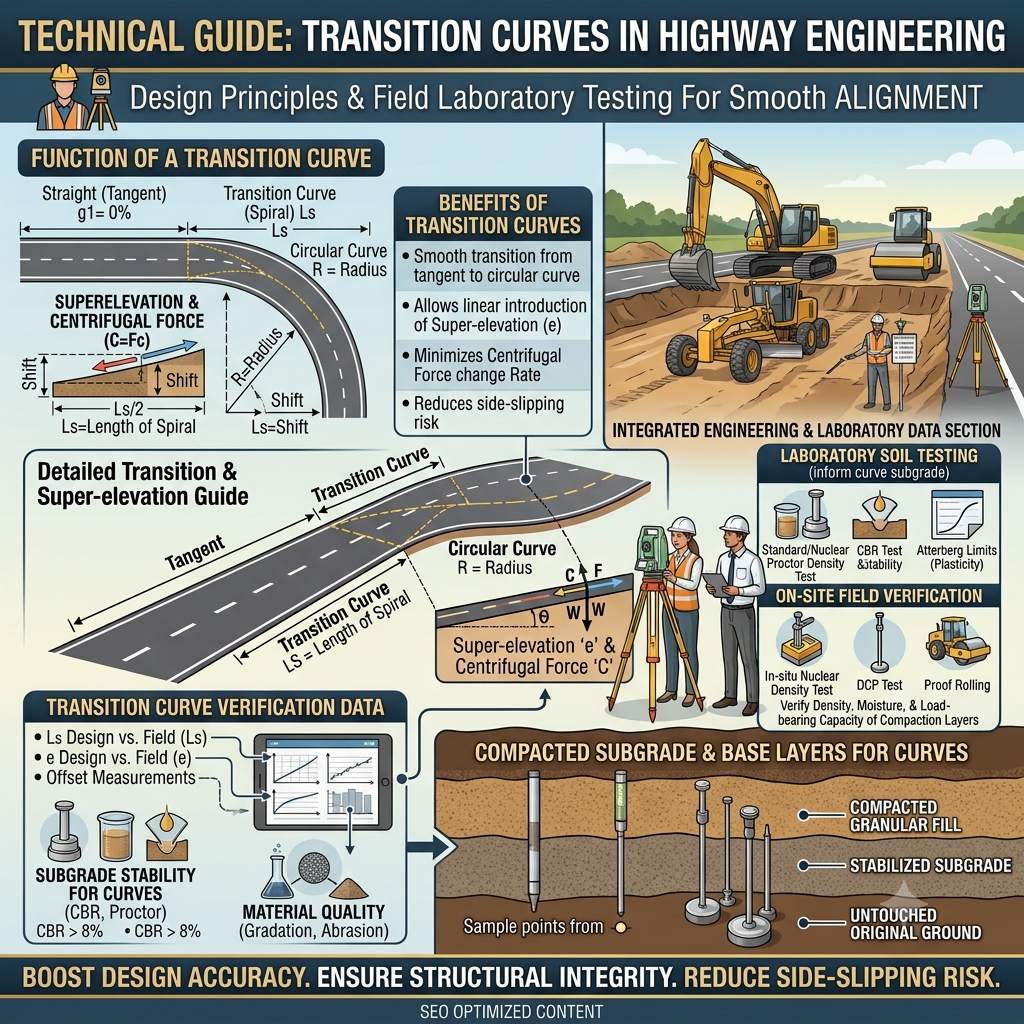
Roads rarely change direction abruptly. Engineers introduce smooth geometric elements that gradually guide vehicles from a straight path into a circular curve. These elements are known as Transition Curves. They improve driving comfort, increase road safety, reduce vehicle wear, and enhance the overall performance of highway alignments.
A well-designed transition curve allows centrifugal force to develop progressively instead of appearing suddenly. Drivers experience a smoother steering movement, passengers enjoy greater comfort, and vehicles maintain better stability throughout the curve. Modern highway and railway projects rely on transition curves because they reduce accident risks and improve operational efficiency.
Understanding Transition Curves is essential for civil engineers, transportation engineers, surveyors, highway designers, contractors, and engineering students. This guide explains the concept, engineering principles, types, practical applications, and best practices used in modern road engineering.
What Are Transition Curves?
A Transition Curve is a curve of continuously changing radius that connects a straight section of road (tangent) with a circular curve. It provides a gradual change in curvature, allowing vehicles to move smoothly from straight-line travel into a curved alignment.
Unlike a simple circular curve, which has a constant radius, a transition curve begins with an infinite radius at the tangent and gradually decreases until it matches the radius of the circular curve.
Definition
A transition curve is a geometric curve whose radius changes progressively from infinity to the design radius of the circular curve, ensuring a smooth change in vehicle motion.
Basic Layout
Straight Road
──────────────────────────────\
                               \
                                \
                                 ) Transition Curve
                                  )
                                   )
                                    ) Circular Curve
                                   (
                                  (
This gradual change prevents sudden steering corrections and improves vehicle stability.
Why Transition Curves Are Important
Road users expect smooth and predictable changes in direction. A sudden connection between a straight road and a circular curve can create discomfort and increase the likelihood of vehicle instability.
Transition curves solve this problem by introducing curvature gradually.
Major Benefits
- Improve driving comfort.
- Reduce steering shock.
- Minimize sudden centrifugal force.
- Enhance vehicle stability.
- Increase passenger comfort.
- Improve road safety.
- Reduce pavement edge stress.
- Extend pavement life.
- Lower maintenance requirements.
- Support higher design speeds.
For highways carrying heavy commercial traffic, transition curves are especially important because large vehicles require more distance to adjust to changing directions.
Objectives of Transition Curves
Every transition curve serves several engineering purposes.
1. Gradual Introduction of Centrifugal Force
As a vehicle enters a curve, centrifugal force increases. A transition curve allows this force to build progressively rather than instantly.
2. Smooth Steering Movement
Drivers can turn the steering wheel gradually, reducing sudden vehicle movements.
3. Development of Superelevation
Engineers use transition curves to introduce superelevation progressively. This ensures the pavement cross slope changes smoothly without causing discomfort.
4. Improved Safety
Gradual curvature helps drivers maintain better control, particularly at higher speeds and during adverse weather conditions.
5. Better Ride Quality
Passengers experience fewer lateral jerks because the change in direction occurs progressively.
Engineering Principles Behind Transition Curves
Transition curve design is based on several fundamental highway engineering principles.
Progressive Curvature
Curvature should increase continuously from zero at the tangent to the full curvature of the circular curve.
Gradual Change in Centrifugal Force
The rate of increase in centrifugal force must remain within acceptable limits to ensure passenger comfort and vehicle stability.
Superelevation Development
The road surface should gradually rotate from the normal cross slope to the full superelevation over the length of the transition curve.
Driver Comfort
Steering adjustments should occur naturally without abrupt corrections.
Vehicle Dynamics
A properly designed transition curve considers:
- Vehicle speed
- Curve radius
- Side friction
- Superelevation
- Driver reaction
- Vehicle stability
Together, these factors create a safe and comfortable driving environment.
Types of Transition Curves
Highway engineers use different types of transition curves depending on project requirements, terrain, and design standards.
1. Spiral (Clothoid) Curve
The spiral, also known as the Clothoid, is the most widely used transition curve in highway engineering.
Its radius decreases uniformly from infinity to the radius of the circular curve.
Characteristics
- Smooth curvature development
- Uniform rate of change
- Easy superelevation design
- Suitable for high-speed highways
- Excellent riding comfort
Applications
- Expressways
- Motorways
- National highways
- Railway alignments
- Airport taxiways
Diagram
Tangent
──────────────\
               \
                \
                 \
                  )
                   )
                    ) Circular Curve
Because of its smooth geometry, the clothoid remains the preferred choice for modern highway design.
2. Cubic Parabola
The cubic parabola is another transition curve used in highway and railway engineering.
Its mathematical equation makes field setting relatively straightforward.
Advantages
- Simple calculations
- Easy surveying
- Smooth vehicle movement
- Suitable for medium-speed roads
Typical Uses
- Rural highways
- Secondary roads
- Rail track transitions
Although modern software has increased the popularity of spiral curves, cubic parabolas remain useful for many practical projects.
3. Lemniscate Curve
The lemniscate curve provides a gradual change in curvature and performs well on sharp horizontal curves.
Features
- Smooth curvature variation
- Good riding comfort
- Efficient for specific alignment conditions
- Suitable where sharper directional changes are required
Applications
- Mountain roads
- Hilly terrain
- Railway engineering
- Urban intersections with geometric constraints
Engineers generally select this curve when site conditions make other transition curves less suitable.
Comparison of Common Transition Curves
| Feature | Spiral (Clothoid) | Cubic Parabola | Lemniscate |
|---|---|---|---|
| Smoothness | Excellent | Very Good | Good |
| Highway Use | Very Common | Moderate | Limited |
| Railway Use | Excellent | Good | Good |
| Survey Simplicity | Moderate | Easy | Moderate |
| High-Speed Roads | Excellent | Good | Fair |
Practical Applications of Transition Curves
Transition curves appear in many transportation projects.
Highway Engineering
Engineers use transition curves to connect tangents with horizontal curves on:
- Expressways
- National highways
- State highways
- Urban arterial roads
Railway Engineering
Railway designers install transition curves to reduce lateral forces on tracks and improve passenger comfort.
Airport Engineering
Airport taxiways and runways often include transition curves to provide smooth aircraft movement.
Mountain Roads
Transition curves improve safety by helping vehicles negotiate winding roads more comfortably.
Real-World Example
Consider a four-lane highway with a design speed of 100 km/h. Without a transition curve, drivers would encounter an immediate change from straight travel to a circular curve, causing sudden steering input and rapid development of centrifugal force.
By introducing a properly designed transition curve, the roadway allows:
- Progressive steering adjustments.
- Gradual development of centrifugal force.
- Smooth application of superelevation.
- Better vehicle stability.
- Improved passenger comfort.
- Reduced tyre and pavement wear.
This example highlights why transition curves are a standard feature in modern highway design.
Key Takeaways
Transition Curves are essential geometric elements that connect straight roads to circular curves through a gradual change in curvature. They improve safety, enhance driving comfort, support smooth superelevation development, and reduce stresses on vehicles and pavements. Among the various types, the spiral (clothoid) curve remains the preferred option for high-speed highways because it provides the most uniform transition. Understanding the objectives, engineering principles, and applications of transition curves forms the foundation for designing safe, efficient, and durable transportation infrastructure.
Design Criteria for Transition Curves
Designing a transition curve requires engineers to balance safety, comfort, vehicle dynamics, and construction feasibility. Every design decision should provide a smooth driving experience while meeting highway standards.
Key Design Factors
Engineers evaluate several parameters before selecting the length and geometry of a transition curve.
Design Speed
Higher vehicle speeds require longer transition curves because drivers need more distance to adjust their steering gradually.
Radius of Circular Curve
A smaller curve radius produces greater centrifugal force. Engineers compensate by increasing the transition length where necessary.
Superelevation
The transition curve provides sufficient distance to introduce superelevation gradually. This gradual rotation improves vehicle stability and driver comfort.
Side Friction
Engineers control the rate of lateral friction between tyres and the pavement to reduce skidding risks and improve handling.
Traffic Composition
Roads carrying a large percentage of heavy vehicles often require more conservative transition curve designs because trucks and buses respond differently to steering changes than passenger cars.
Length of Transition Curve
The length of a transition curve is one of the most important design considerations. An inadequate length may cause uncomfortable steering movements and excessive lateral acceleration, while an unnecessarily long curve can increase construction costs.
Factors Affecting Transition Length
- Design speed
- Radius of the circular curve
- Rate of change of centrifugal acceleration
- Rate of superelevation development
- Terrain conditions
- Highway classification
- Design standards
General Engineering Principle
As the design speed increases, the transition curve length should also increase. Likewise, tighter horizontal curves usually require longer transitions to maintain smooth vehicle movement.
Practical Example
A national highway designed for high-speed traffic requires a much longer transition curve than a local access road because vehicles approach the curve at higher speeds and need additional distance to change direction safely.
Superelevation Development
Superelevation is the practice of raising the outer edge of the roadway on horizontal curves to counteract centrifugal force.
Transition curves provide the ideal location for developing superelevation because the pavement cross slope changes progressively instead of abruptly.
Objectives of Superelevation
- Improve vehicle stability
- Reduce lateral skidding
- Increase passenger comfort
- Minimize tyre wear
- Enhance safety during wet weather
Development Process
- Begin with the normal road camber.
- Gradually rotate the pavement across the transition curve.
- Achieve full superelevation before the circular curve begins.
- Reverse the process when exiting the curve.
Simple Superelevation Diagram
Normal Road Surface

──────────────

Transition Curve

─────────────╱

Circular Curve

────────────╱
A gradual change in cross slope prevents sudden body roll and improves the overall driving experience.
Extra Widening on Curves
Vehicles occupy more pavement width while negotiating horizontal curves because the rear wheels follow a different path from the front wheels. Engineers often provide extra widening along curved sections to maintain safe clearance.
Reasons for Extra Widening
- Off-tracking of heavy vehicles
- Driver steering variations
- Improved overtaking safety
- Better clearance between opposing traffic
Applications
Extra widening is commonly provided on:
- Mountain roads
- Sharp horizontal curves
- Narrow carriageways
- High-volume freight corridors
Proper widening improves operational safety and reduces the risk of side-swipe collisions.
Practical Applications of Transition Curves
Transition curves play a significant role in several transportation engineering projects.
Highways
Modern highways use transition curves to improve comfort, safety, and pavement performance.
Examples
- National highways
- Expressways
- Ring roads
- Bypass roads
- Urban arterial roads
Railways
Railway engineers use transition curves to reduce lateral forces on train wheels and rails. Smooth transitions improve passenger comfort and reduce track maintenance.
Airport Taxiways
Aircraft require gradual directional changes during ground movement. Transition curves help pilots steer safely while reducing tyre wear.
Mountain Roads
Steep terrain often limits alignment options. Transition curves help vehicles negotiate winding roads safely by introducing curvature gradually.
Advantages of Transition Curves
Transition curves provide numerous engineering and operational benefits.
Safety Advantages
- Reduce sudden steering movements
- Improve vehicle control
- Lower accident risk
- Enhance driver confidence
Comfort Advantages
- Reduce lateral jerks
- Improve ride quality
- Increase passenger comfort
Structural Advantages
- Reduce pavement edge stresses
- Minimize tyre wear
- Extend pavement life
- Lower maintenance costs
Operational Advantages
- Support higher design speeds
- Improve traffic flow
- Enhance overall highway performance
Limitations of Transition Curves
Although transition curves offer significant advantages, engineers should also recognize their limitations.
- Require additional land in some locations
- Increase design complexity
- Demand accurate surveying
- Raise construction costs in constrained areas
- Need careful superelevation design
- Require precise field layout
Good planning and modern surveying techniques help overcome most of these challenges.
Common Design Mistakes
Engineers should avoid the following errors when designing transition curves:
- Selecting an insufficient transition length
- Ignoring traffic growth projections
- Developing superelevation too quickly
- Using inaccurate survey data
- Neglecting drainage requirements
- Failing to consider heavy vehicle operations
- Applying inconsistent geometric standards
- Omitting field verification before construction
Avoiding these mistakes improves highway safety and long-term pavement performance.
Best Practices
Successful highway projects follow several proven practices when designing transition curves.
- Conduct accurate topographic and geotechnical surveys.
- Use reliable traffic data during geometric design.
- Match transition length to design speed and curve radius.
- Introduce superelevation gradually.
- Provide adequate drainage throughout the curve.
- Verify field layout before construction.
- Perform regular quality checks during construction.
- Consider future traffic growth and road widening.
- Coordinate geometric design with pavement and drainage design.
- Follow recognized highway engineering standards.
Practical Recommendations
Civil Engineers
- Check geometric consistency throughout the alignment.
- Review transition lengths carefully during design.
- Coordinate with drainage and pavement designers.
- Verify survey control points before construction.
Contractors
- Follow approved construction drawings precisely.
- Maintain correct pavement cross slopes during construction.
- Protect survey control points throughout the project.
- Ensure accurate staking before paving operations.
Engineering Students
- Master the relationship between transition curves and superelevation.
- Practice horizontal curve calculations regularly.
- Visit highway construction sites to observe curve layout.
- Study real design drawings and alignment plans.
General Discussion of IRC, AASHTO, and ICE Practices
Recognized highway engineering organizations such as IRC (Indian Roads Congress), AASHTO (American Association of State Highway and Transportation Officials), and the Institution of Civil Engineers (ICE) emphasize consistent geometric design principles for horizontal alignment.
These organizations generally recommend:
- Providing transition curves wherever design speed and curve geometry require gradual steering changes.
- Selecting transition lengths based on vehicle dynamics, design speed, and curve radius.
- Introducing superelevation progressively along the transition.
- Maintaining adequate sight distance throughout the alignment.
- Coordinating geometric design with drainage, pavement, and safety features.
- Applying rigorous quality control during surveying and construction.
Although specific numerical requirements vary between standards, all three organizations prioritize safety, driver comfort, and long-term pavement performance.
Frequently Asked Questions (FAQs)
1. What is a transition curve in highway engineering?
A transition curve connects a straight road to a circular curve through a gradually changing radius, allowing vehicles to enter and leave curves smoothly.
2. Why are transition curves necessary?
They improve safety, reduce steering shock, support gradual superelevation, and enhance passenger comfort.
3. Which transition curve is most commonly used?
The spiral (clothoid) curve is the most widely used because it provides a uniform rate of change in curvature.
4. Where are transition curves used?
Engineers use transition curves on highways, railways, airport taxiways, mountain roads, and urban road networks.
5. How does a transition curve improve road safety?
It reduces sudden lateral acceleration, improves steering control, minimizes skidding risk, and provides smoother vehicle movement.
6. What factors affect the length of a transition curve?
Key factors include design speed, curve radius, superelevation, side friction, terrain, traffic composition, and applicable design standards.
7. What is the relationship between transition curves and superelevation?
The transition curve provides the distance required to introduce and remove superelevation gradually, ensuring a comfortable and safe change in roadway cross slope.
8. Do low-speed roads always require transition curves?
Not always. On very low-speed roads with large curve radii, a simple circular curve may provide satisfactory performance. Engineers determine the need based on design standards and project requirements.
9. Can transition curves reduce pavement maintenance?
Yes. Smooth vehicle movement lowers dynamic loads on the pavement, reducing edge stresses, tyre wear, and long-term maintenance needs.
10. Which standards provide guidance for transition curve design?
Highway engineers commonly refer to guidance from organizations such as IRC, AASHTO, and ICE, along with local highway authority standards.
Conclusion
Transition Curves are fundamental elements of modern highway and railway geometry because they provide a smooth and gradual connection between straight sections and circular curves. Their thoughtful design improves vehicle stability, enhances passenger comfort, reduces steering effort, and supports the safe development of superelevation. Engineers also use transition curves to minimize pavement stresses, reduce tyre wear, and improve the overall efficiency of transportation networks.
Whether designing an urban roadway, an expressway, or a mountainous highway, careful consideration of transition curve length, curvature, traffic characteristics, and roadway geometry leads to safer and more durable infrastructure. By applying recognized engineering practices and following guidance from organizations such as IRC, AASHTO, and ICE, designers can create alignments that deliver long-term performance, operational reliability, and a comfortable driving experience. A thorough understanding of Transition Curves remains essential for civil engineers, highway designers, contractors, and students who aim to build safe, efficient, and sustainable transportation systems.
