
Introduction
A pavement can look acceptable from a distance while its structural condition is quietly deteriorating underneath. Repeated axle loads, water infiltration, temperature changes, oxidation, cracking, rutting, and surface wear gradually reduce ride quality and pavement life. Reconstructing the entire roadway can solve these problems, but it is often expensive, disruptive, and time-consuming. This is where an asphalt overlay becomes an important pavement rehabilitation strategy.
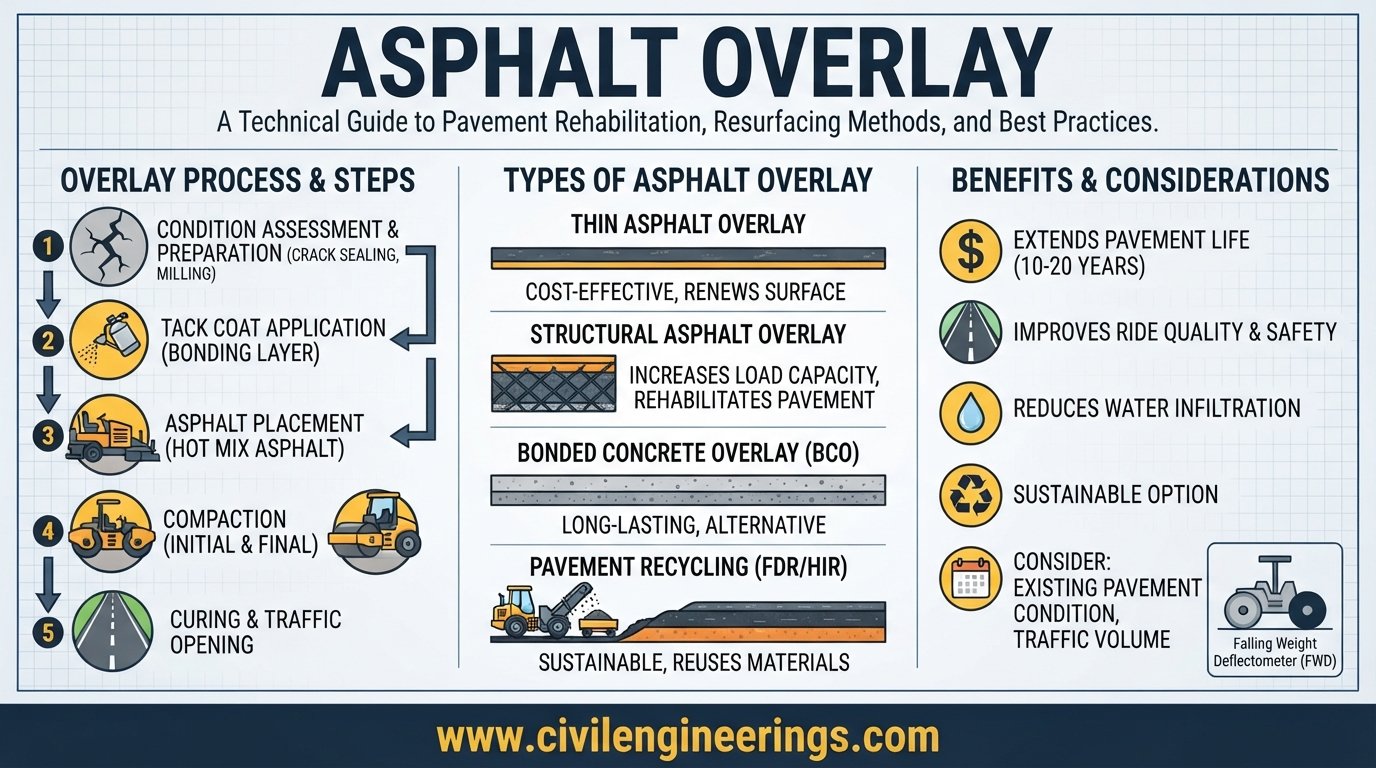
An asphalt overlay involves placing a new asphalt layer over an existing pavement after evaluating and, where necessary, repairing the underlying structure. Depending on pavement condition, the treatment can restore smoothness and skid resistance, correct surface defects, improve structural capacity, or extend service life.
A successful overlay, however, is much more than simply placing hot-mix asphalt over an old road. Engineers must understand existing pavement distress, traffic loading, drainage, layer condition, material properties, milling requirements, overlay thickness, interface bonding, and construction quality.
This guide explains asphalt overlay principles from an engineering and construction perspective, including evaluation, design considerations, thickness selection, preparation, construction procedures, common failures, quality control, and practical recommendations.
What Is an Asphalt Overlay?
An asphalt overlay is a new asphalt pavement layer constructed over an existing pavement to restore or improve its functional and, in suitable cases, structural performance.
The existing pavement may consist of:
- Asphalt pavement
- Asphalt over granular layers
- Asphalt over concrete
- Composite pavement
- Previously overlaid pavement
The overlay can be relatively thin when the primary objective is pavement preservation or surface improvement. A thicker structural overlay may be required when the existing pavement needs additional load-carrying capacity.
FHWA distinguishes structural asphalt overlays from thin, non-structural overlays. Structural overlays are generally thicker and can increase or restore structural capacity, while thin overlays may primarily address functional deficiencies. (Federal Highway Administration)
Basic Asphalt Overlay Cross Section
A typical flexible pavement rehabilitation section may look like:
        NEW ASPHALT OVERLAY
  ─────────────────────────────
        Existing Asphalt
  ─────────────────────────────
        Base Course
  ─────────────────────────────
        Subbase
  ─────────────────────────────
        Compacted Subgrade
The actual arrangement varies according to pavement type, existing distress, traffic, climate, drainage, and design requirements.
Why Asphalt Overlay Is Used
Engineers commonly consider an overlay when the pavement still has sufficient underlying structural integrity but requires rehabilitation.
Typical objectives include:
- Improving riding quality
- Restoring surface friction
- Correcting minor surface deterioration
- Increasing pavement structural capacity
- Reducing water penetration
- Extending pavement service life
- Correcting localized rutting after appropriate preparation
- Improving pavement appearance
- Reducing user disruption compared with reconstruction
Overlay solutions can also be targeted toward high-demand locations such as intersections, ramps, bus lanes, and heavily trafficked sections. FHWA notes that modern asphalt mixtures, including SMA and polymer-modified asphalt, can improve resistance to rutting and cracking when appropriately selected. (Federal Highway Administration)
When Should an Asphalt Overlay Be Used?
Overlay selection should begin with pavement evaluation rather than thickness selection.
A pavement that only needs surface renewal can receive a very different treatment from one with extensive structural failure.
Pavement Conditions Suitable for Overlay
An overlay may be appropriate when:
- Existing pavement has adequate residual structural capacity.
- Distress is primarily surface-related.
- Cracking can be treated or controlled.
- Localized failures can be repaired before overlay.
- Drainage is functioning adequately.
- The subgrade remains reasonably stable.
- Rutting is within manageable limits.
- The proposed overlay can accommodate existing elevations.
- Traffic loading can be supported by the rehabilitated pavement.
FHWA identifies structural overlays as a rehabilitation technique that can restore serviceability and increase pavement strength. (Federal Highway Administration)
Conditions That May Require More Than an Overlay
An overlay should not be treated as a universal solution.
Major reconstruction, recycling, or full-depth rehabilitation may be more appropriate where there is:
- Severe base failure
- Extensive subgrade deformation
- Widespread deep fatigue cracking
- Major moisture damage
- Severe stripping
- Extensive delamination
- Persistent drainage problems
- Significant structural failure throughout the pavement
If the underlying pavement is fundamentally unstable, placing additional asphalt over it may only delay failure.
FHWA notes that full-depth reclamation can become a better alternative when existing asphalt layers are heavily cracked, delaminated, or affected by moisture-related problems. (Federal Highway Administration)


Pavement Evaluation Before Asphalt Overlay
The most important engineering decision is determining why the existing pavement is failing.
An overlay design based only on visual inspection can produce an inappropriate treatment.
Visual Condition Survey
Engineers should document:
- Longitudinal cracking
- Transverse cracking
- Fatigue or alligator cracking
- Block cracking
- Edge cracking
- Rutting
- Potholes
- Raveling
- Bleeding
- Shoving
- Patching
- Surface oxidation
- Drainage-related deterioration
The survey should record distress severity, extent, location, and pattern.
The pattern matters. For example, isolated transverse cracks may have a different cause from widespread interconnected fatigue cracking.
Structural Evaluation
Structural assessment may involve:
- Falling Weight Deflectometer testing
- Benkelman Beam testing where applicable
- Dynamic Cone Penetrometer investigations
- Core sampling
- Test pits
- Deflection analysis
- Existing layer thickness measurements
- Laboratory testing
The purpose is to determine whether the existing pavement can adequately support future traffic after rehabilitation.
Traffic Assessment
Overlay design should consider current and future traffic.
Important inputs include:
- Average Daily Traffic
- Commercial vehicle percentage
- Axle-load distribution
- Design-lane traffic
- Equivalent axle loading
- Growth rate
- Design period
For empirical design approaches, cumulative traffic loading may be expressed using ESALs. Mechanistic-empirical procedures may evaluate axle spectra, material properties, climate, and pavement responses more explicitly.
A simplified traffic-growth relationship can be expressed as:
Where:
- = initial traffic
- = annual traffic growth rate
- = number of years
- = projected traffic
This equation is only a traffic-growth component; it is not, by itself, an overlay thickness design equation.
Drainage Investigation
Water is one of the most damaging factors in pavement performance.
Before overlay construction, engineers should examine:
- Side drains
- Cross-drainage structures
- Shoulder drainage
- Edge drainage
- Surface slopes
- Ponding locations
- Groundwater conditions
- Existing pavement permeability
Improving drainage can be more valuable than simply increasing asphalt thickness when moisture is driving pavement deterioration.
Asphalt Overlay Design Considerations
Overlay design should combine pavement condition, traffic, materials, environment, and desired service life.
Existing Pavement Condition
The residual strength and condition of the existing pavement directly influence the required rehabilitation.
Two roads with identical traffic may require completely different overlay treatments if one has sound base layers and the other has widespread structural failure.
Overlay Thickness
There is no universal asphalt overlay thickness suitable for every project.
Thickness depends on:
- Existing pavement condition
- Design traffic
- Climate
- Asphalt mixture characteristics
- Structural capacity
- Desired design life
- Existing layer thickness
- Milling depth
- Subgrade strength
- Rehabilitation method
- Applicable agency standards
FHWA guidance describes structural asphalt overlays as commonly exceeding approximately 51 mm, while thinner treatments may primarily provide functional improvements rather than substantial structural capacity. (Federal Highway Administration)
The exact thickness must therefore come from the governing design method and project investigation rather than from a generic rule of thumb.
Milling and Level Correction
Milling removes a controlled thickness of existing asphalt before placing the new overlay.
It may be used to:
- Remove distressed surface material
- Correct rutting
- Improve surface profile
- Maintain existing road elevations
- Improve interface conditions
- Remove oxidized asphalt
- Remove old patches or sealants
- Control pavement thickness at curbs and structures
FHWA specifically identifies milling as useful for improving bonding, eliminating surface rutting, controlling elevation, and removing unsuitable surface materials. (Federal Highway Administration)
Tack Coat and Interface Bonding
A good bond between existing pavement and the overlay is essential.
A properly selected and uniformly applied tack coat helps create an effective interface between layers.
Poor tack-coat practice can contribute to:
- Slippage
- Delamination
- Shoving
- Premature cracking
- Localized pavement failure
The surface must be adequately prepared before tack coat application. Excessive dust, standing water, loose particles, and contamination can compromise the bond.
Asphalt Overlay Design Methods and Standards
Different agencies use different pavement rehabilitation procedures. Engineers should always follow the contract documents and applicable national or agency standards.
AASHTO Approach
AASHTO pavement design procedures have historically provided methods for flexible pavement and rehabilitation design. Modern practice increasingly incorporates mechanistic-empirical approaches that consider pavement responses and predicted distress.
AASHTO-based design can involve parameters such as:
- Traffic loading
- Reliability
- Serviceability
- Material properties
- Drainage
- Environmental factors
- Existing pavement condition
FHWA documentation describes the role of AASHTO procedures in pavement design and rehabilitation and also references newer mechanistic-empirical approaches. (Federal Highway Administration)
IRC Considerations
For projects in India and other South Asian environments, engineers may encounter IRC pavement design and rehabilitation practices, including procedures associated with IRC:37.
IRC-published technical work has also examined asphalt overlays over existing rigid pavement using AASHTO and IRC-based approaches, illustrating the importance of pavement type and existing-condition assessment in overlay design. (Indian Registry for Internet Names)
For Pakistani projects, engineers should also check the applicable National Highway Authority specifications, project-specific specifications, approved pavement design criteria, and local material standards rather than automatically adopting an overseas thickness.
ICE and International Practice
The Institution of Civil Engineers and other professional bodies provide broader engineering principles concerning pavement construction, asset management, sustainability, risk, and infrastructure performance.
The key principle is consistent across reputable standards: select the rehabilitation strategy from engineering evidence, not from thickness alone.
Asphalt Overlay Construction Process
A high-quality overlay requires disciplined construction from preparation through final compaction.
Step 1: Survey and Marking
Before construction:
- Confirm pavement limits.
- Mark distressed areas.
- Establish milling depths.
- Check existing elevations.
- Locate utilities and structures.
- Confirm drainage requirements.
- Establish traffic-control arrangements.
Step 2: Repair Existing Failures
Localized failures should be corrected before overlay placement.
Repairs may include:
- Full-depth patching
- Partial-depth patching
- Crack treatment
- Base repair
- Drainage correction
- Utility reinstatement
- Localized milling
Simply covering severe potholes or failed areas with new asphalt usually produces short-lived results.
Step 3: Milling
Where specified, milling equipment removes the required depth of existing asphalt.
Operators should maintain:
- Correct depth
- Uniform profile
- Smooth transitions
- Clean edges
- Proper crossfall
Milled material can often be processed as reclaimed asphalt pavement.
Step 4: Cleaning
The existing surface must be cleaned thoroughly.
Dust and loose particles should be removed using suitable equipment. Contamination can weaken the interface.
Step 5: Tack Coat Application
The tack coat should be applied uniformly at the specified application rate.
Application should account for:
- Surface condition
- Existing pavement texture
- Residual moisture
- Emulsion type
- Weather
- Traffic restrictions
Step 6: Asphalt Mixing and Transportation
The asphalt mixture should be produced according to the approved job mix formula.
Quality depends on controlling:
- Aggregate gradation
- Binder content
- Mixing temperature
- Moisture
- Hauling time
- Segregation
- Delivery consistency
Step 7: Asphalt Placement
The paver should maintain a consistent operation whenever possible.
Important controls include:
- Layer thickness
- Paving speed
- Temperature
- Joint position
- Cross slope
- Surface smoothness
- Material continuity
Unnecessary stops and starts can create construction defects.
Step 8: Compaction
Compaction is one of the most critical stages.
A typical rolling pattern may involve:
- Breakdown rolling
- Intermediate rolling
- Finish rolling
The exact equipment, sequence, number of passes, and temperature window should be established through the project quality-control plan and, where appropriate, a test section.
Step 9: Joint Construction
Longitudinal and transverse joints deserve special attention.
Poorly constructed joints can become:
- Water-entry paths
- Weak structural zones
- Sources of cracking
- Areas of raveling
Joint density should receive the same attention as the mainline mat.
Step 10: Final Inspection
The completed pavement should be checked for:
- Smoothness
- Surface texture
- Crossfall
- Thickness
- Density
- Segregation
- Cracking
- Joint quality
- Drainage
- Finished elevations


Asphalt Overlay Quality Control
Quality control begins before asphalt reaches the project site.
Material Testing
Depending on the specification, testing may include:
- Aggregate gradation
- Asphalt binder properties
- Asphalt content
- Bulk specific gravity
- Maximum theoretical specific gravity
- Air voids
- Voids in mineral aggregate
- Moisture susceptibility
- Mixture temperature
FHWA pavement data documentation includes mixture parameters such as asphalt content, air voids, VMA, effective asphalt content, binder grade, and moisture susceptibility testing. (Federal Highway Administration)
Density Control
Insufficient density can increase:
- Air voids
- Water infiltration
- Oxidation
- Raveling
- Premature cracking
Excessive compaction, however, can also affect mixture performance. Therefore, field density should be controlled within the project’s specified acceptance range.
Temperature Control
Asphalt temperature affects workability and compaction.
The contractor should monitor:
- Plant discharge temperature
- Truck temperature
- Paver temperature
- Mat temperature
- Rolling temperature
The objective is not simply to keep asphalt “hot.” It is to maintain the approved temperature range throughout production, placement, and compaction.
Common Asphalt Overlay Failures
Understanding failure mechanisms helps engineers avoid repeating them.
Reflective Cracking
Cracks in the existing pavement can propagate into the new overlay.
Reflective cracking is particularly important when the old pavement contains:
- Wide cracks
- Jointed concrete
- Severe fatigue cracking
- Differential movement
- Extensive thermal cracking
Mitigation may include milling, localized repairs, crack treatment, interlayers, recycling, structural rehabilitation, or other project-specific measures.
Rutting
Rutting can occur because of:
- Weak underlying layers
- Poor mixture design
- Excessive traffic
- Inadequate compaction
- High temperatures
- Shear deformation
Placing an overlay over an untreated structural rutting problem may reproduce the distress.
Delamination
Delamination occurs when asphalt layers lose their effective bond.
Common causes include:
- Poor tack coat
- Dirty surface
- Moisture
- Inadequate interface preparation
- Construction contamination
Raveling
Raveling may result from:
- Poor aggregate-binder adhesion
- Inadequate compaction
- Binder aging
- Segregation
- Moisture damage
Edge Failure
Weak shoulders and poor edge drainage can accelerate pavement deterioration.
The overlay design should therefore consider the pavement edge, not just the lane center.
Asphalt Overlay Advantages and Limitations
Advantages
A properly designed overlay can:
- Extend pavement life
- Improve ride quality
- Restore surface characteristics
- Increase structural capacity
- Reduce construction time compared with reconstruction
- Reuse existing pavement materials
- Reduce traffic disruption
- Improve roadway appearance
FHWA identifies timely overlays as potentially cost-effective because they can rehabilitate pavements while reducing the amount of subsurface reconstruction required. (Federal Highway Administration)
Limitations
An overlay cannot automatically correct:
- Unstable subgrade
- Severe base failure
- Major drainage defects
- Extensive structural cracking
- Serious moisture damage
- Widespread delamination
The treatment must match the failure mechanism.


Example of Asphalt Overlay Decision-Making
Consider an existing two-lane highway with moderate traffic.
A condition survey finds:
- Surface oxidation
- Moderate transverse cracking
- Localized rutting
- Good drainage
- Sound granular base
- No widespread fatigue cracking
- Adequate subgrade support
An engineer might reasonably consider milling distressed surface material, repairing localized defects, applying tack coat, and constructing a designed asphalt overlay.
Now consider a second road with:
- Extensive alligator cracking
- Repeated pothole formation
- Wet base layers
- Significant deflection
- Failed shoulders
- Poor drainage
A simple overlay would be a weak engineering choice. The project may require drainage correction, full-depth repairs, recycling, or reconstruction before a new wearing surface is considered.
The lesson is straightforward: the appropriate overlay is determined by the pavement’s failure mechanism, not simply by its age.
Practical Recommendations for Students, Engineers, and Contractors
For Civil Engineering Students
Students should learn to connect pavement distress with its probable cause.
Instead of memorizing overlay thickness values, understand:
- Traffic loading
- Pavement layer behavior
- Drainage
- Asphalt rheology
- Compaction
- Fatigue
- Rutting
- Thermal cracking
- Pavement evaluation
A useful field exercise is to inspect an existing road and identify distress type, severity, and probable mechanism.
For Highway Engineers and Consultants
Engineers should:
- Conduct systematic pavement evaluation.
- Investigate subsurface conditions where necessary.
- Use realistic traffic projections.
- Consider drainage before structural rehabilitation.
- Select materials according to climate and traffic.
- Design transitions carefully.
- Evaluate reflective-cracking risk.
- Establish measurable construction acceptance criteria.
- Consider life-cycle cost rather than initial cost alone.
For Contractors
Contractors should focus heavily on construction consistency.
Key priorities include:
- Maintain the approved mix temperature.
- Prevent segregation.
- Control paving speed.
- Maintain proper layer thickness.
- Achieve specified density.
- Construct strong longitudinal joints.
- Keep the surface clean before tack coat.
- Follow the approved rolling pattern.
- Record quality-control results systematically.
Small construction shortcuts can produce disproportionately large pavement problems later.
Sustainability and Asphalt Overlay
Overlay rehabilitation can also support more sustainable pavement management.
Milling generates reclaimed asphalt pavement, or RAP, which can potentially be processed and incorporated into new asphalt mixtures when permitted by the project specification.
FHWA notes that milled asphalt can serve as a RAP source and may be recycled into the same project or stockpiled for later use. (Federal Highway Administration)
Potential sustainability benefits include:
- Reduced virgin aggregate demand
- Reduced material disposal
- Lower reconstruction requirements
- Reuse of existing asphalt
- Potential reduction in project duration
- Improved life-cycle resource efficiency
However, sustainability should not come at the expense of pavement performance. RAP percentage, binder properties, mixture design, durability, and quality control must remain within the applicable specification.
Best Practices for Long-Lasting Asphalt Overlay
For reliable performance, engineers and contractors should follow these principles:
- Evaluate before designing.
- Identify the actual distress mechanism.
- Repair structural failures before overlaying.
- Correct drainage deficiencies.
- Mill where it provides engineering value.
- Prepare the existing surface properly.
- Apply tack coat uniformly.
- Use an approved asphalt mixture.
- Control temperature from plant to pavement.
- Develop an effective compaction strategy.
- Pay special attention to joints.
- Verify density and thickness.
- Control finished elevations and drainage.
- Consider reflective cracking during rehabilitation design.
- Use life-cycle cost when comparing alternatives.
The objective should be a coordinated rehabilitation system rather than simply a thicker asphalt layer.
Frequently Asked Questions About Asphalt Overlay
How thick should an asphalt overlay be?
There is no single standard thickness for every roadway. Required thickness depends on traffic, existing pavement condition, structural capacity, climate, materials, desired service life, milling requirements, and the governing design procedure. A structural overlay is generally thicker than a thin functional or preservation treatment. (Federal Highway Administration)
Can asphalt be placed directly over old asphalt?
Yes, provided the existing pavement is suitable and properly prepared. Engineers may specify cleaning, repairs, milling, leveling, tack coat, or other treatments before overlay placement.
Is milling always required before an asphalt overlay?
No. Milling is project-specific. It becomes particularly useful where the pavement has rutting, elevation constraints, distressed surface material, poor profiles, or unsuitable existing asphalt. (Federal Highway Administration)
Does an asphalt overlay strengthen the pavement?
A sufficiently thick structural overlay can increase or restore pavement structural capacity. A very thin surface treatment may primarily improve functional performance rather than provide significant structural strengthening. (Federal Highway Administration)
Can an overlay stop pavement cracks permanently?
Not necessarily. Existing cracks can reflect through a new asphalt layer. The risk depends on crack type, movement, pavement condition, overlay characteristics, and rehabilitation strategy.
What is the difference between asphalt overlay and resurfacing?
The terms are sometimes used interchangeably. In engineering practice, resurfacing is a broad term for renewing a pavement surface, while an asphalt overlay specifically refers to placing a new asphalt layer over an existing pavement.
Why is tack coat important?
Tack coat promotes bonding between pavement layers. An inadequate or poorly applied tack coat can contribute to slippage, delamination, and premature pavement distress.
How important is compaction?
Compaction is critical. Insufficient density can leave excessive air voids and increase susceptibility to moisture, oxidation, and deterioration. The required density and acceptance criteria should follow the project specification.
Can reclaimed asphalt pavement be used in an overlay?
Yes. RAP can be incorporated into asphalt mixtures when permitted by the governing specification and supported by appropriate mixture design and quality control. FHWA recognizes milled asphalt as a potential RAP source. (Federal Highway Administration)
What standards should engineers use for asphalt overlay design?
Engineers should follow the governing national, state, highway-agency, and project specifications. Depending on location and pavement type, relevant references may include AASHTO procedures, IRC pavement guidance, FHWA guidance, and applicable local highway authority specifications. The latest adopted edition should always control the project.
Conclusion
An asphalt overlay can be one of the most effective pavement rehabilitation solutions when engineers match the treatment to the actual condition of the existing roadway. It can restore smoothness, improve surface performance, increase structural capacity, extend service life, and reduce the disruption associated with full reconstruction.
But an overlay is not simply a layer of new asphalt placed over an old road. Its long-term success depends on pavement evaluation, traffic assessment, drainage, structural analysis, surface preparation, milling decisions, mixture selection, tack coat application, compaction, joint construction, and quality control.
The most important engineering principle is to identify the reason for pavement deterioration before selecting the rehabilitation treatment. A structurally sound pavement with mainly surface deterioration may respond very well to an overlay, while a pavement with severe base, subgrade, moisture, or fatigue problems may require deeper rehabilitation.
By combining sound pavement engineering, appropriate AASHTO/IRC or agency procedures, careful construction, and disciplined quality assurance, an asphalt overlay can become a durable and economical component of a long-term pavement management strategy.
