
Introduction
A road may look simple from the surface, but a durable asphalt pavement is the result of careful engineering beneath the wheels. Every layer must work together to carry repeated traffic loads, resist water and temperature effects, maintain adequate skid resistance, and provide a smooth riding surface throughout its design life. That is why Asphalt Pavement Design is much more than selecting an asphalt thickness.
A properly designed flexible pavement considers traffic loading, axle configuration, design life, subgrade strength, climate, drainage, material properties, construction quality, and expected pavement performance. Poor assumptions in any of these areas can lead to rutting, fatigue cracking, potholes, premature deformation, or costly rehabilitation.
Modern pavement engineering increasingly combines empirical experience with mechanistic analysis. AASHTO’s current mechanistic-empirical guidance reflects this evolution, while IRC guidance remains particularly important for flexible pavement projects in India and South Asia. (AASHTO Journal)
This guide explains the complete design process, from site investigation and traffic estimation to layer selection, structural checks, construction considerations, and practical recommendations.


What Is Asphalt Pavement Design?
Asphalt pavement design is the engineering process of determining an appropriate pavement structure, material properties, and layer thicknesses so a roadway can safely and economically carry anticipated traffic over a specified design period.
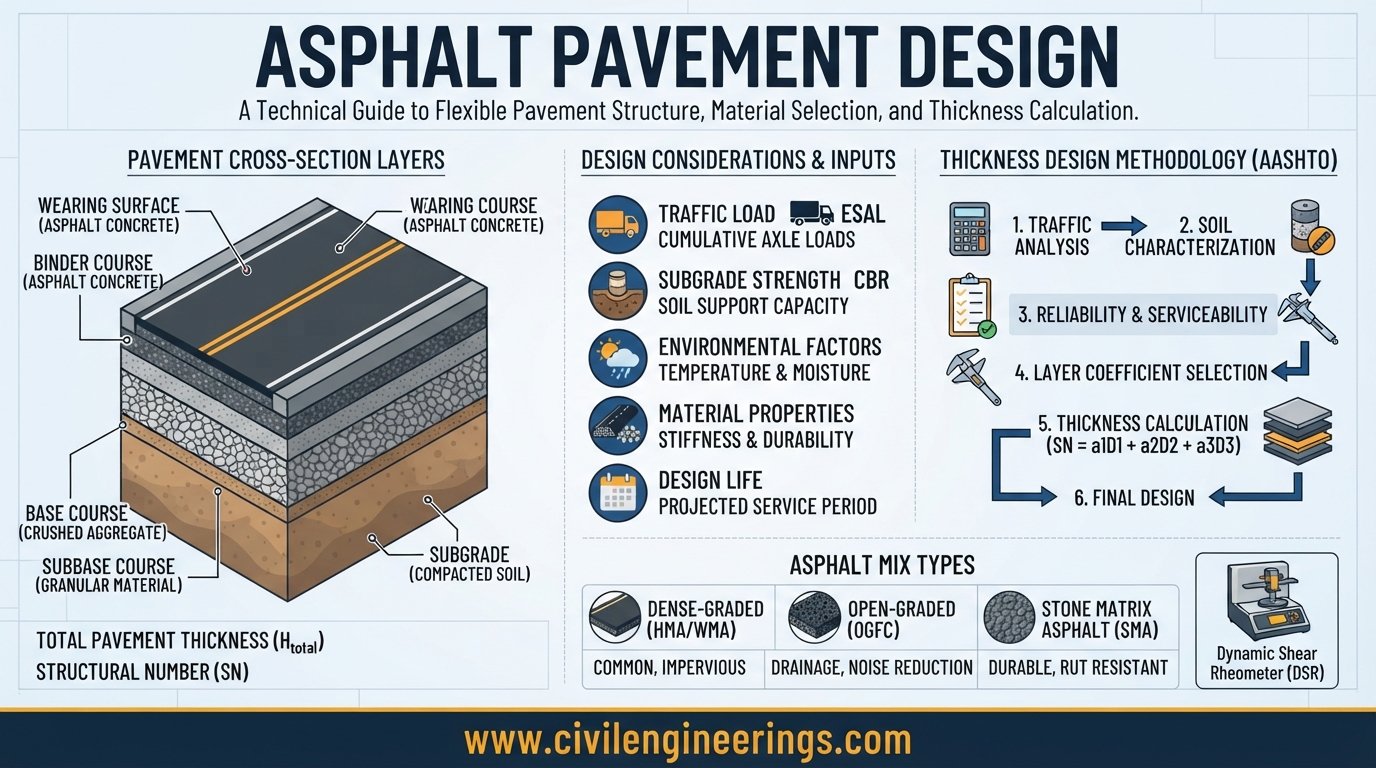
A typical flexible pavement may contain:
- Asphalt wearing or surface course
- Asphalt binder course
- Asphalt base, where required
- Granular or stabilized base
- Granular sub-base
- Prepared subgrade
- Natural soil or embankment foundation
The pavement structure distributes wheel loads over progressively larger areas as they move downward. The objective is not simply to make the pavement thick. Instead, the designer must develop a balanced structure in which each layer provides an appropriate combination of stiffness, strength, durability, drainage, and constructability.
The Federal Highway Administration describes the pavement system as a combination of surface, base, subbase, and subgrade layers that supports traffic while providing a smooth and safe roadway. (Federal Highway Administration)
Main Objectives of Asphalt Pavement Design
A successful design should:
- Carry expected traffic without excessive structural failure.
- Limit fatigue cracking.
- Control permanent deformation and rutting.
- Maintain acceptable ride quality.
- Protect the subgrade from excessive stress.
- Provide adequate surface friction.
- Minimize water infiltration and moisture damage.
- Remain economical over its service life.
- Permit practical construction and maintenance.
- Accommodate local climate and material conditions.
Components of an Asphalt Pavement Structure
Each pavement layer performs a different engineering function. Treating all layers as interchangeable is a common design mistake.
Asphalt Surface or Wearing Course
The surface course directly experiences traffic, rainfall, solar radiation, temperature changes, tire forces, and environmental exposure.
It should provide:
- Adequate skid resistance
- Smoothness
- Rutting resistance
- Durability
- Water resistance
- Resistance to abrasion
- Appropriate surface texture
Dense-graded asphalt concrete is widely used, although stone matrix asphalt, open-graded mixtures, and other specialized mixtures may be appropriate depending on project requirements. (Federal Highway Administration)
Asphalt Binder Course
The binder course lies beneath the wearing course and contributes significantly to structural capacity.
It normally uses a mixture optimized for structural performance and economy rather than surface characteristics alone. Its thickness and stiffness influence pavement response under heavy axle loading.
Base Course
The base course provides substantial structural support and distributes traffic stresses before they reach the subbase and subgrade.
It may consist of:
- Crushed aggregate
- Asphalt-treated material
- Cement-treated material
- Other stabilized materials
A properly selected base can increase stiffness, improve load distribution, and reduce critical strains. (Federal Highway Administration)
Subbase Course
The subbase is normally placed below the base and above the prepared subgrade.
Its functions can include:
- Additional load distribution
- Drainage
- Separation
- Frost protection where applicable
- Limiting migration of subgrade fines
- Improving construction support
Not every pavement requires a separate subbase; the decision depends on structural, geotechnical, drainage, and economic considerations. (Pavement Interactive)
Subgrade
The subgrade is the foundation supporting the pavement system. Its strength and stiffness have a major influence on required pavement thickness.
Important subgrade characteristics include:
- CBR
- Resilient modulus
- Moisture condition
- Soil classification
- Plasticity
- Density
- Swell potential
- Seasonal variability
IRC guidance emphasizes detailed investigation and testing of subgrade conditions for flexible pavement design. (Indian Registry for Internet Names)
Major Factors Affecting Asphalt Pavement Design
A pavement structure should never be selected from thickness tables alone. The designer must first establish the governing inputs.
Traffic Loading
Traffic is one of the most important design variables.
The designer should evaluate:
- Initial traffic
- Commercial vehicle volume
- Axle configurations
- Axle-load distribution
- Directional distribution
- Lane distribution
- Traffic growth
- Design period
- Seasonal variation
Heavy trucks are particularly important because pavement damage does not increase linearly with axle load.
Traditional methods often express cumulative traffic as equivalent standard axle loads or ESALs. Mechanistic-empirical approaches can use axle-load spectra and detailed vehicle classifications instead.
Design Life
Design life represents the period over which the pavement is expected to perform satisfactorily before major rehabilitation.
For example, a highway may have a longer structural analysis period than a low-volume access road. However, structural design life should not be confused with the date of the first maintenance activity.
Routine maintenance, surface treatments, overlays, and rehabilitation can extend functional service life.
Subgrade Strength
Subgrade conditions strongly influence pavement thickness.
A weak subgrade generally requires either:
- Greater structural thickness,
- Subgrade improvement,
- Stabilization,
- Geosynthetic reinforcement where appropriate,
- Improved drainage,
- Or a combination of these measures.
CBR is still widely encountered in pavement practice, particularly in traditional and regional design procedures. Mechanistic approaches increasingly use resilient modulus or other stiffness-related parameters.
Climate and Temperature
Asphalt is temperature-sensitive.
At high temperatures, the binder and mixture can become more susceptible to permanent deformation. At low temperatures, thermal stresses may contribute to cracking.
Design therefore needs to consider:
- Air temperature
- Pavement temperature
- Seasonal moisture
- Freeze-thaw conditions where relevant
- Solar heating
- Rainfall
- Groundwater
- Drainage
Drainage
Water is one of the most underestimated pavement design variables.
Moisture can reduce the strength and stiffness of unbound materials and subgrade soils. Poor drainage can therefore turn an apparently adequate pavement design into a premature failure.
FHWA guidance specifically identifies drainage and moisture as important pavement-system considerations because excessive moisture can weaken materials and contribute to deterioration. (Federal Highway Administration)
Asphalt Pavement Design Methods
Several approaches are used around the world. The correct method depends on the governing standard, project requirements, available data, and agency practice.
Empirical Design
Empirical methods are based largely on relationships developed from observed pavement performance.
Inputs may include:
- Traffic
- CBR or soil strength
- Material properties
- Environmental conditions
These approaches remain useful where data and resources are limited.
AASHTO Structural Design Approach
Traditional AASHTO flexible pavement design relates traffic, reliability, serviceability, subgrade resilient modulus, and structural capacity.
A simplified representation of the structural-number concept is:
SN = a₁D₁ + a₂m₂D₂ + a₃m₃D₃
Where:
- SN = structural number
- a₁, a₂, a₃ = layer structural coefficients
- D₁, D₂, D₃ = layer thicknesses
- m₂, m₃ = drainage coefficients
The actual design equation includes traffic, reliability, standard deviation, serviceability loss, and subgrade properties. Therefore, the simplified equation should not be treated as a complete pavement design formula.
FHWA’s summary of the 1993 AASHTO procedure illustrates the workflow: establish design period and traffic, reliability, serviceability loss, subgrade resilient modulus, layer coefficients, drainage coefficients, structural number, and finally individual layer thicknesses. (Federal Highway Administration)
Mechanistic-Empirical Design
Mechanistic-empirical pavement design combines engineering mechanics with field-calibrated performance models.
The process generally involves:
- Applying traffic and environmental inputs.
- Calculating pavement stresses and strains.
- Predicting pavement damage.
- Relating calculated damage to observed distress.
- Checking performance against specified criteria.
- Adjusting the trial pavement structure.
Typical predicted distresses include:
- Fatigue cracking
- Rutting
- Thermal cracking
- Roughness
- Reflective cracking for applicable rehabilitation designs
AASHTO published the fourth edition of its Mechanistic-Empirical Pavement Design Guide in 2026, reflecting continuing development of mechanistic-empirical pavement engineering. (AASHTO Journal)
Critical Pavement Distresses
Understanding failure mechanisms is essential because pavement thickness should be controlled by the governing distress.


Fatigue Cracking
Fatigue cracking develops from repeated traffic loading and cyclic tensile strain in asphalt layers.
A simplified conceptual relationship is:
Nf ∝ εt⁻ᵇ
Where:
- Nf = allowable load repetitions
- εt = critical tensile strain
- b = empirically calibrated exponent
The actual fatigue relationship varies according to the design method and calibration coefficients.
FHWA describes fatigue cracking as a repeated-load distress influenced by both asphalt material fatigue resistance and tensile strain generated by the complete pavement structure. (Federal Highway Administration)
Rutting
Rutting is permanent deformation occurring in the wheel paths.
It may originate from:
- Asphalt mixture instability
- Excessive asphalt-layer deformation
- Base or subbase deformation
- Subgrade deformation
- Poor compaction
- Excessive moisture
Mechanistic design commonly examines vertical compressive strain near the top of the subgrade and deformation within asphalt and unbound layers.
Thermal Cracking
Thermal cracking can occur when asphalt contracts under low temperatures and the resulting tensile stresses exceed the material’s resistance.
The risk depends on:
- Binder characteristics
- Temperature range
- Aging
- Asphalt mixture properties
- Climate
Moisture-Related Damage
Water can weaken unbound layers, reduce support, accelerate stripping, and promote potholes and deformation.
Consequently, pavement design must integrate drainage with structural design rather than treating drainage as a separate construction detail.
Step-by-Step Asphalt Pavement Design Procedure
Step 1: Establish Project Requirements
Define:
- Road classification
- Number of lanes
- Lane width
- Shoulder arrangement
- Design period
- Reliability requirements
- Maintenance strategy
- Environmental conditions
Step 2: Conduct Site Investigation
Investigate the existing ground and proposed pavement formation.
Testing may include:
- Soil classification
- Grain-size distribution
- Atterberg limits
- Moisture-density relationship
- CBR
- Resilient modulus
- Swell testing
- Groundwater assessment
The investigation should identify changes in soil type rather than relying on a single test value for an entire project.
Step 3: Estimate Design Traffic
A simplified cumulative traffic calculation can be expressed as:
W = 365 × A × F × G × D × L
Where the factors represent annual traffic, vehicle or axle equivalency, growth, directional distribution, and lane distribution according to the selected methodology.
The exact traffic equation varies by design standard. Engineers should use the definitions and factors prescribed by the applicable code.
Step 4: Characterize Materials
Determine the engineering properties of:
- Asphalt mixture
- Bitumen binder
- Aggregate
- Base material
- Subbase material
- Subgrade
For asphalt mixtures, relevant properties can include stiffness, volumetric properties, rutting resistance, fatigue resistance, moisture susceptibility, and durability.
Step 5: Select Trial Pavement Structure
Develop one or more trial sections.
For example:
Asphalt surface → asphalt binder → granular base → granular subbase → prepared subgrade
Alternative structures may use:
Asphalt surface → asphalt base → stabilized base → subgrade
The selection should reflect traffic, material availability, construction capability, drainage, and life-cycle cost.
Step 6: Calculate Structural Response
For mechanistic analysis, engineers calculate responses such as:
- Tensile strain at the bottom of asphalt layers
- Vertical compressive strain on top of the subgrade
- Stresses within pavement layers
- Deflection
- Temperature-dependent material response
These responses are then used in performance models.
Step 7: Check Performance Criteria
The trial pavement should be checked against specified limits for:
- Rutting
- Fatigue cracking
- Thermal cracking
- Roughness
- Other project-specific criteria
If a trial structure fails, modify thicknesses, materials, or layer configuration and repeat the analysis.
Step 8: Optimize the Design
The thickest pavement is not necessarily the best pavement.
Optimization should consider:
- Initial construction cost
- Material availability
- Construction risk
- Maintenance frequency
- Rehabilitation requirements
- Traffic disruption
- Expected service life
- Life-cycle cost
A Simple Asphalt Pavement Design Example
Consider a conceptual highway project with the following assumptions:
- Design period: 20 years
- Heavy commercial traffic: substantial
- Subgrade CBR: approximately 6%
- Good surface drainage
- Granular base available locally
- Asphalt concrete used for the surface and binder layers
The engineer should not immediately assign a thickness simply from the CBR.
Instead, the workflow would be:
Traffic → subgrade characterization → material properties → trial pavement → structural analysis → distress prediction → optimization
Suppose the first trial section consists of:
- Asphalt wearing course
- Asphalt binder course
- Granular base
- Granular subbase
The engineer calculates critical tensile and compressive strains. If predicted fatigue cracking exceeds the permitted level, the designer may increase asphalt thickness, improve mixture properties, strengthen the base, or investigate another structural configuration.
If subgrade rutting controls the design, improving the subgrade or increasing structural support may be more effective than simply adding surface asphalt.
This illustrates an important principle: the governing failure mechanism should determine the design response.
Asphalt Mixture and Material Considerations


Aggregate Quality
It should provide:
- Adequate strength
- Toughness
- Durability
- Appropriate gradation
- Resistance to polishing
- Good particle shape
Aggregate properties strongly influence rutting resistance, stability, surface texture, and durability.
Bitumen Selection
Binder selection should reflect:
- Climate
- Traffic
- Temperature
- Loading conditions
- Aging
- Mixture requirements
A binder that performs well in one climate may not be the optimum choice elsewhere.
Asphalt Content and Volumetrics
Mixture design should balance:
- Air voids
- Voids in mineral aggregate
- Voids filled with asphalt
- Binder content
- Aggregate gradation
- Density
Too much binder may contribute to instability in some conditions, while insufficient effective binder can reduce durability and increase cracking susceptibility.
Compaction
Even an excellent laboratory design can fail if the field mixture is poorly compacted.
Construction control should verify:
- Delivery temperature
- Paving temperature
- Roller pattern
- Compaction temperature window
- Layer thickness
- Density
- Surface smoothness
- Joint quality

Drainage in Asphalt Pavement Design
Drainage deserves special attention because pavement strength can deteriorate rapidly when water remains trapped within the structure.
Good drainage design may include:
- Proper pavement crossfall
- Shoulder drainage
- Side drains
- Subsurface drainage where necessary
- Drainage layers
- Edge drains
- Proper outlet arrangements
- Filter and separator systems
FHWA notes that drainage layers require appropriate collection and outlet provisions; the layer beneath must also be graded to promote positive drainage. (Federal Highway Administration)
A useful engineering rule is simple:
Do not design the pavement structure first and try to solve drainage afterward.
Drainage should influence the structural concept from the beginning.
IRC, AASHTO, and ICE References for Pavement Engineers
IRC Guidance
For engineers working in India and many South Asian projects, IRC:37-2018, Guidelines for the Design of Flexible Pavements, Fourth Revision, is a key reference for flexible pavement design. IRC identifies it as the applicable guideline for flexible pavement design. (Indian Registry for Internet Names)
IRC’s development of flexible pavement procedures has progressively incorporated mechanistic-empirical concepts rather than relying solely on older empirical CBR-based approaches. (Indian Registry for Internet Names)
AASHTO Guidance
AASHTO provides widely used pavement design and materials guidance in the United States and internationally.
Its current publication portfolio includes the Guide to Pavement Design, Construction, and Management, 2nd Edition, published in 2026, as well as the fourth edition of the Mechanistic-Empirical Pavement Design Guide. (AASHTO Journal)
ICE References
The Institution of Civil Engineers and related professional publications can provide useful supporting knowledge on transportation infrastructure, pavement engineering, asset management, sustainability, and construction practice.
However, engineers should always use the governing highway authority’s adopted pavement design code for final structural design rather than treating a general professional reference as a substitute for the applicable national standard.
Common Asphalt Pavement Design Mistakes
Using Inadequate Traffic Data
Underestimating heavy vehicles can produce an under-designed pavement even when all layer calculations are mathematically correct.
Relying on One Subgrade Test
Soil conditions can vary significantly along a road alignment. A single CBR result may not represent the entire project.
Ignoring Drainage
A structurally adequate pavement can deteriorate rapidly when moisture weakens the foundation.
Selecting Thickness Before Analysis
Choosing a pavement thickness first and then trying to justify it reverses the proper engineering process.
Ignoring Construction Quality
Design assumptions depend on achieving specified material properties and density in the field.
Focusing Only on Initial Cost
A cheaper pavement may require more frequent maintenance and rehabilitation. Life-cycle cost can provide a better basis for comparing alternatives.
Practical Recommendations for Students, Engineers, and Contractors
For Civil Engineering Students
Build a strong understanding of:
- Traffic loading
- CBR and resilient modulus
- Flexible pavement layers
- Asphalt mixture properties
- Fatigue
- Rutting
- Drainage
- Pavement design equations
Do not memorize thickness charts without understanding why the thickness changes.
For Highway Engineers and Consultants
Always verify:
- Traffic assumptions
- Subgrade variability
- Material characterization
- Climate inputs
- Drainage provisions
- Design reliability
- Governing distress
- Construction feasibility
Use mechanistic analysis where sufficient data and reliable calibration are available.
For Site Engineers
Focus heavily on translating design assumptions into field quality.
Monitor:
- Material temperatures
- Layer thickness
- Tack and prime coat application
- Aggregate quality
- Compaction
- Joint construction
- Surface levels
- Density
- Drainage
For Contractors
Construction quality can determine whether a theoretically sound pavement actually achieves its intended service life.
Maintain effective control over:
- Plant production
- Mix temperature
- Hauling
- Paver operation
- Roller sequencing
- Compaction
- Weather limitations
- Construction joints
Frequently Asked Questions About Asphalt Pavement Design
What is asphalt pavement design?
Asphalt pavement design is the process of selecting pavement materials, layer thicknesses, structural configuration, and performance criteria so a road can carry expected traffic safely throughout its design period.
What are the main layers of an asphalt pavement?
A conventional structure may contain an asphalt surface course, binder course, base, subbase, and prepared subgrade. The exact configuration depends on traffic, soil, climate, drainage, and design methodology.
What is the most important factor in asphalt pavement design?
There is no single controlling factor for every project. Traffic, subgrade strength, climate, drainage, material properties, and construction quality can all govern pavement performance.
Why is subgrade strength important?
The subgrade supports the complete pavement structure. Weak or moisture-sensitive soil can increase deformation and critical pavement strains, requiring additional structural support or ground improvement.
What causes rutting in asphalt pavement?
Rutting can result from unstable asphalt mixtures, inadequate compaction, excessive deformation in unbound layers, weak subgrade conditions, or a combination of these mechanisms.
What causes fatigue cracking?
Fatigue cracking is primarily associated with repeated traffic loading and cyclic tensile strains in asphalt layers. Poor structural support, inadequate thickness, and weak asphalt mixture properties can increase the risk.
Is CBR enough for modern pavement design?
CBR remains useful in many pavement design procedures, but modern mechanistic-empirical methods can require more detailed characterization such as resilient modulus, stiffness, temperature-dependent asphalt properties, traffic spectra, and climate inputs.
How does drainage affect asphalt pavement life?
Poor drainage can increase moisture in base, subbase, and subgrade materials, reducing their strength and stiffness. Effective drainage helps preserve structural support and reduce moisture-related deterioration.
Which is better: AASHTO or IRC pavement design?
Neither is universally “better.” The appropriate method is normally determined by the project’s governing authority, geographic location, contractual requirements, and available calibration data.
Can a thicker asphalt layer solve every pavement problem?
No. Increasing asphalt thickness may help with certain structural deficiencies, but it will not automatically solve poor drainage, unstable subgrade, unsuitable materials, or construction defects.
Conclusion
Asphalt Pavement Design is a multidisciplinary engineering process that connects traffic analysis, geotechnical investigation, material science, structural mechanics, drainage, climate, construction, and long-term asset management. A successful pavement is not simply the result of selecting a large asphalt thickness. It comes from understanding how every layer behaves under repeated traffic and environmental loading.
The most reliable approach begins with accurate traffic and site data, followed by appropriate subgrade characterization, material testing, trial pavement selection, structural analysis, and performance verification. Engineers should pay particular attention to fatigue cracking, rutting, moisture, drainage, and construction quality.
IRC, AASHTO, and other recognized engineering references provide established frameworks, but the governing road authority’s current specifications should always control the final design. A well-engineered pavement balances structural performance with constructability, maintenance requirements, sustainability, and life-cycle cost.
For students, the key lesson is to understand the engineering principles behind the equations. For practicing engineers and contractors, the priority is to ensure that design assumptions are achieved in the field. When design, materials, drainage, and construction work together, asphalt pavements can provide safer, smoother, and significantly longer-lasting roads.
