
Introduction
Highway infrastructure plays a vital role in economic growth, regional connectivity, and road safety. Whether constructing a rural access road or a multi-lane expressway, following Highway Design Standards is essential for creating roads that are safe, durable, cost-effective, and capable of handling current and future traffic demands. Poor planning or non-compliance with accepted engineering practices often leads to premature pavement failures, increased maintenance costs, traffic congestion, and higher accident rates.
Highway design is much more than selecting pavement thickness or lane width. It involves traffic studies, route alignment, geometric design, geotechnical investigations, drainage planning, pavement engineering, environmental considerations, construction quality, and long-term maintenance strategies. Each element contributes to the overall performance and lifespan of the transportation network.
This comprehensive guide explains the principles, objectives, components, engineering practices, design considerations, construction processes, quality control methods, and internationally recognized guidance related to Highway Design Standards. Whether you are a civil engineering student, highway engineer, contractor, consultant, researcher, or infrastructure professional, this article provides practical knowledge that can be applied to real-world highway projects.
What Are Highway Design Standards?
Highway Design Standards are engineering guidelines that define the minimum technical requirements for planning, designing, constructing, operating, and maintaining highways. These standards promote uniformity, improve road safety, enhance traffic flow, and optimize lifecycle costs.
They establish recommendations for:
- Road alignment
- Design speed
- Lane width
- Shoulder width
- Horizontal curves
- Vertical curves
- Pavement thickness
- Drainage systems
- Roadside safety
- Intersections
- Traffic control devices
Purpose
The primary objective is to ensure every highway performs safely and efficiently throughout its design life while accommodating projected traffic growth and environmental conditions.
Highway Design Standards in Modern Road Engineering
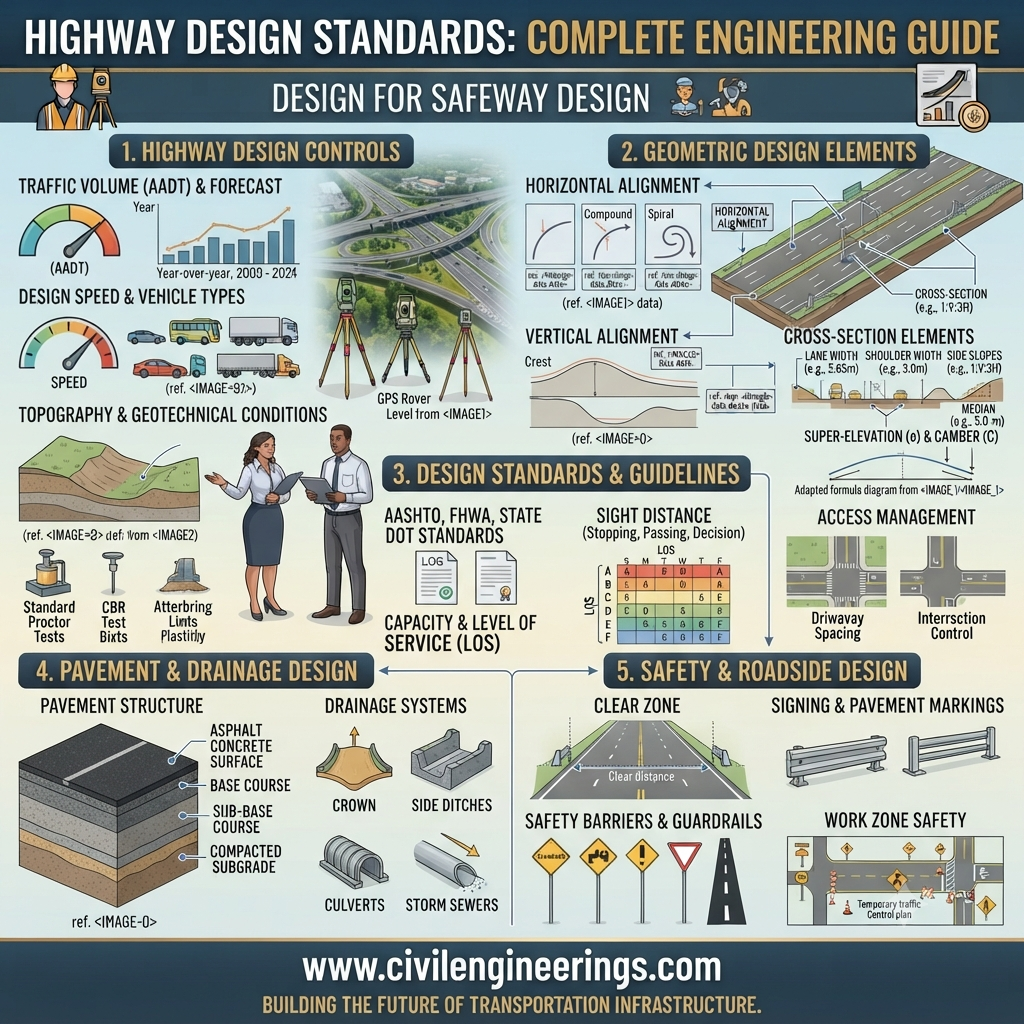
Geometric Design
Geometric design determines the physical layout of a highway.
It includes:
- Horizontal alignment
- Vertical alignment
- Sight distance
- Cross slope
- Superelevation
- Median design
- Intersections
Working Principle
A properly designed alignment minimizes vehicle operating costs while maximizing safety and driving comfort.
Practical Example
A mountainous highway requires larger transition curves and greater attention to stopping sight distance than a straight rural highway because vehicle dynamics differ significantly.
Advantages
- Better traffic flow
- Reduced accident rates
- Improved driver comfort
- Lower vehicle operating costs
Limitations
- High land acquisition costs
- Environmental constraints
- Terrain limitations
Pavement Design
Pavement design determines the structural layers required to carry expected traffic loads.
Typical layers include:
 Asphalt Surface
-----------------------
 Binder Course
-----------------------
 Base Course
-----------------------
 Sub-base
-----------------------
 Compacted Subgrade
Purpose
Distribute wheel loads safely to the subgrade.
Types
- Flexible Pavement
- Rigid Pavement
- Composite Pavement
Design Considerations
- Traffic loading
- Soil strength
- Climate
- Drainage
- Material quality
- Design life
Drainage Design
Water is one of the most damaging factors affecting highway performance.
Drainage systems include:
- Side drains
- Culverts
- Cross drains
- Median drains
- Catch basins
- Subsurface drainage
Best Practice
Keep pavement layers dry to maintain structural capacity.
Traffic Engineering
Traffic engineering improves operational efficiency.
Components include:
- Traffic studies
- Capacity analysis
- Signal design
- Road markings
- Signage
- Speed management
Proper traffic engineering reduces congestion and improves safety.
Highway Design Process
A typical highway project follows these stages:
Planning
    │
Surveying
    │
Traffic Studies
    │
Geotechnical Investigation
    │
Geometric Design
    │
Pavement Design
    │
Drainage Design
    │
Construction Drawings
    │
Construction
    │
Quality Control
    │
Maintenance
Planning
Activities include:
- Feasibility studies
- Economic evaluation
- Environmental assessment
- Route selection
Surveying
Engineers conduct:
- Topographic survey
- GPS survey
- Drone survey
- Total station survey
- LiDAR survey
Geotechnical Investigation
Soil testing determines:
- Bearing capacity
- Moisture content
- Density
- CBR
- Plasticity Index
Poor subgrade conditions require stabilization before pavement construction.
Material Selection
Common materials include:
- Bitumen
- Cement
- Asphalt
- Aggregates
- Sand
- Fly ash
- Lime
- Geotextiles
- Geogrids
- Reinforcement steel
- Concrete
- Chemical stabilizers
Material selection depends on climate, traffic loading, and lifecycle cost.
Earthwork
Major operations include:
- Excavation
- Embankment construction
- Compaction
- Slope protection
Proper compaction minimizes future settlement.
Construction
Typical sequence:
- Clearing
- Grubbing
- Earthwork
- Drainage construction
- Subgrade preparation
- Sub-base placement
- Base course construction
- Asphalt paving
- Road marking
- Safety installations
Engineering Calculations
Flexible Pavement Thickness
Simplified concept:
Total Thickness

T = Surface + Base + Sub-base
Where:
- T = Total pavement thickness (mm)
Example
Surface = 50 mm
Base = 200 mm
Sub-base = 250 mm
Total Thickness
T = 50 + 200 + 250

T = 500 mm
Actual pavement design should consider:
- ESAL
- CBR
- Traffic growth
- Reliability
- Drainage coefficient
Highway Construction Materials
Bitumen
Used in flexible pavements.
Advantages:
- Waterproof
- Flexible
- Durable
Cement
Used for rigid pavements and drainage structures.
Aggregates
Provide strength and load distribution.
Sand
Used in concrete and bedding layers.
Geotextiles
Applications include:
- Separation
- Filtration
- Reinforcement
- Drainage
Geogrids
Improve weak subgrade performance.
Construction Equipment
Common equipment includes:
- Excavators
- Bulldozers
- Motor Graders
- Wheel Loaders
- Asphalt Pavers
- Vibratory Rollers
- Pneumatic Rollers
- Concrete Mixers
- Transit Mixers
- Survey Instruments
- GPS Equipment
- Total Stations
Proper equipment selection improves productivity and construction quality.
Quality Control
Quality assurance ensures compliance with design specifications.
Important tests include:
CBR Test
Measures subgrade strength.
Proctor Test
Determines optimum moisture content and maximum dry density.
Marshall Stability Test
Evaluates asphalt mix performance.
Slump Test
Measures concrete workability.
Core Test
Checks asphalt pavement thickness and density.
Density Test
Verifies field compaction.
Plate Load Test
Determines bearing capacity of foundation soils.
Practical Applications
Highway Design Standards are applied in:
Highways
Support long-distance transportation with safe alignments and durable pavements.
Expressways
Accommodate high-speed traffic using controlled access, wider medians, and advanced safety features.
Urban Roads
Address pedestrian movement, intersections, utilities, and public transport integration.
Rural Roads
Improve agricultural connectivity while balancing construction costs and local terrain.
Airports
Used in designing access roads and service routes capable of handling heavy vehicles.
Industrial Roads
Designed for repetitive heavy axle loads and frequent freight movement.
Smart Cities
Integrated with intelligent transportation systems (ITS), smart traffic management, and sustainable mobility solutions.
Best Practices for
Engineers
- Conduct detailed site investigations.
- Design for future traffic growth.
- Prioritize effective drainage.
- Use durable, locally suitable materials.
- Perform regular design reviews.
Contractors
- Follow approved drawings precisely.
- Maintain strict compaction control.
- Calibrate equipment regularly.
- Protect completed pavement layers from damage.
- Keep accurate quality records.
Students
- Learn the fundamentals of geometric and pavement design.
- Understand soil mechanics and traffic engineering.
- Practice interpreting engineering drawings.
- Stay updated with evolving design guidance and digital design tools.
Common Mistakes
Inadequate Soil Investigation
Why it occurs: Limited site exploration or budget constraints.
Consequence: Differential settlement and pavement failure.
Prevention: Conduct comprehensive geotechnical investigations.
Poor Drainage Planning
Why it occurs: Underestimating runoff or ignoring maintenance.
Consequence: Water infiltration and structural deterioration.
Prevention: Design efficient surface and subsurface drainage systems.
Ignoring Future Traffic Growth
Why it occurs: Reliance on current traffic volumes only.
Consequence: Early congestion and pavement overstressing.
Prevention: Use realistic traffic forecasting methods.
Low Construction Quality
Why it occurs: Inadequate supervision or testing.
Consequence: Premature defects and higher maintenance costs.
Prevention: Enforce robust quality assurance and quality control procedures.
General Overview of Engineering Standards
Highway projects are commonly guided by internationally recognized organizations, including:
- IRC (Indian Roads Congress): Guidance on highway planning, geometric design, pavements, bridges, and road safety.
- AASHTO: Widely referenced practices for geometric design, pavement engineering, and transportation planning.
- ASTM International: Standardized methods for testing soils, aggregates, asphalt, and concrete.
- ICE (Institution of Civil Engineers): Professional engineering guidance and best practices.
- ISO: International standards covering quality management, environmental management, and construction processes.
- FHWA (Federal Highway Administration): Technical resources on highway design, traffic operations, safety, and asset management.
Engineers typically adapt these recommendations to local regulations, environmental conditions, and project requirements rather than relying on a single source.
Frequently Asked Questions
1. Why are Highway Design Standards important?
Highway Design Standards provide a consistent framework for planning, designing, constructing, and maintaining roads. They improve safety, optimize traffic operations, reduce lifecycle costs, and enhance pavement durability. Following recognized engineering guidance also helps ensure compatibility between different infrastructure components while supporting sustainable transportation development.
2. What factors influence highway design?
Key factors include projected traffic volume, axle loads, design speed, terrain, soil conditions, climate, drainage, environmental constraints, available construction materials, and future expansion requirements. A balanced design considers safety, performance, cost, and long-term maintenance.
3. What is the difference between flexible and rigid pavement?
Flexible pavements use asphalt layers that distribute loads through multiple structural courses and are easier to maintain. Rigid pavements use concrete slabs with higher stiffness, providing excellent load distribution and longer service life but generally requiring higher initial construction costs.
4. Why is drainage critical in highway engineering?
Water weakens pavement layers, reduces subgrade strength, and accelerates cracking, rutting, and pothole formation. Effective surface and subsurface drainage protects the pavement structure, improves durability, and lowers maintenance expenses throughout the design life of the highway.
5. Which quality control tests are commonly performed?
Common tests include the CBR Test, Proctor Test, Marshall Stability Test, Slump Test, Core Test, Density Test, and Plate Load Test. Together, these tests verify soil strength, compaction, asphalt performance, concrete quality, pavement thickness, and foundation capacity.
6. How do Highway Design Standards improve road safety?
They establish consistent guidance for alignment, sight distance, lane configuration, intersections, shoulders, roadside features, and traffic control. These measures reduce driver confusion, improve visibility, minimize conflict points, and support safer travel under a wide range of operating conditions.
7. What role does geotechnical engineering play in highway projects?
Geotechnical engineering evaluates subsurface conditions to determine soil strength, settlement potential, groundwater levels, and slope stability. This information supports appropriate foundation design, pavement thickness selection, ground improvement methods, and long-term infrastructure performance.
8. How can engineers extend pavement service life?
Long-lasting pavements require accurate traffic forecasting, proper material selection, effective drainage, quality construction, regular inspections, preventive maintenance, and timely rehabilitation. Addressing small defects early is significantly more economical than major structural reconstruction.
Conclusion
Successful transportation infrastructure begins with sound engineering principles and the consistent application of Highway Design Standards. From route planning and geotechnical investigations to geometric design, pavement engineering, drainage, quality control, and maintenance, every stage influences safety, durability, and lifecycle performance. By combining practical engineering judgment with internationally recognized guidance from organizations such as IRC, AASHTO, ASTM, ICE, ISO, and FHWA, professionals can deliver highways that meet today’s transportation demands while remaining resilient for decades. Whether you are a student building foundational knowledge or an experienced engineer managing complex infrastructure projects, applying these best practices will improve project outcomes, reduce long-term costs, and enhance public safety. Continue refining your expertise and incorporate robust Highway Design Standards into every project to build smarter, safer, and more sustainable roads.
