
Introduction
Modern transportation systems depend on high-speed road networks that move people and goods quickly, safely, and efficiently. Expressway Design plays a vital role in developing these transportation corridors by combining traffic engineering, geometric design, pavement engineering, geotechnical investigation, and construction management into one integrated process. A properly designed expressway reduces travel time, improves road safety, lowers vehicle operating costs, and supports regional economic growth.
Whether you are a civil engineering student, highway engineer, contractor, consultant, or infrastructure professional, understanding the principles of expressway design is essential for successful project planning and execution. This guide explains every major aspect of expressway planning and geometric design in simple engineering language while incorporating practical field experience, engineering calculations, and industry best practices.
What is Expressway Design?
Definition
Expressway Design is the engineering process of planning, analyzing, and designing a high-capacity roadway that allows uninterrupted traffic flow through controlled access, grade-separated intersections, and carefully designed geometric features.
Unlike conventional highways, expressways eliminate direct property access and traffic signals. Vehicles enter and exit only through designated interchanges, allowing higher operating speeds and improved safety.
Expressway design combines multiple engineering disciplines, including:
- Highway Engineering
- Transportation Engineering
- Geotechnical Engineering
- Pavement Engineering
- Traffic Engineering
- Structural Engineering
- Hydrology
- Environmental Engineering
The objective is not simply to build a road but to create a transportation corridor that remains safe, durable, economical, and efficient throughout its design life.
Objectives of Expressway Design
A successful expressway project achieves several engineering and transportation goals.
Improve Mobility
Expressways reduce travel time by allowing uninterrupted vehicle movement with minimal delays.
Enhance Road Safety
Controlled access, wider lanes, median barriers, and proper sight distances significantly reduce accident rates.
Increase Traffic Capacity
Expressways accommodate large traffic volumes, including passenger cars, buses, and heavy commercial vehicles.
Support Economic Development
Efficient transportation corridors improve trade, logistics, tourism, and industrial development.
Reduce Vehicle Operating Costs
Smooth pavement surfaces and optimized alignments reduce fuel consumption, tire wear, and vehicle maintenance costs.
Provide Long-Term Infrastructure
A well-designed expressway can serve traffic efficiently for several decades with proper maintenance.
Major Components of Expressway Design
Designing an expressway requires careful integration of many engineering elements.
              EXPRESSWAY DESIGN

                     │
     ┌───────────────┼───────────────┐
     │               │               │
 Planning      Geometric       Pavement
 Design         Design          Design
     │               │               │
 Survey      Drainage        Construction
     │               │               │
 Traffic      Structures     Maintenance
Each component influences the overall safety, durability, and operational performance of the expressway.
Planning an Expressway Project
Every successful expressway begins with comprehensive planning rather than construction.
The planning phase typically includes:
- Identification of transportation needs
- Existing traffic analysis
- Future traffic forecasting
- Economic feasibility
- Environmental assessment
- Preliminary route alternatives
- Land acquisition studies
- Utility relocation planning
- Cost estimation
- Risk assessment
Proper planning minimizes delays during construction and reduces future maintenance costs.
Route Selection and Corridor Planning
Route selection is one of the most important stages of expressway design because mistakes made here are difficult and expensive to correct later.
Factors Considered
Traffic Demand
Engineers estimate current and future traffic volumes using traffic counts, origin-destination studies, and transportation models.
Topography
Flat terrain generally reduces construction costs, while mountainous regions require tunnels, retaining walls, and extensive earthworks.
Geology
Subsurface investigations identify weak soils, expansive clay, rock formations, and groundwater conditions that affect foundation design.
Environmental Impact
The selected route should minimize impacts on forests, wetlands, rivers, wildlife habitats, and agricultural land.
Land Acquisition
Urban corridors often involve higher land acquisition costs than rural areas. Engineers evaluate multiple alignments to optimize project feasibility.
Construction Cost
Alternative routes are compared based on earthwork, bridges, pavement requirements, drainage structures, and utility relocation.
Simplified Route Selection Process
Transportation Need
        │
        ▼
Traffic Study
        │
        ▼
Alternative Routes
        │
        ▼
Field Investigation
        │
        ▼
Environmental Assessment
        │
        ▼
Economic Analysis
        │
        ▼
Preferred Alignment
Engineering Surveys
Reliable survey data forms the foundation of every expressway design.
Topographic Survey
Topographic surveys provide information about:
- Existing ground levels
- Rivers
- Buildings
- Roads
- Utilities
- Trees
- Natural features
Modern instruments include:
- Total Station
- GPS
- UAV (Drone Survey)
- LiDAR
- Digital Level
Geotechnical Investigation
Geotechnical engineers investigate soil and rock conditions before pavement and embankment design.
Typical investigations include:
- Boreholes
- Trial pits
- Soil sampling
- Rock coring
- Groundwater measurements
Laboratory tests include:
- Grain size analysis
- Atterberg limits
- CBR Test
- Standard Proctor Test
- Modified Proctor Test
- Triaxial Test
These investigations determine bearing capacity, settlement characteristics, and pavement support conditions.
Traffic Survey
Traffic engineering studies determine future expressway requirements.
Common surveys include:
- Classified traffic count
- Origin-Destination Survey
- Speed Survey
- Axle Load Survey
- Travel Time Survey
- Accident Study
Traffic forecasts usually consider a design period of 20 to 30 years.
Geometric Design of Expressway Design
Geometric design determines how safely and comfortably vehicles travel along the expressway.
Design Speed
Design speed is the selected speed used to determine the geometric features of the roadway.
Typical design speeds include:
| Terrain | Typical Design Speed |
|---|---|
| Plain | 100–120 km/h |
| Rolling | 80–100 km/h |
| Mountainous | 60–80 km/h |
Higher design speeds require:
- Larger curve radii
- Longer sight distances
- Gentler gradients
- Wider medians
Typical Cross Section
A standard expressway cross-section includes:
 Shoulder   Lane   Lane  Median  Lane   Lane  Shoulder
-------------------------------------------------------
    3.0      3.75  3.75   4-15m   3.75  3.75    3.0
Typical components include:
- Carriageway
- Shoulders
- Median
- Edge strips
- Side drains
- Safety barriers
- Service roads (where required)
Horizontal Alignment
Horizontal alignment controls the roadway’s path in plan view.
Engineers design:
- Tangents
- Circular curves
- Transition curves
- Superelevation
- Extra widening
Proper horizontal alignment improves:
- Driving comfort
- Vehicle stability
- Road safety
- Traffic flow
Curve Components
 Tangent
     \
      \
       ) Circular Curve
      /
     /
 Tangent
Transition curves provide a gradual change from straight sections to circular curves, reducing lateral forces on vehicles.
Vertical Alignment
Vertical alignment defines the roadway profile along its length.
It consists of:
- Gradients
- Crest curves
- Sag curves
A well-designed profile ensures:
- Smooth driving
- Adequate drainage
- Good visibility
- Comfortable vehicle operation
Sight Distance
Sight distance is the length of roadway visible to a driver ahead.
Important types include:
- Stopping Sight Distance (SSD)
- Overtaking Sight Distance (OSD)
- Decision Sight Distance (DSD)
Adequate visibility allows drivers to react safely to unexpected obstacles.
Interchanges
Unlike conventional highways, expressways use grade-separated interchanges instead of signalized intersections.
Common interchange types include:
- Diamond
- Cloverleaf
- Trumpet
- Directional
- Partial Cloverleaf (Parclo)
These designs eliminate crossing conflicts and maintain uninterrupted traffic flow.
Basic Engineering Calculations
Engineering calculations help verify that the selected geometric elements provide safe operating conditions.
Superelevation
Superelevation counteracts centrifugal force on horizontal curves.
Formula
[
e + f = \frac{V^2}{127R}
]
Where:
- e = Superelevation (decimal)
- f = Side friction factor
- V = Design speed (km/h)
- R = Radius of curve (m)
Example
Given:
- Speed = 100 km/h
- Radius = 600 m
- Side friction = 0.10
e = \frac{100^2}{127 \times 600} – 0.10
= 0.131 – 0.10
= 0.031
Therefore, the required superelevation is approximately 3.1%, subject to applicable design standards and project-specific constraints.
Stopping Sight Distance (Simplified)
A commonly used simplified relationship is:
[
SSD = \text{Reaction Distance} + \text{Braking Distance}
]
Where:
- Reaction Distance depends on vehicle speed and driver perception-reaction time.
- Braking Distance depends on speed, pavement condition, and braking efficiency.
Engineers use SSD to ensure drivers have sufficient distance to perceive hazards and stop safely under design conditions.
Image Alt Text Examples
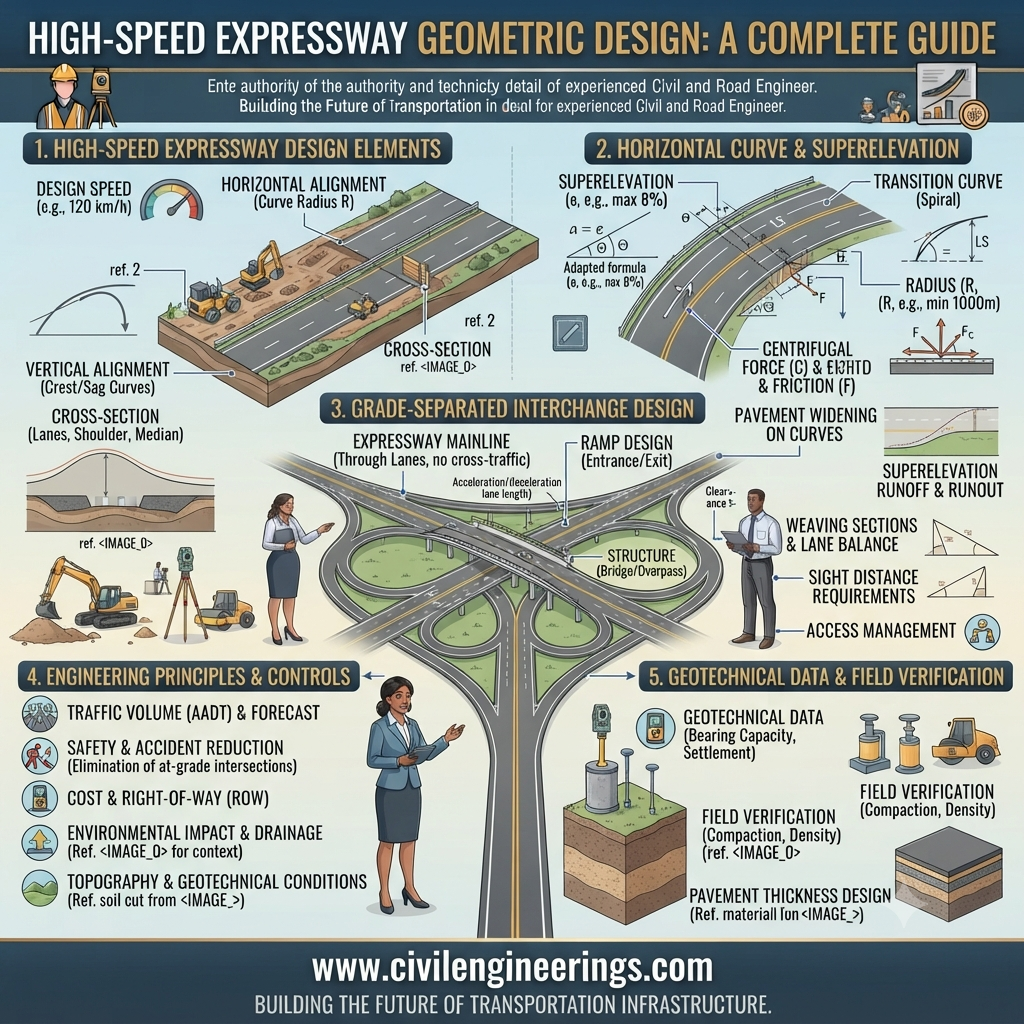
- Expressway Design cross-section showing carriageway, median, shoulders, and drainage system.
- High-speed expressway geometric design with horizontal curve, superelevation, and grade-separated interchange.
Expressway Pavement Design
A strong pavement is the backbone of every expressway. It must withstand millions of axle loads, resist environmental effects, and provide a smooth riding surface throughout its design life. Engineers select pavement type after evaluating traffic loading, subgrade strength, climate, material availability, construction cost, and maintenance requirements.
The two most common pavement systems are:
- Flexible Pavement: Constructed using asphalt and bituminous layers. It distributes wheel loads through multiple layers and is widely used because of its lower initial cost and faster construction.
- Rigid Pavement: Built with cement concrete slabs. It offers excellent durability, lower maintenance requirements, and longer service life but requires a higher initial investment.
A life-cycle cost analysis helps determine the most economical option for a specific expressway project.
Typical Flexible Pavement Structure
        TRAFFIC
           ↓
 ┌────────────────────┐
 │ Asphalt Wearing    │
 ├────────────────────┤
 │ Binder Course      │
 ├────────────────────┤
 │ Base Course        │
 ├────────────────────┤
 │ Granular Sub-base  │
 ├────────────────────┤
 │ Compacted Subgrade │
 └────────────────────┘
Each layer performs a unique function by spreading wheel loads and protecting the underlying soil from excessive stress.
Materials Used in Expressway Construction
Material quality directly affects pavement performance and service life.
Bitumen
Bitumen acts as the binding material in asphalt mixtures. It provides flexibility, waterproofing, and resistance to traffic loading.
Cement
Cement is primarily used for rigid pavements, culverts, bridges, retaining walls, median barriers, and drainage structures.
Aggregates
Crushed stone forms the structural skeleton of pavement layers. High-quality aggregates should possess:
- High crushing strength
- Good abrasion resistance
- Low water absorption
- Excellent durability
Sand
Sand is used in concrete production, drainage layers, and mortar for structural works.
Geotextiles
Geotextiles improve separation, filtration, drainage, and reinforcement while preventing contamination between soil layers.
Geogrids
Geogrids reinforce weak subgrades, increase bearing capacity, and reduce pavement deformation.
Reinforcement Steel
Steel reinforcement is essential for bridges, retaining walls, rigid pavements, and reinforced concrete structures.
Concrete
Concrete provides long-lasting structural strength for rigid pavements and associated infrastructure.
Asphalt
Modern asphalt mixtures improve skid resistance, reduce traffic noise, and provide smoother riding quality.
Soil Stabilizers
Where weak soils exist, stabilizers such as lime, cement, fly ash, or chemical additives improve strength and reduce settlement.
Expressway Construction Process
Constructing an expressway follows a systematic engineering sequence that minimizes risks and ensures quality.
Planning
    │
Surveying
    │
Detailed Design
    │
Land Acquisition
    │
Earthwork
    │
Drainage Construction
    │
Pavement Layers
    │
Road Furniture
    │
Testing & Commissioning
    │
Maintenance
1. Planning
Planning includes feasibility studies, traffic forecasting, environmental assessments, budgeting, scheduling, and stakeholder coordination.
2. Surveying
Survey teams establish the horizontal and vertical alignment using GPS, Total Stations, drones, LiDAR, and digital levels.
3. Detailed Design
Engineers finalize:
- Horizontal alignment
- Vertical profile
- Pavement thickness
- Drainage system
- Bridge and culvert locations
- Utility relocation plans
- Safety features
4. Material Selection
Materials are selected according to engineering specifications, climate, traffic loading, and availability.
5. Earthwork
Earthwork activities include:
- Clearing and grubbing
- Excavation
- Embankment construction
- Soil stabilization
- Layer-by-layer compaction
Proper moisture control and compaction are critical to achieving the required subgrade strength.
6. Pavement Construction
Typical construction stages include:
- Granular sub-base placement
- Base course construction
- Asphalt paving or concrete paving
- Joint construction (for rigid pavements)
- Compaction using rollers
- Surface finishing
7. Quality Control
Quality assurance teams continuously inspect materials, workmanship, and finished pavement to verify compliance with project requirements.
8. Maintenance
Routine maintenance extends pavement life by addressing defects before they become major failures.
Common activities include:
- Crack sealing
- Pothole repairs
- Overlay placement
- Drainage cleaning
- Road marking renewal
- Guardrail repairs
- Vegetation control
Equipment Used in Expressway Construction
Modern equipment increases productivity and construction quality.
| Equipment | Primary Use |
|---|---|
| Excavators | Excavation and trenching |
| Bulldozers | Earthmoving and grading |
| Motor Graders | Final surface grading |
| Wheel Loaders | Material loading |
| Asphalt Pavers | Asphalt placement |
| Vibratory Rollers | Pavement compaction |
| Pneumatic Rollers | Asphalt finishing |
| Concrete Mixers | Concrete production |
| Slip-form Pavers | Concrete pavement construction |
| Total Station | Surveying |
| GPS Equipment | Alignment control |
| Drone Survey Systems | Topographic mapping |
Quality Control and Testing
Quality control ensures that every construction stage meets engineering requirements.
California Bearing Ratio (CBR) Test
Determines the load-bearing capacity of subgrade soil for pavement design.
Standard and Modified Proctor Tests
Identify the optimum moisture content and maximum dry density required for proper compaction.
Marshall Stability Test
Measures the stability and flow characteristics of asphalt mixtures.
Slump Test
Evaluates the workability and consistency of fresh concrete.
Core Test
Checks pavement thickness and asphalt density after construction.
Field Density Test
Verifies whether compacted soil or pavement layers meet specified density requirements.
Plate Load Test
Assesses the bearing capacity and deformation characteristics of foundation soils.
Regular testing throughout construction minimizes future maintenance costs and improves long-term pavement performance.
Best Practices for
Engineers
- Conduct detailed geotechnical investigations before finalizing pavement design.
- Use reliable traffic forecasts with future growth projections.
- Design efficient drainage systems to protect pavement layers.
- Consider climate, axle loads, and maintenance requirements during design.
- Integrate intelligent transportation systems where appropriate.
Contractors
- Follow approved construction procedures.
- Use calibrated equipment.
- Maintain proper asphalt and concrete temperatures.
- Ensure uniform compaction of every layer.
- Document all quality control activities.
Civil Engineering Students
- Build a strong understanding of geometric design principles.
- Learn traffic engineering fundamentals.
- Practice pavement design calculations.
- Study modern construction techniques and digital surveying tools.
- Gain practical field experience whenever possible.
Common Mistakes in Expressway Projects
Inadequate Site Investigation
Why it occurs: Limited geotechnical exploration.
Consequences: Settlement, pavement failure, and increased maintenance costs.
Solution: Conduct comprehensive field and laboratory investigations before design.
Poor Drainage Design
Why it occurs: Insufficient hydraulic analysis.
Consequences: Water infiltration, pavement deterioration, and erosion.
Solution: Design efficient surface and subsurface drainage systems.
Improper Compaction
Why it occurs: Inadequate moisture control or insufficient roller passes.
Consequences: Rutting, settlement, and premature pavement distress.
Solution: Monitor moisture content and perform field density testing regularly.
Inferior Material Quality
Why it occurs: Weak quality assurance procedures.
Consequences: Reduced pavement durability and frequent repairs.
Solution: Test all construction materials before and during use.
Ignoring Future Traffic Growth
Why it occurs: Underestimating traffic demand.
Consequences: Early congestion and structural overloading.
Solution: Use realistic traffic forecasting and appropriate design periods.
Overview of Engineering Standards
Although project-specific requirements vary, engineers commonly refer to internationally recognized guidance documents.
- IRC (Indian Roads Congress): Provides guidance for highway planning, geometric design, pavement engineering, and road safety.
- AASHTO: Widely recognized for transportation design methodologies and pavement design principles.
- ASTM International: Publishes standardized testing procedures for construction materials.
- FHWA (Federal Highway Administration): Offers technical guidance on highway design, construction, traffic management, and asset maintenance.
- ISO: Establishes international standards for quality management, environmental management, and construction processes.
- ICE (Institution of Civil Engineers): Promotes engineering best practices, professional development, and infrastructure excellence.
Engineers should always consult the latest editions of applicable national and project-specific standards without relying on outdated guidance.
Frequently Asked Questions
1. What is the main purpose of expressway design?
The primary purpose of expressway design is to provide a safe, efficient, and high-capacity transportation corridor that supports uninterrupted traffic flow. Controlled access, grade-separated interchanges, proper geometric design, and durable pavement structures help reduce travel time, improve road safety, and lower vehicle operating costs. A well-designed expressway also supports long-term economic development by improving regional connectivity and freight movement.
2. What factors influence pavement design for an expressway?
Engineers consider several factors, including traffic volume, axle loads, design life, subgrade strength, drainage conditions, climate, material availability, and maintenance strategies. Laboratory tests such as the CBR and Proctor tests provide valuable information about soil properties. Selecting an appropriate pavement structure ensures adequate load distribution, minimizes maintenance requirements, and extends the service life of the expressway.
3. Why is drainage so important in expressway projects?
Water is one of the leading causes of pavement deterioration. Poor drainage allows moisture to weaken pavement layers and subgrade soils, resulting in rutting, cracking, pumping, and settlement. Proper surface and subsurface drainage systems quickly remove water, protecting both pavement and earthworks. Effective drainage also reduces erosion, improves driving safety during storms, and lowers long-term maintenance costs.
4. Which surveys are essential before designing an expressway?
Successful expressway projects require topographic, geotechnical, traffic, environmental, hydrological, and utility surveys. These investigations help engineers understand terrain, soil conditions, traffic demand, flood risks, and existing infrastructure. Accurate survey data reduces design errors, improves cost estimates, minimizes construction risks, and supports efficient project execution.
5. How do quality control tests improve expressway performance?
Quality control testing verifies that materials and construction meet project specifications. Tests such as CBR, Marshall Stability, Proctor, Slump, Density, Core, and Plate Load tests identify deficiencies before they affect pavement performance. Continuous inspection ensures stronger foundations, durable pavement layers, and longer service life while reducing maintenance costs and improving public safety.
6. What are the biggest challenges in expressway construction?
Common challenges include land acquisition, difficult terrain, weak subgrade soils, environmental constraints, utility relocation, traffic management, and weather-related delays. Effective planning, stakeholder coordination, accurate surveys, and proactive risk management help overcome these issues. Modern equipment, digital construction monitoring, and strict quality assurance further improve project efficiency and outcomes.
7. Can sustainable practices be incorporated into expressway design?
Yes. Sustainable expressway projects increasingly use recycled asphalt pavement, industrial by-products, warm-mix asphalt, energy-efficient lighting, rainwater management systems, erosion control measures, and environmentally responsible construction practices. These approaches reduce environmental impacts while maintaining safety, durability, and long-term performance.
Conclusion
Expressway Design is far more than drawing road alignments or selecting pavement layers. It is a multidisciplinary engineering process that integrates transportation planning, traffic analysis, geotechnical investigation, geometric design, pavement engineering, drainage, construction management, and quality assurance to deliver safe and efficient highway infrastructure. Every stage—from route selection and surveying to material selection, construction, testing, and maintenance—contributes to the long-term success of the project.
Whether you are a student beginning your engineering journey or an experienced infrastructure professional, mastering the principles of Expressway Design will help you make informed technical decisions and deliver sustainable transportation solutions. Apply these best practices, follow recognized engineering standards, and prioritize quality at every stage to build expressways that serve communities safely for decades. Continue learning, stay updated with modern technologies, and strive for engineering excellence in every project.

Kamran Malik is a passionate civil engineering writer and researcher who specializes in construction, transportation, structural engineering, and infrastructure topics. Through his articles on CivilEngineerings.com, he simplifies complex engineering concepts and shares practical insights, industry trends, and educational resources for students, professionals, and engineering enthusiasts.