
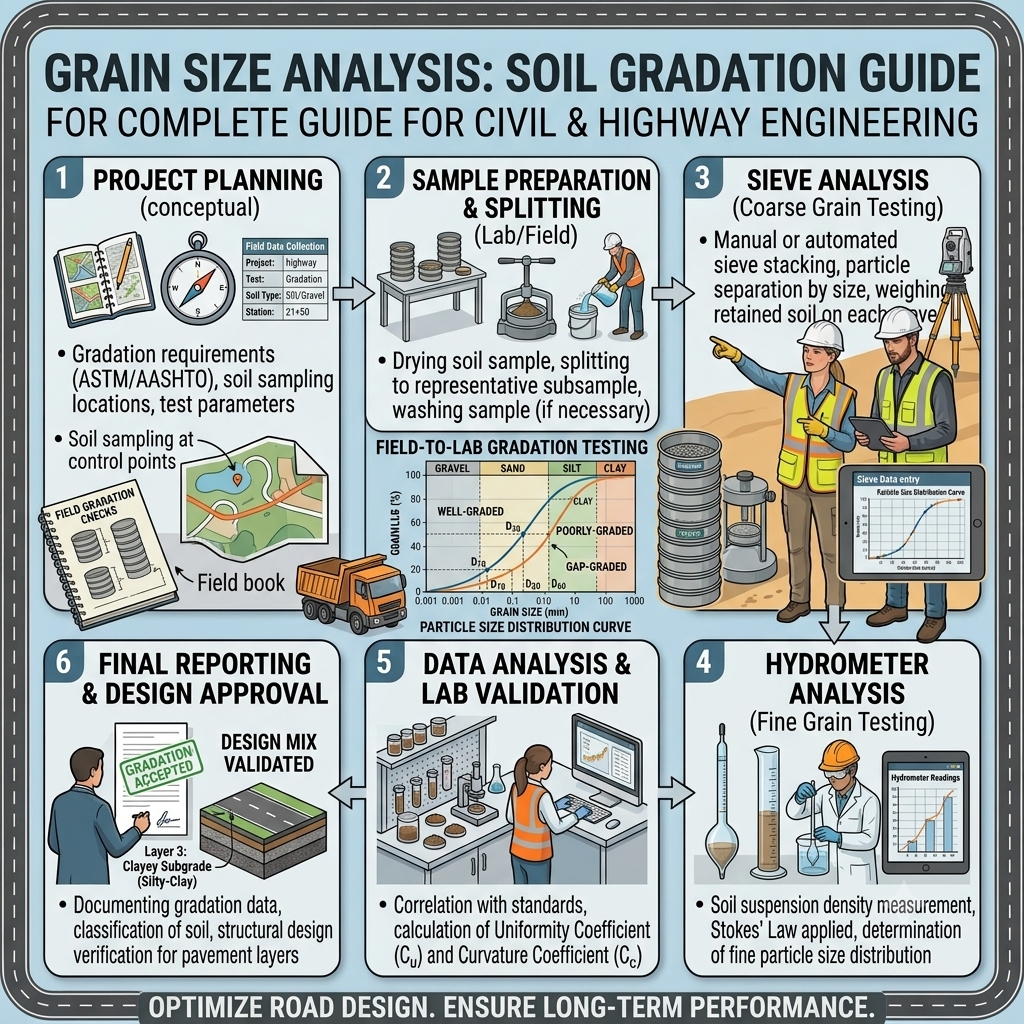
Introduction
Grain Size Analysis ranks among the most important laboratory tests in geotechnical and highway engineering. Every successful road, highway, bridge, embankment, and foundation begins with a clear understanding of soil particle distribution. Engineers perform this test to determine the percentage of gravel, sand, silt, and clay present in a soil sample. Accurate gradation data supports better design decisions, improves construction quality, and reduces the risk of pavement or foundation failure.
Road engineers rely on Grain Size Analysis during site investigations, pavement design, earthwork planning, and material selection. The test reveals whether a soil provides adequate drainage, compaction, strength, and stability. A well-graded soil usually offers higher density and better load-bearing performance, while a poorly graded soil may require stabilization or replacement.
Civil engineers, contractors, laboratory technicians, and engineering students should understand the complete testing procedure, engineering principles, and practical applications of this essential laboratory test. This guide explains the theory, methods, equipment, diagrams, and field significance of Grain Size Analysis using simple language and professional engineering practices.
What Is Grain Size Analysis?
Grain Size Analysis determines the distribution of soil particles according to their size. Engineers separate soil particles into different size ranges and calculate the percentage retained or passing through standard sieves or settling methods.
The results help classify soil according to internationally accepted classification systems and provide valuable information for design and construction.
Objectives of Grain Size Analysis
- Determine particle size distribution.
- Classify soil accurately.
- Evaluate soil suitability for construction.
- Design stable pavement layers.
- Estimate drainage characteristics.
- Improve compaction performance.
- Support foundation design.
- Assist in quality control.
Why Grain Size Analysis Matters
Particle size directly influences the engineering behavior of soil. Every construction project requires materials that meet specific gradation requirements.
A well-graded material contains a balanced mix of different particle sizes. Smaller particles fill the spaces between larger particles, creating a dense and stable structure.
Poorly graded materials often contain particles of similar sizes. These materials usually exhibit lower density and reduced strength after compaction.
Benefits of Proper Gradation
- Higher bearing capacity
- Better compaction
- Reduced settlement
- Improved drainage
- Increased pavement life
- Enhanced slope stability
- Better load distribution
- Lower maintenance costs
Road agencies specify acceptable gradation limits for embankments, subgrades, sub-bases, and base courses to achieve long-term pavement performance.
Engineering Principles Behind Grain Size Analysis
Engineers evaluate soil behavior based on the size, shape, and distribution of particles.
Coarse-Grained Soils
Examples include:
- Gravel
- Coarse sand
- Medium sand
- Fine sand
Characteristics:
- High permeability
- Excellent drainage
- Good bearing capacity
- Easy compaction
- Low compressibility
Fine-Grained Soils
Examples include:
- Silt
- Clay
Characteristics:
- Low permeability
- High plasticity
- Significant volume changes
- Greater compressibility
- Lower drainage capacity
Understanding these characteristics allows engineers to select appropriate construction methods and improve soil performance where necessary.
Typical Soil Particle Size Classification
+--------------------------------------------------+
| Boulder            >300 mm                       |
| Cobble             75–300 mm                     |
| Gravel             4.75–75 mm                    |
| Sand               0.075–4.75 mm                 |
| Silt               0.002–0.075 mm                |
| Clay               <0.002 mm                     |
+--------------------------------------------------+
This classification provides the basis for most soil gradation analyses.
Types of Grain Size Analysis
Engineers generally perform two methods depending on particle size.
1. Sieve Analysis
Sieve Analysis measures the particle size distribution of coarse-grained soils.
Suitable materials include:
- Gravel
- Sand
- Crushed stone
- Aggregates
The method uses a stack of sieves with progressively smaller openings.
2. Hydrometer Analysis
Hydrometer Analysis measures the particle size distribution of fine-grained soils.
Suitable materials include:
- Silt
- Clay
Instead of sieves, the method calculates particle size based on settling velocity in water using Stokes’ Law.
Many laboratory investigations combine sieve analysis and hydrometer analysis to produce a complete gradation curve.
Flow Diagram of Grain Size Analysis
             Soil Sample
                  │
      Drying and Preparation
                  │
      ┌───────────┴───────────┐
      │                       │
Coarse Fraction         Fine Fraction
      │                       │
Sieve Analysis      Hydrometer Analysis
      │                       │
      └───────────┬───────────┘
                  │
        Particle Size Distribution
                  │
         Soil Classification
                  │
     Engineering Design Decisions
This workflow illustrates how laboratory testing supports engineering design.
Equipment Used for Grain Size Analysis
Accurate results depend on calibrated equipment and proper testing procedures.
Common Equipment
- Standard IS/ASTM sieves
- Sieve shaker
- Electronic weighing balance
- Oven
- Mixing trays
- Brushes
- Hydrometer
- Measuring cylinder
- Mechanical stirrer
- Thermometer
- Wash bottle
Each instrument plays a specific role in obtaining reliable test results.
Sieve Analysis Procedure
Sieve Analysis remains the most common method for evaluating coarse-grained soils and aggregates.
Step 1: Sample Collection
Collect a representative soil sample from the project site.
Avoid contamination during sampling and transportation.
Step 2: Oven Drying
Dry the sample in a laboratory oven until it reaches a constant weight.
Drying removes moisture that could affect particle separation.
Step 3: Weighing
Measure the total dry weight using a calibrated balance.
Record the value accurately before testing.
Step 4: Arrange the Sieves
Stack the sieves from the largest opening at the top to the smallest opening at the bottom.
Place a collection pan beneath the smallest sieve.
Typical arrangement:
Top
│
75 mm
37.5 mm
20 mm
10 mm
4.75 mm
2.36 mm
1.18 mm
600 μm
300 μm
150 μm
75 μm
Pan
│
Bottom
Step 5: Mechanical Shaking
Place the soil sample into the top sieve.
Secure the sieve stack in the mechanical shaker.
Shake the sample for the specified duration to achieve complete separation.
Step 6: Record Retained Material
Weigh the material retained on each sieve.
Record the measurements carefully.
Step 7: Calculate Gradation
Engineers calculate:
- Percentage retained
- Cumulative percentage retained
- Percentage passing
These calculations form the basis of the particle size distribution curve.
Hydrometer Analysis Overview
Sieve analysis cannot accurately separate particles smaller than 75 microns. Engineers therefore perform Hydrometer Analysis to evaluate fine-grained soils.
The test measures the rate at which soil particles settle in water.
Larger particles settle quickly, while smaller particles remain suspended for longer periods.
The procedure follows Stokes’ Law, which relates particle size to settling velocity under controlled laboratory conditions.
Hydrometer Analysis complements sieve analysis and provides complete gradation data for soils containing significant silt and clay fractions.
Practical Engineering Example
A highway project requires granular sub-base material for pavement construction.
The laboratory performs Grain Size Analysis on a borrow pit sample.
Results indicate:
- Gravel: 32%
- Sand: 55%
- Silt: 10%
- Clay: 3%
The gradation satisfies the project specifications for a well-graded granular material. Engineers approve the source for construction because the material offers excellent compaction characteristics, good drainage, and sufficient load distribution capacity.
Without Grain Size Analysis, unsuitable material could enter the project and reduce pavement performance.
Key Takeaways
Grain Size Analysis provides the foundation for soil classification and material evaluation in civil and highway engineering. By identifying the distribution of gravel, sand, silt, and clay, engineers can assess strength, drainage, compaction potential, and overall suitability for construction. Sieve Analysis serves coarse-grained materials, while Hydrometer Analysis evaluates fine-grained soils. Together, these methods deliver the data needed to design durable pavements, stable embankments, and reliable foundations. Understanding these principles helps engineers make informed decisions before construction begins.
Grain Size Analysis Calculations
After completing the laboratory test, engineers calculate the percentage of soil retained and passing through each sieve. These calculations form the basis of the particle size distribution curve and help classify the soil.
Formula for Percentage Retained
[
\text{Percentage Retained}=\frac{\text{Weight Retained}}{\text{Total Sample Weight}}\times100
]
Formula for Cumulative Percentage Retained
[
\text{Cumulative Retained}=\sum \text{Percentage Retained}
]
Formula for Percentage Passing
[
\text{Percentage Passing}=100-\text{Cumulative Percentage Retained}
]
Sample Calculation
Assume the total dry weight of a soil sample equals 1000 g.
| Sieve Size | Weight Retained (g) | % Retained | % Passing |
|---|---|---|---|
| 20 mm | 80 | 8 | 92 |
| 10 mm | 150 | 15 | 77 |
| 4.75 mm | 250 | 25 | 52 |
| 2.36 mm | 200 | 20 | 32 |
| 600 µm | 180 | 18 | 14 |
| Pan | 140 | 14 | 0 |
Engineers use these values to prepare the gradation curve.
Particle Size Distribution Curve
The Particle Size Distribution (PSD) Curve, also called the Gradation Curve, provides a graphical representation of soil particle distribution.
Typical Gradation Curve
Percentage Passing (%)

100 |-------------------------------------------------
 90 |---------------------------------------------*
 80 |-----------------------------------------*
 70 |------------------------------------*
 60 |-------------------------------*
 50 |--------------------------*
 40 |---------------------*
 30 |----------------*
 20 |-----------*
 10 |------*
  0 |__|____|____|____|____|____|____|____|____
      75 19 4.75 2.36 0.6 0.3 0.15 0.075
              Sieve Size (Log Scale)
Why the Gradation Curve Matters
A gradation curve allows engineers to:
- Compare materials quickly.
- Identify well-graded and poorly graded soils.
- Evaluate drainage characteristics.
- Estimate compaction performance.
- Select suitable pavement materials.
Interpretation of Grain Size Analysis Results
Laboratory results have little value unless engineers interpret them correctly.
Well-Graded Soil
Characteristics:
- Wide range of particle sizes.
- Excellent compaction.
- High density.
- Better strength.
- Lower settlement.
- Improved pavement performance.
Typical Uses:
- Highway sub-base
- Base course
- Structural fill
- Embankments
Poorly Graded Soil
Characteristics:
- Uniform particle sizes.
- Lower density.
- Higher void ratio.
- Reduced stability.
- Increased settlement risk.
Typical Uses:
- Filter layers (when specified)
- Drainage applications
Gap-Graded Soil
Characteristics:
- Missing one or more intermediate particle sizes.
- Uneven load distribution.
- Lower compaction efficiency.
Engineers generally avoid gap-graded materials in structural pavement layers unless the design specifically requires them.
Engineering Applications of Grain Size Analysis
Grain Size Analysis supports almost every stage of civil and highway engineering projects.
1. Highway Pavement Design
Engineers use gradation results to select suitable materials for:
- Subgrade improvement
- Granular sub-base (GSB)
- Wet Mix Macadam (WMM)
- Base course
- Asphalt aggregates
Proper gradation increases pavement strength and service life.
2. Earthwork Construction
During embankment construction, engineers verify that borrow materials meet the specified gradation requirements before placement and compaction.
3. Foundation Engineering
Particle size distribution influences:
- Bearing capacity
- Settlement
- Drainage
- Foundation type selection
4. Concrete Technology
Aggregate gradation directly affects:
- Workability
- Strength
- Durability
- Cement consumption
Well-graded aggregates reduce voids and improve concrete performance.
5. Drainage Design
Coarse-grained soils permit rapid water movement.
Fine-grained soils restrict water flow.
Engineers use Grain Size Analysis to design:
- Drainage blankets
- Filter layers
- French drains
- Subsurface drainage systems
6. Quality Control During Construction
Construction laboratories routinely perform Grain Size Analysis to confirm that delivered materials comply with project specifications.
Regular testing minimizes the risk of using unsuitable materials.
Best Practices for Accurate Grain Size Analysis
Reliable results depend on proper laboratory procedures and quality control.
Recommended Best Practices
- Collect representative soil samples.
- Remove organic matter before testing.
- Dry samples to constant weight.
- Use clean and calibrated sieves.
- Arrange sieves in the correct order.
- Shake samples for the specified duration.
- Record weights accurately.
- Clean sieves after every test.
- Repeat doubtful tests.
- Maintain detailed laboratory records.
Consistent testing procedures improve result accuracy and repeatability.
Common Mistakes to Avoid
Even experienced laboratories can introduce errors if proper procedures are not followed.
Frequent Mistakes
- Using wet samples.
- Overloading sieves.
- Damaged or worn sieves.
- Inaccurate weighing.
- Insufficient shaking time.
- Mixing different soil samples.
- Poor sample preparation.
- Incorrect calculations.
- Ignoring fine particles during testing.
Avoiding these mistakes improves the reliability of laboratory results and engineering decisions.
Practical Recommendations
Civil Engineers
- Review laboratory reports before approving construction materials.
- Compare test results with project specifications.
- Perform additional testing if results appear inconsistent.
- Monitor material quality throughout construction.
Contractors
- Obtain materials from approved borrow sources.
- Store aggregates to prevent contamination.
- Maintain proper stockpile management.
- Conduct routine quality checks during production.
Engineering Students
- Learn both sieve and hydrometer analysis procedures.
- Understand the relationship between gradation and compaction.
- Practice plotting particle size distribution curves.
- Visit soil mechanics laboratories whenever possible.
General Discussion of IRC, AASHTO, and ICE Practices
Leading highway engineering organizations emphasize the importance of particle size distribution when selecting construction materials.
General engineering guidance includes:
- Perform Grain Size Analysis before approving soils and aggregates.
- Use standardized laboratory procedures for testing.
- Compare results with project specifications and material standards.
- Verify gradation during construction as part of quality control.
- Combine Grain Size Analysis with compaction, moisture, and strength tests for a complete evaluation.
- Maintain accurate testing records and calibrated laboratory equipment.
- Ensure construction materials meet the required gradation limits for pavement layers and structural fills.
Following these widely accepted practices improves construction quality, pavement durability, and long-term performance.
Frequently Asked Questions (FAQs)
1. What is Grain Size Analysis?
Grain Size Analysis is a laboratory test that determines the distribution of soil particles based on size. Engineers use it to classify soils and evaluate their suitability for construction.
2. Why is Grain Size Analysis important in highway engineering?
It helps engineers select appropriate materials for subgrades, sub-bases, base courses, and drainage systems, ensuring strength, stability, and long pavement life.
3. What is the difference between sieve analysis and hydrometer analysis?
Sieve analysis evaluates coarse-grained soils, while hydrometer analysis measures fine-grained particles such as silt and clay.
4. Which soils require hydrometer analysis?
Soils containing significant amounts of particles smaller than 75 microns (0.075 mm) require hydrometer analysis.
5. What does a well-graded soil indicate?
A well-graded soil contains a wide range of particle sizes, providing better compaction, higher density, improved stability, and greater load-bearing capacity.
6. How does Grain Size Analysis affect pavement performance?
Properly graded materials improve load distribution, reduce settlement, enhance drainage, and extend pavement service life.
7. Which laboratory equipment is used for Grain Size Analysis?
Common equipment includes standard sieves, a sieve shaker, an oven, an electronic balance, a hydrometer, measuring cylinders, and mixing trays.
8. Can Grain Size Analysis classify all soil types?
No. Engineers often combine Grain Size Analysis with Atterberg Limits and other geotechnical tests to classify fine-grained soils accurately.
9. How often should construction materials undergo Grain Size Analysis?
Projects typically perform the test during source approval and at regular intervals throughout construction to maintain quality control.
10. Which engineering projects rely on Grain Size Analysis?
Highways, airports, railways, embankments, dams, foundations, retaining walls, drainage systems, and earthworks all depend on Grain Size Analysis for material evaluation.
Conclusion
Grain Size Analysis forms the foundation of soil classification and material evaluation in civil, geotechnical, and highway engineering. By identifying the distribution of gravel, sand, silt, and clay particles, engineers can predict soil behavior, assess compaction characteristics, estimate drainage capacity, and select suitable materials for pavement layers, embankments, and foundations. The combination of sieve analysis and hydrometer analysis provides a complete understanding of particle size distribution, enabling informed engineering decisions that improve structural stability and long-term performance. When laboratories follow standardized procedures, maintain calibrated equipment, and apply rigorous quality control, the test produces reliable results that support safe and economical infrastructure projects. Civil engineers, contractors, and engineering students should master Grain Size Analysis because it directly influences material selection, pavement design, foundation performance, and construction quality. Applying this test correctly helps reduce maintenance costs, minimize failures, and deliver durable infrastructure that meets modern engineering standards.
