
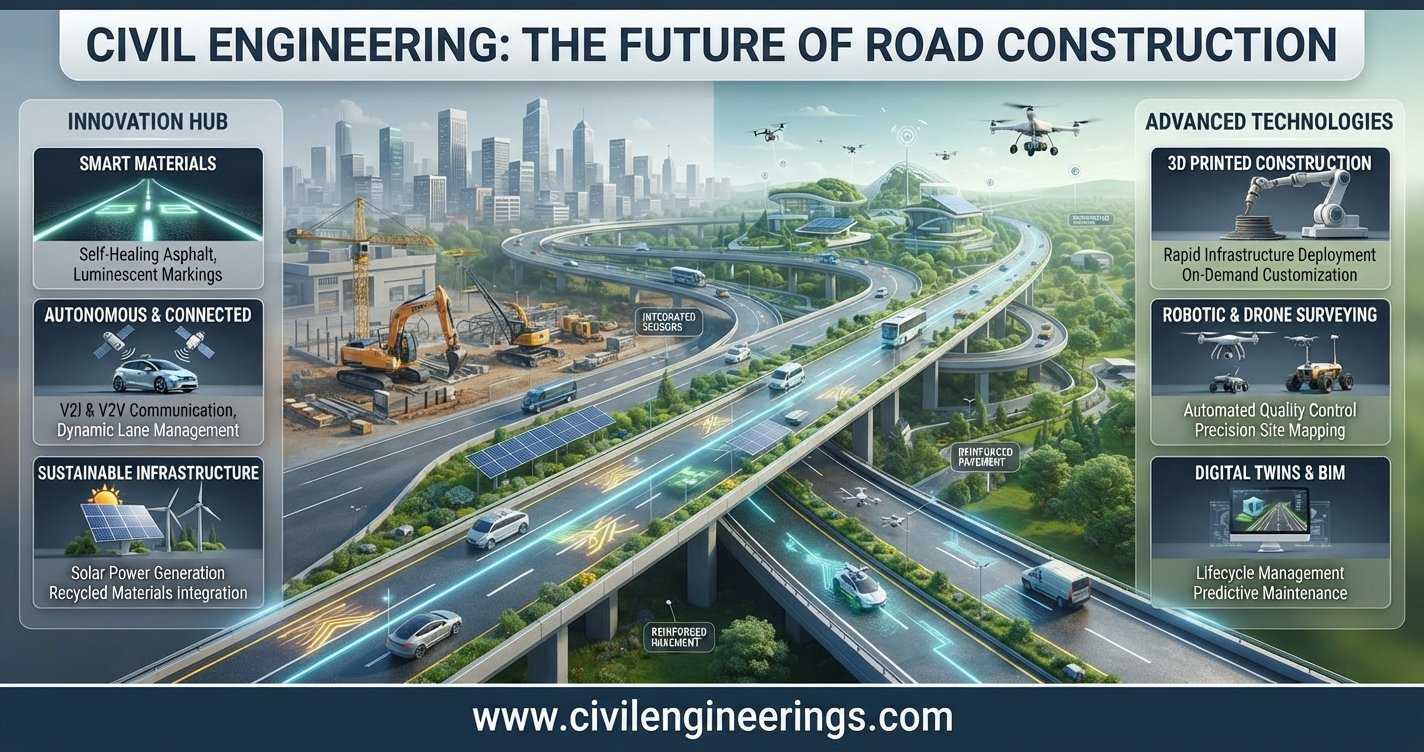
Roads are no longer being designed simply as layers of asphalt, concrete, and aggregates placed over prepared soil. The Future of Road Construction is moving toward intelligent, connected, sustainable, automated, and climate-resilient transportation infrastructure. Advances in artificial intelligence, robotics, digital surveying, smart materials, autonomous vehicles, and low-carbon construction methods are changing how highways are planned, designed, built, monitored, and maintained.
For engineers and infrastructure professionals, this transformation is more than a technological upgrade. It changes the way projects are managed from the earliest feasibility study through pavement construction and long-term maintenance. Digital twins can improve decision-making, drones can accelerate surveying, machine control can increase construction accuracy, and predictive maintenance can identify pavement problems before they become expensive failures.
This article examines the major technologies and engineering practices shaping the future of highways and roads. It also explains how sustainable materials, automation, AI, intelligent transportation systems, connected infrastructure, and resilient pavement design may influence upcoming projects. Whether you are a civil engineering student, highway engineer, contractor, consultant, or government infrastructure professional, understanding these developments can help you prepare for the next generation of road engineering.
Why the Future of Road Construction Matters
The transportation sector faces several difficult challenges. Traffic volumes continue to increase in many regions, construction budgets remain constrained, extreme weather events can damage infrastructure, and governments are under pressure to reduce carbon emissions.
Traditional road construction methods still have an important role, but future projects will need to deliver more performance with fewer resources.
A modern highway therefore needs to achieve several objectives simultaneously:
- Provide safe and reliable mobility.
- Handle increasing traffic demand.
- Reduce construction and maintenance costs.
- Minimize environmental impacts.
- Resist flooding, heat, heavy rainfall, and other climate stresses.
- Integrate with connected and autonomous vehicles.
- Use accurate digital information throughout its life cycle.
- Improve worker safety through automation.
- Extend pavement service life.
The future of road construction is consequently becoming a combination of civil engineering, data science, automation, materials science, environmental engineering, and transportation technology.
Artificial Intelligence in Road Construction
Artificial intelligence is expected to become one of the most influential technologies in future highway engineering. AI can process large quantities of project data and identify patterns that may be difficult to detect through conventional analysis.
AI-Based Highway Planning
During the planning stage, AI can assist engineers in evaluating alternative corridors, traffic conditions, terrain, environmental constraints, land-use patterns, and construction risks.
Instead of relying only on manual comparison, engineers can develop data-driven models that rank potential routes according to multiple criteria.
A simplified route evaluation model can be represented as:
Route Score = w₁C + w₂T + w₃E + w₄S + w₅R
Where:
- C = construction cost
- T = travel or transportation performance
- E = environmental impact
- S = safety performance
- R = project risk
- w₁ to w₅ = assigned weighting factors
The actual model used on a project would be considerably more sophisticated, but the principle demonstrates how multiple engineering factors can be evaluated together.
AI for Pavement Condition Assessment
AI-powered image recognition can analyze road photographs and video footage to identify:
- Cracks
- Potholes
- Rutting
- Edge failures
- Surface deterioration
- Patching
- Marking deficiencies
- Distress patterns
This technology can support pavement management systems by converting visual observations into structured condition data.
Rather than waiting for severe deterioration, agencies can use predictive models to prioritize maintenance before rehabilitation becomes significantly more expensive.
Predictive Maintenance
Predictive maintenance represents a major change from traditional road maintenance.
Instead of asking, “Which roads are already damaged?”, future systems will increasingly ask, “Which roads are likely to fail next?”
AI models can combine pavement condition, traffic loading, rainfall, temperature, drainage performance, pavement age, material properties, and previous maintenance history.
The resulting predictions can help agencies allocate maintenance budgets more effectively.
Digital Twins and Data-Driven Highway Engineering
A digital twin is a dynamic digital representation of a physical asset or system. In highway engineering, it can represent an entire corridor, interchange, bridge, drainage system, pavement network, or transportation facility.

BIM Integration in Road Projects
Building Information Modeling is becoming increasingly important in infrastructure projects. Instead of treating drawings as isolated documents, BIM creates connected digital information about physical infrastructure.
A highway BIM environment may contain information about:
- Horizontal alignment
- Vertical profile
- Earthworks
- Pavement layers
- Drainage structures
- Culverts
- Bridges
- Utilities
- Road furniture
- Signs
- Guardrails
- Lighting
- Construction quantities
The long-term benefit comes when this information remains useful after construction.
Digital Twin During Construction
During construction, survey data, drone imagery, machine-control information, material testing results, and progress records can be compared against the digital model.
This can help project teams identify deviations early.
For example, if the designed formation level differs from the surveyed construction surface, the discrepancy can be detected before subsequent pavement layers are placed.
Digital Twin During Maintenance
After opening a highway to traffic, sensors and inspection systems can continuously update the digital representation.
The asset manager could then see:
- Current pavement condition
- Structural deficiencies
- Drainage problems
- Traffic patterns
- Maintenance history
- Remaining service life
- Locations requiring inspection
This creates a more complete life-cycle approach to infrastructure management.
Robotics and Automation in Road Construction
Automation will increasingly affect repetitive, hazardous, and precision-sensitive construction activities.
Autonomous Construction Equipment
Future construction sites may use partially or fully automated:
- Motor graders
- Asphalt pavers
- Rollers
- Excavators
- Dozers
- Milling machines
- Surveying systems
Machine-control technology already allows equipment to use positioning data and digital terrain models to achieve greater grading accuracy.
Future systems may combine GNSS, LiDAR, cameras, artificial intelligence, and machine learning to improve autonomous decision-making.
Automated Asphalt Paving
Automated paving systems can help maintain:
- Paving width
- Layer thickness
- Grade
- Cross slope
- Temperature monitoring
- Smoothness
Consistent paving is important because variations in density, temperature, thickness, and compaction can affect pavement performance.
Robotic Road Maintenance
Robotic systems could eventually perform selected maintenance activities such as crack detection, marking inspection, localized repairs, and roadside monitoring.
The objective is not necessarily to eliminate workers. Instead, automation can reduce exposure to traffic and dangerous work environments while allowing engineers and operators to focus on higher-value decisions.
Smart Roads and Intelligent Transportation Infrastructure
The future highway will increasingly operate as an intelligent system rather than simply a physical pavement corridor.
Smart roads may incorporate sensors, communication systems, cameras, variable message signs, weather stations, connected signals, and traffic-management platforms.
Connected Road Infrastructure
Roadside infrastructure can communicate information to vehicles and traffic management centers.
Potential applications include:
- Collision warnings
- Congestion information
- Roadwork alerts
- Weather warnings
- Speed management
- Incident detection
- Lane-use information
- Emergency vehicle priority
This becomes particularly important as connected and automated vehicles become more widespread.
Intelligent Transportation Systems
Intelligent Transportation Systems, commonly called ITS, combine transportation engineering with communication and information technology.
An ITS network may collect information about:
- Traffic speed
- Vehicle volume
- Travel time
- Incidents
- Weather
- Road surface conditions
- Parking
- Public transportation
- Work zones
Engineers can use these data to improve traffic operations and traveler safety.
Sustainable Road Construction
Sustainability will become one of the defining characteristics of future highway development.
Future projects will need to consider not only initial construction cost but also carbon emissions, material consumption, energy use, maintenance requirements, and end-of-life recycling.


Recycled Asphalt Pavement
Reclaimed asphalt pavement can reduce the demand for virgin aggregates and asphalt binder.
When properly processed, characterized, designed, and controlled, recycled materials can become an important component of pavement construction.
Engineers must still verify:
- Aggregate quality
- Binder properties
- Gradation
- Moisture susceptibility
- Mix performance
- Recycling percentage
- Production temperature
Recycling should therefore be treated as an engineering decision rather than simply a waste-reduction strategy.
Warm Mix Asphalt
Warm Mix Asphalt allows asphalt mixtures to be produced and compacted at lower temperatures than conventional hot mix asphalt.
Potential benefits include reduced energy consumption, lower emissions at the plant, improved working conditions, and longer paving seasons in some circumstances.
Project-specific specifications and performance requirements should determine whether a particular warm-mix technology is appropriate.
Low-Carbon Pavement Materials
Future research is likely to increase the use of materials with lower embodied carbon.
Potential approaches include:
- Recycled aggregates
- Industrial by-products where technically suitable
- Recycled asphalt
- Alternative binders
- Lower-temperature production
- Longer-life pavement designs
- Cement-reduced concrete systems
- Locally sourced materials
The key principle is performance over the entire life cycle, not simply minimizing the material cost at construction.
Climate-Resilient Roads and Pavements
Climate resilience will become increasingly important in road design.
Flooding, extreme heat, intense rainfall, erosion, freeze-thaw cycles, and changing groundwater conditions can reduce pavement life and damage earthworks.
Improved Highway Drainage
Drainage is one of the most important elements of pavement durability.
Future designs may use:
- Smart drainage monitoring
- Improved culvert capacity assessment
- Flood forecasting
- Permeable systems in suitable applications
- Better roadside channels
- Erosion-control measures
- Real-time water-level sensors
A pavement structure can be technically excellent and still experience premature deterioration if water is allowed to enter or remain within vulnerable layers.
Heat-Resistant Pavements
Higher pavement temperatures can accelerate asphalt aging, rutting, and deformation.
Engineers may increasingly evaluate binder grades, mixture characteristics, pavement thickness, surface properties, and climate-specific performance requirements to improve resistance to thermal stresses.
Advanced Road Materials
Materials science is another area likely to influence highway construction significantly.
Self-Healing Asphalt
Researchers have investigated asphalt mixtures capable of partially restoring cracks through thermal, chemical, or induction-based mechanisms.
Although self-healing technologies are not yet a universal replacement for conventional pavement maintenance, continued research may make selected applications commercially practical.
Fiber-Reinforced Materials
Fibers can improve selected pavement and concrete properties when the material system is properly designed.
Depending on the application, fibers may help control cracking, improve toughness, or enhance structural performance.
High-Performance Concrete
For rigid pavements and highway structures, high-performance concrete can provide improved durability and strength when its constituent materials, curing, and mixture proportions are properly controlled.
Engineers should select materials based on exposure conditions and required performance rather than strength alone.
3D Printing and Advanced Construction Methods
3D printing is another emerging technology with potential applications in infrastructure.
Although printing an entire highway remains technically and economically challenging, additive manufacturing may become useful for selected infrastructure components.
Potential applications include:
- Drainage components
- Roadside structures
- Small concrete elements
- Temporary construction components
- Customized infrastructure parts
The major engineering questions will involve structural performance, production speed, material durability, quality control, codes, and cost.
Drone Surveying and Remote Monitoring
Drones have already changed surveying and construction monitoring on many projects.
A drone can capture large quantities of aerial imagery in a relatively short period.
Applications of Drone Technology
Highway projects can use drones for:
- Topographic surveys
- Progress monitoring
- Stockpile measurement
- Earthwork calculations
- Corridor inspection
- Slope monitoring
- Construction documentation
- Road condition assessment
When combined with photogrammetry or LiDAR, drone surveys can produce detailed terrain models.
However, engineers should verify survey accuracy, establish suitable ground control, comply with applicable regulations, and ensure that the data meet project requirements.
Autonomous Vehicles and the Future Highway
The growth of connected and autonomous vehicles may influence highway geometry, traffic management, pavement markings, signs, and roadside communication.
Future infrastructure could provide vehicles with more precise information about:
- Lane boundaries
- Road geometry
- Work zones
- Speed restrictions
- Traffic conditions
- Incidents
- Weather
- Temporary lane changes
Road Markings and Machine Vision
Autonomous vehicles rely heavily on sensors and machine perception.
This means road markings will need to remain visible, consistent, and properly maintained.
Poor markings, damaged signs, unclear temporary traffic control, and inadequate delineation may create additional challenges for automated driving systems.
Smart Materials and Embedded Sensors
Sensors embedded within or placed around infrastructure can provide real-time information about road conditions.
Possible measurements include:
- Temperature
- Strain
- Moisture
- Traffic loading
- Vibration
- Structural movement
- Pavement response
Instead of depending entirely on periodic inspections, agencies could use continuous monitoring for critical assets.
This approach supports condition-based maintenance and better asset management.
Advanced Highway Safety Systems
Road safety will remain a central engineering objective regardless of technological development.
Future safety systems may use AI-powered cameras and connected sensors to identify dangerous situations.
Potential applications include:
- Wrong-way driving detection
- Pedestrian detection
- Queue warning
- Incident detection
- Variable speed control
- Work-zone alerts
- Dynamic lane management
Safer Work Zones
Road construction work zones are among the most hazardous environments for highway workers.
Automation, remote monitoring, connected warning systems, impact protection devices, and intelligent traffic control can reduce worker exposure to moving traffic.
Contractors should combine technology with established traffic management plans rather than treating technology as a substitute for fundamental safety practices.
Role of IRC, AASHTO, and ICE in Future Road Engineering
Future technologies still require engineering standards, professional judgment, testing, and regulatory control.
Organizations and standards frameworks such as the Indian Roads Congress (IRC), American Association of State Highway and Transportation Officials (AASHTO), and Institution of Civil Engineers (ICE) provide valuable technical guidance, professional knowledge, and engineering frameworks.
Emerging technologies should not be adopted merely because they are new.
Engineers should ask:
- Does the technology improve measurable performance?
- Has it been adequately tested?
- Does it satisfy applicable specifications?
- Can contractors implement it reliably?
- Is trained personnel available?
- Can the owner maintain the system?
- Does the life-cycle benefit justify the additional cost?
Project specifications and local authority requirements should always take precedence over generalized technological claims.
Practical Recommendations for Civil Engineering Students
Students preparing for careers in road and highway engineering should develop both traditional engineering fundamentals and digital skills.
Focus on:
- Highway geometric design
- Pavement engineering
- Soil mechanics
- Surveying
- Transportation engineering
- Construction materials
- Quantity estimation
- CAD and Civil 3D-type workflows
- BIM
- GIS
- Data analysis
- Basic programming
- Drone surveying concepts
- Intelligent transportation systems
Do not abandon fundamentals for technology.
A strong understanding of pavement behavior, drainage, traffic loading, materials, and construction methods will make digital tools much more useful.
Practical Recommendations for Highway Engineers
Highway engineers should gradually incorporate digital workflows into conventional engineering practice.
Useful priorities include:
- Establishing reliable project data standards.
- Using digital terrain models for design coordination.
- Integrating survey and construction data.
- Monitoring pavement performance systematically.
- Evaluating life-cycle costs.
- Learning AI-assisted inspection methods.
- Considering climate resilience during design.
- Using BIM for multidisciplinary coordination.
- Developing measurable performance criteria for new technologies.
Technology should solve an engineering problem. It should not become an additional layer of complexity without a clear benefit.
Practical Recommendations for Contractors
Contractors will play a major role in turning future road technologies into practical construction systems.
Contractors should invest in:
- Skilled equipment operators
- Machine-control systems
- Digital quantity tracking
- Automated quality monitoring
- Modern survey equipment
- Construction data management
- Worker safety technology
- Preventive equipment maintenance
Quality control remains essential.
Even advanced equipment cannot compensate for poor material storage, inadequate compaction, improper temperature control, weak drainage, or poor construction sequencing.
Future Road Construction Cost Considerations
New technology can initially increase project costs.
Sensors, software, automated machinery, BIM implementation, digital surveying, and specialized materials may require additional investment.
However, the correct comparison should consider life-cycle cost, not only initial capital expenditure.
A simplified life-cycle cost concept is:
LCC = Initial Cost + Maintenance Cost + Rehabilitation Cost + User Cost − Residual Value
The exact methodology varies by project and agency.
A more expensive pavement system may become economically attractive if it lasts substantially longer or requires less maintenance.
Challenges Facing the Future of Road Construction
Despite its potential, the transformation of road construction will not happen without obstacles.
High Initial Investment
Digital systems and advanced machinery can be expensive, especially for smaller contractors and developing infrastructure agencies.
Skills Gap
The industry needs professionals who understand both engineering principles and digital technologies.
Data Quality
AI and predictive systems are only as reliable as the data used to train and operate them.
Poor survey information or inconsistent inspection records can produce unreliable conclusions.
Cybersecurity
Connected transportation infrastructure introduces cybersecurity concerns. Traffic systems, sensors, communication networks, and centralized control platforms need appropriate security measures.
Standards and Regulation
New materials and automated technologies must fit within engineering standards, procurement systems, testing procedures, and legal frameworks.
Technology Integration
The biggest challenge may not be adopting individual technologies. It may be integrating them into one reliable project workflow.
What Will Road Construction Look Like by 2035 and Beyond?
The highway construction site of the future is likely to be significantly more connected than today’s typical project.
A possible workflow could look like this:
Satellite/GIS Data → AI Route Analysis → Digital Engineering Model → Drone Survey → Automated Earthworks → Intelligent Paving → Sensor-Based Quality Control → Digital Twin → Predictive Maintenance
The engineer remains responsible for interpreting information and making sound decisions.
Machines may perform more measurements and repetitive operations, but professional judgment will remain essential.
Future road infrastructure will therefore be less about replacing engineers and more about giving engineers better information, faster analysis, and safer construction environments.
Best Practices for Implementing Future Road Technologies
Organizations planning to modernize their road construction operations should adopt technology gradually.
Start With a Real Engineering Problem
Do not purchase technology simply because it is fashionable.
Identify the problem first. It may be poor pavement inspection, inaccurate quantities, construction delays, unsafe work zones, or high maintenance costs.
Establish Baseline Performance
Measure current performance before implementing a new system.
Useful indicators include:
- Construction productivity
- Pavement quality
- Inspection time
- Accident frequency
- Maintenance expenditure
- Material consumption
- Project delays
Run Pilot Projects
A pilot project can reveal technical, operational, and financial problems before large-scale implementation.
Train Personnel
Technology without trained users rarely produces its full value.
Evaluate Life-Cycle Benefits
Compare capital cost, operating cost, maintenance requirements, durability, and expected service life.
Frequently Asked Questions About Future of Road Construction
1. What is the Future of Road Construction?
The Future of Road Construction involves greater use of artificial intelligence, automation, digital twins, BIM, sustainable materials, smart sensors, connected infrastructure, drones, and predictive maintenance alongside conventional civil engineering practices.
2. How will AI change highway construction?
AI can assist with route analysis, pavement inspection, traffic forecasting, construction planning, risk assessment, quality monitoring, and predictive maintenance. It can help engineers make faster decisions from large datasets.
3. Will robots replace highway engineers?
Robots are more likely to automate repetitive and hazardous tasks than replace professional engineers. Engineering judgment, design responsibility, regulatory compliance, project management, and complex decision-making will continue to require qualified professionals.
4. What sustainable materials will be used in future roads?
Future projects may increasingly use recycled asphalt pavement, recycled aggregates, warm-mix technologies, optimized concrete mixtures, alternative binders, and other lower-carbon materials where they meet performance requirements.
5. How will autonomous vehicles affect highway design?
Autonomous vehicles may increase demand for reliable road markings, connected infrastructure, machine-readable signs, accurate digital road information, intelligent traffic management, and improved work-zone communication.
6. What is a digital twin in road engineering?
A digital twin is a continuously updated digital representation of a physical road or highway asset. It can combine design information, survey data, sensor readings, inspection results, traffic information, and maintenance records.
7. Will future roads use sensors?
Yes. Sensors can potentially monitor pavement temperature, moisture, strain, traffic loading, vibration, structural movement, and other parameters. This information can support condition monitoring and predictive maintenance.
8. Why is climate resilience important in future highway design?
Changing rainfall patterns, flooding, extreme heat, erosion, and other environmental stresses can accelerate infrastructure deterioration. Future designs need to consider these risks during route selection, drainage design, pavement selection, and maintenance planning.
9. What should civil engineering students learn for future highway jobs?
Students should combine highway engineering, pavement design, surveying, transportation engineering, geotechnical engineering, BIM, GIS, CAD, data analysis, and basic programming skills. Strong fundamentals remain essential.
10. What is the biggest challenge in future road construction?
One major challenge is integrating advanced technology with established engineering standards, construction practices, budgets, workforce skills, data systems, and maintenance requirements. Successful implementation requires engineering judgment rather than technology adoption alone.
Conclusion:
The Future of Road Construction will be defined by a combination of engineering fundamentals and rapidly developing digital technologies. Artificial intelligence, BIM, digital twins, drones, automated machinery, smart sensors, sustainable materials, predictive maintenance, and intelligent transportation systems are already changing parts of the highway industry.
However, technology alone will not produce better roads. Successful infrastructure still depends on accurate surveys, sound geometric design, appropriate pavement structures, effective drainage, quality materials, competent construction, proper compaction, traffic safety, and disciplined maintenance.
The strongest future projects will connect these traditional principles with modern data-driven tools. Civil engineering students should therefore develop digital skills without neglecting core engineering knowledge. Engineers should evaluate new technologies through measurable performance. Contractors should focus on training, quality control, and practical implementation.
Ultimately, the goal is not simply to build technologically advanced highways. It is to create safer, longer-lasting, more sustainable, climate-resilient, cost-effective, and intelligent transportation infrastructure that serves communities for decades.

Kamran Malik is a passionate civil engineering writer and researcher who specializes in construction, transportation, structural engineering, and infrastructure topics. Through his articles on CivilEngineerings.com, he simplifies complex engineering concepts and shares practical insights, industry trends, and educational resources for students, professionals, and engineering enthusiasts.