
Introduction
Rural Road Design is one of the most important disciplines in highway engineering because it provides safe, reliable, and cost-effective transportation to rural communities. Well-planned rural roads connect villages with towns, markets, schools, hospitals, and industrial areas, improving economic development and the quality of life. Unlike urban roads, rural roads often pass through agricultural land, forests, hills, and remote regions, making their design more challenging. Engineers must balance safety, durability, environmental protection, and construction costs while ensuring long-term performance.
Whether you are a civil engineering student, highway engineer, site engineer, contractor, consultant, or researcher, understanding Rural Road Design is essential. This guide explains the engineering principles, planning process, design components, and best practices used to develop modern rural road infrastructure.
What is Rural Road Design?
Rural Road Design is the systematic process of planning, surveying, designing, constructing, and maintaining roads that serve villages, agricultural areas, mining regions, forests, and other low-density locations. The primary objective is to provide safe and efficient transportation while maintaining affordability and long-term durability.
Unlike expressways or urban roads, rural roads generally carry lower traffic volumes but often experience heavier axle loads from agricultural machinery, trucks, and construction vehicles. Therefore, engineers must design pavements and drainage systems that perform reliably under varying weather and soil conditions.
The design process considers several engineering factors, including:
- Traffic volume and vehicle composition
- Terrain and topography
- Soil strength and bearing capacity
- Rainfall and drainage
- Environmental conditions
- Available construction materials
- Future traffic growth
- Maintenance requirements
A properly designed rural road reduces transportation costs, improves accessibility, and supports sustainable regional development.
Importance of Rural Road Design
An efficient rural road network is essential for both economic growth and social development. It connects isolated communities with employment opportunities, healthcare facilities, educational institutions, and commercial markets.
Improves Accessibility
Reliable rural roads enable year-round transportation between villages and nearby urban centers. Better accessibility reduces travel time and increases mobility for residents.
Supports Agricultural Development
Agriculture depends heavily on transportation. Farmers require dependable roads to move crops, fertilizers, livestock, and machinery efficiently. Better road connectivity minimizes transportation delays and reduces post-harvest losses.
Promotes Economic Growth
Good transportation infrastructure encourages investment, supports local businesses, improves tourism, and creates employment opportunities throughout rural regions.
Enhances Road Safety
Proper alignment, sufficient sight distance, road markings, drainage, and shoulders significantly reduce the risk of accidents.
Strengthens Emergency Services
Emergency vehicles, ambulances, and disaster response teams can quickly reach remote communities when roads remain accessible throughout the year.
Encourages Balanced Regional Development
Rural infrastructure helps reduce the development gap between urban and rural areas by improving access to essential services and public facilities.
Objectives of Rural Road Design
Every rural road project should satisfy multiple engineering, environmental, and economic objectives.
Provide Safe Transportation
The road should safely accommodate pedestrians, bicycles, motorcycles, passenger cars, buses, tractors, and heavy vehicles.
Improve Riding Comfort
Proper pavement smoothness, horizontal alignment, vertical curves, and gradients enhance driving comfort while reducing vehicle operating costs.
Minimize Construction Costs
Selecting economical alignments and utilizing locally available materials lowers project costs without sacrificing quality.
Increase Pavement Life
Effective pavement design and drainage systems extend service life while minimizing maintenance expenses.
Reduce Environmental Impact
Roads should preserve natural watercourses, minimize unnecessary earthwork, and reduce erosion wherever practical.
Simplify Maintenance
Designing roads with durable materials and proper drainage reduces maintenance frequency and lifecycle costs.
Classification of Rural Roads
Rural roads can be classified according to their function, administrative importance, and traffic volume.
Primary Rural Roads
Primary rural roads connect major towns, district headquarters, industrial zones, and regional transportation corridors.
Characteristics
- Higher traffic volume
- Wider carriageway
- Better pavement quality
- Improved drainage
- Higher design speed
Secondary Rural Roads
These roads connect smaller towns with primary roads and serve as important regional transportation links.
Typical characteristics include:
- Moderate traffic volume
- Intermediate pavement standards
- Lower design speed than primary roads
- Economical construction
Village Roads
Village roads provide direct access to residential communities, schools, healthcare centers, agricultural land, and local markets.
Features include:
- Low traffic volume
- Narrow carriageway
- Lower construction cost
- Simple drainage systems
Agricultural Roads
Agricultural roads mainly serve farming operations by transporting crops, fertilizers, livestock, and agricultural equipment.
Their design focuses on:
- Adequate load-carrying capacity
- Seasonal accessibility
- Low maintenance requirements
- Cost-effective construction
Key Components of Rural Road Design
Several engineering elements work together to ensure the road performs safely and efficiently throughout its design life.
1. Road Alignment
Road alignment defines the horizontal and vertical path followed by the roadway.
A good alignment should:
- Follow natural terrain
- Reduce excavation
- Avoid unstable slopes
- Minimize sharp curves
- Lower construction costs
- Improve driver safety
2. Carriageway
The carriageway is the paved portion used by moving vehicles.
Its width depends on:
- Design speed
- Traffic volume
- Vehicle type
- Functional road classification
3. Shoulders
Shoulders provide additional structural support and improve safety by allowing emergency stopping and vehicle recovery.
They also protect pavement edges from damage.
Common shoulder materials include:
- Gravel
- Crushed stone
- Asphalt
- Concrete
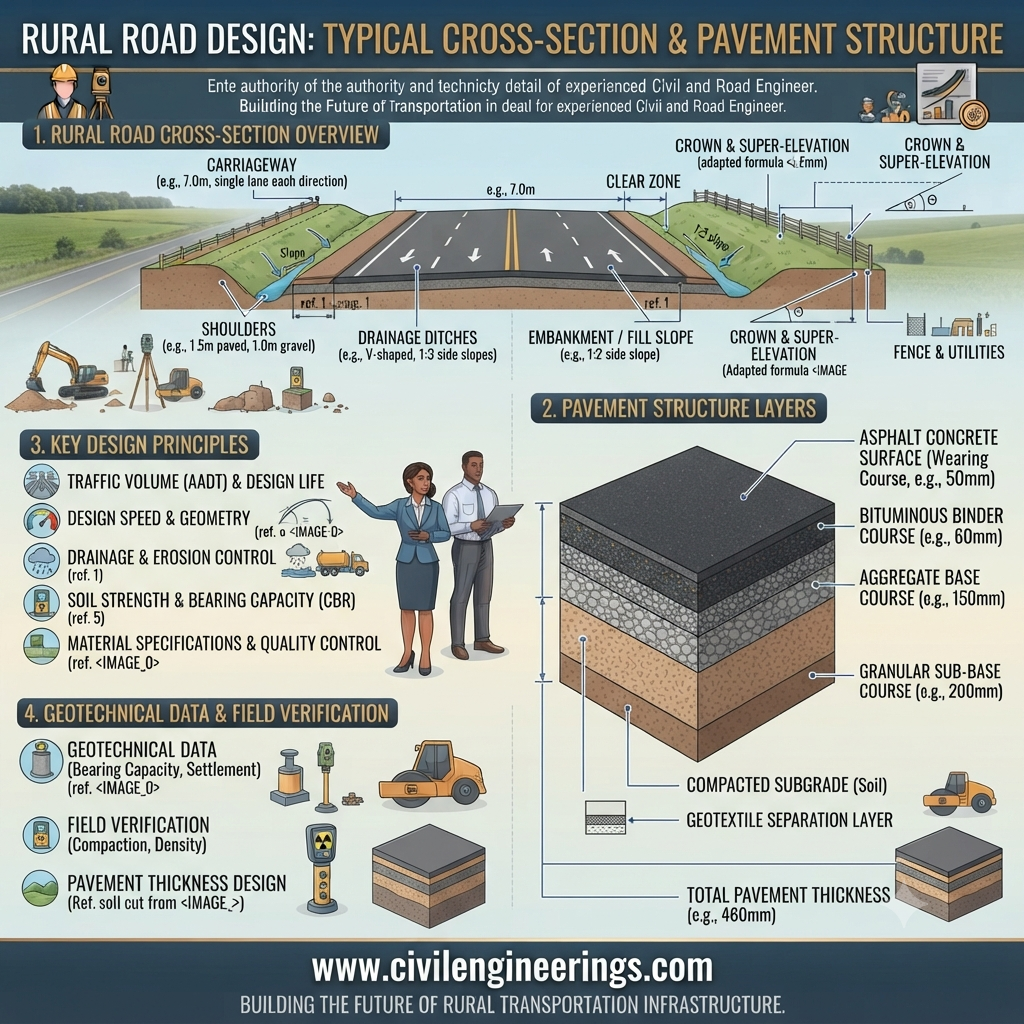
4. Pavement Structure
The pavement distributes traffic loads safely onto the underlying soil.
Typical pavement layers include:
       Asphalt Surface
==============================

        Base Course
------------------------------

      Sub-base Course
------------------------------

      Compacted Subgrade
______________________________
Each layer performs a unique engineering function, contributing to pavement strength, stability, and durability.
5. Drainage System
Drainage is one of the most critical aspects of Rural Road Design because water is the leading cause of pavement deterioration.
Typical drainage components include:
- Side drains
- Cross drains
- Culverts
- Catch water drains
- Longitudinal drains
- Camber
- Cross slope
Proper drainage prevents erosion, minimizes pavement failures, and extends road service life.
6. Roadside Safety Features
Modern rural roads should include safety measures such as:
- Warning signs
- Regulatory signs
- Delineator posts
- Guardrails near embankments
- Reflective pavement markers
- Speed calming measures near villages
These features significantly reduce accident risks, particularly during nighttime and adverse weather conditions.
Factors Affecting Rural Road Design
Several technical and environmental factors influence the final design.
Traffic Volume
Traffic surveys determine:
- Average Daily Traffic (ADT)
- Percentage of heavy vehicles
- Future traffic growth
- Seasonal traffic variation
These values influence pavement thickness and geometric design.
Terrain
Road alignment varies according to terrain.
Typical terrain classifications include:
- Plain terrain
- Rolling terrain
- Mountainous terrain
- Steep terrain
Difficult terrain generally requires additional earthwork, retaining structures, and drainage measures.
Soil Conditions
Subgrade strength directly affects pavement performance.
Engineers commonly evaluate soil using:
- California Bearing Ratio (CBR)
- Standard Proctor Test
- Modified Proctor Test
- Plate Load Test
Weak soils often require stabilization before pavement construction.
Climate
Environmental conditions influence pavement performance and maintenance requirements.
Important climatic factors include:
- Rainfall
- Temperature
- Flooding
- Frost action
- Moisture variation
Proper drainage design becomes especially important in regions experiencing heavy seasonal rainfall.
Available Construction Materials
Using locally available materials can reduce construction costs while maintaining sustainability.
Common materials include:
- Crushed aggregates
- Sand
- Gravel
- Bitumen
- Cement
- Stabilized soil
- Crushed rock
Basic Cross Section of a Rural Road
 Shoulder      Carriageway       Shoulder
----------==================----------
          Asphalt Surface
---------------------------------------
            Base Course
---------------------------------------
          Sub-base Course
---------------------------------------
        Compacted Subgrade
_______________________________________

   Side Drain              Side Drain
This typical cross section illustrates how pavement layers, shoulders, and drainage work together to create a stable and durable rural road.
Rural Road Network Planning
Successful Rural Road Design begins long before construction starts. Proper planning ensures the road meets transportation needs, remains economically viable, and minimizes environmental impacts throughout its service life.
The planning stage involves collecting technical, economic, and environmental data to determine the most suitable road alignment and pavement structure.
1. Traffic Studies
Traffic surveys help engineers estimate present and future transportation demand.
Typical data collected include:
- Average Daily Traffic (ADT)
- Peak Hour Traffic
- Vehicle classification
- Percentage of heavy commercial vehicles
- Traffic growth rate
- Seasonal traffic variation
Accurate traffic forecasting ensures the pavement is neither under-designed nor unnecessarily expensive.
2. Topographic Survey
A detailed survey identifies natural ground features and existing infrastructure.
Common survey information includes:
- Ground elevations
- Contour maps
- Rivers and streams
- Existing roads
- Buildings
- Utility lines
- Property boundaries
Modern surveys use GPS, Total Stations, UAVs (drones), and digital terrain models to improve accuracy.
3. Geotechnical Investigation
The pavement performance depends heavily on subgrade quality.
Engineers investigate:
- Soil type
- Moisture content
- Bearing capacity
- Groundwater level
- Soil permeability
- Swelling or shrinkage potential
Laboratory and field tests provide essential design parameters.
4. Environmental Assessment
Environmental considerations help reduce long-term impacts.
Important aspects include:
- Natural drainage patterns
- Wildlife habitats
- Agricultural land
- Forest areas
- Soil erosion risks
- Flood-prone zones
A well-planned alignment balances engineering requirements with environmental sustainability.
Geometric Design in Rural Road Design
Geometric design determines the physical layout of the roadway, directly influencing safety, efficiency, and driving comfort.
Horizontal Alignment
Horizontal alignment consists of straight sections connected by curves.
A good alignment should:
- Minimize sharp bends
- Provide adequate stopping sight distance
- Follow natural terrain where practical
- Reduce earthwork costs
- Improve driving comfort
Smooth transitions between straight and curved sections enhance vehicle stability and reduce accident risks.
Vertical Alignment
Vertical alignment defines the road profile along its length.
It consists of:
- Gradients
- Summit curves
- Valley curves
Proper vertical alignment improves:
- Driver visibility
- Drainage
- Fuel efficiency
- Vehicle safety
Steep gradients should be avoided whenever possible, particularly on routes carrying heavy trucks and agricultural machinery.
Sight Distance
Adequate sight distance allows drivers to perceive hazards and stop safely.
Key types include:
- Stopping Sight Distance (SSD)
- Overtaking Sight Distance (OSD)
- Decision Sight Distance
Maintaining clear visibility at curves and intersections significantly improves road safety.
Camber (Cross Slope)
Camber allows rainwater to drain quickly from the pavement surface.
Typical Road Camber
          Crown
            ▲
           / \
          /   \
---------/-----\---------
      Water Flow
Proper camber reduces water infiltration and prolongs pavement life.
Road Shoulders
Shoulders improve structural support and provide emergency stopping space.
Benefits include:
- Increased safety
- Edge protection
- Drainage support
- Space for maintenance operations
Pavement Design for Rural Roads
Pavement design aims to distribute traffic loads safely to the underlying soil while maintaining ride quality and durability.
Flexible Pavement
Flexible pavements are commonly used for rural roads due to their lower construction cost and ease of maintenance.
Typical layers include:
- Asphalt wearing course
- Base course
- Sub-base
- Compacted subgrade
Advantages
- Economical
- Faster construction
- Easy maintenance
- Comfortable riding surface
Rigid Pavement
Rigid pavements consist primarily of Portland cement concrete.
They are suitable where:
- Heavy axle loads exist
- Maintenance access is difficult
- Long service life is required
Although initial costs are higher, maintenance requirements are generally lower.
Typical Pavement Structure
 Asphalt Surface Course
==============================

 Base Course
------------------------------

 Granular Sub-base
------------------------------

 Compacted Subgrade
______________________________
Basic Engineering Calculations
Engineering calculations ensure the road meets structural and geometric requirements.
1. Road Gradient
Formula
[
\text{Gradient (%)} = \frac{\text{Vertical Rise}}{\text{Horizontal Distance}} \times 100
]
Example
Vertical rise = 3 m
Horizontal distance = 60 m
Gradient
= (3 ÷ 60) × 100
= 5%
A 5% gradient means the road rises 5 meters for every 100 meters of horizontal distance.
2. Camber Calculation
Formula
[
\text{Camber} = \frac{\text{Cross Fall}}{\text{Road Width}}
]
Example:
Road width = 7.0 m
Cross fall = 0.175 m
Camber
= 0.175 / 7
+ 0.025
= 2.5%
This slope helps drain rainwater efficiently.
3. Pavement Thickness (Concept)
Pavement thickness depends on:
- Traffic loading
- CBR value
- Soil type
- Climate
- Design life
- Material quality
Engineers determine the final thickness using recognized pavement design methods rather than a single universal equation.
Materials Used in Rural Road Construction
Material selection greatly influences pavement strength, durability, and maintenance costs.
Bitumen
Bitumen provides flexibility, waterproofing, and strong bonding between aggregates in asphalt pavements.
Cement
Cement is widely used for:
- Concrete pavements
- Culverts
- Side drains
- Bridges
- Retaining structures
Aggregates
Aggregates form the structural backbone of pavement layers.
Good aggregates should possess:
- High crushing strength
- Abrasion resistance
- Durability
- Proper grading
Sand
Sand is commonly used in:
- Concrete production
- Mortar
- Bedding layers
- Drainage filters
Geotextiles
Geotextiles improve pavement performance by:
- Separating soil layers
- Providing filtration
- Improving drainage
- Preventing contamination
Geogrids
Geogrids reinforce weak subgrades by distributing wheel loads over a larger area.
They are particularly useful on soft soils.
Reinforcement
Steel reinforcement is commonly used in:
- Bridges
- Culverts
- Retaining walls
- Concrete slabs
Concrete
Concrete provides excellent durability for structures subjected to heavy loads and water exposure.
Asphalt
Asphalt produces a smooth, flexible riding surface while reducing vehicle operating costs.
Soil Stabilizers
Stabilizers improve weak soils using materials such as:
- Lime
- Cement
- Fly ash
- Chemical additives
Equipment Used in Rural Road Construction
Modern road construction relies on specialized equipment for efficiency and quality.
Survey Instruments
- GPS receivers
- Total Stations
- Automatic Levels
- Drones
Earthwork Equipment
- Excavators
- Bulldozers
- Loaders
- Backhoe Loaders
Grading Equipment
Motor graders shape the road formation and prepare the subgrade before pavement construction.
Compaction Equipment
Compaction equipment includes:
- Vibratory rollers
- Smooth wheel rollers
- Pneumatic rollers
- Sheep foot rollers
Proper compaction increases pavement strength and reduces settlement.
Asphalt Construction Equipment
Flexible pavement construction commonly uses:
- Asphalt pavers
- Bitumen distributors
- Chip spreaders
Concrete Equipment
Concrete works require:
- Concrete mixers
- Transit mixers
- Vibrators
- Concrete pumps
Rural Road Construction Process
Step 1 – Planning
The project begins with feasibility studies, traffic analysis, budgeting, and route selection.
Step 2 – Surveying
Surveyors establish alignment, benchmarks, cross-sections, and centerlines using modern survey equipment.
Step 3 – Design
Engineers prepare:
- Horizontal alignment
- Vertical profile
- Pavement design
- Drainage system
- Cross-sections
- Quantity estimates
Step 4 – Material Selection
Construction materials are selected based on engineering properties, local availability, climate, and project budget.
Step 5 – Earthwork
Earthwork operations include:
- Clearing
- Grubbing
- Excavation
- Embankment construction
- Subgrade preparation
- Compaction
Proper moisture control during compaction is essential for achieving design density.
Step 6 – Pavement Construction
Typical construction sequence:
- Subgrade preparation
- Sub-base placement
- Base course construction
- Asphalt or concrete paving
- Shoulder construction
- Drainage works
- Road furniture installation
Step 7 – Quality Control
Continuous inspection ensures compliance with project specifications.
Common quality control tests include:
- California Bearing Ratio (CBR) Test
- Standard Proctor Test
- Modified Proctor Test
- Marshall Stability Test
- Slump Test
- Core Cutting Test
- Density Test
- Plate Load Test
- Aggregate Crushing Value Test
- Bitumen Content Test
These tests verify material quality, compaction, pavement strength, and structural performance.
Step 8 – Maintenance Planning
Routine maintenance begins immediately after construction and includes:
- Crack sealing
- Pothole repairs
- Shoulder maintenance
- Drain cleaning
- Vegetation control
- Pavement resurfacing
Preventive maintenance significantly extends pavement service life.
End of Part 2
Part 3 will include:
- General overview of IRC, AASHTO, ASTM, FHWA, ICE, and ISO guidance
- Best Practices for Engineers, Contractors, and Students
- Common Mistakes, Their Consequences, and Prevention
- 6–8 detailed FAQs (80–100 words each)
- 120–150 word Conclusion
- Final Quality Checklist
- Persuasive Meta Description (115–140 characters)
Engineering Standards for Rural Road Design
Successful Rural Road Design follows recognized engineering standards and guidelines to achieve safety, durability, and long-term performance. Although the exact requirements vary by country and project, engineers commonly refer to internationally accepted organizations for best practices.
Indian Roads Congress (IRC)
The IRC publishes guidance on geometric design, pavement design, drainage, traffic engineering, road safety, and maintenance. Its recommendations help engineers develop safe, economical, and durable rural road networks suited to local traffic and environmental conditions.
AASHTO (American Association of State Highway and Transportation Officials)
AASHTO provides internationally respected guidance on:
- Highway geometric design
- Pavement design principles
- Bridge engineering
- Traffic loading
- Road safety
Many countries adapt AASHTO concepts to their national standards because of their strong engineering foundation.
ASTM International
ASTM develops standardized testing procedures for construction materials.
Common ASTM applications include:
- Aggregate quality testing
- Asphalt evaluation
- Concrete testing
- Soil classification
- Geotextile performance
Using standardized tests ensures consistency and reliable material performance.
FHWA (Federal Highway Administration)
The FHWA promotes best practices in:
- Rural transportation planning
- Highway safety
- Asset management
- Sustainable infrastructure
- Pavement preservation
Its publications are valuable references for engineers involved in modern road projects.
ISO Standards
ISO standards support quality management, environmental management, occupational safety, and laboratory testing.
Following ISO principles improves project quality, documentation, and continuous improvement.
Institution of Civil Engineers (ICE)
The ICE publishes technical guidance, research papers, and engineering best practices covering transportation infrastructure, sustainability, construction management, and professional development.
Best Practices for Rural Road Design
Engineers
- Conduct detailed traffic and topographic surveys before beginning design.
- Select an alignment that minimizes earthwork and environmental impacts.
- Design an efficient drainage system to prevent water-related pavement failures.
- Use locally available materials where they meet engineering requirements.
- Verify design assumptions through geotechnical investigations.
- Consider future traffic growth rather than current traffic alone.
- Incorporate road safety features from the initial design stage.
- Perform regular construction inspections to maintain quality.
Contractors
- Follow approved construction drawings and specifications.
- Ensure proper moisture content during compaction.
- Store bitumen and cement correctly to prevent material deterioration.
- Calibrate construction equipment regularly.
- Maintain accurate quality control records.
- Protect completed pavement layers from construction traffic.
- Keep drainage channels free from debris throughout construction.
- Implement strong health and safety practices on site.
Civil Engineering Students
- Understand the relationship between soil strength and pavement design.
- Practice interpreting engineering drawings and cross-sections.
- Learn field surveying techniques using Total Stations and GPS.
- Study pavement failures and their causes.
- Gain familiarity with material testing procedures.
- Visit active road construction projects whenever possible.
- Stay updated with modern highway engineering technologies and standards.
Common Mistakes in Rural Road Design
Even experienced professionals can encounter problems if important design principles are overlooked.
Poor Drainage Design
Why it Occurs
Drainage is often underestimated during the planning stage.
Consequences
- Water infiltration
- Pavement cracking
- Potholes
- Subgrade weakening
- Reduced pavement life
Prevention
Provide adequate camber, side drains, culverts, and cross-drainage structures to quickly remove surface water.
Inadequate Soil Investigation
Why it Occurs
Limited project budgets or insufficient site investigations.
Consequences
- Excessive settlement
- Rutting
- Pavement failure
- Increased maintenance costs
Prevention
Carry out comprehensive geotechnical investigations and laboratory testing before finalizing pavement design.
Incorrect Traffic Estimation
Why it Occurs
Using outdated traffic data or ignoring future growth.
Consequences
- Under-designed pavements
- Premature structural failures
- Increased rehabilitation costs
Prevention
Use reliable traffic surveys and realistic traffic growth projections.
Poor Compaction
Why it Occurs
Improper moisture content or insufficient rolling.
Consequences
- Differential settlement
- Cracking
- Reduced bearing capacity
- Shortened pavement life
Prevention
Monitor field density regularly using approved testing methods and achieve the specified compaction requirements.
Using Low-Quality Materials
Why it Occurs
Cost-cutting measures or inadequate quality control.
Consequences
- Weak pavement layers
- Reduced durability
- Higher maintenance costs
Prevention
Test all materials before use and reject those that fail to meet project specifications.
Frequently Asked Questions (FAQs)
1. What is Rural Road Design?
Rural Road Design is the engineering process of planning, surveying, designing, constructing, and maintaining roads that serve villages, agricultural regions, and remote communities. It considers traffic demand, soil conditions, terrain, drainage, environmental factors, and available materials to create roads that are safe, durable, and economical. A well-designed rural road improves connectivity, supports local economies, and reduces long-term maintenance costs.
2. Why is drainage important in rural roads?
Drainage is one of the most critical factors affecting pavement performance. Water weakens the subgrade, reduces bearing capacity, and accelerates pavement deterioration. Proper side drains, culverts, cross-drainage structures, and adequate road camber quickly remove surface water, preventing potholes, rutting, and erosion. Investing in effective drainage significantly extends the service life of rural roads.
3. Which pavement type is commonly used for rural roads?
Flexible pavements are generally preferred because they are economical, quicker to construct, and easier to maintain. They consist of asphalt layers placed over granular base and sub-base courses. However, rigid concrete pavements may be selected in areas with heavy traffic, difficult maintenance access, or locations requiring a longer service life despite their higher initial construction cost.
4. Which soil tests are important before road construction?
Engineers commonly perform the California Bearing Ratio (CBR) Test, Standard or Modified Proctor Test, grain-size analysis, Atterberg Limits, moisture content determination, and Plate Load Tests. These tests evaluate the strength and engineering properties of the subgrade soil. Reliable soil data enables engineers to select appropriate pavement thickness and determine whether stabilization or reinforcement is necessary.
5. What materials are commonly used in Rural Road Design?
Typical materials include aggregates, crushed stone, sand, bitumen, asphalt, cement, concrete, geotextiles, geogrids, steel reinforcement, and soil stabilizers such as lime or cement. Material selection depends on traffic volume, climate, soil conditions, project budget, and local availability. Proper testing ensures these materials provide the required strength, durability, and long-term performance.
6. Which equipment is essential for rural road construction?
Common equipment includes excavators, bulldozers, motor graders, loaders, rollers, asphalt pavers, concrete mixers, backhoe loaders, water tankers, GPS receivers, Total Stations, and automatic levels. Each machine plays a specific role in earthwork, grading, compaction, paving, surveying, and quality control. Using modern equipment improves construction accuracy, productivity, and overall project quality.
7. How can engineers increase the service life of rural roads?
Engineers can extend pavement life by conducting thorough site investigations, selecting suitable materials, providing efficient drainage, achieving proper compaction, implementing quality control testing, and performing routine maintenance. Preventive measures such as crack sealing, drainage cleaning, and timely resurfacing help prevent small defects from developing into major structural failures.
8. Why is Rural Road Design important for sustainable development?
A well-designed rural road network improves access to healthcare, education, markets, and employment while reducing travel time and transportation costs. It also supports agriculture, tourism, and regional industries. When combined with environmentally responsible planning, durable materials, and efficient maintenance strategies, rural roads contribute to long-term social, economic, and environmental sustainability.
Conclusion
Rural Road Design is far more than laying pavement between two locations. It is a comprehensive engineering process that integrates planning, surveying, geometric design, pavement engineering, drainage, material selection, construction management, and long-term maintenance. Every decision—from route alignment and soil investigation to quality control and safety features—directly influences the road’s performance, durability, and lifecycle cost.
By applying sound engineering principles, following recognized standards, and adopting modern construction practices, engineers can build rural roads that improve connectivity, stimulate economic growth, and enhance community well-being. Whether you are a student beginning your engineering journey or a professional managing infrastructure projects, mastering Rural Road Design will help you create safer, more resilient, and sustainable transportation networks. Continue learning, apply best practices consistently, and contribute to building infrastructure that serves communities for generations.
