
Introduction
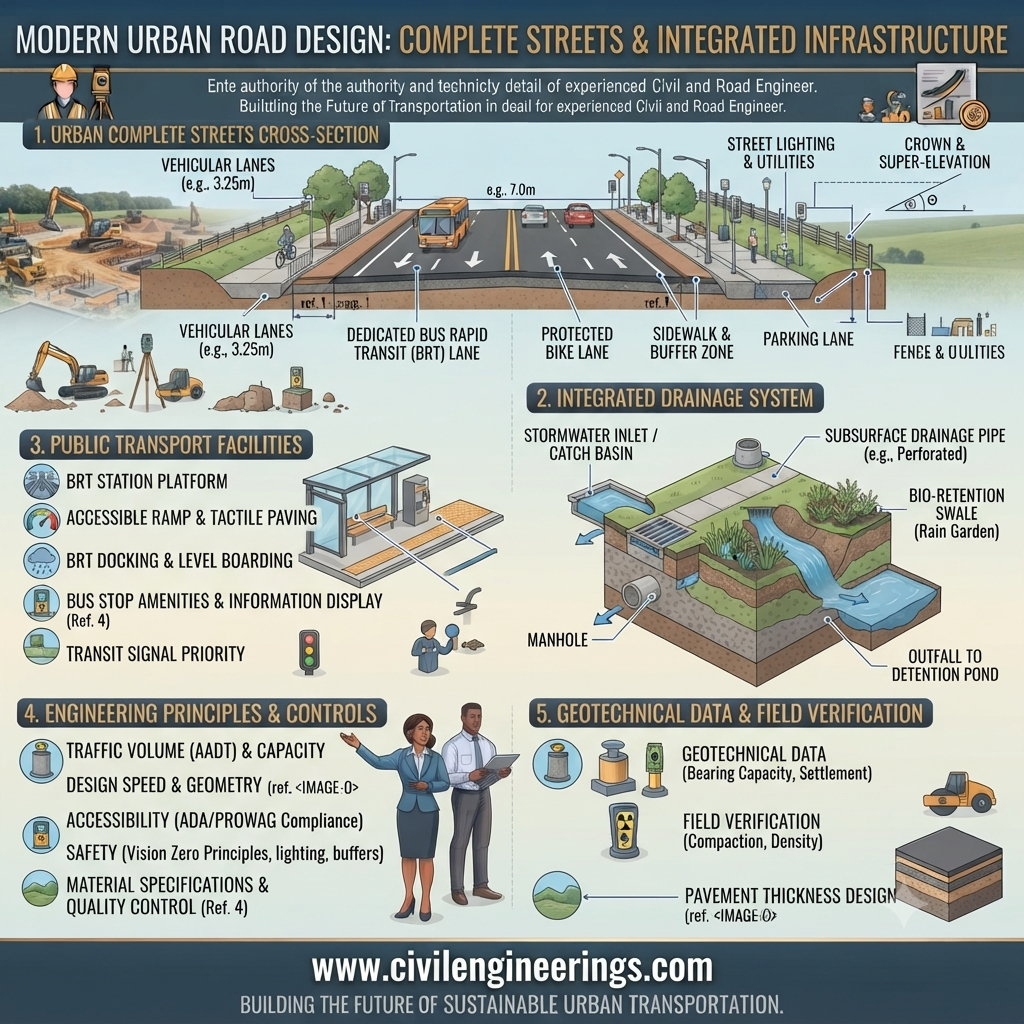
Urban Road Design is the foundation of modern transportation systems, shaping how people, vehicles, cyclists, and pedestrians move safely through cities. As urban populations continue to grow, the demand for efficient, sustainable, and well-planned road networks has never been greater. A properly designed urban road not only improves traffic flow but also enhances public safety, supports economic development, reduces environmental impacts, and creates more livable communities.
Unlike rural highways, urban roads must accommodate diverse users, including public transport, emergency vehicles, pedestrians, cyclists, and people with disabilities. Engineers must carefully balance mobility, accessibility, safety, and sustainability while considering limited land availability and existing infrastructure.
This comprehensive guide explores the principles, objectives, classifications, components, and design considerations of Urban Road Design. Whether you are a civil engineering student, highway engineer, contractor, consultant, or infrastructure professional, this article provides practical engineering knowledge supported by industry best practices and modern transportation concepts.
What is Urban Road Design?
Urban Road Design is the engineering process of planning, designing, and developing roads within cities and built-up areas to ensure safe, efficient, and sustainable transportation. It combines geometric design, pavement engineering, traffic engineering, drainage planning, utility coordination, environmental considerations, and road safety principles into a single integrated system.
Unlike highways that primarily focus on vehicle movement over long distances, urban roads serve multiple purposes. They provide access to residential neighborhoods, commercial districts, industrial zones, educational institutions, healthcare facilities, and public spaces. Therefore, an effective urban road design must accommodate various transportation modes, including:
- Passenger vehicles
- Public buses
- Freight trucks
- Emergency vehicles
- Cyclists
- Pedestrians
- Persons with disabilities
- Micro-mobility vehicles such as e-scooters and bicycles
Urban road design also considers traffic management, intersection performance, parking demand, landscaping, public transport facilities, and utility corridors, making it one of the most multidisciplinary fields in transportation engineering.
Purpose of Urban Road Design
The primary purpose of Urban Road Design is to create transportation corridors that safely and efficiently connect different parts of a city while supporting long-term urban growth. A well-designed road network minimizes travel delays, improves accessibility, reduces crash risks, and enhances the overall quality of life.
Key purposes include:
- Improving traffic mobility
- Ensuring pedestrian safety
- Supporting public transportation
- Reducing congestion
- Facilitating economic activities
- Providing emergency access
- Promoting sustainable transportation
- Enhancing environmental performance
Importance of Urban Road Design
Modern cities rely heavily on transportation infrastructure. Poorly designed urban roads often result in congestion, accidents, flooding, pollution, and increased maintenance costs. Conversely, a well-planned road network delivers long-term social, economic, and environmental benefits.
Some major benefits include:
- Improved traffic flow and reduced travel time
- Lower vehicle operating costs
- Enhanced road safety for all users
- Better accessibility to schools, hospitals, and businesses
- Increased property values
- Support for public transport systems
- Reduced greenhouse gas emissions
- Improved resilience against urban flooding
As cities continue to expand, urban road design plays a critical role in developing smart, connected, and sustainable transportation networks.
Objectives of Urban Road Design
Every urban road project should achieve a balanced combination of safety, efficiency, sustainability, and accessibility. The following objectives guide transportation engineers during planning and design.
1. Improve Road Safety
Safety is the foremost objective of urban road design. Engineers aim to minimize conflicts between vehicles, cyclists, and pedestrians through proper lane arrangements, traffic calming measures, pedestrian crossings, and clear road markings.
2. Enhance Traffic Efficiency
An efficient road network reduces congestion by optimizing lane capacity, intersection performance, and signal coordination while maintaining smooth traffic flow during peak hours.
3. Provide Universal Accessibility
Urban roads should be accessible to everyone, including children, elder individuals, and persons with disabilities. Features such as curb ramps, tactile paving, and accessible pedestrian signals improve inclusivity.
4. Encourage Sustainable Transportation
Modern road design promotes walking, cycling, and public transportation by incorporating dedicated bicycle lanes, bus lanes, sidewalks, and transit-friendly infrastructure.
5. Support Economic Growth
Efficient transportation systems improve connectivity between residential, commercial, and industrial areas, reducing logistics costs and stimulating economic development.
6. Protect the Environment
Sustainable urban road design incorporates green infrastructure, stormwater management systems, noise reduction measures, and landscaping to minimize environmental impacts.
Characteristics of Urban Roads
Urban roads differ significantly from rural highways due to higher traffic density, frequent intersections, and mixed land use.
Some distinguishing characteristics include:
- High traffic volume
- Frequent signalized intersections
- Lower design speeds
- Mixed traffic conditions
- Numerous pedestrian crossings
- Dedicated cycling facilities
- Street lighting
- Utility corridors
- Bus stops and transit stations
- On-street parking in selected areas
- Commercial frontage access
- Enhanced drainage systems
These characteristics require careful coordination between transportation engineers, urban planners, utility agencies, and environmental specialists.
Urban Road Hierarchy
Urban transportation networks are organized into different road classes based on their function and traffic volume.
                 Urban Road Network

                    Expressway
                        │
                  Arterial Roads
                        │
                 Collector Roads
                        │
                  Local Streets
Each category serves a distinct purpose within the transportation system.
1. Expressways
Expressways are high-capacity roads designed for uninterrupted traffic movement. Access is controlled through interchanges, and direct property access is prohibited.
Typical features include:
- Grade-separated intersections
- High design speeds
- Multiple traffic lanes
- Limited access points
- Median barriers
- Intelligent traffic management systems
Expressways primarily connect major urban centers and regional transportation corridors.
2. Arterial Roads
Arterial roads distribute traffic between expressways and urban districts. They carry large traffic volumes while allowing limited access to adjacent properties.
Key characteristics include:
- Multiple travel lanes
- Signalized intersections
- Bus priority lanes
- Central medians
- Controlled turning movements
- Wide sidewalks
Arterial roads form the backbone of urban transportation systems.
3. Collector Roads
Collector roads gather traffic from local streets and direct it toward arterial roads.
Typical characteristics include:
- Moderate traffic volumes
- Residential and commercial access
- Lower operating speeds
- Bus routes
- Bicycle facilities
- Frequent intersections
Collectors strike a balance between mobility and accessibility.
4. Local Streets
Local streets provide direct access to homes, schools, parks, and neighborhood facilities.
Primary characteristics include:
- Low traffic speeds
- Residential access
- On-street parking
- Traffic calming measures
- Sidewalks
- Pedestrian-friendly environment
Safety and accessibility take priority over traffic speed on local streets.
Major Components of Urban Road Design
A successful Urban Road Design integrates several engineering elements into one coordinated system.
             Urban Road Cross Section

   Building     Sidewalk     Cycle Track

     │             │              │
 ┌────────┬──────────┬──────────────┐
 │Footpath│ Bike Lane│ Vehicle Lane │
 └────────┴──────────┴──────────────┘
           Median / Divider
 ┌──────────────┬──────────┬────────┐
 │ Vehicle Lane │ Bus Lane │Footpath│
 └──────────────┴──────────┴────────┘
        Drain        Utility Zone
Major components include:
Roadway
The carriageway accommodates moving vehicles and is designed based on projected traffic volume, design speed, and pavement requirements.
Sidewalks
Sidewalks provide a safe and comfortable space for pedestrians while separating them from vehicular traffic.
Bicycle Lanes
Dedicated cycling infrastructure encourages active transportation and reduces conflicts between cyclists and motor vehicles.
Medians
Medians separate opposing traffic streams, improve safety, and provide space for landscaping or pedestrian refuges.
Drainage System
Proper drainage prevents water accumulation, protects pavement layers, and extends the service life of the roadway.
Utility Corridor
Urban roads often contain underground utilities such as water supply lines, sewer systems, gas pipelines, electrical conduits, and communication cables. Coordinated utility planning minimizes future road excavations.
Bus Stops and Transit Facilities
Modern urban roads include well-designed bus bays, shelters, and accessible boarding areas to improve public transport efficiency.
Street Lighting
Adequate lighting enhances visibility during nighttime and improves safety for drivers, cyclists, and pedestrians.
Key Design Considerations in Urban Road Design
Several engineering factors influence the success of an urban road project:
- Projected traffic demand
- Design speed
- Land use patterns
- Population growth
- Pedestrian movement
- Public transportation requirements
- Cycling infrastructure
- Parking demand
- Drainage and flood resilience
- Utility coordination
- Environmental sustainability
- Road safety audits
- Future expansion needs
- Smart traffic management systems
Engineers must evaluate these considerations during the planning and preliminary design stages to create roads that remain functional, safe, and adaptable for decades.
Urban Road Design Process
Designing an urban road involves much more than determining pavement width or selecting asphalt thickness. It requires a systematic approach that integrates transportation planning, traffic engineering, geotechnical investigations, environmental considerations, utility coordination, and future urban development.
A successful Urban Road Design project generally follows the stages below.
          Urban Road Design Workflow

      Planning & Feasibility
               │
       Traffic & Topographic Survey
               │
      Geotechnical Investigation
               │
      Preliminary Road Alignment
               │
        Geometric Road Design
               │
         Pavement Design
               │
    Drainage & Utility Coordination
               │
      Detailed Engineering Design
               │
      Construction & Supervision
               │
      Quality Control & Testing
               │
      Maintenance & Performance Review
Each stage contributes to the safety, durability, and long-term performance of the roadway.
1. Planning and Feasibility Study
Every urban road project begins with a comprehensive planning phase. The objective is to determine whether the proposed road meets present and future transportation demands while remaining technically, economically, and environmentally feasible.
Key Activities
- Identify project objectives
- Analyze existing traffic problems
- Study land use and zoning plans
- Forecast future traffic demand
- Evaluate environmental impacts
- Estimate construction costs
- Perform economic analysis
- Consult stakeholders and local authorities
Engineering Output
- Feasibility Report
- Preliminary Cost Estimate
- Traffic Demand Forecast
- Environmental Screening
- Initial Alignment Options
2. Topographic and Traffic Surveys
Accurate survey data forms the foundation of every successful Urban Road Design.
Topographic Survey
A topographic survey captures ground elevations, natural features, buildings, existing roads, drainage systems, and utilities.
Common survey equipment includes:
- Total Station
- GNSS/GPS Receivers
- Digital Levels
- Drones (UAVs)
- LiDAR Systems
Survey information helps engineers prepare accurate design drawings and earthwork estimates.
Traffic Survey
Traffic studies determine how many vehicles use the road and how traffic patterns change throughout the day.
Common traffic surveys include:
- Traffic Volume Count
- Turning Movement Count
- Origin-Destination Survey
- Speed Survey
- Parking Survey
- Pedestrian Count
- Bicycle Count
- Public Transport Survey
Important Traffic Parameters
- Average Daily Traffic (ADT)
- Annual Average Daily Traffic (AADT)
- Peak Hour Volume (PHV)
- Design Hour Volume (DHV)
- Passenger Car Unit (PCU)
Reliable traffic data ensures the road is designed for both current and future demand.
3. Geotechnical Investigation
Before pavement design begins, engineers evaluate the engineering properties of the underlying soil.
The investigation typically includes:
- Trial pits
- Boreholes
- Soil sampling
- Groundwater assessment
- Laboratory testing
Common Soil Tests
- California Bearing Ratio (CBR)
- Standard Proctor Test
- Modified Proctor Test
- Grain Size Analysis
- Atterberg Limits
- Specific Gravity Test
- Moisture Content Test
These tests determine the soil’s load-bearing capacity and guide pavement thickness design.
4. Geometric Design of Urban Roads
Geometric design defines the physical layout of the roadway. A well-designed geometry improves safety, enhances driver comfort, and increases traffic efficiency.
Major design elements include:
- Lane width
- Carriageway width
- Shoulder width (where applicable)
- Horizontal alignment
- Vertical alignment
- Cross slope (camber)
- Superelevation (where required)
- Sight distance
- Intersection design
- Roundabouts
- Bus bays
- Parking lanes
- Bicycle tracks
- Sidewalks
Typical Urban Road Cross Section
 Building    Sidewalk   Cycle Track   Parking

     │           │            │          │
 ─────────────────────────────────────────────
 | Footpath | Bike | Lane | Median | Lane |
 ─────────────────────────────────────────────
        Drain            Utility Corridor
Modern urban roads are increasingly designed using the Complete Streets concept, where every road user receives equal consideration rather than prioritizing vehicles alone.
Design Speed
Design speed influences nearly every geometric feature of a road, including curve radius, stopping sight distance, and intersection layout.
Urban roads generally have lower design speeds than rural highways because of:
- Frequent intersections
- Mixed traffic
- Pedestrian crossings
- Commercial frontage
- Public transport stops
Selecting an appropriate design speed improves both safety and operational efficiency.
Sight Distance
Drivers must be able to identify hazards in sufficient time to stop safely.
Two important types include:
Stopping Sight Distance (SSD)
Distance required to perceive a hazard and bring the vehicle to a complete stop.
Intersection Sight Distance (ISD)
Distance required for drivers to safely enter or cross an intersection.
Adequate sight distance significantly reduces collision risk.
5. Pavement Design
Pavement design determines the structural layers needed to safely distribute traffic loads to the underlying soil.
The pavement must resist:
- Repeated wheel loads
- Temperature variation
- Water infiltration
- Fatigue cracking
- Rutting
- Settlement
Typical Flexible Pavement Structure
        Asphalt Wearing Course
──────────────────────────────────

        Binder Course
──────────────────────────────────

        Base Course
──────────────────────────────────

        Subbase
──────────────────────────────────

        Compacted Subgrade
Each layer performs a specific engineering function.
Surface Course
Provides:
- Smooth riding quality
- Skid resistance
- Waterproofing
- Load distribution
Common material:
- Hot Mix Asphalt (HMA)
Base Course
Transfers wheel loads to lower layers while maintaining structural stability.
Typical materials include:
- Crushed aggregate
- Cement-treated base
- Bituminous base
Subbase
Provides additional load distribution and drainage.
Materials commonly include:
- Granular aggregate
- Stabilized soil
- Recycled materials
Subgrade
The subgrade is the natural soil supporting the pavement system.
Proper compaction is essential because pavement performance largely depends on subgrade strength.
Basic Pavement Design Formula
Although complete pavement design uses sophisticated methods, the relationship between load and pavement thickness can be simplified as:
[
\text{Pavement Thickness} \propto
\frac{\text{Traffic Load}}{\text{Subgrade Strength}}
]
This means:
- Higher traffic loads require thicker pavements.
- Stronger subgrade soils allow thinner pavement structures.
- Weak soils require stabilization or increased pavement thickness.
Example Engineering Calculation
Given
Design traffic = 12 million ESAL
Subgrade CBR = 6%
Expected design life = 20 years
Assume preliminary pavement thickness:
- Asphalt = 100 mm
- Base = 200 mm
- Subbase = 250 mm
Total Pavement Thickness
[100 + 200 + 250 = 550 \text{ mm}]
Total pavement thickness = 550 mm
Note: Final layer thicknesses should always be determined using recognized pavement design methods and project-specific investigations rather than simplified assumptions.
6. Drainage Design
Water is one of the leading causes of pavement deterioration. Effective drainage design protects both the pavement and underlying soil.
Drainage objectives include:
- Rapid removal of stormwater
- Prevention of water ponding
- Protection of pavement layers
- Reduction of erosion
- Improved road safety
Surface Drainage Components
- Side drains
- Kerb and gutter
- Catch basins
- Inlets
- Storm sewers
- Culverts
- Median drains
Typical Drainage Layout
 Footpath      Roadway        Footpath
    │             │               │
──────────────Camber───────────────
        \                  /
         \                /
          Side Drain  Side Drain
Proper crossfall directs runoff toward the drainage system, reducing hydroplaning risks and extending pavement life.
7. Utility Coordination
Urban roads often contain extensive underground infrastructure. Coordinating utilities before construction minimizes future disruptions.
Typical utilities include:
- Water supply pipelines
- Sewer lines
- Stormwater drains
- Gas pipelines
- Electric cables
- Fiber-optic communication lines
Proper planning reduces costly excavations after road completion.
Materials Used in Urban Road Construction
Material selection directly influences durability, maintenance costs, and lifecycle performance.
| Material | Primary Application |
|---|---|
| Bitumen | Asphalt pavement binder |
| Cement | Concrete pavements and structures |
| Aggregates | Base, subbase, and asphalt mixes |
| Sand | Concrete and bedding layers |
| Concrete | Rigid pavements, kerbs, sidewalks |
| Geotextiles | Separation, filtration, and drainage |
| Geogrids | Soil reinforcement |
| Lime | Soil stabilization |
| Fly Ash | Stabilized pavement layers |
| Cement Stabilizers | Improving weak subgrade soils |
Engineers select materials based on traffic loading, climate, local availability, and life-cycle cost considerations.
Construction Equipment Used
Urban road construction relies on specialized machinery to achieve productivity and quality.
Common equipment includes:
- Excavators
- Bulldozers
- Motor Graders
- Wheel Loaders
- Asphalt Pavers
- Vibratory Rollers
- Pneumatic Tyre Rollers
- Concrete Mixers
- Slipform Pavers
- Milling Machines
- Water Tankers
- Survey Instruments (Total Station, GNSS)
- Road Marking Machines
Proper equipment selection enhances construction efficiency and helps achieve specified quality standards.
Urban Road Construction Process
After the design phase is complete, the focus shifts to construction. Successful Urban Road Design depends not only on sound engineering drawings but also on proper execution, quality assurance, and compliance with project specifications. Every stage must be carefully planned to minimize traffic disruption, ensure worker safety, and deliver a durable roadway.
The construction process typically follows these stages:
        Urban Road Construction Process

      Site Preparation
             │
      Utility Relocation
             │
      Earthwork & Grading
             │
      Subgrade Preparation
             │
      Subbase Construction
             │
      Base Course Placement
             │
      Asphalt/Concrete Paving
             │
      Kerbs & Sidewalks
             │
      Road Furniture
             │
      Road Markings
             │
      Inspection & Opening
1. Site Preparation
Construction begins by clearing the project site and preparing the working area.
Typical activities include:
- Clearing vegetation
- Removing debris
- Demolishing unsuitable structures
- Relocating utilities
- Establishing site control points
- Installing temporary traffic management
- Implementing environmental protection measures
Proper preparation reduces delays during later construction stages.
2. Earthwork and Grading
Earthwork creates the required road profile while ensuring a stable foundation.
Major operations include:
- Excavation
- Filling low areas
- Embankment construction
- Soil compaction
- Slope stabilization
- Final grading
Compaction is performed in layers using vibratory rollers to achieve the specified density.
3. Subgrade Preparation
The subgrade is the foundation of the pavement structure.
Construction activities include:
- Moisture conditioning
- Proof rolling
- Removal of weak spots
- Soil stabilization (if required)
- Final compaction
A poorly prepared subgrade often leads to premature pavement failures such as rutting and settlement.
4. Subbase and Base Construction
Granular materials are spread, graded, and compacted layer by layer.
Engineers monitor:
- Layer thickness
- Moisture content
- Density
- Surface level
- Crossfall
- Material gradation
Uniform compaction ensures effective load distribution.
5. Asphalt or Concrete Paving
Depending on the pavement type, asphalt or concrete is placed using specialized paving equipment.
Asphalt Pavement
Construction involves:
- Tack coat application
- Asphalt transportation
- Mechanical paving
- Rolling and compaction
- Joint finishing
Concrete Pavement
Typical operations include:
- Formwork installation
- Reinforcement placement (where required)
- Concrete pouring
- Vibration
- Surface finishing
- Curing
Proper temperature control and compaction are essential for achieving long-term pavement performance.
6. Roadside Infrastructure
Modern urban roads include much more than the carriageway.
Typical roadside works include:
- Kerbs
- Sidewalks
- Bicycle lanes
- Bus bays
- Parking areas
- Drainage channels
- Street lighting
- Traffic signals
- Landscaping
- Road signs
- Safety barriers
These elements improve functionality, accessibility, and user safety.
Quality Control in Urban Road Construction
Quality control ensures that construction complies with design specifications and performance requirements.
Regular inspections and laboratory testing help identify defects before they become costly failures.
Common Quality Control Tests
California Bearing Ratio (CBR) Test
Purpose:
- Evaluates subgrade strength
- Supports pavement thickness design
Proctor Compaction Test
Purpose:
- Determines optimum moisture content
- Establishes maximum dry density
Importance:
Proper compaction improves pavement stability and reduces settlement.
Marshall Stability Test
Purpose:
- Evaluates asphalt mix strength
- Measures flow characteristics
- Determines optimum bitumen content
Widely used for flexible pavement mix design.
Slump Test
Purpose:
- Assesses concrete workability
- Ensures consistent concrete quality before placement
Core Test
Purpose:
- Measures pavement thickness
- Determines in-place asphalt density
- Verifies construction quality
Field Density Test
Purpose:
- Confirms compaction of soil and granular layers
- Ensures compliance with specifications
Common methods include:
- Sand Cone Test
- Nuclear Density Gauge
Plate Load Test
Purpose:
- Evaluates bearing capacity
- Measures foundation deformation characteristics
Useful for assessing pavement foundation performance.
Maintenance of Urban Roads
Even a well-designed road requires regular maintenance to preserve safety, ride quality, and structural integrity.
Routine Maintenance
Activities include:
- Pothole repairs
- Crack sealing
- Cleaning drainage systems
- Repainting road markings
- Replacing damaged signs
- Vegetation control
Routine maintenance helps prevent minor issues from developing into major structural failures.
Periodic Maintenance
Periodic maintenance is scheduled at longer intervals and may involve:
- Asphalt overlays
- Surface rejuvenation
- Milling and resurfacing
- Joint resealing
- Pavement rehabilitation
These treatments extend pavement service life and improve ride quality.
Emergency Maintenance
Emergency work addresses unexpected damage caused by:
- Flooding
- Utility failures
- Traffic accidents
- Heavy rainfall
- Pavement collapse
Rapid response minimizes safety risks and restores traffic flow.
Best Practices for Urban Road Design
Engineers
- Base designs on reliable traffic forecasts.
- Conduct comprehensive geotechnical investigations.
- Integrate drainage into the initial design.
- Prioritize pedestrian and cyclist safety.
- Coordinate utility layouts before construction.
- Perform independent road safety audits.
- Consider future expansion and smart mobility solutions.
Contractors
- Follow approved construction specifications.
- Maintain strict quality control throughout the project.
- Calibrate construction equipment regularly.
- Protect completed pavement layers from unnecessary traffic.
- Ensure proper curing of concrete pavements.
- Keep accurate construction records for future maintenance.
Students
- Develop a strong understanding of pavement materials and soil mechanics.
- Learn surveying techniques and traffic engineering principles.
- Study geometric design concepts through real-world projects.
- Become familiar with CAD, Civil 3D, and pavement design software.
- Stay updated with modern transportation technologies and sustainable infrastructure practices.
Common Mistakes in Urban Road Design
Understanding common errors helps engineers avoid costly redesigns and operational issues.
| Mistake | Consequence | Prevention |
|---|---|---|
| Inadequate traffic analysis | Congestion and capacity issues | Conduct detailed traffic studies and future demand forecasting |
| Poor drainage design | Waterlogging and pavement deterioration | Design efficient surface and subsurface drainage systems |
| Weak subgrade preparation | Settlement and rutting | Perform geotechnical investigations and proper compaction |
| Ignoring pedestrian facilities | Increased accident risk | Include sidewalks, crossings, and accessibility features |
| Utility conflicts | Construction delays and rework | Coordinate with utility agencies during planning |
| Insufficient quality control | Premature pavement failure | Implement regular inspections and laboratory testing |
| Lack of maintenance planning | Reduced service life | Establish preventive maintenance schedules |
Overview of Engineering Standards
Urban road projects are generally guided by internationally recognized engineering practices and national standards. While detailed provisions vary between agencies, they share common objectives of safety, durability, accessibility, and sustainability.
Indian Roads Congress (IRC)
IRC provides guidance on road planning, geometric design, pavement design, traffic engineering, and urban street development. Its publications are widely referenced in South Asia.
AASHTO
The American Association of State Highway and Transportation Officials publishes widely adopted guidance covering geometric design, pavement design, bridge engineering, and transportation planning.
ASTM International
ASTM develops standardized laboratory and field testing methods for construction materials, including aggregates, asphalt, concrete, and soils, helping ensure consistency and quality.
Institution of Civil Engineers (ICE)
ICE promotes engineering excellence through professional guidance, technical knowledge sharing, and best practices for infrastructure development.
ISO
The International Organization for Standardization develops standards related to quality management, environmental management, occupational health and safety, and asset management that support road infrastructure projects.
Federal Highway Administration (FHWA)
FHWA publishes technical guidance on highway safety, pavement management, traffic operations, intelligent transportation systems, and sustainable roadway design, influencing best practices worldwide.
Frequently Asked Questions (FAQs)
1. What is the primary objective of Urban Road Design?
The primary objective of Urban Road Design is to provide safe, efficient, accessible, and sustainable transportation infrastructure for all road users. A well-designed urban road balances the needs of motorists, pedestrians, cyclists, and public transport while supporting economic development and minimizing environmental impacts. Good design also reduces congestion, improves road safety, and accommodates future urban growth.
2. How is urban road design different from rural road design?
Urban roads operate in densely populated environments with frequent intersections, mixed traffic, public transport, and significant pedestrian activity. Rural roads generally prioritize higher travel speeds and longer-distance mobility with fewer access points. Consequently, urban road design places greater emphasis on accessibility, multimodal transportation, traffic calming, and utility coordination.
3. Why is drainage so important in urban roads?
Effective drainage prevents water from infiltrating pavement layers, which can weaken the subgrade, cause rutting, and accelerate pavement deterioration. It also reduces the risk of hydroplaning, localized flooding, and traffic disruptions. Properly designed surface and subsurface drainage systems significantly extend pavement life and lower long-term maintenance costs.
4. Which factors influence pavement thickness?
Pavement thickness depends on several engineering factors, including anticipated traffic loading, axle loads, subgrade strength, climatic conditions, drainage performance, material quality, and the intended design life of the roadway. Engineers evaluate these parameters using recognized pavement design methodologies to develop a safe and economical pavement structure.
5. What materials are commonly used in urban road construction?
Urban road construction typically uses bitumen, asphalt, cement, concrete, crushed aggregates, sand, geotextiles, geogrids, lime, fly ash, and other soil stabilizers. Material selection depends on traffic demand, environmental conditions, availability, project budget, and lifecycle performance requirements. Durable, high-quality materials improve pavement longevity and reduce maintenance needs.
6. Why are quality control tests necessary?
Quality control tests verify that materials and construction activities meet project specifications. Tests such as the CBR Test, Proctor Test, Marshall Stability Test, Slump Test, Density Test, and Core Test help identify defects before they affect pavement performance. Consistent testing improves durability, safety, and overall project reliability.
7. How does Urban Road Design support sustainable cities?
Modern Urban Road Design encourages sustainable transportation by integrating pedestrian facilities, bicycle lanes, public transport corridors, green infrastructure, and efficient stormwater management. These features reduce traffic congestion, lower greenhouse gas emissions, improve public health, and create more resilient and livable urban environments.
8. What software is commonly used for urban road design?
Transportation and civil engineers commonly use software such as AutoCAD Civil 3D, Bentley OpenRoads Designer, Autodesk InfraWorks, MX Road, ArcGIS, and various traffic analysis and pavement design tools. These applications support surveying, geometric design, earthwork calculations, drainage analysis, visualization, and project documentation.
Conclusion
Urban Road Design is a multidisciplinary engineering process that combines transportation planning, geometric design, pavement engineering, drainage, traffic management, and sustainable infrastructure to create safe and efficient urban transportation networks. From careful planning and geotechnical investigations to quality-controlled construction and proactive maintenance, every stage contributes to the long-term performance of a roadway.
Successful projects prioritize all road users—not only motorists but also pedestrians, cyclists, and public transport passengers. By applying sound engineering principles, selecting appropriate materials, following recognized standards, and embracing modern technologies, engineers can develop resilient roads that support economic growth and enhance urban quality of life.
Whether you are a civil engineering student, highway engineer, contractor, or infrastructure professional, mastering Urban Road Design will help you deliver transportation systems that are safer, smarter, and better prepared for the cities of tomorrow. Continue learning, apply best practices, and contribute to building sustainable urban infrastructure.
