
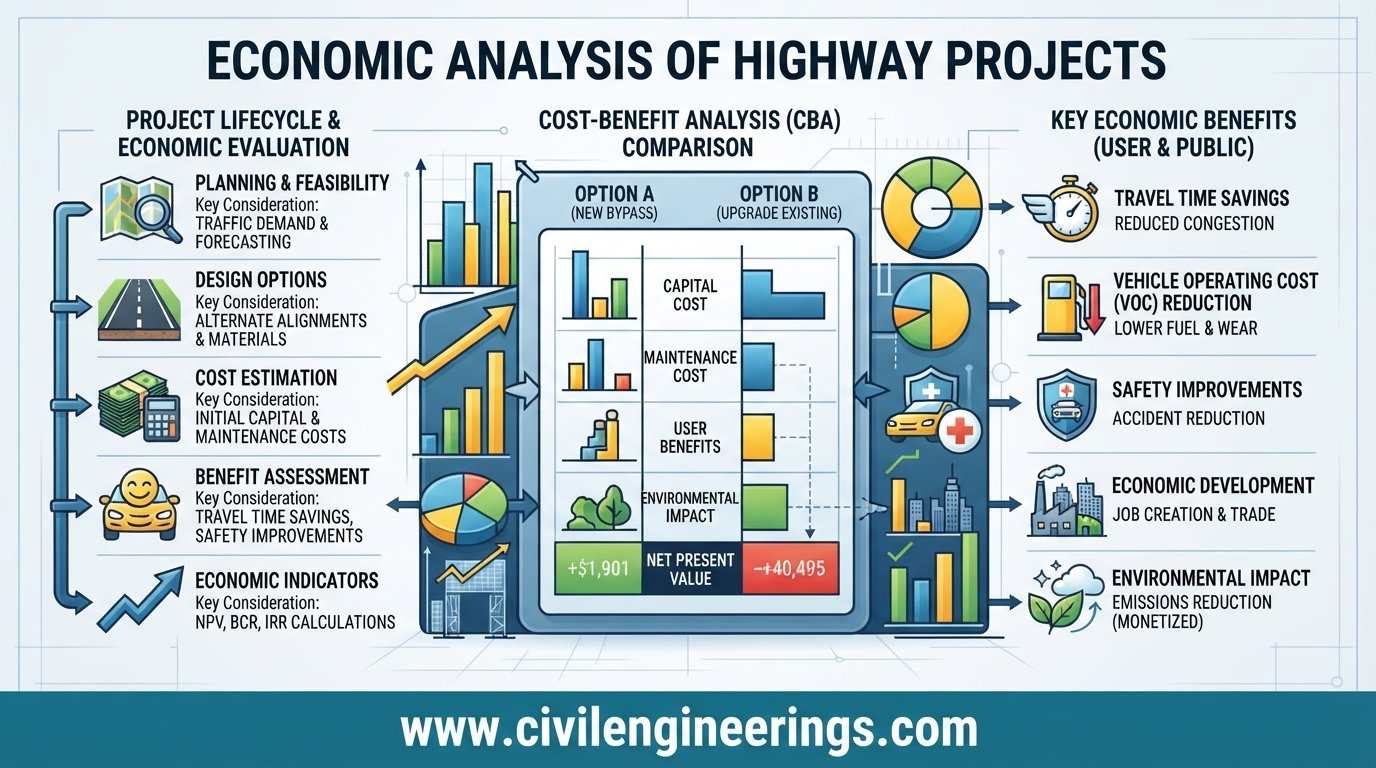
A highway can transform a region, shorten travel times, improve access to markets, and stimulate economic activity. However, a technically sound highway is not automatically an economically justified investment. Governments, investors, and infrastructure agencies must determine whether the benefits generated over the road’s service life justify the resources spent on planning, land acquisition, construction, operation, and maintenance.
This is where Economic Analysis of Highway Projects becomes essential. It provides a structured way to compare project costs with measurable economic benefits and helps decision-makers select projects that deliver the greatest value from limited public funds. The analysis considers factors such as construction cost, vehicle operating costs, travel-time savings, accident reduction, maintenance expenditure, environmental impacts, and future traffic growth.
For highway engineers and civil engineering professionals, economic analysis also connects engineering design with practical investment decisions. A small change in pavement design, alignment, interchange configuration, or construction strategy can significantly affect life-cycle costs and user benefits.
This guide explains the principles, methods, formulas, practical applications, examples, limitations, and best practices used in highway economic evaluation.
What Is Economic Analysis of Highway Projects?
Economic analysis of highway projects is the systematic evaluation of the costs and benefits associated with constructing, improving, or maintaining a highway over a defined analysis period.
The objective is not simply to identify the cheapest construction option. Instead, the objective is to determine whether the economic value created by a highway exceeds the resources consumed by the project.
A highway project can generate benefits in several ways:
- Reduced vehicle operating costs
- Reduced travel time
- Lower accident costs
- Improved freight movement
- Reduced congestion
- Better access to employment and services
- Increased reliability of transportation
- Regional economic development
- Reduced pavement and vehicle maintenance costs
Project costs may include:
- Engineering and feasibility studies
- Land acquisition
- Earthwork
- Pavement construction
- Bridges and culverts
- Drainage structures
- Interchanges
- Traffic control systems
- Utility relocation
- Environmental mitigation
- Routine maintenance
- Periodic rehabilitation
- Road-user costs during construction
The analysis normally compares a project scenario with a without-project or base-case scenario. This distinction is important because the benefits should represent improvements caused by the proposed investment rather than benefits that would occur anyway.
Why Economic Analysis Is Important in Highway Engineering
Highway projects require substantial capital and often remain in service for several decades. A decision made during preliminary design can therefore influence public expenditure for many years.
Economic analysis helps answer practical questions such as:
- Should the road be constructed now or later?
- Is widening justified by expected traffic?
- Is a bypass economically preferable to improving the existing route?
- Which pavement alternative provides better long-term value?
- Does an expensive interchange provide sufficient benefits?
- Is rehabilitation better than complete reconstruction?
- Which project should receive funding first?


Supporting Investment Decisions
Public agencies usually have more potential highway projects than available funding. Economic evaluation provides a rational basis for prioritizing investments.
For example, suppose two road projects require similar capital investment. Project A may serve a low-volume rural corridor, while Project B may remove severe congestion on a major freight route. If Project B produces substantially greater travel-time and vehicle operating-cost savings, economic analysis may show that it deserves higher priority.
Considering the Entire Project Life Cycle
Initial construction cost alone can produce misleading conclusions.
A pavement alternative with a lower initial cost may require frequent rehabilitation. Another alternative may cost more initially but remain serviceable for longer with lower maintenance requirements.
Economic analysis therefore considers life-cycle cost, rather than focusing only on the construction budget.
Improving Engineering Design
Economic analysis can influence technical decisions.
Engineers can evaluate alternatives involving:
- Highway alignment
- Road width
- Pavement thickness
- Intersection treatment
- Interchange configuration
- Bridge dimensions
- Drainage facilities
- Construction staging
- Maintenance strategies
The economically optimal solution may not always be the solution with the lowest initial cost.
Major Cost Components in Highway Economic Analysis
A reliable analysis begins with realistic cost identification. Highway costs are generally divided into initial costs, recurring costs, and user-related costs.
Initial Construction Costs
Initial costs occur before and during construction. Typical components include:
- Feasibility and survey work
- Preliminary and detailed design
- Land acquisition
- Site clearance
- Earthwork
- Subgrade preparation
- Pavement layers
- Structures
- Drainage
- Road furniture
- Lighting
- ITS equipment
- Environmental mitigation
- Construction supervision
A useful preliminary relationship is:
Total Initial Cost = Construction Cost + Land Cost + Design Cost + Other Development Costs
For detailed feasibility studies, each component should be estimated using quantities, unit rates, market prices, and appropriate contingencies.
Maintenance and Rehabilitation Costs
Highways require continuous expenditure after opening.
Routine maintenance can include:
- Shoulder maintenance
- Drain cleaning
- Vegetation control
- Pavement patching
- Road marking
- Sign maintenance
Periodic maintenance may include:
- Asphalt overlays
- Surface treatments
- Pavement strengthening
- Bridge maintenance
- Major drainage rehabilitation
These costs should be placed in the correct years of the economic analysis.
Road-User Costs
Road-user costs are particularly important during construction and rehabilitation.
Temporary lane closures, detours, rough pavement, reduced speeds, and construction congestion can increase:
- Fuel consumption
- Vehicle wear
- Travel time
- Freight operating costs
- Accident exposure
Ignoring these costs can overstate the economic attractiveness of a construction alternative.
Major Economic Benefits of Highway Projects
The benefits of highway investment usually come from improvements experienced by road users and, in some cases, the wider economy.
Vehicle Operating Cost Savings
Better roads can reduce fuel consumption, tire wear, maintenance requirements, and vehicle depreciation.
A simplified benefit can be expressed as:
VOC Saving = VOC Without Project − VOC With Project
The total annual benefit can then be estimated from traffic volume, vehicle composition, and the corresponding operating-cost difference.
Vehicle operating costs should ideally be estimated separately for:
- Cars
- Buses
- Light commercial vehicles
- Heavy trucks
- Other relevant vehicle classes
Travel-Time Savings
Time savings are among the most important highway benefits.
If a project reduces average travel time from 60 minutes to 40 minutes, the saving is 20 minutes per trip.
A simplified annual time benefit is:
Time Benefit = Traffic Volume × Time Saving × Value of Time
The value of time depends on the purpose of travel, vehicle occupants, income levels, freight characteristics, and the methodology adopted by the responsible agency.
Accident Cost Savings
A highway improvement may reduce crashes through:
- Better geometry
- Improved sight distance
- Median separation
- Safer intersections
- Better lighting
- Pedestrian facilities
- Improved signs and markings
- Access control
Economic analysis can assign monetary values to avoided fatalities, injuries, property damage, and emergency response costs.
Safety benefits require careful treatment because crash reductions should be supported by credible engineering and historical evidence rather than arbitrary assumptions.
Congestion Reduction
Highway widening, bypasses, grade separation, and intelligent traffic management can reduce congestion.
Congestion benefits may include:
- Reduced delay
- More reliable travel
- Lower fuel consumption
- Improved freight productivity
- Reduced vehicle emissions
For heavily trafficked urban corridors, congestion benefits can become a major component of total project benefits.
Wider Economic Benefits
Some highway projects influence economic activity beyond direct road-user savings.
Potential effects include:
- Improved market access
- Expansion of commercial activity
- Better agricultural distribution
- Increased tourism access
- Improved logistics
- Greater labor mobility
- Development of previously isolated areas
However, analysts should avoid automatically counting regional economic growth as an additional benefit if it already appears indirectly through travel-time, freight, or accessibility benefits. Double counting can significantly distort project evaluation.
Key Methods Used in Highway Economic Evaluation
Several financial and economic indicators are commonly used to evaluate highway investments.
Net Present Value
Net Present Value (NPV) converts future costs and benefits into their present values.
A simplified formula is:
NPV = Σ [(Bt − Ct) / (1 + r)^t]
Where:
- Bt = benefits in year t
- Ct = costs in year t
- r = discount rate
- t = analysis year
A positive NPV generally indicates that the project’s discounted benefits exceed its discounted costs under the selected assumptions.
NPV is particularly useful when comparing projects of different sizes.
Benefit-Cost Ratio
The Benefit-Cost Ratio (BCR) compares the present value of benefits with the present value of costs.
BCR = Present Value of Benefits / Present Value of Costs
A BCR greater than 1 generally indicates that discounted benefits exceed discounted costs.
For example, assume:
- Present value of benefits = $180 million
- Present value of costs = $120 million
Then:
BCR = 180 / 120 = 1.50
This means that each monetary unit of discounted project cost produces approximately 1.50 monetary units of discounted benefits, under the assumptions used.
Internal Rate of Return
The Economic Internal Rate of Return (EIRR) is the discount rate at which the project’s NPV becomes zero.
Conceptually:
0 = Σ [(Bt − Ct) / (1 + EIRR)^t]
If the EIRR exceeds the applicable economic discount rate or decision threshold, the project may be considered economically viable.
EIRR is useful for comparing investment efficiency, although it should not normally replace NPV as the primary decision indicator.
Payback Period
The payback period identifies how long it takes for accumulated benefits to recover the investment.
Although easy to understand, it has limitations. It generally ignores benefits occurring after the payback point and may not properly account for the time value of money.
Consequently, payback period is better treated as a supplementary indicator rather than the sole basis for highway investment decisions.
Discounting and the Time Value of Money
A highway project involves costs and benefits occurring at different times.
One dollar received today is generally considered more valuable than one dollar received many years later because today’s resources can be invested or used elsewhere.
Discounting converts future monetary values into present values.
The basic relationship is:
PV = FV / (1 + r)^n
Where:
- PV = present value
- FV = future value
- r = discount rate
- n = number of years
The selected discount rate can substantially affect project results. A project with large long-term benefits may appear attractive at a low discount rate but less attractive at a higher rate.
For this reason, economic evaluations should clearly document the adopted rate and perform sensitivity testing.
Economic Analysis Process for a Highway Project
A professional highway economic evaluation normally follows a structured sequence.
Define the Project and Alternatives
First establish:
- Project limits
- Road function
- Design period
- Existing condition
- Proposed improvement
- Alternative alignments
- Design standards
- Construction schedule
Alternatives should be technically feasible before detailed economic comparison.
Establish the Base Case
The base case, sometimes called the without-project scenario, represents what is expected to happen if the proposed investment does not proceed.
It may include normal maintenance and minor improvements.
The project case represents the situation after implementation.
The economic benefit is essentially the difference between these scenarios.
Forecast Traffic
Traffic forecasting is a critical input.
Engineers may need to estimate:
- Current Average Annual Daily Traffic (AADT)
- Passenger traffic
- Commercial traffic
- Heavy vehicles
- Origin-destination patterns
- Future growth
- Diverted traffic
- Generated traffic
- Seasonal variation
An oversimplified traffic forecast can undermine an otherwise sophisticated economic analysis.
Estimate Project Costs
Develop cost estimates for:
- Land
- Construction
- Structures
- Engineering
- Supervision
- Maintenance
- Rehabilitation
- Construction-related user costs
Costs should be expressed consistently in the chosen price basis.
Quantify Benefits
Estimate annual benefits associated with:
- Vehicle operating costs
- Travel time
- Safety
- Congestion
- Reliability
- Other justified economic effects
Each benefit should have a transparent calculation method.
Discount Costs and Benefits
Convert annual future values into present values using the selected discount rate.
This creates a common basis for comparison.
Calculate Economic Indicators
Calculate:
- NPV
- BCR
- EIRR
- Payback period where appropriate
The results should be reviewed together rather than relying on a single indicator.
Conduct Sensitivity and Risk Analysis
Finally, test how the outcome changes if important assumptions vary.
Useful variables include:
- Construction cost
- Traffic growth
- Value of time
- Fuel prices
- Maintenance costs
- Project opening date
- Discount rate
- Accident reduction
- Construction duration
Worked Example of Highway Economic Analysis
Consider a proposed highway improvement with the following simplified assumptions:
- Initial investment = $50 million
- Annual economic benefits = $7 million
- Annual maintenance cost = $1 million
- Analysis period = 20 years
- Discount rate = 8%
The approximate annual net benefit is:
$7 million − $1 million = $6 million
The project generates a stream of discounted net benefits over 20 years.
The present value of the annual net benefits can be calculated using:
PV = 6 × [1 − (1 + 0.08)^−20] / 0.08
This produces a present value of approximately $58.9 million.
Therefore:
NPV ≈ $58.9 million − $50 million = $8.9 million
The simplified result is positive, suggesting economic viability under these assumptions.
The example is intentionally basic. A professional feasibility study would include changing traffic volumes, periodic rehabilitation, residual value, construction-stage user costs, inflation treatment, risk, and multiple benefit categories.
Life-Cycle Cost Analysis in Highway Projects
Life-Cycle Cost Analysis (LCCA) is especially important when comparing pavement and rehabilitation alternatives.
Consider two alternatives:
Alternative A
- Lower initial construction cost
- More frequent rehabilitation
- Higher maintenance expenditure
Alternative B
- Higher initial cost
- Longer service intervals
- Lower maintenance requirements
The correct decision cannot be made by comparing initial costs alone.
A simplified life-cycle cost equation is:
LCC = Initial Cost + PV(Maintenance) + PV(Rehabilitation) + PV(User Costs) − PV(Residual Value)
Residual value represents the remaining economic value of an asset at the end of the analysis period.
For pavement engineering, LCCA can help compare flexible pavement, rigid pavement, strengthening, reconstruction, and rehabilitation strategies.
Risk and Sensitivity Analysis
Highway projects rarely follow the exact assumptions established during feasibility studies.
Traffic may grow more slowly than expected. Construction costs can rise. Land acquisition may take longer. A major economic change can also alter travel demand.
Sensitivity Analysis
Sensitivity analysis changes one or more assumptions to observe the effect on project performance.
For example:
| Variable | Base Case | Alternative Case |
|---|---|---|
| Construction cost | $50M | $60M |
| Traffic growth | 4% | 2% |
| Discount rate | 8% | 10% |
| Benefit value | $7M/year | $6M/year |
If the project remains economically viable under unfavorable assumptions, confidence in the investment decision increases.
Scenario Analysis
Scenario analysis can evaluate:
- Optimistic scenario
- Base scenario
- Pessimistic scenario
A more advanced study can use probability distributions and Monte Carlo simulation to estimate the probability that NPV or EIRR will fall below an acceptable threshold.
Economic Analysis vs Financial Analysis
These two concepts are related but not identical.
Financial analysis focuses on the project’s cash flows from the perspective of the project owner or implementing organization.
Economic analysis evaluates the project’s contribution to the wider economy.
For example, financial analysis may consider toll revenue as project income. Economic analysis is more concerned with resource costs and benefits to society, such as travel-time savings and reduced vehicle operating costs.
Taxes, subsidies, transfer payments, and market distortions may therefore require special treatment in economic evaluation.
Role of IRC, AASHTO, and ICE Guidance
Highway economic analysis should follow the requirements and guidance applicable to the project’s country, funding agency, and road authority.
Organizations and references such as IRC (Indian Roads Congress), AASHTO (American Association of State Highway and Transportation Officials), and ICE (Institution of Civil Engineers) provide valuable technical frameworks, standards, professional guidance, and engineering knowledge relevant to transportation infrastructure.
Their guidance should not be treated as interchangeable. A project team should identify the governing road authority and applicable national standards before selecting design criteria, traffic assumptions, economic parameters, pavement methods, and safety procedures.
For international or donor-funded projects, additional guidance from the relevant development bank or funding institution may also apply.
Common Mistakes in Highway Economic Analysis
Even a technically sophisticated model can produce unreliable results if its assumptions are weak.
Overestimating Traffic Growth
Traffic forecasts should be supported by historical traffic counts, socioeconomic indicators, land-use changes, network models, and realistic development assumptions.
Ignoring Maintenance
A road does not stop consuming resources after construction. Maintenance and rehabilitation should be included throughout the analysis period.
Double Counting Benefits
Time savings, congestion reduction, productivity improvements, and regional development can overlap. Analysts should establish clear benefit boundaries.
Using Unrealistic Construction Costs
Early cost estimates should include appropriate quantities, unit rates, contingencies, escalation assumptions where relevant, and realistic construction conditions.
Ignoring Construction-Stage Impacts
Traffic disruption during construction can be economically significant, especially on heavily trafficked routes.
Treating Economic Results as Absolute
NPV and BCR are outputs of a model. They are not guarantees.
Decision-makers should also consider:
- Environmental impacts
- Social effects
- Safety
- Resilience
- Strategic importance
- Land-use objectives
- Equity
- Climate risks
Best Practices for Highway Economic Evaluation
A strong economic analysis should follow several principles.
Use Transparent Assumptions
Every major assumption should be documented. Traffic growth, discount rate, construction cost, maintenance cycles, vehicle operating costs, and value of time should be traceable.
Compare Realistic Alternatives
Do not compare one fully developed alternative against an unrealistic base case. Each option should provide a technically credible solution to the identified transportation problem.
Use Life-Cycle Thinking
Engineers should consider the complete asset life rather than optimizing only the construction phase.
Update the Analysis
Economic conditions change. During major design revisions, procurement delays, or significant scope changes, the economic model should be reviewed.
Combine Engineering and Economic Judgment
A spreadsheet cannot replace engineering judgment. Economic results must be interpreted alongside pavement performance, geotechnical conditions, drainage, safety, constructability, environmental constraints, and operational requirements.
Practical Recommendations for Students, Engineers, and Contractors
For Civil Engineering Students
Students should learn the relationship between traffic engineering, highway design, transportation economics, and pavement engineering.
Practice calculating:
- Present value
- NPV
- BCR
- EIRR
- Vehicle operating cost savings
- Travel-time benefits
- Life-cycle costs
A small spreadsheet project using hypothetical highway data can provide valuable practical experience.
For Highway Engineers and Consultants
Engineers should build economic considerations into the project from the feasibility stage.
Do not wait until the final report to evaluate alternatives. Early economic screening can prevent unnecessary detailed design of technically attractive but economically weak options.
For Contractors
Contractors should recognize that construction methodology can influence the economic performance of a highway.
Factors such as:
- Construction duration
- Traffic management
- Material availability
- Equipment productivity
- Temporary diversions
- Phasing
- Quality control
can affect both agency costs and road-user costs.
Efficient construction planning can therefore contribute to better overall project value.
For Government Engineers and Infrastructure Professionals
Use economic analysis as one component of a broader investment framework. Projects should be prioritized using transparent criteria and updated data.
Particular attention should be given to uncertainty in traffic demand, land acquisition, construction costs, climate resilience, and long-term maintenance funding.
Frequently Asked Questions
What is the main purpose of economic analysis of highway projects?
Its main purpose is to determine whether the economic benefits generated by a highway investment justify its costs over the project’s analysis period.
What is the most important economic indicator for a highway project?
NPV is generally one of the strongest indicators because it measures the absolute economic value created after discounting future costs and benefits. BCR and EIRR provide useful complementary information.
What costs are included in highway economic analysis?
Costs can include land acquisition, construction, engineering, supervision, maintenance, rehabilitation, environmental mitigation, and road-user costs during construction.
What are the major benefits of highway projects?
Major benefits commonly include travel-time savings, vehicle operating cost savings, accident reduction, congestion reduction, improved freight movement, and better accessibility.
What is the difference between BCR and EIRR?
BCR compares the present value of benefits with the present value of costs. EIRR is the discount rate at which the project’s NPV equals zero.
Why is traffic forecasting important?
Future traffic determines how many users will receive project benefits. Errors in traffic forecasting can therefore significantly change NPV, BCR, and EIRR.
What is life-cycle cost analysis?
Life-cycle cost analysis evaluates costs throughout an asset’s useful life, including initial construction, maintenance, rehabilitation, user costs where appropriate, and residual value.
Can a highway project with a high construction cost still be economically viable?
Yes. A high-cost project can be economically justified if it generates sufficiently large long-term benefits, such as major travel-time savings, congestion reduction, safety improvements, or freight efficiency.
Should environmental impacts be included?
Yes. Where reliable valuation methods are available, environmental costs and benefits should be incorporated into the economic assessment. At minimum, significant environmental impacts should be identified alongside the economic indicators.
Is economic analysis the same as financial feasibility?
No. Financial feasibility focuses on financial cash flows for the project entity, while economic analysis evaluates costs and benefits from the broader societal or economic perspective.
Conclusion
Economic Analysis of Highway Projects provides the bridge between engineering design and sound infrastructure investment. A highway may be structurally strong, geometrically appropriate, and operationally efficient, yet still require careful economic evaluation before scarce resources are committed.
A professional assessment considers the complete project life cycle, including land acquisition, construction, maintenance, rehabilitation, traffic growth, vehicle operating costs, travel-time savings, safety improvements, and construction-stage user impacts. Indicators such as NPV, BCR, and EIRR help convert these factors into understandable measures for investment decisions.
The strongest highway evaluations do more than produce attractive numbers. They use realistic traffic forecasts, transparent assumptions, credible cost estimates, sensitivity analysis, and sound engineering judgment. They also recognize environmental, social, safety, and resilience considerations that may not be fully captured in conventional monetary calculations.
For students, engineers, consultants, contractors, and government professionals, understanding highway economics is therefore as important as understanding pavement design or geometric design. When technical performance and economic value are evaluated together, highway investments can deliver greater mobility, productivity, safety, and long-term public value.
