
Introduction
A road, highway, bridge, interchange, airport, dam, or urban development can transform an area within a relatively short period. It can improve mobility, create jobs, strengthen regional connectivity, and support economic growth. At the same time, poorly planned infrastructure may disturb ecosystems, increase air and noise pollution, affect water resources, fragment habitats, or create social problems for nearby communities.
This is where Environmental Impact Assessment (EIA) becomes an essential part of modern engineering and project planning.
Environmental Impact Assessment is a systematic process used to identify, predict, evaluate, and manage the environmental and social consequences of a proposed development before major decisions are finalized. A good EIA does more than produce a regulatory report. It helps engineers compare alternatives, avoid sensitive locations, develop mitigation measures, improve construction practices, and establish monitoring requirements.
For highway and civil engineering projects, the process can influence route selection, geometric design, drainage, material sourcing, construction methods, land requirements, traffic management, and long-term maintenance.
This guide explains the EIA process, major environmental components, impact assessment methods, mitigation hierarchy, environmental management plans, highway applications, practical examples, standards, and recommendations for students, engineers, contractors, and project owners.
What Is Environmental Impact Assessment?
Environmental Impact Assessment is a structured environmental planning and decision-support process used to understand how a proposed project may affect the natural, built, and human environment.
It normally examines the existing environmental conditions, evaluates potential project impacts, considers reasonable alternatives, proposes mitigation measures, and establishes monitoring requirements.
An EIA should begin early rather than after the engineering design has effectively been finalized. Early assessment gives the project team an opportunity to change the alignment, footprint, construction technique, or operating strategy before modifications become expensive.
For infrastructure projects, the assessment may cover:
- Air quality
- Surface water
- Groundwater
- Soil and geology
- Noise and vibration
- Flora and fauna
- Wildlife habitats
- Wetlands and drainage channels
- Landscape and visual resources
- Land acquisition
- Communities and livelihoods
- Cultural heritage
- Traffic and road safety
- Construction waste
- Occupational and community health
- Climate and disaster resilience
- Resource consumption
- Greenhouse-gas emissions
The exact scope depends on the project’s location, size, environmental sensitivity, applicable legislation, and potential significance of impacts.
International environmental review systems differ. For example, the U.S. National Environmental Policy Act framework uses different levels of environmental review, including Environmental Assessments and Environmental Impact Statements for applicable federal actions.
In Pakistan, Section 12 of the Pakistan Environmental Protection Act, 1997 requires proponents of applicable projects to submit an Initial Environmental Examination or Environmental Impact Assessment and obtain approval before construction or operation, subject to the Act and applicable regulations.
Why Environmental Impact Assessment Is Important in Civil Engineering
Environmental considerations are now closely connected with engineering quality. A highway may satisfy geometric design criteria and pavement requirements but still create serious environmental problems if its location or construction strategy is inappropriate.
Supporting Better Project Planning
EIA provides environmental information during project planning. Engineers can use this information to identify sensitive areas before fixing the final corridor.
For example, an alignment passing through a floodplain may require additional hydraulic structures, embankment protection, erosion control, or even route modification. Identifying the issue during feasibility studies is usually better than discovering it during construction.
Comparing Project Alternatives
One of the strongest features of EIA is alternative analysis.
Possible alternatives may include:
- Different highway alignments
- Different bridge locations
- Tunnel versus surface construction
- Different interchange configurations
- Different construction methods
- Different borrow-pit locations
- Different disposal areas
- A reduced project footprint
- The no-project alternative
The environmentally preferable alternative is not necessarily the cheapest option. Decision-makers should consider technical feasibility, cost, environmental effects, social consequences, safety, and long-term performance together.
Reducing Environmental Risks
EIA identifies risks before they become construction problems.
A road project, for instance, may create:
- Dust from earthworks
- Sediment runoff
- Vegetation clearance
- Construction noise
- Fuel and oil contamination
- Waste generation
- Traffic congestion
- Wildlife disturbance
- Community access problems
Mitigation measures can then be incorporated into drawings, specifications, contracts, method statements, and the Environmental Management Plan.
Improving Regulatory Compliance
Environmental approvals often contain conditions that become contractual or project-management requirements.
A contractor may therefore need to maintain records of:
- Water spraying
- Waste disposal
- Noise monitoring
- Environmental incidents
- Fuel storage
- Tree replacement
- Worker training
- Community complaints
- Site inspections
- Corrective actions
Environmental compliance should therefore be managed as part of project controls rather than treated as paperwork.
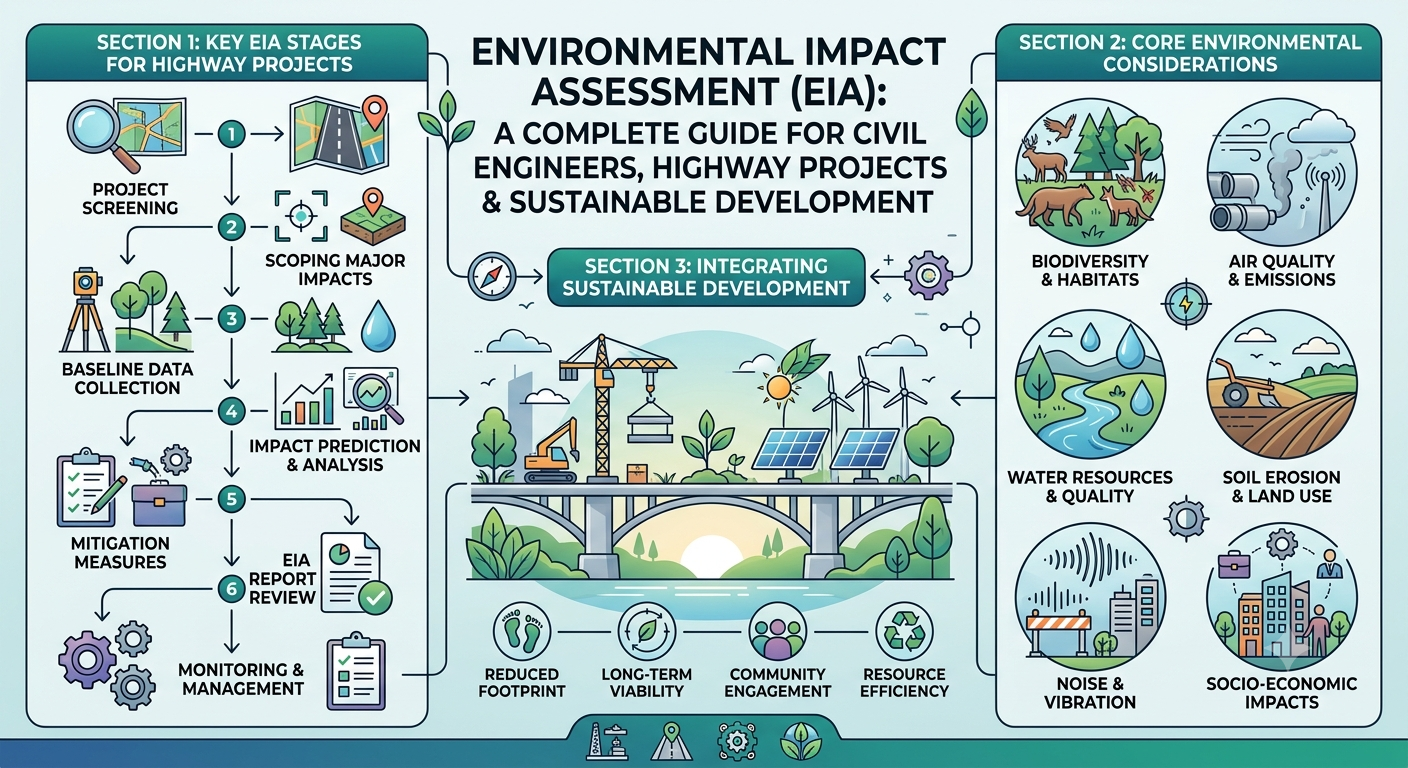
Main Stages of the Environmental Impact Assessment Process
Although procedures vary by jurisdiction, a practical EIA process generally follows a logical sequence.
Project Screening
Screening determines whether a project requires detailed environmental assessment and, where applicable, what level of assessment is appropriate.
Project size, type, location, sensitivity, and expected impacts are commonly considered.
A small rehabilitation project in an existing corridor may have a different assessment requirement from a new motorway crossing forests, wetlands, agricultural land, and populated areas.
Scoping
Scoping identifies the environmental issues that deserve detailed investigation.
A good scoping exercise answers questions such as:
- What environmental resources could be affected?
- Which impacts could be significant?
- Which alternatives need investigation?
- What baseline data are required?
- Which stakeholders should participate?
- What specialist studies are necessary?
Scoping prevents the assessment from becoming unnecessarily broad while ensuring important risks are not overlooked.
Baseline Environmental Studies
Baseline studies document existing conditions before project implementation.
For a highway project, the baseline may include:
Physical environment: climate, geology, soils, topography, hydrology, air quality, water quality, and noise.
Biological environment: vegetation, wildlife, habitats, protected areas, aquatic ecology, and biodiversity.
Socioeconomic environment: settlements, land use, businesses, agriculture, public services, cultural resources, and community characteristics.
Baseline information provides the reference condition against which future changes can be evaluated.
Impact Identification
At this stage, the assessment team identifies project activities that may interact with environmental receptors.
A simple interaction matrix can be useful.
For example:
| Project Activity | Air | Water | Soil | Noise | Ecology | Community |
|---|---|---|---|---|---|---|
| Clearing | High | Medium | Medium | Low | High | Medium |
| Excavation | Medium | High | High | Medium | Medium | Medium |
| Asphalt production | High | Medium | Low | High | Low | Medium |
| Paving | Medium | Low | Low | Medium | Low | Medium |
| Traffic operation | Medium | Low | Low | High | Medium | High |
The ratings are illustrative rather than universal. Actual significance should be established using project-specific evidence and the applicable regulatory framework.
Impact Prediction and Evaluation
Impact prediction estimates how environmental conditions may change.
Engineers and environmental specialists may use:
- Field measurements
- Geographic Information Systems
- Traffic models
- Noise models
- Air-dispersion models
- Hydrological models
- Hydraulic calculations
- Ecological surveys
- Remote sensing
- Historical records
- Risk assessment techniques
Impact significance is commonly evaluated by considering factors such as magnitude, duration, geographic extent, reversibility, probability, sensitivity of the receptor, and effectiveness of mitigation.
A conceptual significance relationship can be expressed as:
Impact Significance ≈ Magnitude × Receptor Sensitivity × Exposure
This is not a universal statutory formula. It is a useful engineering framework for understanding why a moderate emission near a highly sensitive ecological receptor may deserve more attention than the same emission in a less sensitive setting.
Mitigation Planning
Mitigation should follow a hierarchy rather than immediately relying on compensation.
A practical sequence is:
- Avoid the impact.
- Minimize the impact.
- Restore affected areas.
- Compensate for residual impacts where appropriate.
For example, avoiding a wetland by changing a road alignment is generally preferable to constructing through it and attempting to compensate later.
Public and Stakeholder Consultation
Stakeholder participation can reveal information that technical surveys miss.
Local communities may know:
- Seasonal flood paths
- Traditional access routes
- Water collection points
- Wildlife movement areas
- Agricultural patterns
- Informal businesses
- Sensitive community facilities
- Cultural or historic locations
Public consultation also provides an opportunity to explain project benefits, risks, mitigation measures, and grievance mechanisms.
Environmental Decision and Approval
The competent environmental authority reviews the assessment according to applicable legislation and procedures.
Depending on the jurisdiction and project, the outcome may include approval, conditional approval, requests for additional information, redesign requirements, or rejection.
For example, the U.S. EPA describes an EIS process that includes alternatives, affected environment, environmental consequences, public review, responses to comments, and a decision document.
Environmental Monitoring and Follow-Up
EIA should continue after approval.
Monitoring verifies whether predicted impacts and mitigation measures are working as intended.
Typical indicators include:
- PM10 and PM2.5
- Noise levels
- Surface-water quality
- Groundwater quality
- Soil erosion
- Waste quantities
- Vegetation restoration
- Wildlife observations
- Community complaints
- Occupational incidents
Follow-up is particularly important because actual project conditions may differ from predictions.
Environmental Impact Assessment for Highway and Road Projects
Highway projects often require broad environmental assessment because they occupy long corridors and interact with many land uses.
Route and Corridor Assessment
Route selection can be one of the most environmentally important decisions in highway engineering.
A corridor study should consider:
- Protected areas
- Forests
- Wetlands
- Rivers
- Floodplains
- Agricultural land
- Urban settlements
- Archaeological sites
- Wildlife corridors
- Sensitive community facilities
- Existing utilities
GIS-based constraint mapping can help engineers identify areas that should be avoided or require additional investigation.
Construction-Phase Impacts
Road construction involves excavation, embankment formation, aggregate production, hauling, asphalt work, drainage installation, and heavy equipment movement.
Potential impacts include dust, noise, erosion, sedimentation, vegetation loss, waste generation, traffic disruption, and accidental spills.
Construction Environmental Management Plans should translate EIA commitments into site-level controls.
Operational Impacts
After opening, environmental effects may continue.
Traffic can produce:
- Vehicle emissions
- Traffic noise
- Light disturbance
- Road runoff
- Wildlife mortality
- Habitat fragmentation
- Increased development pressure
Noise barriers, drainage treatment, wildlife crossings, landscaping, intelligent traffic management, and appropriate land-use planning may reduce selected impacts.
Environmental Components Commonly Studied in EIA
Air Quality
Construction activities can generate particulate matter through excavation, crushing, hauling, and exposed soil.
Typical controls include:
- Water spraying
- Covered trucks
- Wheel-wash facilities
- Speed control
- Equipment maintenance
- Dust suppression at stockpiles
For major projects, baseline monitoring and dispersion modelling may be appropriate.
Water Resources
Water is especially important for highways crossing rivers, streams, irrigation systems, and flood-prone areas.
Assessment may consider:
- Drainage patterns
- Surface-water quality
- Groundwater
- Sedimentation
- Flood risk
- Construction dewatering
- Accidental contamination
Temporary erosion and sediment controls should be installed before major earthworks begin.
Soil and Geology
Large cut-and-fill operations can expose soil to erosion and destabilization.
Engineers should assess:
- Soil erodibility
- Slope stability
- Expansive soils
- Contaminated land
- Borrow materials
- Spoil disposal
- Landslide susceptibility
Good environmental management therefore overlaps with geotechnical and earthwork planning.
Noise and Vibration
Construction equipment, blasting, piling, crushers, and traffic can affect nearby receptors.
Sensitive locations may include:
- Schools
- Hospitals
- Residential areas
- Religious buildings
- Wildlife habitats
Noise assessment should consider both construction and operational phases.
Biodiversity and Wildlife
Roads can fragment habitats and interrupt animal movement.
Possible measures include:
- Wildlife crossings
- Underpasses
- Culverts designed for ecological connectivity
- Fencing
- Habitat restoration
- Vegetation management
- Construction timing controls
Ecological mitigation should be based on actual species and habitat information rather than generic landscaping alone.
Environmental Impact Assessment Methods and Tools
No single method works for every project.
Checklists
Checklists provide a structured way to identify common environmental issues.
They are simple and useful during preliminary screening but may not adequately describe complex interactions.
Impact Matrices
Matrices compare project activities with environmental receptors.
They are particularly useful for highway projects because many construction activities occur simultaneously.
GIS and Spatial Analysis
GIS can overlay:
- Proposed alignments
- Land use
- Rivers
- Forests
- Settlements
- Protected areas
- Topography
- Flood zones
- Cultural sites
This supports corridor optimization and environmental constraint mapping.
Life-Cycle Assessment
Life-cycle thinking examines environmental effects beyond construction.
For roads, this can include:
- Material extraction
- Aggregate production
- Cement and bitumen production
- Transportation
- Construction
- Maintenance
- Rehabilitation
- End-of-life management
This approach helps engineers compare alternatives based on whole-life performance rather than initial construction cost alone.
Environmental Management Plan
An Environmental Management Plan, often called an EMP, converts EIA recommendations into practical project controls.
A useful EMP should identify:
| Environmental Issue | Mitigation | Monitoring Indicator | Responsibility | Frequency |
|---|---|---|---|---|
| Dust | Water spraying and speed control | Visible dust/PM | Contractor | Daily |
| Noise | Equipment control and work-hour restrictions | dB level | Contractor/Engineer | Periodic |
| Waste | Segregation and approved disposal | Disposal records | Contractor | Weekly |
| Water pollution | Sediment controls | Water quality | Environmental team | Periodic |
| Vegetation loss | Controlled clearing and restoration | Restored area | Contractor | Monthly |
The exact parameters and frequency should follow the approved environmental requirements and project risk profile.
An EMP becomes much more effective when environmental requirements are included in:
- Contract documents
- Technical specifications
- Method statements
- Inspection checklists
- Construction schedules
- Payment mechanisms
- Performance reporting
Environmental Risk Assessment and Significance
Environmental risk can be evaluated using a simple risk matrix.
A conceptual relationship is:
Risk = Probability of Occurrence × Consequence
For example, a fuel-storage area located near a drainage channel may have a relatively high pollution risk because both the probability of accidental release and the consequence of contamination may be significant.
Risk controls could include:
- Secondary containment
- Spill kits
- Impervious storage surfaces
- Emergency response procedures
- Staff training
- Regular inspections
The important point is that EIA should not merely describe impacts. It should guide practical risk reduction.
Climate Change and Environmental Impact Assessment
Modern infrastructure assessment increasingly considers climate-related risks.
Highway projects may be exposed to:
- Extreme rainfall
- Flooding
- Heat waves
- Drought
- Landslides
- Coastal hazards
- Changing drainage patterns
Climate resilience can influence culvert capacity, bridge freeboard, pavement materials, slope protection, drainage design, and emergency planning.
At the same time, infrastructure can contribute to greenhouse-gas emissions through material production, construction equipment, traffic, and land-use change.
Engineers can reduce emissions through:
- Optimized earthwork
- Recycled materials
- Warm-mix asphalt where appropriate
- Efficient haul routes
- Low-carbon materials
- Durable pavement design
- Energy-efficient equipment
- Reduced material wastage
ICE infrastructure guidance emphasizes strategic infrastructure planning and the need to consider environmental and societal outcomes throughout infrastructure decision-making.
EIA References: IRC, AASHTO, ICE and International Practice
Environmental assessment should always follow the legal requirements applicable to the project’s jurisdiction.
For highway engineering, practitioners may also consult relevant IRC publications, AASHTO guidance, and transportation agency environmental procedures for road planning, geometric design, drainage, safety, construction, and asset management.
These references should complement—not replace—the environmental legislation, approval conditions, and technical standards applicable to a particular project.
The Institution of Civil Engineers (ICE) provides broader infrastructure guidance emphasizing strategic planning, lifecycle considerations, resource efficiency, and sustainable infrastructure decision-making.
The U.S. EPA also publishes environmental assessment resources that describe internationally recognized assessment elements, including alternatives, baseline conditions, impact evaluation, mitigation, consultation, decision-making, and monitoring.
For projects in Pakistan, engineers should specifically check the applicable provisions of the Pakistan Environmental Protection Act and current federal or provincial environmental approval procedures rather than relying on a generic international EIA template. The Pakistan Environmental Protection Act expressly addresses IEE/EIA submission, review, approval, and public participation.
Practical Recommendations for Civil Engineering Students
Students can build strong EIA knowledge by connecting environmental theory with engineering design.
Focus on:
- Understanding environmental terminology.
- Learning basic GIS concepts.
- Studying road alignment alternatives.
- Practicing impact matrices.
- Understanding erosion and sediment control.
- Learning basic environmental monitoring.
- Reading real EIA reports.
- Studying highway construction methods.
- Understanding environmental legislation in your country.
- Connecting environmental mitigation with engineering drawings.
A useful student exercise is to select a proposed highway corridor and identify environmental constraints using a map. Then compare two possible alignments and explain which one creates fewer environmental and social impacts.
Practical Recommendations for Highway Engineers
Engineers should integrate environmental assessment into design rather than treating it as an external approval process.
Before finalizing an alignment, review environmental constraints with the survey, geotechnical, drainage, traffic, and land-acquisition teams.
During detailed design:
- Minimize unnecessary land disturbance.
- Protect natural drainage.
- Reduce cut-and-fill where practical.
- Avoid sensitive ecological areas.
- Provide appropriate erosion protection.
- Coordinate utility relocation.
- Consider wildlife movement.
- Design construction access carefully.
- Incorporate approved mitigation into drawings and specifications.
Environmental requirements should also be tracked during design reviews so that commitments are not lost when drawings change.
Practical Recommendations for Contractors
Contractors are responsible for turning environmental commitments into daily site practices.
Before construction:
- Review the approved EIA and EMP.
- Prepare environmental method statements.
- Train workers.
- Identify sensitive areas.
- Establish waste-management facilities.
- Prepare spill-response arrangements.
- Obtain required environmental permits.
During construction:
- Control dust.
- Maintain equipment.
- Prevent uncontrolled wastewater discharge.
- Store fuel safely.
- Manage hazardous materials.
- Control construction noise.
- Protect drainage channels.
- Dispose of waste at approved locations.
- Restore disturbed areas.
- Maintain environmental records.
A contractor should never assume that environmental compliance belongs only to the environmental officer. Site supervisors, equipment operators, surveyors, foremen, and subcontractors all influence environmental performance.
Common EIA Mistakes to Avoid
Several weaknesses repeatedly reduce the practical value of environmental assessments.
Starting Too Late
If EIA begins after the alignment and design are effectively fixed, meaningful alternatives become difficult to introduce.
Using Weak Baseline Data
Poor baseline information makes impact prediction uncertain.
Treating Mitigation as Generic
Statements such as “proper precautions will be taken” are not sufficient. Measures should identify what will be done, where, by whom, and how performance will be verified.
Ignoring Cumulative Impacts
Several projects in the same corridor can collectively create impacts greater than those of a single project.
Failing to Link EIA With Contracts
Environmental commitments that never appear in construction specifications can easily be ignored.
Neglecting Follow-Up
Monitoring is essential for determining whether mitigation actually works.
FAQs About Environmental Impact Assessment
What is the main purpose of Environmental Impact Assessment?
The main purpose is to identify and evaluate potential environmental and social impacts before a project is approved or implemented, allowing decision-makers to consider alternatives and mitigation measures.
Is EIA required for every construction project?
Not necessarily. Requirements depend on the project’s type, scale, location, environmental sensitivity, and applicable legislation. Some jurisdictions use screening procedures to determine the required level of assessment.
What is the difference between EIA and EMP?
EIA is the broader assessment and decision-support process. An Environmental Management Plan translates identified environmental risks and mitigation commitments into practical management, monitoring, and reporting actions.
Why is EIA important for highway projects?
Highways cover long corridors and can affect land, water, wildlife, communities, air quality, noise, drainage, and traffic. EIA helps engineers select better routes and develop measures to reduce these impacts.
What environmental factors are assessed in road construction?
Common factors include air quality, water resources, soil, geology, noise, biodiversity, vegetation, land use, communities, cultural heritage, waste, traffic, and climate-related risks.
What is environmental impact mitigation?
Mitigation means taking measures to avoid, reduce, control, restore, or compensate for adverse environmental impacts. Avoidance is generally preferred where practical.
Can EIA change a highway alignment?
Yes. Environmental findings can influence corridor selection and detailed alignment. Sensitive ecosystems, settlements, cultural sites, floodplains, or other constraints may justify changing the proposed route.
What is baseline environmental data?
Baseline data describe environmental and social conditions before project implementation. They provide the reference point for predicting and monitoring project-related changes.
Who prepares an EIA?
Depending on the project and jurisdiction, an EIA may involve environmental specialists, civil engineers, highway engineers, ecologists, hydrologists, geologists, social specialists, planners, GIS professionals, and other technical experts.
Is EIA only about environmental protection?
No. A good EIA supports better overall decision-making. It can improve project design, reduce environmental risks, identify social issues, strengthen regulatory compliance, and sometimes reduce long-term project costs by preventing avoidable problems.
Conclusion
Environmental Impact Assessment has become an essential component of responsible civil engineering and infrastructure development. For highway projects, its influence can begin at corridor selection and continue through detailed design, construction, operation, maintenance, and eventual rehabilitation.
The strongest EIA is not simply a large technical report prepared to obtain approval. It is a practical decision-making process that connects environmental science with engineering judgment. When baseline studies, alternatives analysis, impact prediction, mitigation, stakeholder consultation, and monitoring are integrated early, project teams can avoid many environmental and construction problems before they become expensive.
Civil engineers should therefore treat environmental requirements as part of good engineering practice. Highway engineers can use EIA findings to improve alignment and drainage decisions. Contractors can convert mitigation measures into daily site controls. Government agencies can use the assessment to make informed approval decisions. Researchers can strengthen prediction and monitoring methods.
Ultimately, successful infrastructure should deliver mobility, safety, economic value, resilience, and environmental responsibility together. A well-managed Environmental Impact Assessment helps make that balance achievable.

Kamran Malik is a passionate civil engineering writer and researcher who specializes in construction, transportation, structural engineering, and infrastructure topics. Through his articles on CivilEngineerings.com, he simplifies complex engineering concepts and shares practical insights, industry trends, and educational resources for students, professionals, and engineering enthusiasts.