
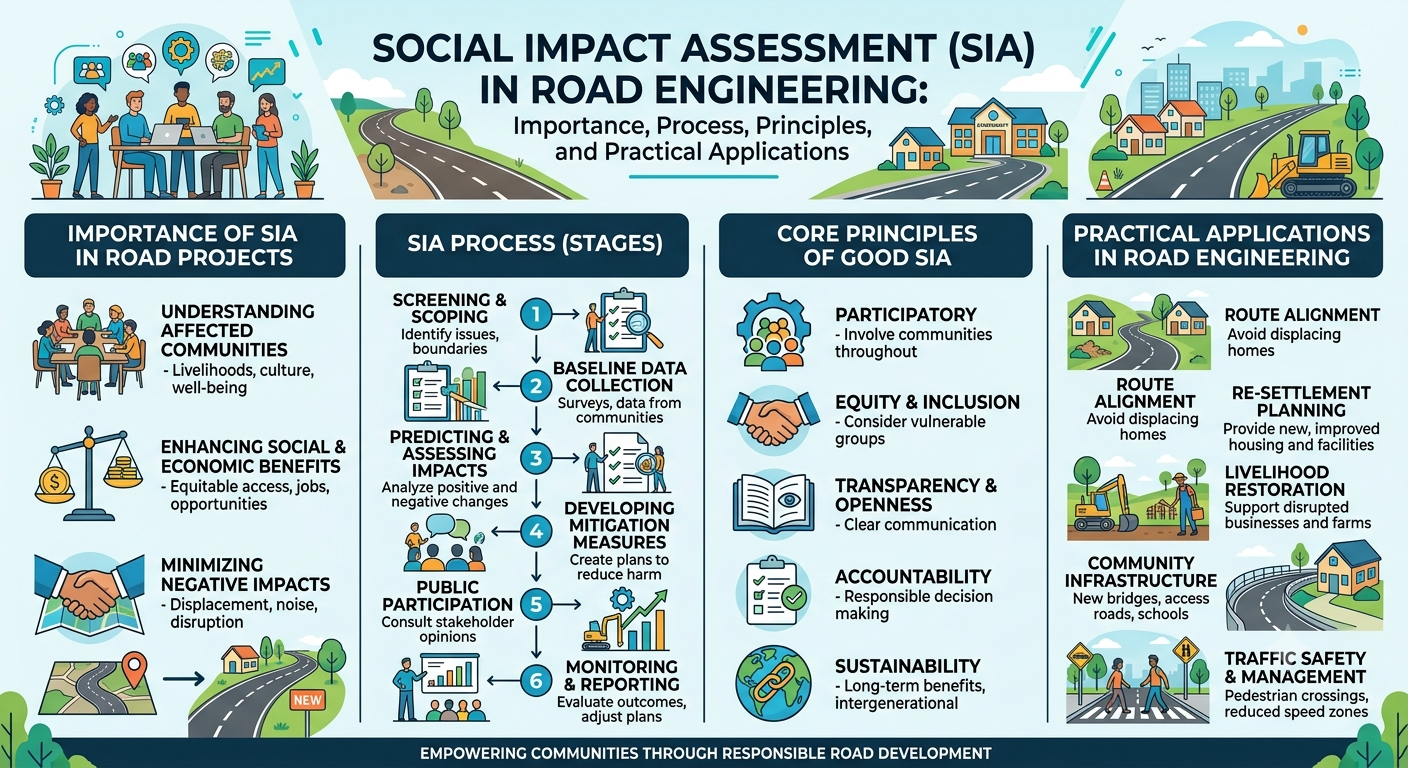
Road infrastructure does far more than connect cities and towns—it transforms communities, creates economic opportunities, and influences people’s daily lives. While engineers traditionally focus on technical design, pavement performance, and structural safety, modern infrastructure projects also require careful evaluation of their effects on society. This is where Social Impact Assessment (SIA) becomes an essential part of Road Engineering.
A well-executed Social Impact Assessment helps identify how a proposed road project may affect local residents, businesses, cultural heritage, livelihoods, public services, and vulnerable groups. It enables engineers and project planners to anticipate both positive and negative consequences before construction begins. By integrating social considerations into project planning, road authorities can reduce conflicts, improve public acceptance, and deliver infrastructure that benefits communities while minimizing adverse impacts.
This comprehensive guide explains the concept of Social Impact Assessment, its objectives, guiding principles, stages, and practical significance in road engineering projects.
What is Social Impact Assessment (SIA)?
Social Impact Assessment (SIA) is a systematic process used to identify, analyze, predict, and manage the social consequences of proposed infrastructure or development projects before implementation. In road engineering, SIA evaluates how the planning, construction, operation, and maintenance of roads may influence the lives of individuals, communities, institutions, and local economies.
Unlike technical studies that focus on pavement design or structural capacity, SIA examines the human dimension of infrastructure development. It helps decision-makers understand how a project may affect employment, housing, public health, education, accessibility, cultural heritage, community cohesion, and quality of life.
The assessment considers both positive impacts, such as improved transportation and economic growth, and negative impacts, including displacement, noise, dust, traffic disruption, and changes to local livelihoods.
Ultimately, the purpose of Social Impact Assessment is not to stop development but to ensure that road projects are socially responsible, inclusive, and sustainable.
Why Social Impact Assessment is Important in Road Engineering
Road projects often extend across large geographical areas, affecting thousands of people directly or indirectly. Without proper planning, construction activities can disrupt communities, reduce access to essential services, and create social tensions.
A comprehensive SIA helps engineers recognize these issues early and incorporate solutions into project planning.
Benefits of Social Impact Assessment
- Improves community acceptance of road projects.
- Identifies vulnerable populations requiring special consideration.
- Supports transparent decision-making.
- Minimizes land acquisition conflicts.
- Protects cultural and historical resources.
- Reduces construction-related social disturbances.
- Enhances long-term project sustainability.
- Strengthens trust between project authorities and local communities.
For example, constructing a new bypass road around a town may reduce traffic congestion within the urban center. However, it could also affect businesses that depend on passing motorists. An SIA evaluates these trade-offs and recommends measures to reduce negative consequences while maximizing project benefits.
Objectives of Social Impact Assessment
Every Social Impact Assessment aims to balance infrastructure development with community well-being. While the objectives may vary depending on the project, several core goals remain consistent.
1. Identify Social Impacts
The first objective is to determine how a road project may influence nearby communities during planning, construction, and operation.
2. Protect Community Interests
SIA seeks to safeguard the rights, livelihoods, health, and welfare of affected populations by identifying potential risks before construction begins.
3. Support Better Decision-Making
Project planners use SIA findings to modify designs, improve project implementation, and reduce avoidable social impacts.
4. Encourage Public Participation
Meaningful engagement with local communities ensures that stakeholder concerns are considered throughout the project lifecycle.
5. Promote Sustainable Development
Road projects should contribute to economic growth while preserving social stability, cultural heritage, and environmental quality.
6. Reduce Project Risks
Early identification of social issues helps minimize delays, legal disputes, community opposition, and additional project costs.
Key Principles of Social Impact Assessment
An effective SIA follows internationally recognized principles that emphasize fairness, transparency, and sustainability.
Human-Centered Planning
Infrastructure exists to serve people. Therefore, every road project should prioritize public safety, accessibility, and quality of life alongside engineering performance.
Stakeholder Participation
Local residents, businesses, government agencies, non-governmental organizations, and other interested parties should have opportunities to participate in the planning process. Their knowledge often provides valuable insights that technical studies alone cannot reveal.
Transparency and Accountability
Project authorities should communicate openly about project objectives, expected impacts, mitigation measures, and implementation schedules. Transparent communication builds public confidence and reduces misunderstandings.
Sustainability
Social considerations should be integrated with economic and environmental objectives to achieve balanced, long-term infrastructure development.
Equity and Inclusion Inclusive planning reduces inequalities and promotes equitable access to transportation.
Social Impact Assessment Process
Although the specific methodology varies between projects, the Social Impact Assessment process generally follows a structured sequence.
Step 1: Screening
Screening determines whether a proposed road project requires a detailed Social Impact Assessment and establishes the level of analysis needed.
Factors considered during screening include:
- Project size
- Population affected
- Land acquisition requirements
- Environmental sensitivity
- Community concerns
- Government regulations
Large highway projects passing through densely populated areas typically require comprehensive social assessments, while smaller road improvement projects may require only limited evaluation.
Step 2: Scoping
Scoping defines the boundaries and focus of the assessment. During this stage, engineers and social specialists identify the key issues that require detailed investigation.
Typical scoping activities include:
- Defining study boundaries
- Identifying affected communities
- Selecting assessment methods
- Establishing baseline indicators
- Developing stakeholder engagement plans
- Determining project alternatives for comparison
A well-defined scope ensures that the assessment remains focused, efficient, and relevant to project objectives.
Step 3: Baseline Social Studies
Baseline studies provide a comprehensive understanding of existing social conditions before construction begins. This information serves as the reference point for measuring future project impacts.
Common data collected during baseline surveys include:
- Population demographics
- Household income
- Employment patterns
- Education levels
- Healthcare access
- Transportation facilities
- Land ownership
- Cultural heritage sites
- Public utilities
- Community organizations
Reliable baseline information enables engineers to distinguish between pre-existing conditions and project-related impacts.
Step 4: Stakeholder Identification
Identifying stakeholders is a critical component of Social Impact Assessment. Stakeholders include individuals, groups, or organizations that may influence or be affected by the project.
Typical stakeholders include:
- Local residents
- Business owners
- Farmers
- Educational institutions
- Healthcare providers
- Government agencies
- Utility companies
- Community leaders
- Environmental organizations
- Transport operators
Each stakeholder group may experience different benefits and challenges, making comprehensive engagement essential.
Step 5: Public Consultation
Public consultation is one of the most important stages of Social Impact Assessment. It provides opportunities for communities to express concerns, ask questions, and contribute local knowledge during project planning.
Common consultation methods include:
- Public meetings
- Community workshops
- Household surveys
- Focus group discussions
- Interviews with community leaders
- Online feedback platforms
- Information centers
Effective consultation is continuous rather than a one-time event. Regular communication throughout planning and construction helps maintain trust and encourages collaborative problem-solving.
Practical Example
Consider a proposed four-lane highway connecting two growing cities. While the project promises reduced travel times and improved regional trade, it also passes through several villages. During the Social Impact Assessment, engineers discover that the proposed alignment would divide farmland, limit access to schools, and increase noise near residential areas.
By incorporating feedback from local communities, the design is modified to include service roads, pedestrian underpasses, noise barriers, and improved access points. These adjustments preserve community connectivity while allowing the highway to achieve its transportation objectives.
Impact Prediction and Evaluation
Once the baseline data has been collected and stakeholders have been consulted, the next stage is to predict and evaluate the potential social impacts of the proposed road project. This step helps engineers and planners understand how different groups may be affected during construction and throughout the operational life of the highway.
Impact prediction combines engineering analysis, field surveys, demographic studies, and stakeholder feedback to estimate both the magnitude and significance of social changes.
Types of Social Impacts
Positive Impacts
Well-planned road projects often create substantial social and economic benefits, including:
- Improved accessibility to schools, hospitals, and markets.
- Reduced travel time and transportation costs.
- Increased employment during construction.
- Better regional trade and tourism opportunities.
- Enhanced emergency response and disaster management.
- Growth in local businesses and property values.
- Improved public transportation connectivity.
Negative Impacts
If not properly managed, road projects may also produce adverse social consequences such as:
- Land acquisition and displacement.
- Loss of agricultural land.
- Temporary business interruptions.
- Noise and vibration.
- Air pollution and dust generation.
- Increased accident risks during construction.
- Community fragmentation.
- Pressure on public services due to workforce migration.
Impact Evaluation Criteria
Engineers generally assess impacts based on:
- Magnitude
- Duration
- Geographic extent
- Reversibility
- Frequency
- Likelihood
- Sensitivity of affected communities
Projects with significant long-term social impacts require stronger mitigation measures and continuous monitoring.
Mitigation Measures
The objective of mitigation is to eliminate, minimize, or compensate for unavoidable social impacts identified during the assessment process.
Mitigation planning should begin during the design stage rather than after construction has started.
Common Mitigation Strategies
Land Acquisition and Resettlement
When relocation cannot be avoided, project authorities should provide:
- Fair compensation.
- Transparent valuation procedures.
- Livelihood restoration programs.
- Resettlement assistance.
- Access to essential public services.
Traffic Management
Construction traffic can disrupt daily life. Effective traffic management plans include:
- Temporary diversions.
- Warning signs.
- Night-time construction where appropriate.
- Safe pedestrian crossings.
- Emergency vehicle access.
Noise and Dust Control
To reduce disturbances near residential areas:
- Install temporary noise barriers.
- Spray water on unpaved roads.
- Cover construction materials during transport.
- Limit noisy activities during nighttime.
Community Safety
Construction zones should include:
- Proper fencing.
- Warning lights.
- Safety signage.
- Traffic marshals.
- Pedestrian walkways.
Employment Opportunities
Hiring local workers whenever possible strengthens community support while generating economic benefits for nearby residents.
Social Management Plan (SMP)
The Social Management Plan converts assessment findings into practical actions that guide project implementation.
It outlines responsibilities, schedules, monitoring procedures, and mitigation measures throughout the project lifecycle.
Components of a Social Management Plan
- Identified impacts
- Proposed mitigation measures
- Responsible organizations
- Implementation schedule
- Budget allocation
- Performance indicators
- Community grievance mechanism
- Monitoring program
A well-prepared SMP ensures that social commitments are implemented rather than remaining theoretical recommendations.
Monitoring and Evaluation
Social Impact Assessment does not end when construction begins. Continuous monitoring ensures that mitigation measures remain effective and allows corrective actions when unexpected issues arise.
Monitoring Activities
- Community satisfaction surveys.
- Traffic safety observations.
- Employment statistics.
- Noise level monitoring.
- Air quality assessments.
- Public grievance tracking.
- Periodic stakeholder meetings.
Monitoring should continue during both construction and operation to verify that project objectives are being achieved without creating unacceptable social impacts.
Practical Applications in Road Engineering
Social Impact Assessment supports better engineering decisions throughout the life of a road project.
Highway Construction
SIA helps determine suitable construction schedules, traffic diversion plans, and community protection measures to reduce inconvenience during major highway works.
Urban Road Improvement
In densely populated areas, SIA assists engineers in minimizing disruptions to businesses, pedestrians, schools, and public transport services.
Rural Road Development
For rural projects, social assessments help preserve farmland access, irrigation systems, and community connections while improving transportation infrastructure.
Bridge and Interchange Projects
Large structures often require extensive land acquisition. Social assessments guide relocation planning and community engagement to reduce conflicts.
Engineering Best Practices
Experienced transportation engineers recognize that technical excellence alone is not enough. Successful projects combine sound engineering with effective stakeholder management.
Best practices include:
- Begin social assessments during the earliest planning stage.
- Integrate SIA findings into geometric design and alignment selection.
- Coordinate closely with environmental and land acquisition teams.
- Maintain transparent communication with affected communities.
- Keep detailed records of consultations and commitments.
- Review mitigation measures throughout construction.
- Encourage multidisciplinary collaboration among engineers, planners, and social specialists.
- Allocate sufficient resources for community engagement and monitoring.
Practical Recommendations
Civil Engineers
- Consider social impacts alongside technical and economic factors during design.
- Review community feedback before finalizing project layouts.
- Incorporate pedestrian facilities, service roads, and access points where needed.
- Monitor social risks throughout construction.
Contractors
- Inform nearby communities about construction schedules.
- Minimize dust, noise, and traffic disruptions.
- Employ local labor whenever feasible.
- Respond promptly to public complaints.
Engineering Students
- Study both technical and social dimensions of infrastructure projects.
- Understand stakeholder engagement techniques.
- Learn basic environmental and social assessment procedures.
- Participate in field visits to observe community interactions during road construction.
Simple Social Impact Assessment Process Diagram
Project Proposal
        │
        ▼
Screening
        │
        ▼
Scoping
        │
        ▼
Baseline Social Studies
        │
        ▼
Stakeholder Consultation
        │
        ▼
Impact Prediction
        │
        ▼
Mitigation Planning
        │
        ▼
Social Management Plan
        │
        ▼
Monitoring & Evaluation
This process demonstrates how social considerations are integrated into the planning and implementation of road projects to improve outcomes for both infrastructure and communities.
General Discussion of IRC, AASHTO, and ICE Practices
Although project requirements vary between countries, established engineering organizations such as the Indian Roads Congress (IRC), AASHTO (American Association of State Highway and Transportation Officials), and the Institution of Civil Engineers (ICE) consistently emphasize the importance of incorporating social considerations into transportation planning.
Their general guidance supports:
- Early stakeholder engagement during project planning.
- Comprehensive feasibility and impact assessments.
- Safe access for pedestrians, cyclists, and vulnerable road users.
- Transparent decision-making processes.
- Sustainable infrastructure development.
- Integration of environmental and social considerations with engineering design.
- Continuous monitoring and quality management throughout the project lifecycle.
Applying these internationally recognized principles helps deliver road projects that are technically sound, socially responsible, and environmentally sustainable.
Frequently Asked Questions (FAQs)
1. What is Social Impact Assessment in road engineering?
Social Impact Assessment is a structured process used to identify, evaluate, and manage the effects of road projects on people, communities, livelihoods, and public services before construction begins.
2. Why is Social Impact Assessment important?
It helps reduce social conflicts, protects community interests, supports informed decision-making, and improves the overall sustainability of road infrastructure projects.
3. When should a Social Impact Assessment be conducted?
Ideally, it should begin during the planning and feasibility stage so that social concerns can influence project design and route selection.
4. Who participates in a Social Impact Assessment?
Participants typically include engineers, planners, government agencies, local communities, business owners, environmental specialists, contractors, and other stakeholders.
5. What are the main benefits of SIA for road projects?
Benefits include improved public acceptance, reduced project delays, better community relations, enhanced safety, and more sustainable infrastructure development.
6. How does public consultation improve road projects?
Community feedback helps engineers identify local issues, improve project designs, and develop practical mitigation measures that reduce negative impacts.
7. What is included in a Social Management Plan?
An SMP outlines mitigation measures, responsibilities, implementation schedules, budgets, monitoring procedures, and grievance mechanisms to manage social impacts effectively.
8. Can Social Impact Assessment reduce project costs?
Yes. By identifying potential social issues early, SIA can prevent delays, legal disputes, redesigns, and compensation claims that may significantly increase project costs.
9. How is Social Impact Assessment different from Environmental Impact Assessment?
While Environmental Impact Assessment focuses on natural resources and ecosystems, Social Impact Assessment evaluates the effects of a project on people, communities, cultural heritage, livelihoods, and social well-being.
10. How does SIA contribute to sustainable road engineering?
SIA promotes balanced decision-making by ensuring that transportation improvements support economic growth while protecting community interests, social equity, and long-term quality of life.
Conclusion
Social Impact Assessment has become an indispensable component of modern Road Engineering because successful transportation projects must serve both infrastructure needs and the communities they affect. From identifying stakeholders and assessing baseline conditions to predicting impacts, implementing mitigation measures, and monitoring outcomes, SIA provides a structured framework for responsible decision-making. When engineers integrate social considerations into project planning, they can reduce conflicts, improve public trust, protect vulnerable groups, and deliver roads that generate lasting economic and social benefits. Adopting recognized engineering practices, encouraging meaningful community participation, and maintaining transparent communication throughout the project lifecycle contribute to safer, more sustainable infrastructure. Whether you are a civil engineer, transportation planner, contractor, or engineering student, understanding Social Impact Assessment strengthens your ability to develop road projects that are technically efficient, socially inclusive, and aligned with the broader objectives of sustainable Road Engineering.

Kamran Malik is a passionate civil engineering writer and researcher who specializes in construction, transportation, structural engineering, and infrastructure topics. Through his articles on CivilEngineerings.com, he simplifies complex engineering concepts and shares practical insights, industry trends, and educational resources for students, professionals, and engineering enthusiasts.