
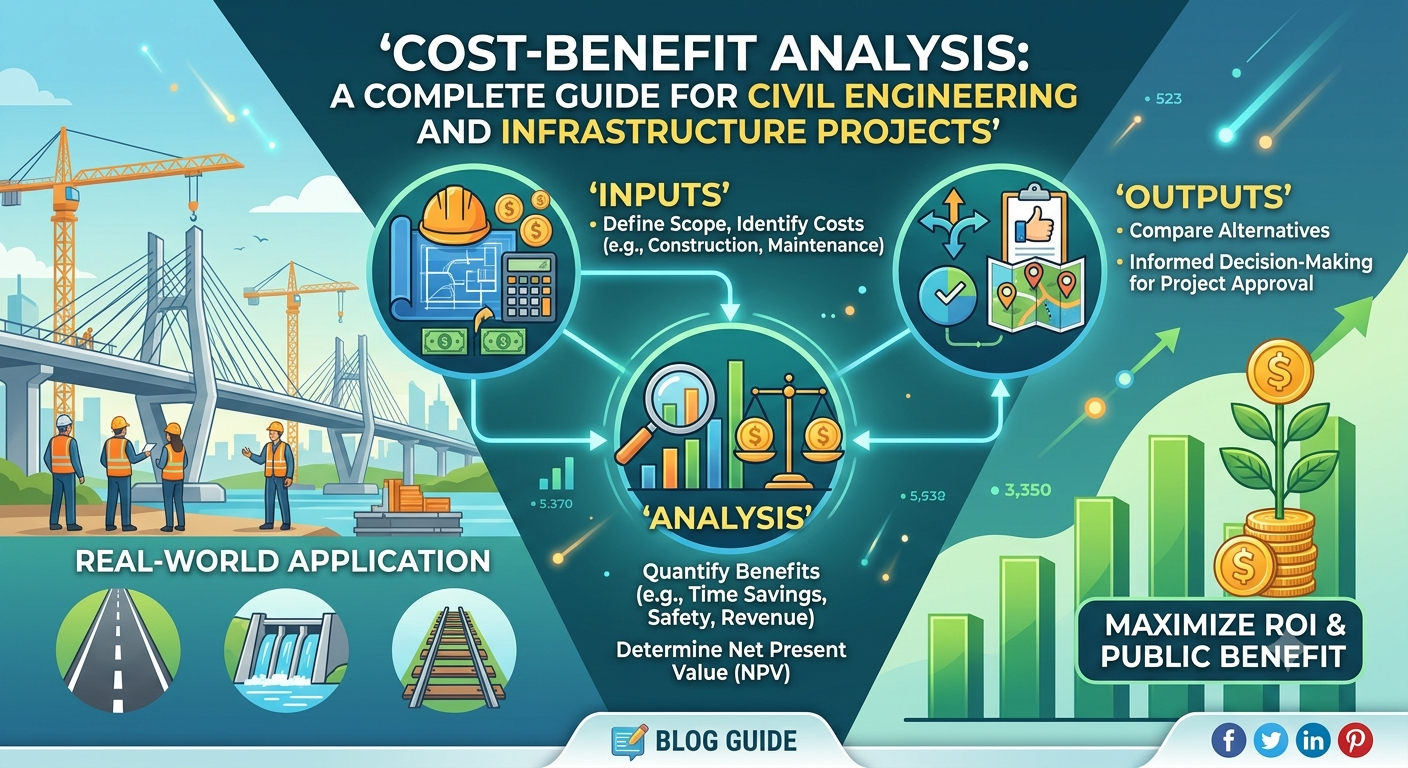
Introduction
Major infrastructure projects require significant investments, careful planning, and informed decision-making. Whether constructing a highway, bridge, railway, airport, or urban roadway, engineers must determine whether the expected benefits justify the overall investment. This is where Cost-Benefit Analysis (CBA) becomes an indispensable tool.
Cost-Benefit Analysis is a systematic economic evaluation method used to compare the total expected costs of a project against its anticipated benefits. Rather than focusing solely on construction expenses, it considers long-term economic, environmental, and social impacts. This broader perspective helps governments, consultants, transportation planners, and private investors prioritize projects that deliver the greatest value to society.
In transportation engineering, Cost-Benefit Analysis plays a vital role in selecting the most efficient design alternatives, allocating limited budgets, and supporting sustainable infrastructure development. By converting both costs and benefits into monetary values, engineers can objectively compare competing projects and identify the option with the highest overall return.
This guide explains the fundamentals of Cost-Benefit Analysis, its engineering principles, practical applications, evaluation process, and best practices used in modern civil and transportation engineering.
What is Cost-Benefit Analysis?
Cost-Benefit Analysis (CBA) is an economic decision-making technique that compares the total costs of a proposed project with the total expected benefits over its entire life cycle. The purpose is to determine whether the investment is economically worthwhile.
The analysis assigns monetary values to all measurable costs and benefits, allowing decision-makers to evaluate different alternatives on a common financial basis.
In transportation engineering, Cost-Benefit Analysis is frequently used to assess projects such as:
- Highway construction
- Bridge development
- Road widening
- Intersection improvements
- Public transit systems
- Airport expansion
- Railway infrastructure
A project is generally considered economically viable when its expected benefits exceed its total costs.
Why is Cost-Benefit Analysis Important?
Infrastructure investments often involve substantial public funds and long service lives. Selecting the wrong project can lead to financial losses, inefficient resource allocation, and reduced public benefits.
Cost-Benefit Analysis helps decision-makers by:
- Supporting evidence-based investment decisions.
- Comparing multiple project alternatives.
- Maximizing economic efficiency.
- Improving budget allocation.
- Reducing financial risk.
- Enhancing project transparency.
- Promoting sustainable infrastructure development.
- Justifying funding requests to stakeholders.
For government agencies, it provides an objective framework for prioritizing projects that offer the highest value to society.
Objectives of Cost-Benefit Analysis
The primary objective of Cost-Benefit Analysis is to determine whether the anticipated benefits of a project justify the required investment.
Additional objectives include:
- Identifying the most cost-effective solution.
- Estimating long-term economic returns.
- Supporting strategic planning.
- Evaluating environmental and social impacts.
- Improving infrastructure investment decisions.
- Enhancing accountability in public spending.
- Optimizing lifecycle project performance.
By evaluating both direct and indirect impacts, CBA enables engineers to make balanced and informed decisions.
Engineering Principles Behind Cost-Benefit Analysis
Cost-Benefit Analysis is grounded in economic and engineering principles that ensure consistent and objective evaluations.
1. Lifecycle Perspective
Rather than focusing only on initial construction costs, engineers assess expenses and benefits throughout the project’s entire service life.
Lifecycle considerations include:
- Planning
- Design
- Construction
- Operation
- Maintenance
- Rehabilitation
- Final disposal or replacement
This approach captures the true economic value of the project.
2. Time Value of Money
Money available today has greater value than the same amount received in the future due to inflation, investment opportunities, and risk.
Therefore, future costs and benefits are discounted to their present value using an appropriate discount rate.
This principle allows meaningful comparisons between projects with different timelines.
3. Incremental Analysis
Cost-Benefit Analysis compares alternatives by examining the additional costs and additional benefits associated with each option.
For example, engineers may compare:
- Two pavement designs
- Alternative bridge alignments
- Different drainage systems
- Asphalt versus concrete pavements
The alternative with the highest net economic benefit is generally preferred.
4. Comprehensive Evaluation
A robust Cost-Benefit Analysis considers more than financial costs. It also evaluates:
- Social impacts
- Environmental effects
- User benefits
- Safety improvements
- Travel time savings
- Vehicle operating cost reductions
This comprehensive approach ensures balanced decision-making.
Components of Cost-Benefit Analysis
A complete Cost-Benefit Analysis consists of two primary elements: costs and benefits.
Project Costs
Project costs include all expenditures incurred throughout the project lifecycle.
Direct Costs
These are directly associated with construction activities.
Examples include:
- Land acquisition
- Site preparation
- Construction materials
- Equipment
- Labor
- Utilities
- Quality control
- Traffic management during construction
Indirect Costs
Indirect costs support project delivery but are not directly tied to construction operations.
Examples include:
- Engineering design
- Project management
- Environmental assessments
- Administrative expenses
- Legal services
- Insurance
- Permitting fees
Operation and Maintenance Costs
These recurring expenses occur after the project becomes operational.
Examples include:
- Pavement maintenance
- Bridge inspections
- Drainage cleaning
- Resurfacing
- Sign replacement
- Snow removal in cold regions
- Routine repairs
Including maintenance costs improves the accuracy of lifecycle economic evaluations.
Environmental Costs
Infrastructure projects may create environmental impacts requiring mitigation.
Typical examples include:
- Habitat restoration
- Noise barriers
- Air pollution control
- Stormwater treatment
- Tree replacement
- Soil erosion control
Modern transportation projects increasingly incorporate these costs during project planning.
Project Benefits
Benefits represent the positive outcomes generated throughout the project’s operational life.
Direct Benefits
These benefits are easily measurable.
Examples include:
- Reduced travel time
- Lower vehicle operating costs
- Reduced fuel consumption
- Increased freight efficiency
- Lower maintenance costs
Indirect Benefits
Indirect benefits are broader economic effects.
Examples include:
- Regional economic growth
- Increased employment
- Higher property values
- Improved accessibility
- Tourism development
- Business expansion
Although more difficult to quantify, these benefits often contribute significantly to project value.
Social Benefits
Transportation improvements create numerous social advantages.
Examples include:
- Improved road safety
- Better emergency access
- Enhanced mobility
- Reduced accident rates
- Greater accessibility for rural communities
These outcomes improve quality of life and strengthen community development.
Environmental Benefits
Well-designed infrastructure can generate positive environmental outcomes.
Examples include:
- Reduced vehicle emissions
- Lower fuel consumption
- Improved traffic flow
- Better stormwater management
- Increased use of sustainable transportation
Environmental benefits are becoming increasingly important in modern infrastructure evaluations.
Step-by-Step Cost-Benefit Analysis Process
A systematic approach improves the reliability and transparency of Cost-Benefit Analysis.
Step 1: Define Project Objectives
Clearly identify the infrastructure problem and establish measurable project goals.
Step 2: Identify Alternatives
Develop multiple feasible design or construction alternatives for comparison.
Examples include:
- Alternative alignments
- Different pavement materials
- Bridge versus underpass
- Various intersection configurations
Step 3: Estimate Costs
Calculate all lifecycle costs, including:
- Initial construction
- Land acquisition
- Maintenance
- Rehabilitation
- Environmental mitigation
- Operation
Accurate cost estimation is essential for meaningful analysis.
Step 4: Estimate Benefits
Quantify expected benefits over the project’s service life.
These may include:
- Travel time savings
- Reduced accidents
- Lower vehicle operating costs
- Economic development
- Environmental improvements
Whenever possible, convert benefits into monetary values for direct comparison.
Step 5: Compare Costs and Benefits
Use economic evaluation techniques to determine whether project benefits outweigh costs.
Common metrics such as Benefit-Cost Ratio (BCR), Net Present Value (NPV), and Internal Rate of Return (IRR) are discussed in Part 2.
Step 6: Select the Preferred Alternative
Choose the option that provides the greatest overall economic value while meeting technical, environmental, and social objectives.
The selected alternative should balance affordability, performance, sustainability, and long-term public benefits.
Practical Applications in Civil and Transportation Engineering
Cost-Benefit Analysis supports decision-making across a wide range of engineering projects.
Highway Construction
Engineers compare alternative pavement types, alignments, and construction methods to identify the most economical solution over the pavement’s design life.
Bridge Projects
CBA helps evaluate different bridge configurations by considering construction costs, maintenance requirements, user delay costs, and expected service life.
Urban Road Improvements
Municipal agencies use Cost-Benefit Analysis to prioritize road widening, intersection upgrades, and traffic signal improvements based on safety and mobility benefits.
Public Transportation Systems
Transit authorities apply CBA when assessing investments in bus rapid transit, metro systems, and railway expansions by examining passenger demand, travel time savings, operating costs, and environmental impacts.
Road Safety Programs
Projects such as installing guardrails, improving road signage, upgrading intersections, and adding pedestrian crossings are often justified through reductions in crash frequency and severity, along with associated economic savings.
Evaluation Techniques Used in Cost-Benefit Analysis
.
After estimating project costs and expected benefits, engineers use several economic evaluation methods to determine whether an infrastructure investment is financially and socially worthwhile. These techniques provide objective criteria for comparing project alternatives and selecting the option that delivers the greatest long-term value.
1. Benefit-Cost Ratio (BCR)
The Benefit-Cost Ratio (BCR) compares the present value of total benefits with the present value of total project costs.
Formula
Benefit-Cost Ratio = Present Value of Benefits ÷ Present Value of Costs
Interpretation
- BCR > 1: Benefits exceed costs, indicating an economically desirable project.
- BCR = 1: Benefits and costs are equal.
- BCR < 1: Costs outweigh benefits, suggesting the project may not be financially justified.
Practical Example
Suppose a highway improvement project costs $60 million and is expected to generate $90 million in discounted benefits.
BCR = 90 ÷ 60 = 1.50
This means every dollar invested returns approximately $1.50 in measurable benefits.
2. Net Present Value (NPV)
Net Present Value measures the difference between the present value of benefits and the present value of costs.
Formula
NPV = Present Value of Benefits − Present Value of Costs
Interpretation
- Positive NPV indicates an economically beneficial investment.
- Zero NPV means benefits equal costs.
- Negative NPV suggests the project is unlikely to generate sufficient economic value.
Engineering Significance
Transportation agencies often prioritize projects with higher positive NPVs because they create greater long-term economic returns.
3. Internal Rate of Return (IRR)
The Internal Rate of Return represents the discount rate at which the project’s Net Present Value becomes zero.
A higher IRR generally indicates a more attractive investment, provided it exceeds the organization’s required rate of return.
Applications
IRR is frequently used when comparing:
- Highway expansion projects
- Bridge replacements
- Airport improvements
- Public transportation investments
4. Payback Period
The payback period estimates how long it takes for cumulative project benefits to recover the initial investment.
Although this method is simple, it should not be used alone because it ignores benefits occurring after the payback period and does not account for the time value of money.
Simple Flow Diagram of Cost-Benefit Analysis
Project Identification
          │
          ▼
Estimate Costs
          │
          ▼
Estimate Benefits
          │
          ▼
Discount Future Values
          │
          ▼
Economic Evaluation
(BCR • NPV • IRR)
          │
          ▼
Compare Alternatives
          │
          ▼
Select Preferred Project
This structured process helps ensure that engineering decisions are based on measurable economic evidence rather than assumptions.
Practical Road Engineering Case Study
Scenario
A transportation agency plans to widen a two-lane highway into a four-lane divided carriageway to improve traffic flow and reduce congestion.
Estimated Costs
- Land acquisition
- Earthwork and grading
- Pavement construction
- Drainage improvements
- Utility relocation
- Environmental mitigation
- Future maintenance
Total Estimated Cost: $120 million
Expected Benefits
- Reduced travel time
- Lower fuel consumption
- Reduced vehicle operating costs
- Fewer traffic accidents
- Increased freight efficiency
- Regional economic development
- Improved emergency response times
Economic evaluation shows:
- Benefit-Cost Ratio = 1.85
- Positive Net Present Value
- Internal Rate of Return exceeds the required discount rate
Based on these results, the project demonstrates strong economic viability and becomes a high-priority investment.
Advantages of Cost-Benefit Analysis
A properly conducted Cost-Benefit Analysis offers numerous benefits to engineers and decision-makers.
Major Advantages
- Supports objective decision-making.
- Encourages efficient use of public funds.
- Compares multiple project alternatives fairly.
- Improves project transparency.
- Identifies long-term economic impacts.
- Considers social and environmental outcomes.
- Strengthens investment justification.
- Promotes sustainable infrastructure planning.
Limitations of Cost-Benefit Analysis
Despite its usefulness, Cost-Benefit Analysis has several limitations that engineers should recognize.
Common Challenges
- Difficulty assigning monetary values to environmental and social impacts.
- Dependence on assumptions regarding future traffic growth.
- Sensitivity to the selected discount rate.
- Uncertainty in long-term economic forecasts.
- Potential omission of intangible community benefits.
- Risk of inaccurate cost estimates during early project stages.
To improve reliability, engineers often perform sensitivity analysis by testing different assumptions and scenarios.
Engineering Best Practices
The quality of a Cost-Benefit Analysis depends on the accuracy of data, engineering judgment, and transparent evaluation methods.
Follow these best practices:
- Define project objectives clearly before analysis.
- Use reliable traffic, geotechnical, and economic data.
- Estimate lifecycle costs instead of focusing only on initial construction costs.
- Include maintenance, rehabilitation, and operational expenses.
- Evaluate environmental and social impacts whenever possible.
- Apply appropriate discount rates.
- Conduct sensitivity and risk analyses.
- Document all assumptions and calculation methods.
- Review results through independent technical evaluation.
A disciplined approach increases confidence in investment decisions and reduces the likelihood of costly project revisions.
Practical Recommendations for Engineers, Contractors, and Students
Engineers
- Integrate Cost-Benefit Analysis during the planning stage rather than after design completion.
- Compare several technically feasible alternatives before selecting a preferred option.
- Consider lifecycle performance instead of only initial construction costs.
- Incorporate safety, resilience, and sustainability into economic evaluations.
Contractors
- Provide accurate cost estimates supported by current market data.
- Identify construction methods that reduce lifecycle costs without compromising quality.
- Maintain detailed records of material quantities, equipment use, and productivity for future project evaluations.
Engineering Students
- Develop a strong understanding of engineering economics and lifecycle costing.
- Practice preparing Cost-Benefit Analyses using hypothetical infrastructure projects.
- Learn spreadsheet-based financial analysis and economic evaluation techniques.
- Study real transportation projects to understand how economic decisions influence design choices.
General IRC and AASHTO Considerations
Cost-Benefit Analysis is widely used alongside engineering standards published by recognized highway organizations.
IRC (Indian Roads Congress)
IRC guidelines emphasize the importance of economic evaluation during:
- Highway planning
- Capacity expansion
- Pavement selection
- Maintenance prioritization
- Rural road development
- Road safety improvement programs
These recommendations encourage engineers to balance technical performance with long-term economic efficiency.
AASHTO (American Association of State Highway and Transportation Officials)
AASHTO promotes lifecycle thinking and economic analysis in transportation decision-making. General guidance supports:
- Evaluation of alternative pavement structures
- Traffic demand forecasting
- Asset management
- Maintenance optimization
- Sustainable investment planning
While project-specific requirements vary by jurisdiction, both IRC and AASHTO encourage informed, data-driven investment decisions that maximize public value.
Frequently Asked Questions (FAQs)
1. What is Cost-Benefit Analysis in civil engineering?
Cost-Benefit Analysis is an economic evaluation method used to compare the total lifecycle costs of an engineering project with its expected financial, social, and environmental benefits.
2. Why is Cost-Benefit Analysis important for transportation projects?
It helps decision-makers determine whether a project provides sufficient value for its investment by comparing expected benefits with total project costs.
3. What is the difference between Cost-Benefit Analysis and Life Cycle Cost Analysis?
Cost-Benefit Analysis evaluates both costs and benefits to determine overall economic value, whereas Life Cycle Cost Analysis primarily focuses on the total costs incurred throughout a project’s service life.
4. What is a good Benefit-Cost Ratio?
A Benefit-Cost Ratio greater than 1.0 generally indicates that a project’s economic benefits exceed its costs, making it a financially attractive investment.
5. Which engineering projects commonly use Cost-Benefit Analysis?
It is widely applied to highways, bridges, tunnels, airports, railways, urban transportation systems, drainage improvements, and road safety enhancement projects.
6. Can environmental benefits be included in Cost-Benefit Analysis?
Yes. Reduced emissions, improved stormwater management, lower fuel consumption, and ecosystem protection can be incorporated when reliable valuation methods are available.
7. What are the main limitations of Cost-Benefit Analysis?
Key limitations include uncertainty in future projections, difficulty valuing intangible impacts, sensitivity to discount rates, and dependence on accurate input data.
Conclusion
Cost-Benefit Analysis is a fundamental decision-making tool that enables engineers, planners, and policymakers to evaluate whether infrastructure investments deliver meaningful long-term value. By comparing lifecycle costs with economic, environmental, and social benefits, it provides a structured framework for selecting projects that maximize public benefit while using available resources efficiently.
In civil and transportation engineering, Cost-Benefit Analysis supports transparent planning, improves investment prioritization, and promotes sustainable infrastructure development. When combined with sound engineering practices, accurate data, and general guidance from organizations such as IRC and AASHTO, it helps reduce financial risk and improve project outcomes. Whether assessing a highway expansion, bridge replacement, or urban mobility improvement, a well-executed Cost-Benefit Analysis leads to smarter decisions, stronger infrastructure, and greater value for both present and future generations.

Kamran Malik is a passionate civil engineering writer and researcher who specializes in construction, transportation, structural engineering, and infrastructure topics. Through his articles on CivilEngineerings.com, he simplifies complex engineering concepts and shares practical insights, industry trends, and educational resources for students, professionals, and engineering enthusiasts.