
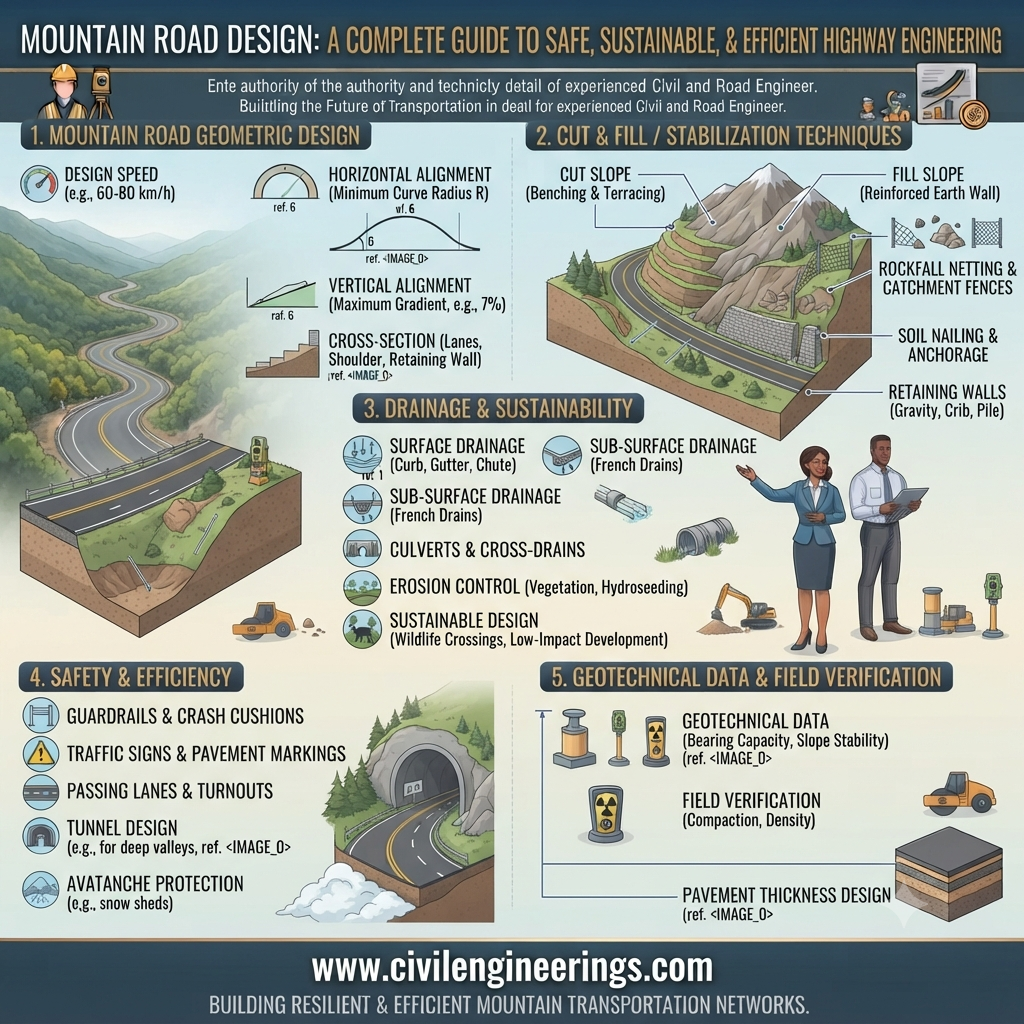
Mountain Road Design
Designing roads in mountainous terrain is one of the most demanding disciplines in highway engineering. Unlike highways built across flat plains, mountain roads must overcome steep gradients, unstable slopes, unpredictable weather, complex geology, and environmental constraints while ensuring safety and long-term durability.
Mountain Road Design combines civil engineering, transportation engineering, geotechnical engineering, hydrology, environmental science, and traffic engineering to create reliable road networks through challenging landscapes. Every curve, retaining structure, drainage channel, and pavement layer plays a vital role in maintaining road performance and protecting road users.
Whether the objective is connecting remote villages, supporting tourism, improving military logistics, or enabling economic development, well-designed mountain roads become lifelines for entire regions.
This comprehensive guide explains the complete process of mountain road design, engineering principles, design standards, best practices, common challenges, and practical recommendations for engineers, contractors, and students.
What is Mountain Road Design?
Mountain Road Design is the process of planning, surveying, designing, constructing, and maintaining highways and roads in hilly or mountainous terrain while ensuring safety, stability, environmental protection, and economic feasibility.
Unlike conventional highway projects, mountain road engineering requires engineers to carefully balance:
- Terrain limitations
- Geological conditions
- Natural drainage
- Vehicle performance
- Slope stability
- Climate impacts
- Environmental conservation
The objective is not merely reaching a destination but creating a safe transportation corridor that remains operational throughout its design life.
Importance of Mountain Roads
Mountain roads contribute significantly to regional development by improving accessibility and connectivity.
Major benefits include:
- Connecting isolated communities
- Supporting tourism
- Facilitating emergency response
- Improving trade and transportation
- Enhancing national security
- Providing access to healthcare and education
- Encouraging regional economic growth
- Supporting forestry and mining operations
Reliable mountain highways often transform the social and economic landscape of remote regions.
Objectives of Mountain Road Design
The primary objectives include:
- Ensure road safety under difficult terrain
- Minimize excavation and earthwork
- Reduce construction costs
- Maintain stable slopes
- Prevent landslides
- Provide efficient drainage
- Improve ride quality
- Protect surrounding ecosystems
- Extend pavement life
- Reduce maintenance requirements
Successful mountain road projects achieve a balance between engineering performance and environmental responsibility.
Engineering Challenges in Mountain Terrain
Mountain highway engineering presents unique technical challenges rarely encountered on level ground.
Geological Challenges
Mountain geology is highly variable.
Engineers frequently encounter:
- Weak rock formations
- Fault zones
- Fractured rock masses
- Loose soil deposits
- Weathered rock
- Landslide-prone slopes
Detailed geological investigations are essential before finalizing the alignment.
Climatic Challenges
Mountain regions often experience:
- Heavy rainfall
- Snowfall
- Ice formation
- Freeze-thaw cycles
- Fog
- High winds
Each factor directly affects pavement performance, visibility, and road safety.
Environmental Challenges
Construction activities may disturb:
- Forest ecosystems
- Wildlife habitats
- River systems
- Natural drainage
- Sensitive vegetation
Modern projects therefore integrate environmental mitigation measures during planning and construction.
Construction Challenges
Limited working space makes construction considerably more difficult.
Common issues include:
- Equipment movement
- Material transportation
- Deep excavation
- Rock blasting
- Worker safety
- Disposal of excavated material
Careful project planning reduces these risks.
Route Selection for Mountain Roads
Route selection is arguably the most important stage in mountain road design.
Engineers evaluate several alternatives before selecting the optimum alignment.
Important considerations include:
- Terrain characteristics
- Geological stability
- Environmental impact
- Drainage patterns
- River crossings
- Existing settlements
- Construction cost
- Future expansion
- Maintenance accessibility
The preferred alignment minimizes excessive excavation while maintaining acceptable gradients and curvature.
Modern projects frequently use satellite imagery, GIS, drone surveys, LiDAR, and digital terrain models to optimize alignment selection.
Geometric Design Principles
Geometric design directly influences safety, vehicle operation, and driver comfort.
Horizontal Alignment
Horizontal alignment consists of:
- Tangent sections
- Circular curves
- Transition curves
- Hairpin bends
Sharp curves should be minimized wherever practical because they reduce vehicle speed and increase accident risk.
Appropriate superelevation helps vehicles negotiate curves safely.
Vertical Alignment
Vertical alignment includes:
- Gradients
- Crest curves
- Sag curves
Steep grades increase fuel consumption and reduce vehicle performance.
Engineers generally maintain gradients within acceptable design standards to ensure safe operation for heavy vehicles.
Hairpin Bends
Hairpin bends are often unavoidable in mountainous terrain.
Proper design requires:
- Adequate turning radius
- Transition curves
- Widened pavement
- Proper banking
- Safety barriers
- Adequate sight distance
Poorly designed hairpin bends become accident hotspots.
Sight Distance
Adequate visibility is essential.
Design should provide:
- Stopping sight distance
- Overtaking sight distance (where feasible)
- Decision sight distance at critical locations
Obstructions such as rock faces and vegetation should be minimized.
Slope Stability and Geotechnical Considerations
Slope failures represent one of the greatest threats to mountain highways.
Comprehensive geotechnical investigations evaluate:
- Soil strength
- Rock quality
- Groundwater conditions
- Discontinuities
- Weathering
- Seismic activity
Common stabilization techniques include:
- Rock bolts
- Soil nailing
- Anchors
- Shotcrete
- Retaining walls
- Reinforced earth structures
- Geogrids
- Bioengineering methods
Continuous monitoring is often necessary in landslide-prone regions.
Drainage Design
Water is one of the leading causes of pavement deterioration and slope instability.
An effective drainage system includes:
- Side drains
- Catchwater drains
- Cross-drainage structures
- Culverts
- Subsurface drainage
- Chutes
- Energy dissipators
Proper drainage prevents:
- Erosion
- Pavement failure
- Flooding
- Slope collapse
- Waterlogging
Regular maintenance keeps drainage systems functioning efficiently.
Pavement Design for Mountain Roads
Mountain pavements experience unique loading conditions.
Design considerations include:
- Heavy truck traffic
- Freeze-thaw effects
- Water infiltration
- Steep gradients
- Braking forces
- Temperature variation
Flexible pavement is commonly adopted because it accommodates differential settlement more effectively.
Rigid pavement may be selected in areas experiencing severe braking stresses or frequent maintenance challenges.
Material quality significantly influences pavement life.
Retaining Structures and Protective Works
Retaining structures stabilize slopes and protect the roadway.
Common protective works include:
- Gravity retaining walls
- Reinforced concrete retaining walls
- Gabion walls
- Mechanically stabilized earth walls
- Rockfall barriers
- Catch fences
- Avalanche protection structures
- Rock sheds
The selection depends on soil conditions, slope height, groundwater, and economic considerations.
Road Safety Features
Safety must remain the highest priority.
Essential safety features include:
- Guardrails
- Crash barriers
- Reflective road studs
- Chevron signs
- Delineators
- Convex mirrors
- Speed control measures
- Emergency escape ramps
- Road markings
- Warning signage
Intelligent Transportation Systems (ITS) are increasingly used to monitor weather conditions and traffic movement.
Environmental and Sustainable Design
Modern mountain road projects emphasize sustainability.
Best environmental practices include:
- Minimizing tree removal
- Controlling erosion
- Reusing excavated materials
- Installing sediment control systems
- Protecting watercourses
- Wildlife crossings
- Bioengineering for slope stabilization
- Carbon footprint reduction
Balancing infrastructure development with ecological preservation is now considered a core engineering objective.
Construction Methodology
Typical construction sequence includes:
- Detailed survey
- Geological investigation
- Alignment marking
- Site clearing
- Earthwork
- Rock excavation
- Drainage construction
- Retaining structures
- Pavement construction
- Safety installations
- Quality testing
- Final inspection
Strict quality control ensures long-term performance.
Maintenance of Mountain Roads
Maintenance requirements are generally higher than those of roads in flat terrain.
Routine activities include:
- Clearing debris
- Cleaning drainage channels
- Repairing retaining walls
- Removing fallen rocks
- Pothole repairs
- Vegetation control
- Slope inspection
- Guardrail maintenance
- Pavement rehabilitation
Preventive maintenance significantly reduces long-term repair costs.
Best Practices in Mountain Road Design
Successful projects typically follow these best practices:
- Conduct comprehensive geological investigations.
- Prioritize slope stability throughout the project lifecycle.
- Optimize alignment to reduce excessive excavation.
- Design efficient drainage systems.
- Use durable construction materials.
- Implement rigorous quality assurance.
- Install adequate road safety features.
- Apply modern surveying technologies.
- Monitor high-risk slopes continuously.
- Integrate environmental protection measures from project inception.
These practices improve safety, durability, and lifecycle performance.
Practical Recommendations for
Engineers
- Perform detailed geotechnical investigations before finalizing the alignment.
- Use numerical slope stability analyses for critical sections.
- Incorporate climate resilience into drainage and pavement design.
- Review designs against recognized standards such as IRC and AASHTO guidance where applicable.
Contractors
- Sequence excavation carefully to maintain slope stability.
- Protect exposed slopes immediately after cutting.
- Ensure proper compaction and drainage installation.
- Maintain strict quality control during retaining wall construction.
Students
- Strengthen your understanding of highway geometric design.
- Learn geotechnical engineering fundamentals.
- Study drainage engineering and pavement design.
- Practice using GIS, AutoCAD Civil 3D, and slope stability software.
- Familiarize yourself with IRC, AASHTO, and ICE recommendations for mountain highways.
Frequently Asked Questions
1. What is Mountain Road Design?
Mountain Road Design is the engineering process of planning and constructing safe roads through hilly and mountainous terrain while addressing slope stability, drainage, and geometric constraints.
2. Why is mountain road design more difficult than highway design on flat terrain?
Mountain roads involve steep slopes, unstable geology, difficult access, sharp curves, and harsh weather conditions, making design and construction significantly more complex.
3. What is the ideal gradient for mountain roads?
The preferred gradient varies according to terrain classification and applicable design standards. Engineers aim to keep gradients within acceptable limits to maintain safety and vehicle performance.
4. Why are retaining walls necessary?
Retaining walls stabilize excavated slopes, prevent soil movement, reduce landslide risks, and protect the roadway.
5. What role does drainage play in mountain roads?
Drainage removes surface and subsurface water, preventing erosion, pavement damage, slope failures, and flooding.
6. Which pavement type is commonly used?
Flexible pavements are commonly adopted because they adapt better to differential settlement and varying ground conditions, although rigid pavements may be appropriate in selected locations.
7. How are landslides minimized?
Landslide risks are reduced through geotechnical investigations, proper drainage, slope stabilization, retaining structures, rock bolts, soil nailing, and vegetation.
8. Which software is commonly used in mountain road design?
Engineers frequently use AutoCAD Civil 3D, Bentley OpenRoads, GIS platforms, LiDAR data processing tools, and geotechnical analysis software for alignment, terrain modeling, and stability assessments.
9. Which standards are generally consulted?
Projects commonly refer to guidance from the Indian Roads Congress (IRC), the American Association of State Highway and Transportation Officials (AASHTO), and the Institution of Civil Engineers (ICE), together with local regulations and project-specific requirements.
10. What skills are essential for a mountain road engineer?
Strong knowledge of highway engineering, geotechnical engineering, surveying, hydrology, pavement design, drainage, and construction management is essential.
Conclusion
Mountain Road Design represents one of the most technically demanding areas of civil and transportation engineering. Success depends on integrating sound geometric design, thorough geotechnical investigation, effective drainage, durable pavement design, and robust slope protection into a cohesive solution. Every decision—from selecting the route to detailing a retaining wall—affects safety, operational efficiency, maintenance costs, and environmental performance.
Modern mountain highways increasingly benefit from digital terrain modeling, GIS, LiDAR surveys, intelligent monitoring systems, and sustainable construction practices. At the same time, adherence to recognized engineering guidance from organizations such as IRC, AASHTO, and ICE helps engineers develop resilient infrastructure that can withstand challenging terrain and extreme weather conditions. By following proven engineering principles, investing in comprehensive site investigations, and prioritizing long-term maintenance, professionals can deliver mountain roads that remain safe, reliable, and economical for decades. Ultimately, excellent Mountain Road Design is the foundation for improving regional connectivity, supporting economic development, and ensuring safer transportation in mountainous environments.

Kamran Malik is a passionate civil engineering writer and researcher who specializes in construction, transportation, structural engineering, and infrastructure topics. Through his articles on CivilEngineerings.com, he simplifies complex engineering concepts and shares practical insights, industry trends, and educational resources for students, professionals, and engineering enthusiasts.